

Alexander Grabovetskiy, woodcarver, School of Woodcarving · Published 2020
What does a wood carver mean by "leave it alone"?
Quick answer: Leave alone is what I said in part 12 of Venice Room 63, about one area of the panel, after "Maybe it's too much." A question about staying in one area came with it. Other lessons show what I did next, with a knife, a smaller gouge or glue.
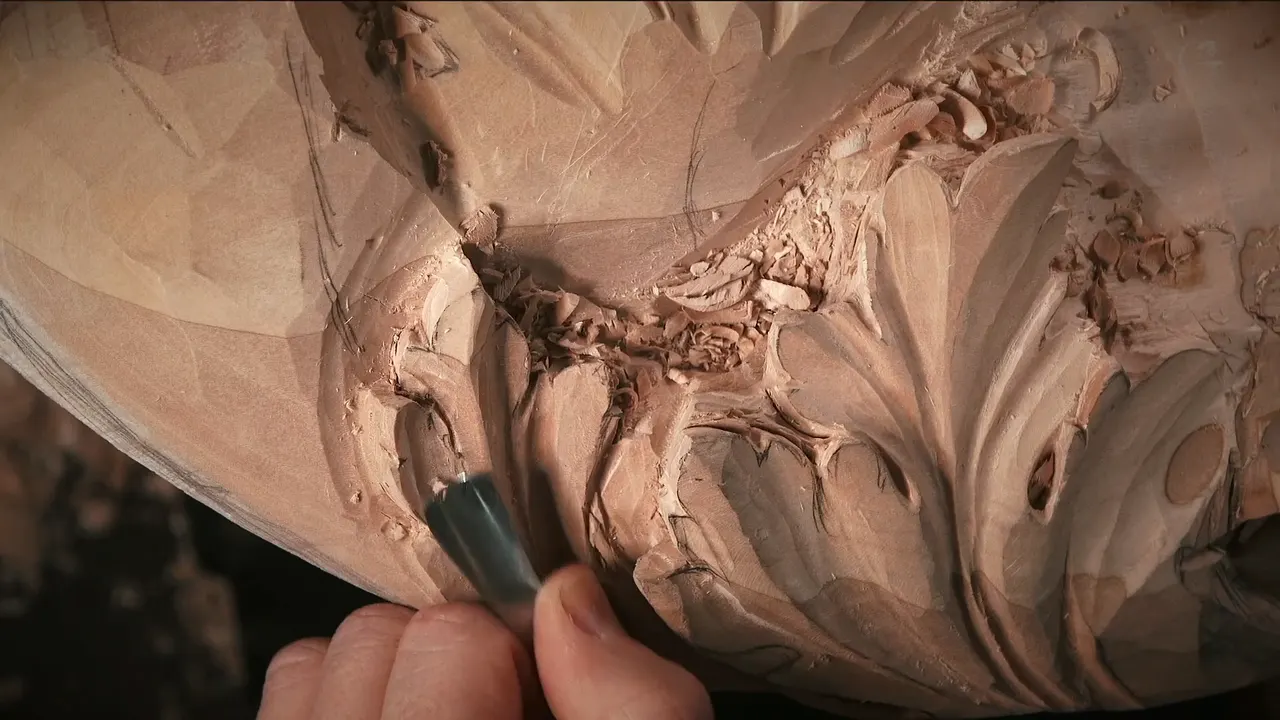

I said it in Venice Room 63, part 12, about one area of the panel: "I'm going to leave it alone." Right behind it came "I could spend all day long in one area, but do I want to? No, I don't." Other lessons show what came before those words and what I did next, with a knife, a smaller gouge or glue.
Have you ever fixed one spot on a carving until it looked worse? Would you like to hear how I decide to stop? Start with my words in workshop 63, then read what I said in lessons from other courses.
What did I say before I decided to stop in workshop 63?
The part opens on a problem with the wood. "And it's sponging slightly, even with the super sharp tools." Then my plan, "Maybe some of them I have to actually do even more sharper." Then "Yes. I guess that's exactly what I have to do." And "Otherwise, it's just sponging. Sponging, sponging."
"So that is no good. No bueno." Next, a plan, "Let me check if I have sharp enough tools." Then "It's still slightly sponging." And "Okay, let me make it sharp." Later, "Okay, I got that tool little sharper now, let me try."

On this pass I said "I have to be really slow how I'm doing it, okay?" The area was "really tricky." Then "I'm slicing through." That was "number nine, by the way."
A better surface followed. "Wonderful. So now it's much better." Then "Okay, now I'm happy with the result. Not all the way. I still not happy about this finish." And "for some reason, I really want to take care of it with just the gouge." Then "Something really bugs me," with "I don't like that."

A different tool came next. "All right. That is better. Although maybe number six will work little better." Then, as a plan, "Number six, let me try number six." A doubt followed, "Maybe it's too much."
"All right." The line quoted at the top of this page came next.

Something else showed in the wood. "What I can see, I'm able actually to develop extra beautiful movement right here, which could be just a convex movement." Later, "So that is convex, and I hope you can see it."

On the divisions my words were "Let me get a little deeper inside of those divisions. Otherwise, it's not visible too much." Then "it makes me more happy," and "it's equal, equal, and it's beautiful. It's going up." Then "Although I had right here going down movement, but that's okay."
One side still did not please me. "Except I still not happy about that side." My plan was to get that division done, with "much more logical, I would say."

About one spot I said "That is a really strange area, I can work on that detail a little later." And "I'm not sure if you're going to be able to see it or not, that's why." The plan was "maybe just preliminary." Then "going to excavate slightly and give a little bit of a shadow."

Late in the part came grain. "Have to be really mindful of the grain. So that's why I'm trying to attack it from different positions." And "maybe I can actually lower this down slightly, like this," with "give a motion downhill a little bit." I used "number three," and "Maybe slightly underneath." Then "Now it feels more organic, I would say."
The finish comes up in part 11 of workshop 63 too: "I'm still not too happy about the finish I see, and for some reason, I still like out of the gouge finish much better." In part 10, "But overall, it's okay," and "I'm still not too happy about those extra ridges, extra tool marks."

How did I handle a spot that still bugged me?
The opposite turns up in Venice Room 41, part 10: "Still bugs me." That spot I could not leave. My plan was number eight, and "Try to go in." Of the edge, "my tool is really sharp, but it still struggles to slice." I also said "I think I could use nine or 11."

Part 5 of Workshop 89 has the words too. I called it better to stop for the moment, "that is the part I don't really like it and it bugs me, okay?" The risk was "the more I take the material out, the more chance" of a mistake.
So my plan there was "I need to walk away for a couple of days or so from this area and come back and just see what I'm able to do." A worry stayed with it, losing the overall feel, and I called that "my challenge."

Workshop 60, part 5, gives more damage as the reason. I probably should stop already, "because the more I do, the more damage I create." It sat "right on the movement top." Next, "Let me leave alone this one, and I'll work on the pipe on inside of this movement, which is a good area."
A tool size followed. "Number 11, and that's 4 millimeters" (roughly 0.16 in), then "I could use actual 3 millimeters" (close to 0.12 in) "or even 2 millimeters" (0.08 in). Then "Maybe just 2 millimeters." The reason for the small one was "Because I don't have too much space, and I don't want to create a look that I don't like."

When do I stop for now and go to another section?
In Furniture Panel lesson 17, part 2, I put one spot aside. "Let me concentrate on this section as of now." An outline method came up at "approximately 1/32 of an inch" (about 0.8 mm), with "I really don't want to go deeper, but there is a danger." And "That's not my preferred method."

In lesson 20 of the same course, part 3, a weak spot comes first. "Careful because you have a really weak spot right here. Okay, that's why I don't push." I would leave that for the moment, and "I'll take a knife." The knife came up again, "even in this area, I'll just use my heel of the knife."

Cleaning can wait too, as in lesson 19, part 11. "As of now, this section I can leave alone, at least for a little while." Also "you will see some imperfections yet." "I usually leave it to the last point."

In Lily Box lesson 2, part 11, I said of one spot "This one is almost all the way through on both sides. Got to be careful." I put it aside, with "I'll take care of it a little later." Before that, "Half a millimeter again" (about 0.02 in).

The same plan is in Venice Room 32, part 9: "I left some space on inside for future development." Next, "I still not sure what I want to see right here." I would put it aside "for a little bit," and the next section would be "this acanthus movement."

A maybe turns up in Venice Room 28, part 6: "Maybe yes, maybe no." I might just stop on that side as it was, "Otherwise, it's going to be too stripy." And another idea, "I could actually create a little deeper I." My tool for it was "Number 11 and 1 millimeter" (0.04 in).

Another maybe shows in Venice Room 102, part 10: "Maybe I should just jump on another area." Then "Maybe yes, maybe no, let me actually just reposition a little bit." Later, about a chunk, "Maybe too much, maybe not, I don't know."

A plan follows in Venice Room 80, part 3: "So let me leave that alone," and then "jump right now." My tool plan was "just four millimeters" (roughly 0.16 in), "Number 11, of course." Then "little by little get to the point."

Grape Onlay lesson 4, part 1, has the words near the start of the part. "I'm kinda gonna leave alone those grapes for now." Of the piece at that point, "I really don't worry about how it looks at this point." And "I'm looking for overall shape that is more important for me."
How do I know when to stop on one spot?
A little cleanup is the subject in Venice Room 67, part 9, "which I could spend all day long if I wish." Then "Do I have to? Oh, absolutely not." Next, "I don't need to spend long time on it, so I need to go and do something else." The last line was "probably leave it like that for now."
The same question is in Venice Room 64, part 5. "And yes, again, I could spend much longer and clean it even better. But the question is, should I?" Then "There is a nonstop process. So I really have to stop at some point."
Lily Box lesson 11, part 12, puts it this way: "there is no end." Then "So you have to decide when you're going to stop," with "the stopping point." The whole day on a single spot, "I shouldn't, probably."
In Floral and Molding lesson 10, part 1, I said "I could spend a lot more on this side, but I think it's probably a good time for me to just develop the left-hand side." And "if I need to later on, I'll just go back and just do all the cleanup and so on."
Does stopping for now mean glue first?
Glue comes up beside the words in Venice Room 78, part 4. I had moved out a part I broke before. "I can glue it, but it's less than a 16th of an inch thick" (less than 1.6 mm). I was not sure it was a good idea. "Maybe I'll just glue it back." Then "I'll go glue it off camera."

A close cousin is in Venice Room 8, part 9: "I need to glue it." Later, "For now, at least, okay, and I'll glue it back."
A hazelnut lesson has it too. In Carving Hazelnuts lesson 1, part 2, I said "the main chunk is taken." Then "Now I need to glue just whatever those offcuts" and to stop there. Before that came "you don't really need to do this stage at this point if you got tired already."

How long can a carving sit before I look at it again?
In Cutting Board lesson 15, part 1, I used a mirror. "A broken mirror or just a shattered mirror, just with a crack or so, and you notice that for a couple of days later on, your eye is adjusting to it." Then "when you're carving, your eye's adjusting to what you see."
My advice there was to leave a spot alone sometimes for days, "even longer sometimes, even for a week or so, and work on something else, on different type of carving, and come back." The result was "then you'll see all the mistakes you made."

Some of you probably had a question, I said, "Why in the world he leaves some spots rough?" My answer was "I know I still going to find some imperfections, but I'll find them much quicker after a few days when I'm looking back."
Then my teacher's words. "If you look at your work, let's say, and you think it's done and you like it, you are not an artist anymore." And "So art never ends."
In that lesson I also said "I'll spend maybe half an hour just cleaning everything, just to find whatever I find, and later on, so I say, Hey, let's leave it like that." About a bubbly spot that was not flowing, "But it takes fresh eyes. Fresh look."
How do twelve times I stopped on a spot line up?
The table has twelve lessons, with workshop 63 first. The middle column says what I left, and the last gives my words in two or three. Where I named a size in millimeters, the inch figure sits beside it in the text above. For the craft itself, see wood carving, gouge, grain and furniture. The kitchen lesson is about a cutting board.
| Where | What I left alone | Why |
|---|---|---|
| This part, 63.12 | Number six, then one area left | All day |
| Room 41.10 | One spot I could not leave | Can't leave |
| Venice 60.5 | A spot right on the movement top | More damage |
| Workshop 89.5 | An area I don't really like | Mistake chance |
| Panel 17.2 | One section left, another one next | This section |
| Furniture 20.3 | A semi-rotation near a weak spot | Knife next |
| Lesson 19.11 | A section that still has imperfections | Clean last |
| Lily Box 2.11 | A place almost through both sides | Be careful |
| Room 32.9 | Space I kept inside the volute | Not sure |
| Venice 28.6 | A slight concave on one side | Too stripy |
| Venice Room 67.9 | A little cleanup I could keep doing | Not needed |
| Cutting Board 15.1 | Rough spots left for days, even a week | Fresh eyes |
Where can you watch the full videos?
Every lesson on this page has a page of its own, and workshop 63 belongs to Venice Room Part 6. The wood in part 11 of workshop 63 was lime, in my words "the same lime wood." To watch the full lessons, start here.
How it's done
- Sharpen when the wood sponges. Sponging showed up even with super sharp tools. I sharpened again and went slow, and with number nine I was slicing through.
- Say what still bothers you. Something about the finish really bugged me, and I did not like it.
- Try the other gouge. I named number six as a try, and a doubt came with it.
- Decide how long to stay. On that area I was going to stop, and I asked myself if I wanted to spend the whole day there. My answer was no.
- Look at what the wood shows. I was able to develop extra beautiful movement right there, which could be just a convex movement.
Frequently asked questions
What did I say before I stopped on one area in workshop 63?
Part 12 opens on sponging. I said "It's still slightly sponging," and "Okay, let me make it sharp." Later came "Clean little bit this area, too." Number six came up after that, and then the line this page is named for.
Do I stop on a spot when it still bugs me?
My lessons go both ways. Venice Room 41, part 10, has a spot where I could not stop, and I planned number eight. Workshop 89, part 5, has me calling it better to stop for the moment, and later saying "I don't like it, but I have to figure out what I should do."
How long can a carving rest?
In the cutting board lesson I said it is sometimes a good idea to leave a spot for days, and to work on something else. The mirror in that lesson was my example. Over in Venice Room 89 I said I needed to walk away from one area, then come back and see.
What to carve next
- Workshop 63 lesson
- Workshop 62 to 73 course
- Workshop 41 lesson
- Workshop 89 lesson
- Workshop 60 lesson
- Furniture Panel lesson 17
- Furniture Panel lesson 20
- Furniture Panel lesson 19
- Lily Box lesson 2
- Workshop 32 lesson
- Workshop 28 lesson
- Workshop 102 lesson
- Workshop 80 lesson
- Grape Onlay lesson 4
- Workshop 67 lesson
- Workshop 64 lesson