

Alexander Grabovetskiy, woodcarver, School of Woodcarving · Published 2020
What does a wood carver mean by "jump on"?
Quick answer: Jump on is my plain way of saying I am leaving one spot for the next. In Venice Room 63, part 11, a spot still bothered me, but that was okay, and I said "I'm going to jump now on that section right here." Other lessons use the words for a side, a leaf or a smaller gouge.
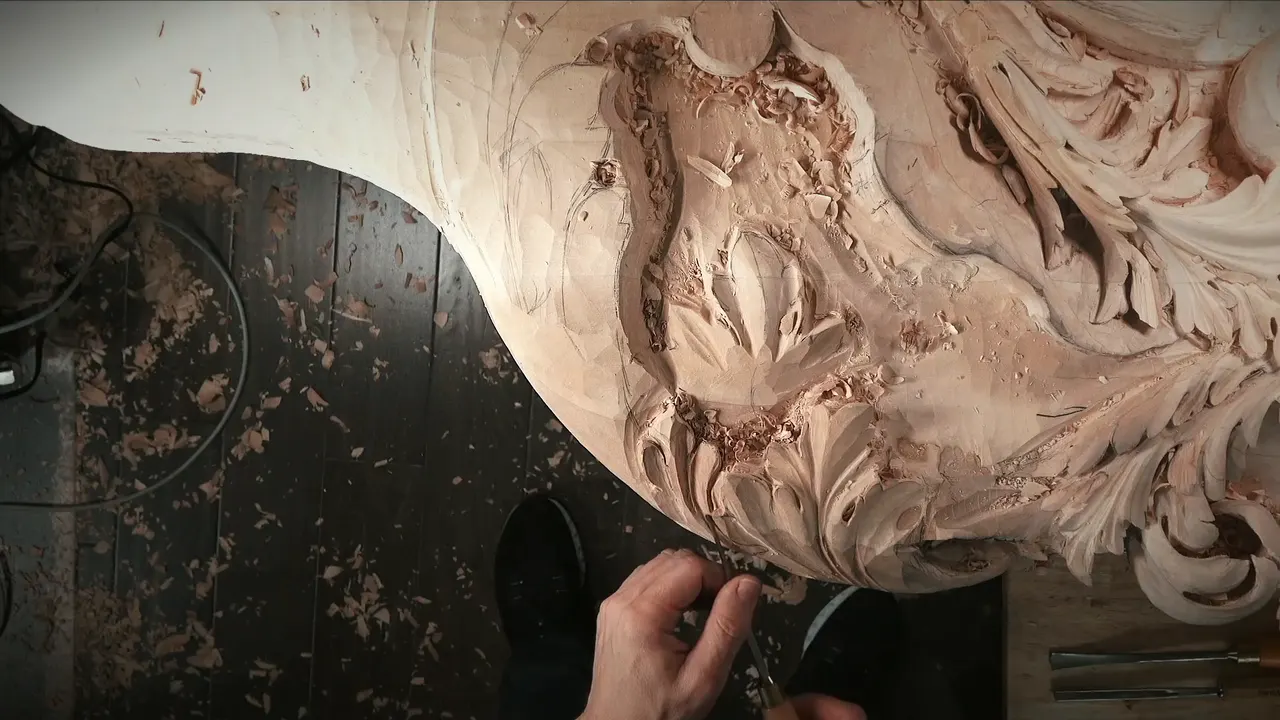

Jump on is how I say I am leaving one spot for the next, on another side, in another section or with a smaller gouge. In Venice Room 63, part 11, my words were "I'm going to jump on this section," said just after I told you a spot still bothered me. Other lessons show what comes before and after.
Have you ever worked one corner of a carving until it stopped telling you anything? Would you like to hear how I decide to leave it and go to the next corner? Then read my words from workshop 63 first, and from other lessons after it. Wikipedia has a page on phrasal verbs, the kind of word pair that "jump on" belongs to, if the words themselves puzzle you.
What does jump on mean in part 11 of workshop 63?
My first words were about tools. "Maybe number five will work and a quarter inch. We'll see." A quarter inch is about 6 mm. A direction followed, "And go that direction a little bit."
A sharp ridge bothered me. I meant to break it "because I really think it's just too sharp," and the shadow was my reason, "a little too strong of a shadow." After the pass came "Okay, that is much better, I would say."

Next I stopped to think about a section. "Maybe I can clean this section." My plan was more lines, "I will give more divisions right now, and that way it's going to make a lot more sense." Soon I said "Okay. So those are going to be divisions."
For those divisions I would get "my number 11 and 5 millimeters" (about 0.2 in), and I said "Relief those parts." The work followed, "So just relieving them, and one more time right here." And "now it's already looking different."

The change pleased me, and I could "probably just give a much better shape now to this detail," I said, with "I like how it looks." Not done, though. "It's not done yet, but still, preliminary, I think it looks really good."
A word of praise, "That is wonderful," came before a corner, "Get that corner out." Tool talk went along with it, "with the same tool" and "this is number six," at "about three-eighths of an inch, about 10 millimeters." The result, in my words, was "much, much better."

One line sums up detail work, "every detail you add gives somewhat final look what you're after." I followed it with "That is a really good detail."
A second section needed work. "So now I need to fix this section" and "because it doesn't make too much sense now also." Not all of it pleased me, "I still kind of don't like what I see right here, but that's okay." My next move was to "jump now on that section," and then "Chop a little bit."

A verdict came, "That is good. That is really good." The plan grew from there, "And now I can actually start dividing even more," for "more or less like a semifinal look." One spot got a doubt, "I could actually divide even this, but I'm not sure if I should or not." Another got a sure thing, "at least I know for sure I can divide that."
A smaller tool did the next pass, "the smaller tool Number 11 in this case, and three millimeters, that's what I'm using." My inch figure was "One-eighth of an inch." Below it I saw "mess," and I said "I really don't need that mess." The job was "to clean it and give a better shape."

Late in the part I said "I think it's good," though "I'm still not too happy about the finish I see." The finish out of the gouge still won with me, "I still like out of the gouge finish much better." Then came a note on the wood, "even if it's the same species." My example was lime, "you can see variations of softness." In my case, on the darker patch, "the wood is a little softer."

What do I mean when I leave one side for another?
The words fit when I leave one spot and go to the next one. In workshop 71, part 6, a concave was the spot. A mistake was the worry. My plan was to "leave for now this concave," and then "jump on another side." A gouge was the plan, "number 11," at seven millimeters (0.28 in). A straight tool would be no good, "Have to use a long bent."

A spot I disliked comes up in workshop 98, part 12, "I kind of don't really like how this one looks." The maybe came next, "leave it for now" and then "go back and work on that one." Then I corrected myself, "But I need to fix it first. Not fix it, but give somewhat logical shape to it." A 10 millimeter number 11 (about 0.4 in) was the tool plan, and "somewhat logical shape" was the goal.

Another maybe sits in workshop 102, part 10, "Maybe I should just jump on another area and leave it alone for now." A second maybe followed, "Maybe yes, maybe no," and a plan to "reposition a little bit."
An idea was the reason in workshop 47, part 6. I said "I like it" about one element and left it alone. Another side got the work, "because I've got an idea and I could probably develop that part," and that side held a head of acanthus.
Cleanup waits in Molding lesson 14, part 2. I planned to spend "a little longer cleaning everything on this side," and then "I am go ahead and just jump" to the next. The cleanup would not change the shape, "I'm not going to change the shape of it." Then came "on the left-hand side." Wikipedia explains molding.

A limit came in Furniture Panel lesson 17, part 6. I did not want to dig too deep. "Later on, when we're going to work on that detail, we can always go deeper if we need to, but as of now, it's good," I said, and "So I'm not going to touch this side anymore."
Plans can turn around, and workshop 83, part 2, shows it in my own words. "I think I want to jump on this side." Then "Or not." The curve got a second look, "Maybe I have to just clean a little bit this curvature, which is not too nice yet."
A corbel comes into workshop 101, part 9. "And that's common practice for me," I said, and I named it "jumping all over if I'm tired of one area." The cap sides had to wait, "So we're going to do that a little later." What I picked was "the opposite side of the corbel," to "work on my acanthus."

Being ready is a reason too, as in workshop 65, part 9. "I am ready, actually, to jump." Then "Almost done with the main movement." Some work waited, "I still have to work on the ceiling part."
Does the same move work with a smaller gouge?
Tool sizes move this way too in workshop 111, part 2. A seven millimeter number 11 (0.28 in) was the plan, then "Maybe it's a little too big. Let me jump on four millimeters." My inch figure was "not quite 3/16 of an inch," with "millimeter less than 3/16 and millimeter more than one-eighth of an inch." Four millimeters is about 0.16 in. I called it a start, "I think that is good, at least as a starting point."

A smaller one was the next idea, "I think I can jump on smaller one," with "Let's say two millimeters" as the size, number 11 again, close to 0.08 in.
That order shows in workshop 101, part 12, "Let me do 4 millimeters, and then I'll jump on a 2 millimeters." In inches, that is 0.16 and 0.08.

The same two words show up in the Acanthus over Moldings course, lesson 4, part 3, with other makers as the subject. "Most of the manufacturers they jump like let's say you have number three then you jump on number five." Then "you jump on number seven and so on." Some makers count another way, I said, "some of the manufacturers they still do like two three four, five six, seven eight nine."
What do I say before the next job starts?
Order comes first in Molding lesson 10, part 2. "Let me actually first establish that form, and then I'll jump on that side," I said, and my verdict was "I think, wiser." And then "I don't want to rush it."
A line can wait for a later job. A reminder sits in lesson 17, part 8, that the line is not final. "Final line will be determined pretty much when we get done with the background," and then "jump on details." After that "we'll know exactly where the final line is supposed to land."

A cleanup was too early in lesson 31. "That's little too early." The leaf was where I could go next, and a little later came "Make sure you don't press too hard, otherwise you're gonna destroy your tendril, that movement."

What else do I jump on besides a side?
A whole stage may be the next job. This plan sits in lesson 10 of the molding course, part 1, "without the details, I just going to work all of my shapes," then "all of my curves in three-dimensional world." Next stage was "jump on flowers," and I added "So I hope it makes sense." A flower comes after the shapes in that plan.
Design is a job too. In lesson 19 of the furniture course, part 3, I said "we can probably jump on design," and then "I know some of you are already waiting on that." The plan was "same tools, same approach, same idea."
A detail can go first and a leaf second. Part 9 of workshop 67 calls one thing "a beautiful detail," with a plan to "attack first this" and "jump on acanthus." The job after it would be "pretty much really easy to do."
One more name for a job is an operation. Cleaning came first in workshop 136, part 3, "and I'll see you after I clean everything." Next came "another operation," then "do the cleanup of this flower off-camera" and "Let me jump right away on this guy, okay?"

The words can open a day, as in lesson 33, where I said I wanted to work on one flower that day, "This flower is kinda interesting flower."
A finished detail leads to the next one. In lesson 27 I said "that detail I'm happy with," and then "now I'm gonna jump on the next one."

Why move on to another side when the camera is in the way?
Grape Onlay lesson 2, part 2, moves to a new side. My reason was the camera, "it's a really awkward for me not to cover the camera." The fix was "I'm gonna just change the camera position," and later "I changed the position and now I can just concentrate on this one again."

Between takes, Molding lesson 8 tells you what I did. "I actually decided to work on another side without filming because it's going to be exactly the same." For example, "I removed some of the material on this side, and then I stopped filming, jumped on the left side, and did exactly the same." And "That way I can save some time."

How do twelve moves line up?
The table has twelve lessons, with workshop 63 first. The middle column says what I jumped on, and the last one gives my reason in two or three words. Where I named a size in millimeters, the inch figure sits beside it in the text above. For the craft itself, see wood carving and relief.
| Where | What I jumped on | Why |
|---|---|---|
| Part 11, 63.11 | Fresh section, one spot not liked | Next spot |
| Venice 71.6 | A concave left alone for the moment | No mistake |
| Workshop 98.12 | This one first, then back to that one | Not liking it |
| Venice 102.10 | An area left alone for now, maybe | Maybe yes |
| Room 47.6 | Finishing one part from another side | An idea |
| Molding 14.2 | The left-hand side after one cleanup | Same shape |
| Panel 17.6 | Once one side is good, another side | Good for now |
| Molding 10.2 | That side, after the form comes first | Wiser order |
| Panel 31.2 | This leaf, before cleaning the inside | Too early |
| Grape 2.2 | A new side, with the camera moved | Awkward angle |
| Floral 8.3 | The left side, without any filming | Same work |
| Room 111.2 | Four millimeters, then a smaller gouge | Too big |
Where can you watch the full videos?
Every lesson on this page has a page of its own, and workshop 63 sits in Venice Room Part 6. To watch the full lessons, start here.
How it's done
- Say what bothers you. One section did not make much sense yet, I said, and I was not all the way happy with it.
- Name the next spot. I named the section I would work on next, and said it plainly.
- Pick the tool for it. The tools I named in part 11 were a number 11 at 5 millimeters (about 0.2 in), a number six of about three-eighths of an inch (about 10 mm), and a number 11 of 3 millimeters (1/8 in).
- Leave the old spot for now. A concave stayed for now in workshop 71, and I went to another side with a mistake as the worry.
- Look at the finish. Later in the part I said I was not too happy about the finish I saw, and I still liked the gouge finish much better.
Frequently asked questions
What did I say in part 11 before I jumped?
I said I needed to fix a section because it did not make much sense, and that I still did not like part of what I saw there, but that was okay. Then I named the next section and said I would jump on it.
Do I finish a spot before I move on?
My lessons answer in different ways. Workshop 98 has a maybe about leaving a spot for now and going back to it. In the furniture course, lesson 17, I said "as of now, it's good" and that I would not touch that side anymore.
Does jump on mean a smaller gouge?
A seven millimeter tool was maybe a little too big in workshop 111, so I planned to jump on four millimeters. Later in that part came a smaller one, two millimeters. In another course I used the words about how makers number gouges.
What to carve next
- Workshop 63 lesson
- Workshop 62 to 73 course
- Workshop 71 lesson
- Workshop 98 lesson
- Workshop 102 lesson
- Workshop 47 lesson
- Floral and Molding lesson 14
- Furniture Panel lesson 17
- Workshop 83 lesson
- Workshop 101 lesson
- Workshop 111 lesson
- Acanthus over Moldings lesson 4
- Floral and Molding lesson 10
- Furniture Panel lesson 31
- Furniture Panel lesson 19
- Workshop 136 lesson