

Alexander Grabovetskiy, woodcarver, School of Woodcarving · Published 2020
What does a wood carver mean by "to prove the point"?
Quick answer: In part 1 of Venice Room workshop 76 I said a knife or a skew would do the same job as my chisel, then said I would go with a skew. Other lessons put the same words after a number 11, a number nine, a number five, a skew knife and a breast mallet.
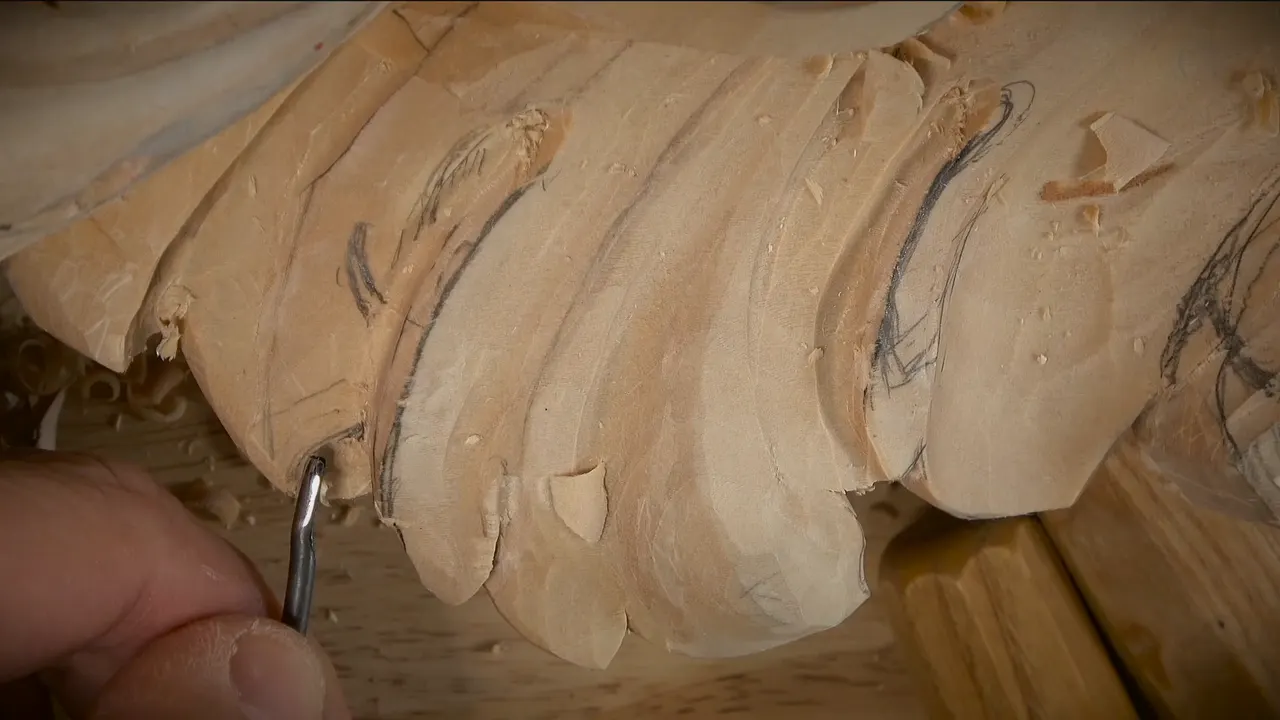

In Venice Room workshop 76, part 1, I told you that any knife or any skew will do the same job as the double-bevel chisel number one I was using. After that came my plan to use a skew. The words I put on that choice also turn up in lessons on acanthus, hazelnuts, grapes, a furniture panel and tool sharpening.
Ever picked up a tool that was not the "right" one and wondered if the carving would suffer? Did anyone tell you there is a single tool for each job? Walk through part 1 with me, then through the other lessons where I used those words at the bench, and see what I did next.
What was I carving before I said it?
Part 1 has me saying "So now just to go and create the plug cut." Then: "And see it's already giving me that curly effect." I was close right on the edge, I said, "but if you go inside, there is a thicker material." That "means I can excavate little deeper on inside," I said. It gives "even better shadow." A warning to myself followed: "But again, I have to be really careful not to overdo it."

The design came up. Something "more interesting," I said. I could leave it "like original," the shape I "designed at the beginning." A change, I thought, would give "a little more movement."
The dig came next, and my words were "And here you go. I've got really deep excavation." On the cleanup I said "Little cleanup because it's going to be visible," and then "Not as much, but still." The shadow: "But see? It casts beautiful shadow already." Not all of that showed on the video, because "you really don't see too much of it because that position of the camera." My depth was "maybe about quarter inch in," or about 6 mm.

Which tools came before the skew?
Roughness first. "So let me clean little bit some roughness of this cut," I said, "and I'll take care of it with probably number seven." On size: "Yeah, well, let's do number seven, four millimeters" (0.16 in).
On tool marks I said "I don't want to see those facets, tool marks. Well, I want to see them, but not as much, okay? I still like those facets." Next: "And that's it." What I left behind was "about one millimeter thick" (0.04 in), and I said "That's what I left. One millimeter." I called the result "a really, really beautiful shadow," and I said "I separated that element."

The wall came next. "Clean that S movement, and now I need to undercut, remove that wall right here before I can create my separation cut." For that I named "five millimeters, number 11" (0.2 in) and said I was "going to start that removal."
How small did the tool have to go?
Size came up. "So I have to probably use three millimeters or two millimeters even," I said, and "Let me use three millimeters first." My verdict on that one: "But three millimeters is too big also." Next: "Let me use two millimeters." Those sizes are 0.12 in and 0.08 in, and another size came after.

"And I can jump and use maybe one and a half millimeters, like 16th of an inch, and excavate even deeper," I said. I don't really need to, I said, but I think it will give me a shadow.
Then the lamps. "Right now, I don't see that shadow because I've got the light sources. It's actually from two sides." They were "shining from both sides, and I kill that shadow." And still: "I need those two lights. That way I can see from both sides." I added "That's what I'm using, two lights at the same time."

What did I say at the skew?
"I think it's good," I said, and "actually looking not bad in all," but a spot still bothered me. "Although I kind of still not too happy with this part." I should "knock that part right here," and the reason I gave was "I think it just distracting."
"Let me knock that down carefully." Then the tool talk. "I'm using just chisel number one, double-sided bevel. Double bevel. It doesn't have to be. Any knife or any skew will do exactly the same job."

And the line this page is named for: "Right now I'll just use a skew just to prove the point." In this part I called the tool only "a skew."
What came next was "Right. So now it's better." Another spot was "not too happy with this, too, because it doesn't look too appealing. Little too long, maybe, for my taste, this part." But it was "much better than it used to be," and I said "I must chop little bit of here. Just like that."

What did parts 2 and 3 say about trying a tool?
In part 2 came "I think it's possible," then "Or even roll it a little bit." One doubt: "I'm not sure if the rolling going to help or not. Maybe not, but at least I'll try." Then: "It's actually not bad at all. It actually looking good."
Tools change in part 3: "Use number six and a smaller one. This one is not going to work. Use number seven and even smaller." Later I said "This number 11 is a little too small. I should use bigger one, like 10 millimeters or so" (0.39 in). Then: "And it does give me much better transition."
Which gouges did I pick in other lessons to make the same point?
Each lesson below has me saying the same words as at the skew, sometimes in a slightly different form. One is Acanthus over Moldings 3, in its third video. I said there: "You can do all of those operations pretty much by using number 11 or even number nine." Then "Obviously some tools you have to have, okay, so I'll use a number 11," with the same words right behind it. My size: "number 11 and two and a half millimeters" (0.1 in). On cleanup I said you "just rotate either to the left or to the right."

Carving Floral and Molding for the Panel 1, part 3, has a number nine. The point, I said, was that multiple tools will work, and a number 11 is only one of them. I went on with "Let me now create outline cut." The size: "In this case, I got 10 millimeters, number nine, about three-eighths of an inch."

Undercutting with smaller tools is the talk in the Lily Box course, lesson 3, third video. My words: "If you don't have a number 11, you can always use a small number three, well, even bigger one." I named a number five and said "This one is about a quarter inch" (about 6 mm). You can "just use upside down that number five, and use just the corner of a tool and go on inside just like that and create your cut."

Carving Hazelnuts, lesson 7, part 2, includes a back bent tool. "Let me clean up with the back bent," I said, and the back bent "gives you a lot more chance to make it nicer and cleaner." The same words showed up before "let me get any flatter tool, like maybe number three, just normal gouge number three." On slicing: "you just go right underneath, but still slice it, okay? Just still slice it." On thickness I said "I'll keep the thickness of it at least 10 millimeters, at least three-eighths of an inch."

Carving Grape Onlay 3, part 2, says you can use pretty much any "flatter tools in this case." Then "Let me grab," with those words in between, "a little bigger." It was a number three, "approximately 19 millimeters or so, three quarter of an inch." And "it's not about really the tool matching" the exact profile, I said, but using "just a corner of it" gets you pretty much any profile.

In Venice Room 151, part 3, I said "you don't need a big tool to do that. I can do that with a smaller tool." Those words followed, and then: "you really don't need the big tool, so you can use a smaller tool, even just number nine, what I used previously." The size was "three quarters of an inch" (19 mm). And a last line: "make sure you're creating that slicing cut if you're going to do something like that."
Bigger comes up in Acanthus over Moldings 2, part 2: "I'll take a bigger one," and the same words came next. After "I'll just roll it somewhat" came a reminder: "Be careful when you work with the grain."
Which lessons put a knife or a skew in my hand?
Venice Room 103, part 4, brings a knife. The same words come first. Then "so any knife will work." One piece was planned "on the camera," and the second one "off-camera." For the blade I said "I'll just create a few straight-down cuts, follow those lines." And "obviously, the knife's supposed to be really sharp."

Sharp ridges needed care in Furniture Panel 34, part 2, and the shape "has to be a convex feel, like a convex." My tool: "a small skew knife number one." My reason came in those words and "it's not necessarily up to the tools. There are multiple ways actually to do that." Blending came next: "I can just blend that with this knife to the concave both sides."

The tool in Carving Greek Acanthus 7, part 4, was a number one: "it's a chisel because it's a straight and it's number 1." It would be a double bevel. On the knife: "I could use just the knife," and "good idea to use this tool in this case." I was "still utilizing just a corner of my tool."

The line itself: "And again, to prove a point, so there's more than one way you could achieve the same results."
Chamomile and Bow Rosette 4, part 3, finds me "removing some of the material" and doing it slow, with the same words after. "It's a slicing pretty much. It's what I do." Also "really legit way to remove a lot of material at once."
Did I say it about anything but a swap of tools?
Furniture Panel 26, part 1, goes beyond gouges. "Now I'm gonna grab again my number 11. And in this time I'm gonna use a mallet, although a small mallet will help probably." I usually don't like to use a breast mallet, I said, but then those words: "that is possible," and "I'll do it." You "just place that inside of your palm and you use it just little by little."

In Furniture Panel 18, part 7, I said "you could use actually a little flatter gouge, to clean that area," and "Let's say like a bigger number four or so." And this: "I don't have to do that because I'm still going to use a router plane, but just to prove a point so it's possible." Then I said I would get the router plane.

A plug cut is also in Venetian Flowers 6, part 2. "Again, I could leave it like just without doing it, but I'm going to do it, okay?" Next came "Let me do another one," same words next, and "Plug cut. I'm going to make a rotation, but carefully, without forcing it." I asked "see how deep shadow it creates?"
A curl is also in Venetian Flowers 3, part 2, in the part about raising a ridge. "And again, I can probably do exactly the same idea," I said, adding the same words and "even when it curls up." My plan: "Raise this ridge."
Finish is the topic in Venetian Flowers 5, part 3, where I would paint a piece, those words included, "for those of you who like the idea of sanding." Of the sanding I said "I didn't sand all the way, but just high spots and then burnished a little bit."
Is it ever about sharpening, or about a limit?
In Sharpening Straight Gouge, part 3, I said "it's a 6,000, which is plenty. I don't even have to do that." Then came the same words and "I usually do because I really like the mirror finish, okay?" The V-tool lesson, Sharpening V-Tool, has "I'm just using one hand right now," then the same words, then "So it still takes the metal out."
Venice Room 57, part 2, has a ceiling in the way. "Somehow I have to attack from the opposite side and go this way, but I can't because I have a ceiling." Then: "To prove my point, I'll show to you. I'm hitting, and my piece is right here, and I really can't carve like that." I named two ways out: "a spoon gouge, which in this case would be good idea," or "a little smaller veiner, and it has to be super sharp."
Where does each lesson put the tool and the size?
Each lesson on this page, what I picked, and the size or note I gave with it.
| Lesson | Tool | Size |
|---|---|---|
| This part, 76.1 | A skew, after a number one chisel | Not said |
| Moldings course, lesson three, third video | A number 11 | Two and a half millimeters, 0.1 in |
| Floral 1.3 | A number nine, beside number 11 | Got ten millimeters |
| Lily Box course, third video, an undercut | Number five | About a quarter inch, upside down |
| Carving Hazelnuts 7.2 | A flatter gouge, maybe a number three | Slice inside |
| Grape Onlay lesson three, part two | A bigger one | About 19 millimeters, or three quarter inch |
| Venice 151.3 | A smaller tool, even number nine | Three quarter inch |
| Carving Furniture Panel lesson 34, sharp ridges | Skew knife | Number one, small, blends both sides |
| Venice workshop 103.4 | A knife for a few straight-down cuts | Really sharp |
| Carving Greek Acanthus 7, part 4 | Number 1 chisel | Double bevel, working with just the corner |
| Furniture 26.1 | A small mallet in my palm | Little by little |
| Furniture 18.7, a bigger number four option | Router plane | A little spot, but still possible |
Where can you watch part 1 and the other lessons?
Part 1 is in Venice Room 76, inside Venice Room Part 7, which holds workshops 74 to 85. Every other lesson on this page has its own page, linked above. For my sharpening lessons, see the Carving Tool Sharpening course.
Want to hear me say it myself? Start here.
How it's done
- Knock the part down. I planned to knock that part down carefully, with a double-bevel chisel.
- Name what else would work. I told you what else would work in its place.
- Go with the skew. I planned to go with a skew right now, and I gave my reason.
- Look at the part. My verdict was better, though one spot looked too long to me.
Frequently asked questions
Which tool was in my hand before the skew in part 1?
The number one chisel with a double bevel, and my plan was to knock a part down carefully. That chisel is not required, I told you, since any other knife or skew gives the same result. My next words were about picking a skew.
How did I plan the knife in Venice Room 103, part 4?
My pick was a knife, with one piece on the camera and a second one off-camera. The plan was straight-down cuts along the lines, then the same from the opposite side. The blade should be "really sharp."
Which tool did I name for the sharp ridges in Furniture Panel 34?
Number one, a small skew knife, for a ridge that needed a convex feel. I added that it is not necessarily up to the tools, and that there are multiple ways to do it. Blending with that knife to the concave on both sides came next.
What to carve next
- Venice Room 76
- Venice Room Part 7
- Acanthus over Moldings 3
- Acanthus over Moldings 2
- Floral and Molding 1
- Lily Box 3
- Carving Hazelnuts
- Grape Onlay 3
- Venice Room 151
- Venice Room 103
- Furniture Panel 34
- Greek Acanthus 7
- Chamomile and Bow Rosette 4
- Furniture Panel 26
- Furniture Panel 18
- Venetian Flowers Rosette 6
- Venetian Flowers Rosette 3
- Venetian Flowers Rosette 5