

Alexander Grabovetskiy, woodcarver, School of Woodcarving · Published 2020
What does a wood carver mean by "a straight cut"?
Quick answer: In part 9 of workshop 76, I left about a quarter inch (about 6 mm) on a piece sawn out for the Venice Room panel, and said my movement would go that way and "just create a straight cut pretty much." Other lessons use the same words about a knife, a gouge, a saw and a board.
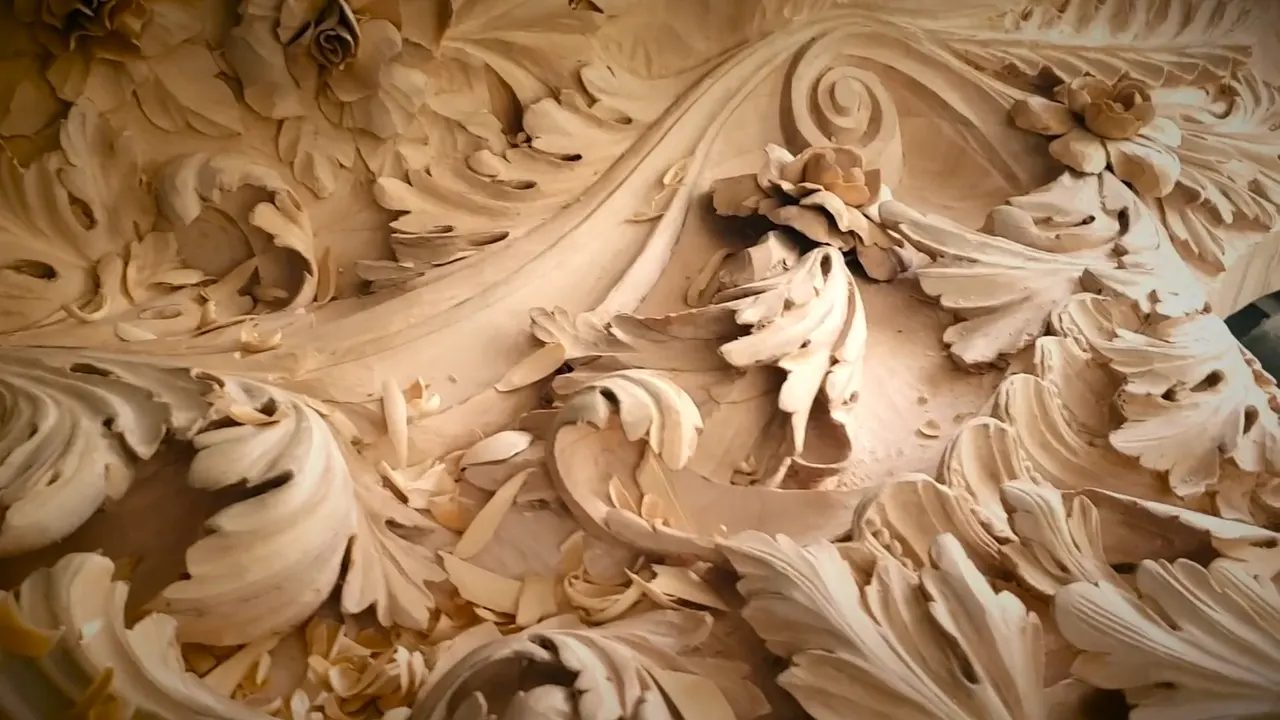

"Straight cut" is a phrase I used in workshop 76, part 9, about a piece I sawed out on the scroll saw for the Venice Room panel. In other lessons I said the same two words about a knife, a gouge, a saw and a board.
Ever hear a carver say "straight cut" and wonder if it means one thing? Walk through part 9 with me, then through the lessons where I said it. Each line is in my own words, with the lesson named.
How does part 9 begin?
A plan ends part 8: "what I need to do now, I need to go on my main body and work on my flowers." Part 9 opens: "So I'm done with pretty much all of my flowers, and that section is almost complete, like 99.9%."
Next I would show you the scale of it and walk around, so "you'll see how it looks." Then a line about the work: "I love carving flowers."

Which part did I skip on video?
A petal count. The petals were "supposed to be in a deep undercut," and I said: "I didn't do that on the camera for a purpose, okay?" My reason was that I had done it already on the Hashemi flowers, "and there's a lot, and I needed the time to carve them, so it would be just too long to explain."
Which spot did I leave open?
The spot was "this area." I could have carved it "out of solid," I said, but "I left that spot on purpose for the school because I really want to show the technique." "Like a secondary layer," I called it.
One piece was the plan, "which you could use somewhere else." It comes "from a ceiling part." From that piece I would cut and "stick that inside of that cavity."

Did the grain matter for this piece?
The piece is "two inches thick, eight quarter material." Two inches is 51 mm. About the grain: "I really don't care as far as the grain run."
"If it would be stain grade, I would definitely have to use different piece. But that is not stain grade. It's going to be a paint." So changing the direction of the grain was no problem, I said. Those are two finishes: stain and paint.
How would I mark the piece?
The goal was to "fill that spot just to get that really beautiful looking stem with some leaves." The marking: "try my best to trace around. It doesn't have to be perfect, but it somewhat has to kind of repeat that shape right here."
On thickness: "I'm going to need the whole body, two inches. Although I don't have too much space. Maybe I do." The scroll saw would come first.

Could this piece be a project on its own?
I thought so: "really, really nice project for you." On the wood: "This is of course, basswood, but you can apply it on oak background, and I'll show you." About the piece itself: "it could be a project on its own."
"Just the stem," I said. No flowers yet: "There's not going to be any flowers, although I could do, maybe I'll do later, some kind of inserts." For now: "it's pretty much just the leafage."
Which saw did I pick?
A band saw would be "probably the quickest," I said, "but I'll use just a scroll saw." A question I get: "Can I scroll two-inch thick stuff? Yeah. And absolutely, you are able to."
My saw was "made in Canada," a "little older model." Of how it runs: "I love it, I love it, I love it because it's actually powerful, no vibration whatsoever."

The blade is "really tiny," a "skip tooth," and I said it will still cut "with no problem." The condition: "I need to get the right tension."
How accurate did the saw cut need to be?
On accuracy: "In this case, I really don't have to be really accurate." The sentence after it trails off. Next: "Now, okay, let me remove this. See? That's actually not bad at all, and it's quick process."

Why did I leave a handle?
A handle came next, to "create some kind of handle" and "leave that handle, for I can clamp it easily."
My waste was to stay "untouched" for now: "Later on, I can always chop out that part." The handle is "really important to hold it in the vice," I said.

Where does the phrase come in part 9?
Here is the line: "I left approximately, I would say, about quarter inch right here." A quarter inch is just over 6 mm. It would be "a lot easier for me to remove with the gouges." And: "my movement going to go that way, and just create a straight cut pretty much."

Which side did the handle go on?
My design will sit "on this side," I said, and that side "is going to go to the surface, to the existing surface right now." The handle had to sit closer to the main body, and the other part is waste: "I don't really need that part."
The waste would be cut out, and I said: "Again, it's somewhat like a straight cut."
How does part 9 end?
I held the piece up: "Here you go. So that is the piece, and that's how it's supposed to look. This part is a handle." Clamping the handle is next, and the body is "what I'm going to carve."
And: "You can apply that on a different types of backgrounds. And before I glue it, I'll show you how you can use it."

What does part 10 say about the handle?
Next, in part 10, comes sticking that piece in "right here." The method: "multiple layers, sticking on inside, gluing, and so on."
I also talked about shaving the handle: "it's a good idea to make it like octagonal." I named "any straight chisel." With four sides, "I would be limited to clamp just in those positions." The setup is the topic of the whole lesson.
Where else did I say straight cut?
Here are those lessons, one at a time, in my own words.
Which knife angles did I name?
The beginner course, First Cuts for Beginners, workshop 1, part 3, has this: "the knife is used pretty much in three different angles." They are the straight cut, a right-hand angle and a left-hand angle.
For the arch point I gave a measure: five millimeters out (about 0.2 in), or "3/16ths approximately." A fix for a chip: "if this chip is not going away, so what you do, you come back and make a straight cut again, and you should have that same clean result."

Does one show on a Hashemi flower?
Carving Hashemi Flowers 15, part 3, holds a plan: "maybe I should use number three. I'll take 20 millimeters and make a cut straight down 90 degrees." Twenty millimeters is about 0.8 in.
Later: "little by little, lower this down. Again, I don't want to force it, although I could because I do have a support now. I can actually make a straight cut down like this."

Can a straight cut be an undercut?
Workshop 21, part 11, says so: "I can start excavating little bit underneath." Then: "And yes, you're looking straight from above, and it looks like I'm just doing a straight cut, but I'm actually excavating."
From below, "it's just an undercut pretty much." The tool was "number seven and 4 millimeters," about 0.16 in.

Why do people carve an almost straight cut?
Part 10 of workshop 52 gives two reasons people do not undercut too much. One is a piece made "too thin, so it becomes fragile, so you can easily break it."
The other: "Lots of people, they just do almost a straight cut. We call it wall undercut. It's almost straight down, almost 90 degree, just a slightly angled little bit, okay?" That way is "really strong," I said, and "much faster process of wood carving."
My own way is different: "If you don't undercut extremely like I do, it's a lot easier to cut straight, just a little angle it like that."

When did I say I was not doing one?
Venice Room 55, part 2, has the eye of an acanthus: I would "exaggerate this eye area." The tool: "10 millimeters, by the way", a "veiner number 11." Ten millimeters comes to about 0.4 in.
The shape was "like letter U shape." Then: "See? I'm not doing a straight cut. I'm leaning little bit toward the right side." Next I said it had "already created a raised part and extra shadow on this side."

Does a straight cut go down a channel?
At workshop 80, part 3: "now I've got a high spot, which is the highest spot right there, and gradually it's supposed to go downhill." So: "I can really take a straight cut down channel between those, and go to that point." Care was still needed: "kind of careful."
One more option: "But I also could drill multiple holes if I wanted to, but I don't think I need it."

Why did I skip one in workshop 145?
Workshop 145, part 3, reads: "And blend it better this way. It's not the final shape yet, but still you should get an idea."
A reason followed: "And why I'm using not a straight cut because I really want to see already convex on this side. So important for me to start convexing."

Is there a straight cut I cannot see?
Undercutting came up in Carving Roman Acanthus 11, part 4: "I know it's impossible to see what is going on inside when I'm undercutting," but "there's nothing exciting, just a straight cut." And: "no beauty in it." I still like "to see all my undercuts really clean."

What about the fibers?
Carving Plate with Butterflies 7, part 1, has this: "I feel like if I gonna continue just the straight cut like this I can break some fibers." The lines around it are not clear in the captions, so I print only this one.

Where did it come up on the scroll saw?
Carving Lily Box 1, part 2, is the scroll saw lesson. Of a sharp point I said: "if I want to do a really sharp point, then I would just go from this side and go like that and cut the sharp point." A sharp point was not needed: "I really don't need that sharp point."
For the speed: "lower a little bit my speed." Then: "I will go to this point with a straight cut, just like that." And after it: "Then I'll create my loop."

How did a rosette background get one?
For a background, Carving Flower Rosette 7 says the original piece is "about 1/32 of an inch lower than the border." That is about 0.8 mm. And: "I did not lower that all the way."
What I made: "You can see in some sections, I made an angle cut, the straight cut around and an angle cut, and I left that way." Why I left it: "once we're going to apply that punch, and we're going to do the background," the punch will press down the fibers of the wood.

Did a board get a straight cut too?
In the Livestream April 2020, a question came in from the chat about the wood I use. My answer started with buying wood: "When I buy wood, if you know the difference about rift cut and just the straight slicing, or quarter sawn."
About a straight cut on a board, I said it is "also dangerous," and that it will cup. My preference: "I look for a quarter sawn or rift cut." I pulled up the computer to explain a board: "if it's a straight cut, you're going to see rings like this. It's a straight slicing of the board. I try not to buy it because it's going to move a lot."

Where does each line sit?
Each lesson on this page, with the work I was doing and the words I used.
| Lesson and part (the Venice Room unless named) | The work I was doing | The words I used in that lesson |
|---|---|---|
| 76.9 (this lesson) | A piece sawn out on the scroll saw, with a handle left on it | Somewhat like a straight cut |
| First Cuts for Beginners, workshop 1 | Knife cuts | The straight cut, a right-hand angle and a left-hand angle |
| Carving Hashemi Flowers 15 | Lowering a spot little by little, now with a support | Down like this |
| 21 | Starting to excavate a little bit underneath, and looking at it from above | It is just like undercut |
| 52 | Why people do not undercut too much | Wall undercut |
| 55 | The eye of an acanthus, with a number 11 veiner | I'm leaning little bit toward the right side |
| 80 | A high spot that goes downhill, and a channel between two spots | Down channel between those |
| 145 | Blending, and not the final shape yet | Not a straight cut, because I want to see convex |
| Carving Roman Acanthus 11 | Undercutting, where I could not see inside | Just a straight cut |
| Carving Plate with Butterflies 7 | A plate, and a worry about the fibers | I can break some fibers |
| Carving Lily Box 1, Scroll Saw | Going to a point on the saw, then a loop, with the speed lowered a little | To this point with a straight cut |
| Carving Flower Rosette 7 | A background left a little higher than the border, with an angle cut | The straight cut around |
| Livestream April 2020 | A question from the chat about the wood | A straight slicing of the board |
Where can you watch part 9 and the lessons on this page?
You can watch part 9 in Venice Room 76. Workshops 74 to 85 sit in the Part 7 course. Every other lesson on this page has its own page, linked above, and each is open to you with school access. A workshop number means the Venice Room, and every other lesson carries the name of its own course. All of it is wood carving I did at my own bench.
Want to hear me say it in my own voice? Start here.
How it's done
- Plan the trace. Tracing was the plan, I said: try my best to trace around it. It need not be perfect, but it somewhat has to repeat the shape.
- Saw the piece out. I sawed a piece two inches (51 mm) thick on my scroll saw, and I said I did not need to be really accurate.
- Leave a handle. Leaving a handle was the idea, so the piece clamps easily, with my waste beside it.
- Name the quarter inch. I left a quarter inch, roughly 6 mm, for the gouges.
- Hold the piece up. The part is a handle that I am going to clamp, and the body is what I am going to carve.
Frequently asked questions
What stayed on the piece in part 9?
A handle, so the piece clamps easily. A quarter inch (6 mm) stayed in one spot, easier to take off with the gouges, I said.
Did the grain matter for the piece?
In this case I really don't care about the grain run. Not stain grade, and it will be painted. For stain grade I would definitely use a different piece of wood.
Will a scroll saw go through two-inch stock?
Yes, I said, and absolutely, you are able to do it. Two inches is 51 mm. My saw takes it even with a really tiny skip tooth blade, though I needed the right tension.
What shape did a straight cut take in the Venice Room?
What to carve next