

Alexander Grabovetskiy, woodcarver, School of Woodcarving · Published 2020
What does a wood carver mean by "long movement"?
Quick answer: "Long movement" is a phrase I said in part 8 of workshop 76, about a concave, with a reason and a plan for a preliminary cut. Other lessons carry it over a pipe and an acanthus, a hanging leaf and a flower, each in its own words.
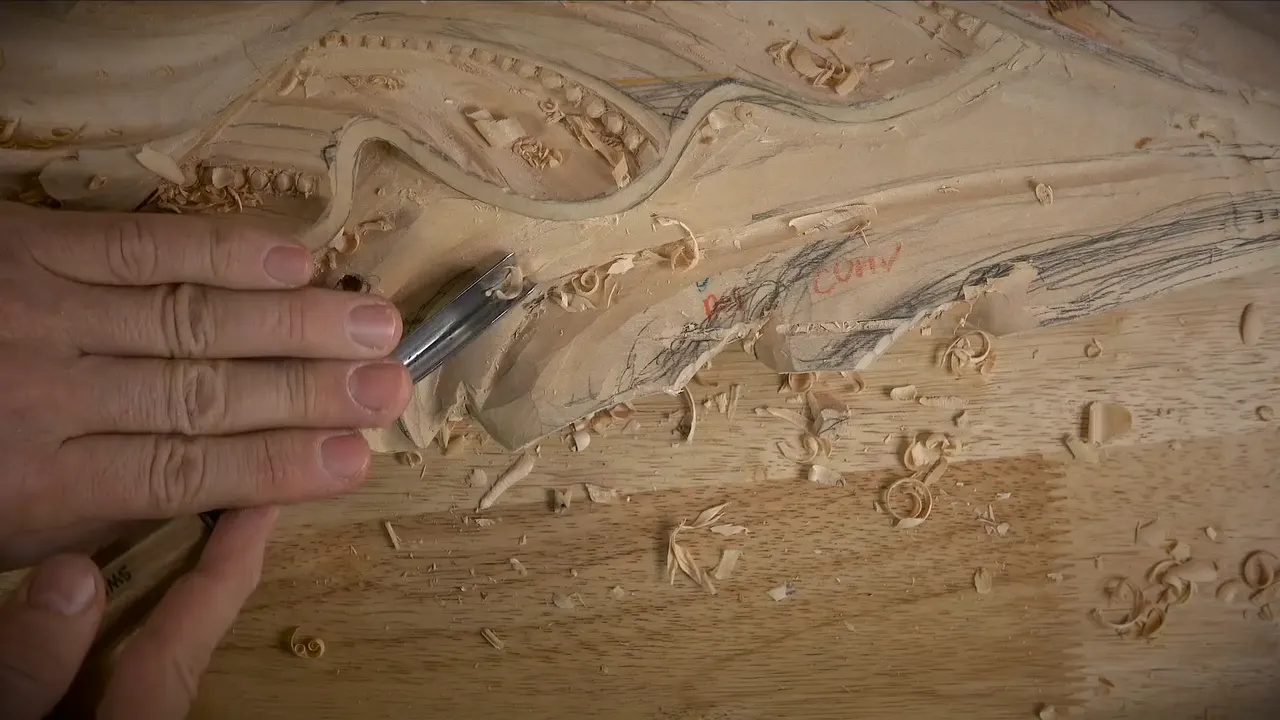

"Long movement" is a phrase I said in workshop 76, part 8, about a concave that could go all the way. In other lessons I said it about a pipe and an acanthus, a hanging leaf and a flower.
Ever look at a piece of wood carving and wonder where the eye is meant to travel? Walk through part 8 with me, then through the lessons where I said the same two words, and read the words around them.
What came before the phrase?
The part opens mid-thought: "I probably should use a bigger..." and then "I don't really need deep cut anymore." Of the shape I had made: "I created that convex feel, and I like it. I like it actually a lot."
A to-do came next: "And I also need to knock down this middle convex or create little better version of it, okay?"

How did I describe the concave?
Next, "let me leave it for now." Here comes the phrase: "Although that concave can go all the way like this, because it's going to create a long movement."
A small plan came with it: "So let me preliminary cut it." And a line for you: "you'll see what I mean. It actually really gives me beautiful motion."

Could you see the shadow in part 8?
Hard to see at that point, in my words: "I know it's almost impossible to see now, but let me try to change the light position, and you'll see it actually gives me some shadow." That was a plan, said as a plan. Then: "It's not clean yet, of course, but it's okay."
An option followed: "And I could create a deeper cut, by the way, pretty much this way." Then: "Because it's long motion like this. Okay?" My verdict, in my own plain words: "That is actually really good."

What did I leave for later?
The details. "So now I can always work little more on details, but I'll do it maybe off camera because, again, on details, I need to get little closer to my work and to clean everything and so on."
Gained, in my words: "But at least I can see now the main movements that I'm after." And: "that's a lot easier for me now to develop those motions." One fix to my own speech: "Well, I should say what I've done right here, not we."

Which tools did I name in part 8?
A plan came first: "Let me get that separation done little more cleaner." Next: "So now I'll use number seven and 14 millimeters, and I can just create that cut down like this." Fourteen millimeters is about 0.55 in.

A feeling followed: "it feels like this part is actually underneath of that motion. It's really good." The tool changed. "But number seven is not good tool anymore for me. So now I need the flatter one, like maybe number two or so."
After that: "That is good." The clean-up was still ahead: "It will be clean once I clean it."

How far had the carving come?
"But I've got to the point when I'm able to actually work on details of this movement." A note to you followed: "please understand that, again, I probably going to work that off camera." On the next step: "I need to get little closer to it." And: "hard for me to work the really nice details without sticking my head in."
The layout was a plan, in my words: a main separation right here, an eye, and another separation. I spoke of one part and a second part. And: "So three different leaves, actually, pretty much."

What waited in part 8?
Little more would be done to it, I said. I would not go further this way, with "no reason" until I develop the ends. What I had: "But now I've got the movements and I've got somewhat undercut. Actually, pretty much just brought everything to the edge."
The clean-up waited: "Yes, I still need to clean little bit, and that's what I'm going to do a little later, not now." For now, I said, the job was my main body and my flowers. My last words about the carving: "that is the result as of today, and I hope you like it." Last: "And it doesn't look too bad at all."
What do the parts beside part 8 say?
Part 76.7, before it, ends on a tool and a feeling: "I'll use probably just a number five back bend." And: "And now I can clean it." Part 76.9, after it, begins: "So I'm done with pretty much all of my flowers, and that section is almost complete, like 99.9%."
Where else did I say long movement?
Here are those lessons, one at a time, in my own words.
Where did workshop 13 use it?
Workshop 13 of the Venice Room, part 6, has this: "That is not bad at all except right here, I can probably clean a little bit more." The phrase: "And that gave me a really nice long movement. Beautiful."
A clean-up followed: "Let me clean this one." The look bothered me. "I need to use a bigger tool." Plus a gouge number: "I could use actually number seven."

How did workshop 17 describe a movement?
Part 12 of workshop 17 holds this: "And maybe clean a little better right here. And finish it there. All right. So nice and long movement."
About one more movement: "I also would love to fix this movement because it still doesn't look too good, and maybe I can do exactly the same." The idea: "I can actually start from almost nothing from here." Also: "With the same tool, carefully."

Why did a steady hand matter?
Workshop 18, part 1, has "Couple of preliminary cuts." The reason for a steady hand came with it: "just because it has a long movement, so really important to be really stable with the hand."
My goal, in my words: "if I need to recut multiple times, I'll do it. But my goal is to make one long and nice movement." And: "that is probably good." A need followed: "give a better shape on this side, slightly better shape on this side."

What about the middle line in workshop 22?
Workshop 22, part 2, gives it again: "Yep, that is actually excellent. And I'm going to do another eye." Right after: "So got the main idea."
I wanted to make sure I was not losing my middle line. And: "everything's supposed to go to the middle line." The words came next: "That's going to be a long movement like that."

Did a pipe get the same treatment?
Workshop 26, part 1, has it about a pipe, and a long pipe was my plan: "Let me draw that pipe." I was not sure: "I'm not sure if I should create more divisions right there or not."
My choice: "But, originally, I want to make it a long movement. At least here." And: "Let me do that, just to stick to the original."
The concave was next, in my words: "I need to create the concave right on the side of the pipe." A really deep concave was not the plan. The tool, as a plan: "Let me use just the number six for the beginning."

Can a long movement hang down?
In the Furniture Panel design lessons, lesson 12, part 2, I talked about one movement meeting another, an "invisible connection." Long, I said, like this: "also long movement, like hanging down, okay, if it makes sense."
I planned to just hang this down, with a question to myself: "let me think what kind of leaves I can use."
My ideas: "I can actually repeat this line with my leaves and maybe go downhill. So start with this line and finish with that line." Underneath, an option: "I can go with another one", and it would look like a double leaf, I said.

Does a flower get one too?
In the Furniture Panel carving stage, lesson 25, part 1, I talked about one flower: "you can see right from the middle right from the center." Some kind of "long long movements" were there, I said. Then: "I think that detail gonna be really beautiful detail."
My reason for drawing it: "we would like to be authentic to the period and that's what they've done. So that is why I drew that same idea right here." And: "I think it's good to follow what they did."

Where does Venetian style come in?
Workshop 66, part 8, has a plan for the inside: extra divisions, "because right now it's just too pointy." Something needed a trim: "And this one needs to be a little shortened also." Then a doubt: "Maybe yes, maybe I don't need to."
Next: "Maybe I'll just keep it long because I'm explaining to you, but beside you, nobody else is going to know that on a Venetian style, you're not supposed to have long movements like that." Then: "Okay. It's okay." And: "We'll develop something new and get that thing done."
That lesson also has a line about the grain: "And yes, I am working against the grain."

Why set the eyes closer?
Workshop 69, part 7: there would be another eye, I said. And: "I could do the eye farther, but there's no reason." It would not be visible, I said.
Closer eyes had a reason: "Okay, so that's why I'm actually doing those eyes right now a little closer, which, in another case, would be a little farther on the back." Then: "And here you go." I said this would be the long movement, and that part would be hollowed out, a concave.
One spot waited. I still had to figure out what to do below it, because it needed filling somehow, later on.

How do three divisions fit in?
Workshop 74, part 9: "We've got three main divisions, and inside of those three main divisions, we also divide by three. One, two, three. Okay? So that's going to create our long movement acanthus."
I counted out loud: "if there is three divisions, one, two, and three, it should be two eyes." On the eyes: "If you have an eye, you always have a convex. It's like the main vein, if you wish." The next count: "So two eyes, two main convexes." The last one was Venetian: "If it's Venetian style, you will have also convex, convex, and a convex. Five total."

A shell or an acanthus in workshop 75?
Workshop 75, part 1: "there's supposed to be a shell and another movement this direction. But I need to decide. I need to make the decision."
My original plan, in my words: "my original plan is to get an acanthus. But it's going to be a long movement acanthus". It kind of "has a motion return this way, just like that." And: "the shell will overlap that acanthus movement."
The first job: "what I have to do, I need to knock down all that mess." For the tool: "I will outline it with the number 11 and at 12 millimeters." A mallet would be needed too. Twelve millimeters is about 0.47 in.

How long was the movement I called somewhat long in workshop 117?
Workshop 117, part 1: the plan was to take two spots and "move about six parts out of 10, golden ratio." Then I called it "a somewhat long movement."
It would be one of the divisions later on, I said. A need followed: "I need to lower down a little bit that section, for I will see where I'm at."

Can a leaf sit on top of one?
Workshop 133, part 1, about one leaf: "I want to make it like growing from the same bunch, going from underneath of this leaf and going on top of that long movement, which is a little challenging."
I was not sure it showed: "I'm not sure if you see it or not, how it's supposed to be. I think this is the best angle." For the tool, a plan: "I'll take number two, and going to start moving this direction, although probably number seven will be better." And: "Have to attack from the right position."

Where does each line sit?
Each lesson on this page, with the work I was doing and the words I used.
| Lesson and part (the Venice Room unless named) | The work I was doing | The words I used in that lesson |
|---|---|---|
| 76.8 (this lesson) | A concave, with a preliminary cut as the plan | Beautiful motion |
| 13.6 | A clean-up and a bigger tool, with a number seven as an option | Really nice long movement |
| 17.12 | One more movement that still did not look too good to me | Nice and long movement |
| 18.1 | Preliminary cuts, and a movement that needs a steady hand | Long and nice movement |
| 22.2 | Another eye, and keeping the middle line | The middle line |
| 26.1 | A long pipe and a concave on the side of it | Stick to the original |
| 12.2 (Furniture Panel design) | Leaves that hang down, and maybe a double leaf | Also long movement |
| 25.1 (Furniture Panel carving) | The center of one flower, and why I drew it | Long long movements |
| 66.8 | Something I might keep long, and extra divisions inside | Keep it long |
| 69.7 | Eyes set a little closer, and a part hollowed out | And here you go |
| 74.9 | Divisions, each divided by three, and two eyes | Five total |
| 75.1 | A shell or an acanthus, and a decision to make | A motion return |
| 117.1 | Two spots, six parts out of 10, and the golden ratio | A somewhat long movement |
| 133.1 | A leaf meant to grow from underneath, a little challenging | That long movement |
Where can you watch part 8 and the lessons on this page?
You can watch part 8 in Venice Room 76. Workshops 74 to 85 sit in the Part 7 course. Every other lesson on this page has its own page, linked above, and each is open to you with school access. A workshop number means the Venice Room, and every other lesson carries the name of its own course.
Want to hear me say it in my own voice? Start here.
How it's done
- Set the convex. The convex feel was made, and I liked it a lot.
- Name the movement. That concave got the name long movement from me, and a preliminary cut was the plan.
- Plan the light. I planned to change the light position to get some shadow.
- Name the tool. I named a number seven, 14 millimeters (about 0.55 inch). A flatter one, maybe number two, was the need.
- Leave the clean-up. Cleaning waited. Going on my main body and working on my flowers came first.
Frequently asked questions
Why did I call the concave a long movement?
In part 8 of workshop 76, I tied the concave to a long movement and planned a preliminary cut. I also said it gives me beautiful motion.
Was the shadow easy to see in part 8?
No. It was almost impossible to see at that point, I said, so I planned to move the light and look for a shadow.
Which tool did I name for the separation?
A number seven, 14 millimeters (0.55 inches). I also said it was not a good tool anymore, and that I needed a flatter one, maybe a number two.
What do my lessons say about long movements and Venetian style?
What to carve next