

Alexander Grabovetskiy, woodcarver, School of Woodcarving · Published 2020
What does a wood carver mean by "always helpful"?
Quick answer: Part 3 of Venice Room workshop 76 has me calling a number 11 "always helpful" and asking for a "more subtle" shape. I said the tool was slightly too small and named 10 millimeters, 3 and 1.5. Other lessons use "helpful" for a back bend, a bigger tool and a mallet.
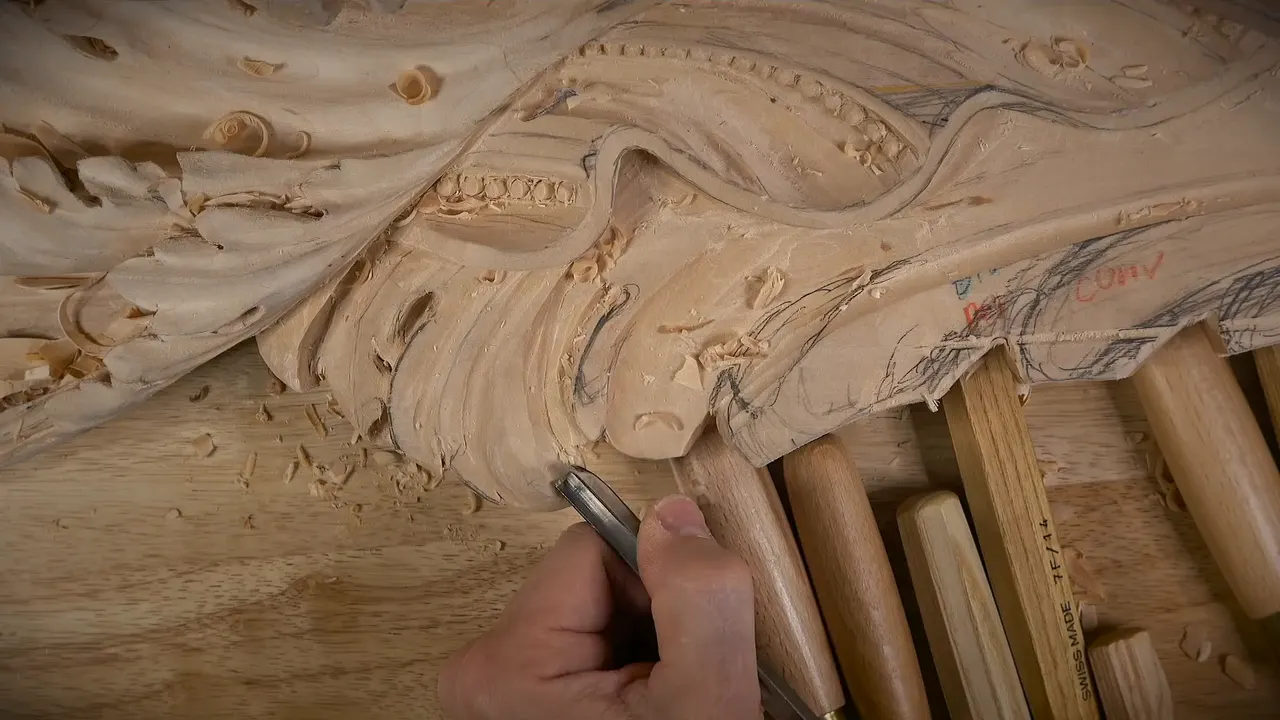

In Venice Room workshop 76, part 3, I said "Number 11, always helpful, but I really don't want to see that deep concave." The two words came with a warning about depth. In my Grinling Gibbons, Corinthian, Roman, Lily Box and Furniture Panel lessons I used "helpful" for other tools and choices too.
Ever reached for a gouge you trust and still held back? Does a tool that helps in one spot help in every spot of a wood carving job? Walk through part 3 with me. After that come the lessons where I used the same word, and you will see what I put each tool to work on.
Where did number 11 come in during part 3?
The part starts with a tool call and no hello. "Use number six and a smaller one," I said, and right behind it "This one is not going to work." The next call was "Use number seven and even smaller."

I gave my reason out loud. "I need gradual transition from a convex to the concave. Okay? That's why I'm doing what I'm doing." A maybe followed: "Maybe I can actually get a little deeper. So we'll see if I'll be able to."
"And again, it doesn't help me." A few lines later came "Oh, let me use just number 11."

I kept going after that line: "So if you understand what I mean, I really want a more gradual, more subtle, if you wish, more subtle."
How did the size change in the middle of part 3?
"I think I'm getting there," I said. The very next words were "This number 11 is a little too small." My plan came in the same breath. "I should use bigger one, like 10 millimeters or so" (about 0.39 inch), and "It's going to give me better transition."

Only the size went up; the sweep stayed number 11. "Again, 10 millimeters, number 11," I said. The result, in plain words: "And it does give me much better transition. Much better transition." On the wood itself: "You can probably already see it created convex going underneath of this part."
Next, a cleaning job: "And let me clean all that mess," I said. My tool plan for the inside was "probably going to use six millimeters, number nine to clean on the inside of that" (6 millimeters is about 0.24 inch).

The aim, in my words: "a little better, cleaner transition. At least that's what I'm after. So I kind of like it." The check I care about most came right after: "I did not lose overall feel. It's still there."

Why strop a number 11 before the undercut?
"And now I need to undercut underneath of this section. Just go that way." For the tool I said "To undercut, I'll use exactly the same tool what I used before, maybe three millimeters, I would say." "Number 11, 3 millimeters," I said, and "Let me first kind of strop it a little bit."

My warning came with it. "Make sure when you strop it, also please don't rock it like that. Okay? So you're going to roll the edge." I asked for a steady hand: "just try to stay your hand steady. Okay? Catch the bevel and just go without rocking."
Back to the size: "Okay, so 3 millimeters, one-eighth of an inch, and I carefully going to start my excavation." That was not the end of it. "Okay, that is a little too big, so I have to probably use one and a half millimeter," about 0.06 inch. "Of course, it's the same number 11, but one and a half millimeters," I said. My verdict: "And that is good."

Where did part 3 end, after the 1.5 millimeter cut?
"And let me excavate that part. Just exaggerate that eye." The last words of part 3 are a plan and a fallback in one: "See if I'll be able to hit with number seven and 14 millimeters straight down at first, and I can always undercut this way." Fourteen millimeters is about 0.55 inch, a bit over half an inch.
Put together, "always helpful" sits beside a number 11, while the deep concave was the part I did not want from that tool. The sizes I named in this part: 10, 3 and 1.5 millimeters.
Which tools show up in the parts on both sides?
The end of part 2 reads "Maybe use just a number four upside down first, and I'll just go in, create preliminary move. And I'll follow with the number five spoon gouge. Maybe this one is little too big."
Over in part 4 I picked up a back bend and decided against a mallet. "I'll take a back bend. Number five will do, and I'll just excavate this direction." About it I said "So that is almost impossible to do with any straight tool. See, the back bend allows me not to damage opposite side because it just rides above it." I closed with "That's why I love those back bends or bended backward gouges."

The mallet got a no: "I really can't use any mallet because I already have the main body of a carving." By hand, I said, "at least I can just by hand try to excavate a little deeper." A little hit with the mallet was floated as a maybe. My answer? "I don't think that's a good idea, by the way. Mallet is not good idea in this case."
In that same part I put a question to myself about one cut. Earlier came "I can create the plug cut with the number nine. And again, one-eighth of an inch." The question: "Do I have to do that? Oh, no. Absolutely not. But I like shadows, okay?" A reason followed: "painted with one color, just pretty much white." Next: "those shadows, they are going to be really important," in my words.
Which tools did I name as helpful in other lessons?
Other courses of the school use the same word. Each line comes with its source.
My own tool. The first line of Venice Room 72, video three, is "It's always a helpful tool. Really, really helpful." Right after: "Even if I'm not going to have full convex on this side, I'm okay with that." A few lines later: "And with the same tool, what I can do, I can actually undercut right away, pretty much, and remove all that mess and hook out whatever I don't need."
A back bend. In Grinling Gibbons, Maine class 12, video three, where I was blending what was left. There are lots of different tools to use, I said. "Backbend, it's always helpful." Mine was six millimeters (0.24 inch), I said, and back bends are "really helpful." Of the blend, I said "It gives me somewhat finished look."
The Corinthian Acanthus Leaf course, lesson 6, video two, has a line that starts alike. "A really helpful tool would be," I said, naming the tool in use. Then: "I could use a back bend." Next: "And the back bend would be excellent tool in this case also." And "You can get in really, really deep areas sometimes just because it's a handy tool."
Then there is Venice Room 20, video two. In it I said "Number five back bend. And little by little. I'm going to excavate that way." Then: "And of course, my back bend needs to be sharpened. That would be really helpful."

A tool for the inside. In Furniture Panel 19, video nine, I said "Now I need to attack inside right here," and I named a tool for it. "It's actually excellent tool to use in case like that." More came: "And it just helpful tool sometimes." The idea of that tool, I said, is "to eliminate the need of multiple tools."

Small spoons. In Maine class 9, lesson nine, I said I was using a big tool, a straight one. "I do have a tiny small spoons," I said. Spoons like that are "really helpful actually" in an area "that work with the grain." I left you a way out: without them you can still carve it "like I just did it."

A bigger tool. Roman Acanthus 4 has a size line. "And if you do have a bigger tool, that would much more helpful. For example, I could use my number 7 and 2 inches in case like that." That is 2 inches (51 mm). "It would be much more quicker carving for me."

A mallet. Here the word comes with a rule that I break on purpose. In Lily Box 5, video nine, I told you "you're really not supposed to use a mallet, actually, on a small, tiny tools." "I know I said that many times," I said. Then: "But if you're really careful, even if you're not supposed to, sometimes it's helpful, actually, to use a mallet. You can gain a lot better control."

Back in Venice Room 37, video 12, I said "And yes, I could probably use just a mallet. It would be more helpful." That one stays a maybe, and the problem is named soon after: "This area needs to be excavated right now deeper."

In Roman Acanthus 10, video four, I said I would take number 3 and push it straight down, and that you could use an actual mallet: "Mallet would be helpful in this area."
Small tools in harder woods. Lily Box 4, video nine, is about going with smaller tools and creating "multiple holes." On the waste I said "easier to remove later on." My word comes next: "And especially it's helpful on harder woods."

An alternating cut. In Grape Onlay 10, video two, I was undercutting with the same tool and said "But you can alternate. I mean, it's also helpful and that's also depends how extreme you wanna go in." A caution came next. "But be careful again, it's better to attack from two sides, rotate slightly."
The grain. In The Tray of Blessing, lesson 3, video one, I said "See how quickly I can establish the shape." Then: "working with that grain is gonna be more helpful."

A router plane. Furniture Panel 26, video three, has me doing only one side, "for the reason," I said. A router plane could always make it "really, really good," I said. And: "I don't have to, but sometimes it's helpful."

When did I say a tool was not helpful at all?
The word turns around too. In Hashemi Flowers 47, video four, I said I needed to refine my curl, "although it's not really helpful that that is the end grain." Next: "But still, looks like I am able to cut even deeper."
The lights come up in Venice Room 57, where I was talking about my lights. "It is already evening and I'm just using lights and that's not helpful." In Grape Onlay 13, video one, I was trying something with light and said "Not sure if it's gonna be even helpful or not."
Workshop 76 has its own pair: "And again, it doesn't help me" in part 3, and the mallet that was not a good idea in part 4.
Which tool goes with which line?
Each row is a lesson, the tool or choice I named, and what I said about it.
| Lesson | Tool or choice I named in it | What I said |
|---|---|---|
| This part, 76.3 | Number 11, with no deep concave wanted | "always helpful" |
| Lesson 72 of the Venice Room, video three, first line of the part | Tool in my hand, then the same tool for an undercut | "Really, really helpful" |
| Gibbons class in Maine, lesson 12, video three | Back bend of 6 millimeters (a quarter inch) | "it's always helpful" |
| Corinthian Acanthus Leaf course, lesson 6, video two | Back bend for deep areas | "really good and useful" |
| Workshop 20 of the Venice Room, second video | Number five back bend, sharp | "That would be really helpful" |
| The Roman Acanthus course, lesson 4, the third video | A bigger tool, number 7 and 2 inches (51 mm) | "much more helpful" |
| Lily Box, lesson 5, video nine | Mallet, even on tiny tools | "helpful, actually" |
| Venice Room 37, video 12 | The mallet | "more helpful" |
| The Tray of Blessing, lesson 3, video one | Working with that grain | "more helpful" |
Where can you watch part 3 and the other lessons?
Part 3 is in Venice Room 76, inside Venice Room Part 7, which holds workshops 74 to 85. Every other lesson on this page has a page of its own, linked above, in Venice Room and in the school's other courses.
Want to hear me say it myself? Start here.
How it's done
- Name the tool. My pick was number 11, and I called it "always helpful."
- Say what you do not want. A deep concave was what I did not want, so I asked for something more subtle.
- Change the size. Too small, I said of the number 11, and I planned a bigger one, 10 millimeters (3/8 inch).
- Check the feel. After the cleaning I said "I did not lose overall feel. It's still there."
Frequently asked questions
Which tool did I call always helpful in part 3?
The number 11. A shape that was "more gradual, more subtle" is what I asked for, not a deep concave.
What did I do when the tool was slightly too small?
My words were "This number 11 is a little too small" and "I should use bigger one, like 10 millimeters or so." That is about 0.39 inch. I said the result was "much better."
Why did I warn about rocking a gouge on a strop?
The words were "So you're going to roll the edge." The fix, in my voice: "stay your hand steady" and "catch the bevel and just go without rocking."
Which size did I plan for the undercut, and was it right?
What to carve next