

Alexander Grabovetskiy, woodcarver, School of Woodcarving · Published 2020
What does a wood carver mean by "absolutely not"?
Quick answer: In part 4 of Venice Room workshop 76 I asked myself about the plug cut. My answer was "Absolutely not." Shadows were my reason, on a piece set for one color of paint. Other lessons use the words for a cleaning step, a scraper and a few wrong ideas.
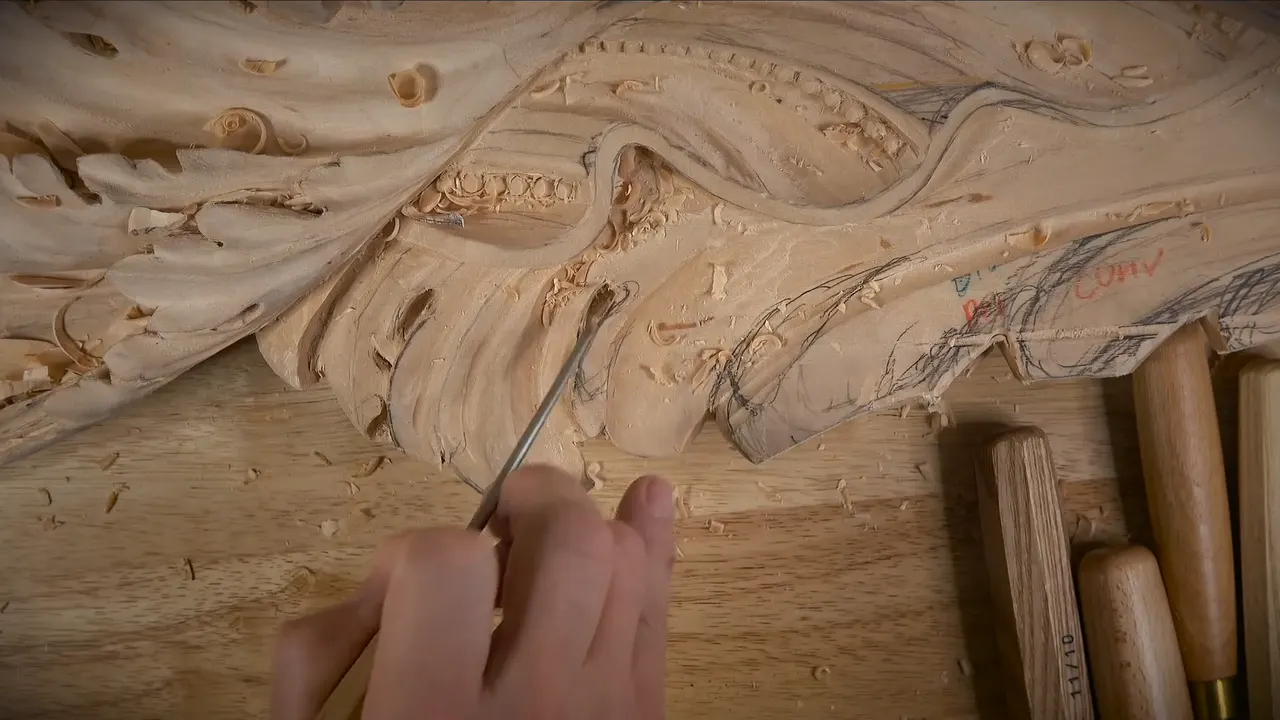

In Venice Room workshop 76, I asked myself in part 4 about a deep plug cut and answered "Absolutely not." The shadows came right behind it, as the reason. In other lessons I used the same two words to skip a step I could take, and to say no to a wrong idea.
Ever stood over a wood carving job with a gouge in your hand and wondered if one more pass is needed? Is a pass you could make the same as a pass you must make? Start with part 4. After it come the lessons where I said it again, and you can hear what I did next in each one.
What did I ask myself in part 4?
The part opens with no hello. "And let me excavate right away that direction," I said. "And I can create the plug cut with the number nine. And again, one-eighth of an inch." About 3 millimeters. The plug cut would go on the inside, I said, and it would give me "a really beautiful and deep shadow."

I asked you to look. "See how deep I can go?" A moment later came my own answer: "Here you go. I've got really deep." The same went for a second spot, "right away pretty much."
About that area I said "At this point, I don't think I'm going to change this part. No more changes to this part, I should say." I said all of my cuts can go to that plug cut, "the hole I created by removing that plug."

And then the question. "Do I have to do that? Oh, no. Absolutely not. But I like shadows, okay?"
Why do I like shadows on a carving that will be painted white?
The reason came right after. Of the piece I said "it's going to be painted with one color, just pretty much white." My next line was "And those shadows, they are going to be really important." I called it the main idea, "especially on a white color."

I wanted a shadow from the plug cut.
The paint came up again. "I have to be also mindful how I'm going to paint it," I said, and my own answer was "With a small brush, of course." So a small brush was the plan.
How does a back bend reach under the eyes?
There was more to carve underneath. "Of course, I could go underneath this way, which I probably should." My plan was a back bend: "Number five will do, and I'll just excavate this direction."

I expected "even lighter feel, more airy." Next I said "Let's open up this eye," and a second direction was open too: "opposite direction. Same way," and "right here, too."
So why a back bend? A straight tool makes it "almost impossible," I said. The back bend "allows me not to damage opposite side because it just rides above it."

With it I can create "really deep excavations on inside of those eyes or any other undercutting parts, whatever I need to undercut." On back bends I said "That's why I love those back bends or bended backward gouges."
After that I could remove the waste and open the inside up bigger. "Even deeper shadow it's going to cast," I said.

A second spot wanted the same effect. For that spot I would need a smaller back bend, "maybe number seven," going that direction. A maybe, so a plan.
Why not use a mallet on this part?
The main body of the carving was already done. "I really can't use any mallet," I said, so I would "try to excavate a little deeper" by hand.

I talked through it. The plug cut was out of reach. Maybe a little hit with the mallet. Then my verdict: "I don't think that's a good idea, by the way. Mallet is not good idea in this case."
For the waste I named a small tool: "And let me hook out whatever I don't need with the one millimeter spoon" (about 0.04 inch).

Next came the mess on one side: "So I need two millimeters. And remove all that mess." Two millimeters is about 0.08 of an inch.
Why stop before carving straight through the piece?
The last lines of part 4 take up a question you might ask. "And if you would ask me why I didn't just got my cut all the way through, which I could. Yes, I could, but it would look unnatural toward the ceiling, the overall movement."

"You're still going to detect that there's something just wrong," I said. The other road was fine too. "If I would do all the way pierced work, that would be okay, but I didn't."
So much for part 4. A question I put to myself, my answer, and then my reason. Other lessons carry the same words with other reasons. Each passage below says which lesson it comes from, with a link.
Which steps did I skip with those words?
A cleanup. In part 9 of Venice Room 67 I said "That is just gorgeous, actually." Next came "maybe just little cleanup, which I could spend all day long if I wish," and I asked myself whether I had to. The words were "absolutely not. I don't need to spend long time on it." I said I needed to "do something else."

"Maybe I still have to hit slightly this side because it has to blend in," I said. Of the next area I said "another leaf, like maybe acanthus leaf," and a flower. A plan, so it stays a plan.
A clean spot. A big gouge left a place in Venice Room 20, part 10, that I liked: "I really like how clean it looks right here because I used the really big gouge, and I really would love to keep that like that." Then "But do I have to?" Twice over came "absolutely not, absolutely not," followed by "Let me think."

A "flipping backward movement" was my next question: "Should I do or not that?" I answered "Maybe I should." And if I don't like it, I said, "I'll redo something new, okay?" The next tool would be number seven, "and create roundness."
A scraper. Asked about scraping the surface in Furniture Panel 21, I said "Oh, no, absolutely not." Scraping, I added, is "one of the techniques." "I don't use it a lot, but I think I like it."

On the cost to the tool I said "Not as much as you think if you've got really good tools. But still, yes, it will dull your tool, but you can always buff it or get some cheap tools, really cheap set, like imported tools." I also said "as you know, I like to use a reed brush."
A fresh surface. Floral and Molding for the Panel 1 has, in part 3, "Sometimes it's a good idea to clean it if you do have some kind of skew tool." Then came the question: "Do you need to clean it? Oh, absolutely not. You don't. But I like to create a fresh canvas."

Drawing was the reason. It is "a lot easier to draw little later," I said, to place my lines, "just for the convenience." And for a rushed day, "somebody's pushing you, you don't really have to. You don't have to clean that, but I will."
Every cleaning step. In Hashemi Flowers 49 I spoke of carving flowers like that with "some certain level of confidence," and said "you don't need to see all the steps of cleaning. Absolutely not." What I'll use is small tools, "like number five, for example."

On a rough petal the number five can "create the middle convex and outer concave." And it will look "absolutely different," I said.
More material. I was excavating in The Tray of Blessing, lesson 8, part 4, and kept checking how much material I had left. "That is important for me," I said. Then: "I can still probably take out this material, but do I need to do that? I know the way, absolutely not."
Then: "But just for the sake of practicing, I think it's gonna be a good idea for you to do that."

When did "absolutely not" answer a worry instead of a step?
The words work as a plain no too. A wrong idea. Furniture Panel 17 has, in part 3, "Some people don't understand, if it's shallow, that doesn't mean it's easier. It is absolutely not."

I granted that "it's easier comparing to really complicated carving." But compare the time spent in one area. How long does one square centimeter take (about 0.16 square inch)? In imperial units, how long to carve "half an inch, or one inch," about 13 millimeters or 25 millimeters? "You're still spending a lot of time."
A fear. I did not want to overdo it in Venice Room 96, part 2. "I'm still safe, but I got to be careful." Asked if I was afraid of losing outlines, I said "absolutely not," then "I am not."

A scraped petal. In Furniture Panel 20, part 3, I scraped a little with a small knife and said "it's absolutely not going to destroy the tool." It dulls it a little bit. And what scraping leaves: "a lot nicer and cleaner, smoother look, like almost it sands it, but without leaving any abrasive parts inside of that wood."
Sandpaper. Lily Box 12, part 7, has the question for you: "Should I hit that with the sandpaper or I shouldn't? What would you do?" Then what Europe would say: "If you are in Europe somewhere, you would say, 'absolutely not, don't use sandpaper whatsoever.'" The USA answer is the other way: "Oh, yes, sand that. Make it smooth." My summary was "Just two different cultures."

Then came a hedge of my own: "I'm basing just on my experience. Not expert on the cultures." On the flower in front of me: "this flower looks really good without any sanding." A little sandpaper at 320 on the ridges would not destroy them, "just to give a smoother light travel."
A symmetry that is not. In lesson 3 of that course, part 1, I said "Even if it looks like it's symmetrical, it is absolutely not." On why, I said "That movement is different from this side, and that what creates beauty, I should say, in a design like that." The same lesson has a curve in part 3 that I called "absolutely not round overall movement. So which is okay, which is absolutely fine."
A piece that could break. I was supporting a fragile piece from the bottom in Hashemi Flowers 11, part 1. "I can easily break it, which I don't want to do," I said. "Okay? So that is absolutely not my goal to break that."
Venice Room 77, part 5, has a really fragile piece. "In the middle, it's about eighth of an inch, like three millimeters, but at the edges, it is absolutely not." One-eighth of an inch is about 3 millimeters, as I said.
A straight line. The Law of Arabesque, in Principles of Design 4, part 2, starts with "There should not be any straight line." Looking at my flowers, I asked "Can you find any straight line right here?" My words were "absolutely not, none," and "everything connects everything."
Which lesson used the words, and what came next?
Each row is a lesson, what I asked about, and what I did or said next.
| Lesson | What the question was about, in my words | What came next |
|---|---|---|
| This part, 76.4 | A plug cut I could skip, so I named my reason | Shadows |
| Workshop 67.9 | A cleanup I could spend all day on | Something else |
| Workshop 20.10 | A clean spot I wanted to keep, and a backward movement | Let me think |
| Furniture Panel 21.4 | Scraping the surface of the carving | One technique |
| Floral and Molding 1-3 | Cleaning the surface before I draw my lines | Fresh canvas |
| Hashemi Flowers 49.8 | Showing every step of cleaning a petal | Number five |
| Tray of Blessing 8-4 | Taking out the last of the material | Good practice |
| Panel 17.3, furniture course | The idea that a shallow carving is easy | Time spent |
| Lily Box 12.7 | Sandpaper on a finished flower, Europe against the USA | Two cultures |
| Principles of Design 4.2 | Looking for one straight line in my flowers | None |
Where can you watch part 4 and the other lessons?
You can find part 4 in Venice Room 76, inside Venice Room Part 7, which holds workshops 74 to 85. Every other lesson on this page has a page of its own, linked above, in Venice Room and in the school's other courses.
Want to hear me say it myself? Start here.

How it's done
- Ask if the plug cut is needed. Before that plug cut I asked myself if it was needed. The reply was "Absolutely not."
- Say why you do it. Shadow was the reason, and the piece gets one color of paint.
- Choose a back bend for the underside. I named a number five back bend to excavate under the eye, and maybe a number seven for the next part.
- Leave the mallet out. With the main body done, I decided against the mallet.
- Stop short of piercing. I could have gone through, but I did not.
Frequently asked questions
Did I have to carve the plug cut in part 4?
No. I asked myself, and the reply was a flat "Absolutely not." My reason was shadows: the piece gets one color, pretty much white, and I called those shadows "really important."
Which tool was my plan under the eyes in part 4?
A back bend. "Number five will do," I said, excavating that direction. It "just rides above" the opposite side, I said, so it does not damage it. For another spot I named a number seven back bend, maybe.
Why did I leave the mallet out in part 4?
The main body was already carved. "I really can't use any mallet," I said. I floated a small hit anyway, then said no to it, and named small spoons for the waste, one millimeter (about 0.04 inch) and two (about 0.08 inch).
What to carve next