

Alexander Grabovetskiy, woodcarver, School of Woodcarving · Published 2020
What does a wood carver mean by "extra material"?
Quick answer: "Extra material" is wood I say I can chop off, or keep on purpose for later. In workshop 76, part 12, I said I could probably chop it. My other lessons use the same words, some to take wood away and some to hold it back.
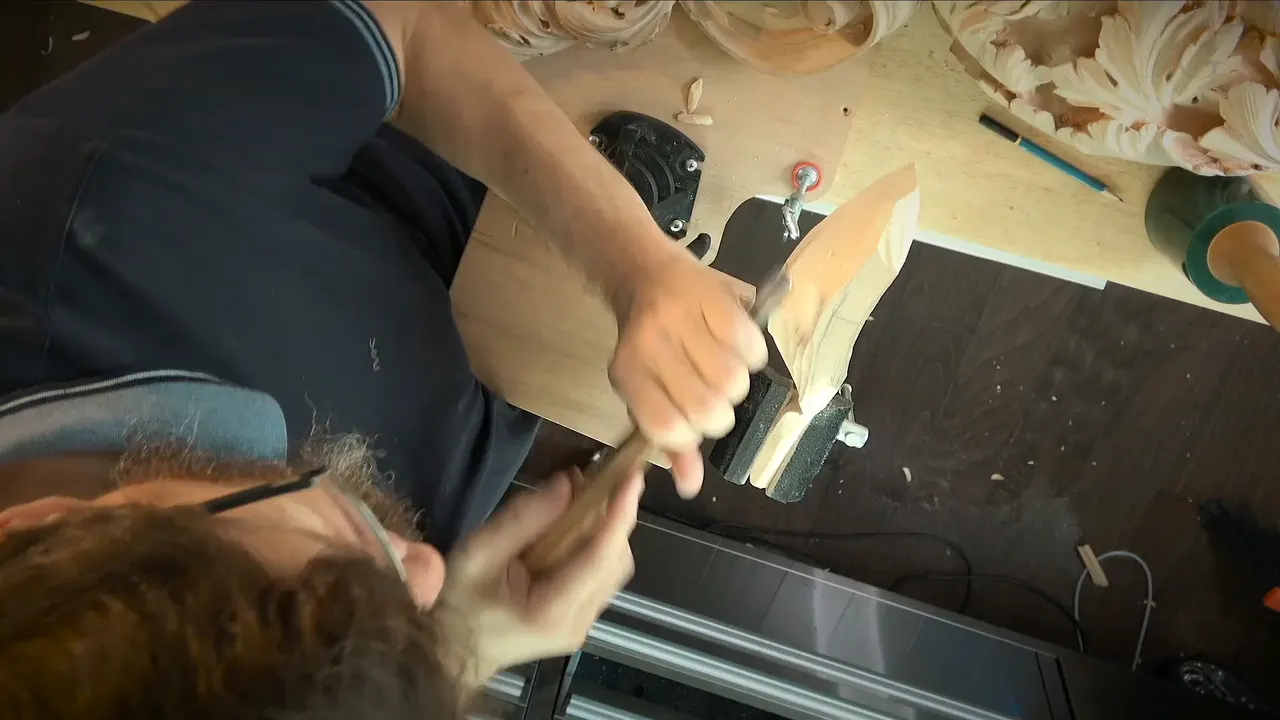

The words "extra material" mean wood I say I can chop off, or wood I keep on purpose so the next pass of the tool has something to work with.
Ever stand in front of a carving and wonder how much wood is too much? The words came up once in workshop 76, part 12. Other lessons of mine use them too, and the two meanings pull in opposite directions.
What does "extra material" mean in part 12?
My line was "And now I can probably chop some of that extra material I don't need." Notice "can" and "probably". It is an option, not a promise, and which spot the wood sat in, I did not say.
Before the line came my plan for the tool: "Maybe seven millimeters," or about 0.28 in. Ahead of that came my advice about a smaller tool.

Why did I reach for a smaller tool?
I opened the part with the idea: "And sometimes for work like that, smaller tools are actually better than the big tools." The other half came later, for when the wood pushes back. "You're having too much resistance, so it's a good idea to switch to little smaller tool."
Thinking out loud, I said "Let me think what I should use." The seven millimeters was a plan.

Where was I carving, and could you see it?
At first, you could not. "Maybe I have to change the position for you to see what I'm doing because I'm carving right now on that side, and you really don't see it." My plate sat closer to one side, and that "gives me advantage, actually, to change the position, how I clamp my vice, the secondary vice, this vice."
Then came a short one. "And nothing is going to be on my way." Right after, the point of it all: "But I really want to show you what I'm doing."

What distance did I name in part 12?
One distance came up, and it was small. "My goal is to get that closer, at least to this point right here." The number: "Not all the way to the bottom, but somewhere, like about half an inch above." In metric, 12.7 mm. A second small plan followed: "And maybe I can chop a little section right here too. Chop off that part."

What was that deep channel for, anyway?
I wanted it deep. "I want to get actually that channel as deep as possible to my opposite side." The leaves were the reason, and I said it twice: "it has to feel like it's going both directions. Those leaves are going to go both directions."
They would not be plain, either, since there would be "just some waviness also on inside." The parts that stick out would carry it, and the main stem would sit "somewhere right there on inside."

What held the work steady?
A jaw for a pipe, right below the vice I like. "I'm not sure if you'll be able to see it or not, but it has a jaw for the pipe right below. So I can actually use that and clamp it like in a jaw for the pipe, so that would give me some stability also."

Small clamps came next. "They're not holding too good, but they're okay. Also by Bessey. That's a German brand." Around a dowel I had holes drilled, "multiple holes I can just stick from all the sides pretty much."

Last came the system itself. I can attach "any type of jig, any type of plate if I need to, and so on." And I use "exactly the same system to hold my furniture panel on that workbench."
When is extra material wood I take off?
A barrel started it in Venice Room 62, part 10. "I really need to expose it." The job, in my words: "I need to kind of remove some of the extra material around this side." The tool was a number 11 again, at "18 millimeters, like 5/8 of an inch." Five eighths is 15.9 mm, so my 18 mm ran wider. The aim was to "excavate much deeper in this area," because "I really need that movement."

A deep spot sent me to Carving Hazelnuts 3, part 1. It had gone "pretty deep," maybe "nine millimeters, a little less than 3/8 of an inch." Nine millimeters is 0.35 in. A number seven, "approximately 10 millimeters or so" (0.39 in), was the tool I named for chopping extra material away.
Later came "So now I got my shadow." Then a thought: I could probably take out "some of this material to make it more wrapping."

A bigger tool turned up in Floral and Molding for the Panel 10, part 2: "maybe number seven, but the bigger one." Then the size, "About an inch or bigger than one inch," so 25.4 mm or more. It was for the extra material, and it would "save me some time."

Hashemi Flowers 35, part 2, paired the words with a number nine. My words were "extra material we don't need," and then "I'll just use number nine and excavate." The card on screen gives 5/8 in (16 mm). Next: "Just excavate as much as possible." I was "not afraid to be really deep right here," and my reason was that it would "create even more a three-dimensional look."

In Greek Acanthus Leaf 13, part 1, I kept it short. "Well, actually, I can use the same tool for now. Just remove some extra material." Then I said I would use a knife, and my advice was to "make multiple passes. It's better to make multiple passes than a single one."

Roman Acanthus 10, part 1, used a close cousin of the phrase. "I'll take probably just a number five, a quarter-inch," which is 6.4 mm, and after that I would "remove some excess material." A limit came with it: "I have to be careful not to overdo, because I still have to keep some meat." Otherwise, the piece turns too fragile.

A plain decision sits in Venice Room 29, part 4. One section made no sense from the bottom, and "So that would be extra material I need to clean, take out, I should say." Then came the turn: "But let me think first, well, no, actually, nothing to think about, just take it out."
Leaves came up again in Venice Room 26, part 10. I said it is "logical" when all of them point the same direction. My plan: "Let me get rid of this extra material, what I don't need anymore."
When do I keep extra material on purpose?
When a detail has to wait. I was outlining a part in Venice Room 38, part 4, that was supposed to look like it sat underneath another one. Then: "So see how important it is to keep extra material for the later times. Because those details you can always work on a little later."

Workshop 6 had it early. In Venice Room 6, part 9: "the outer shape is not the final shape yet. So I left extra material. So we're going to make the decision what we want to see yet."

Beginners got the same rule. The third part of Carving Hazelnuts 2 spoke to people who never carved, and I said it does not mean you cannot pull it off "if you follow the right directions or right rules." Next came the rule. "Don't take too much material at once." Then: "Keep some extra material, and you should be okay. Keep an eye on those center points."

The clearest reason came in Venice Room 150, part 2. "I'm happy that I left extra material, so that is sometimes smart thing to do, just to leave some extra if you're not 100% sure what you want to do." Then the payoff: "you look at it, at the design, and you see exactly what you want to change."
One section looked really good on a computer and on the print. Still, "Hey, I can make it much better." Then a note you may not expect: "I didn't have to do it, by the way, nobody would know it, but it's just going to give me more satisfaction to do that way."
A choice came into the open in Furniture Panel 17, part 5. "I need to relieve it inside, but I need to get smaller tool, like one millimeter" (0.04 in). I did not want to lose a detail, and I said it was important. Then: "Let me keep little extra material right here, I'll make the decision later."
Do I leave extra material on a panel too?
Yes. In Furniture Panel 16, part 2, I said "And like I said, I'm going to leave extra material. Once we're going to get ready to work on the details, we can always remove whatever we left extra." Seconds later I said I went all the way, and maybe I made a mistake. But "it's okay, I'll take care of it."
A wall of wood came up again in part 2 of Floral and Molding for the Panel 10. The wall would stay, "like a wall, this wall, because I still have to establish overall shape, so I need that extra material."
From the backside I had taken my depth in Venice Room 86, part 3, so "I cannot go farther than that." There was "extra material left, maybe about half an inch or so." I would go "really close to the line."

A good thing, in my words, came up in Hashemi Flowers 41, part 3. "That is actually a good thing that I have extra material right here, so I can create stuff like that." Small as it was, "every little tiny detail will create a beautiful look."

How close to the line should I carve?
A millimeter away, in Furniture Panel 18, part 8, where I had a curly detail. My plan was to stay away from the line, I would say "a millimeter on both sides, maybe less," which is 0.04 in. It would be "tiny at the end."
My reason was that I would need "the extra material for now," and I did not want to "cut that on the line right away."
The rule behind it: "I am able to make it smaller even later, but if I'm going to cut too much, I can't make it bigger, it's impossible."
How small can it get? Down to a hair in Lily Box 2, part 3. "You probably don't see that on the camera, but I am leaving approximately about between my final detail, between my final line and the wall, approximately maybe 1/64 of an inch." About 0.4 mm. "Just in case, okay?" Those were my words for it, and I called it "extra material."
What if I took too much?
Venice Room 35, part 6, went the other way. "And that is a good thing that I have extra material." Next came a plan to leave it. Then "I didn't lose too much." What happened, I told you: "we had a problem and we solved that, I should say I created the problem, and my problem was overthinking, overdoing it."
A molding sat beside the work in Venice Room 145, part 1, and it had to go "right underneath." My line: "I don't want to remove what I don't need to remove, if you know what I mean." The reason was it would be "detectable." The line was "I need extra material," then "It's always easy to take what you don't need to take." For the tool I wanted "a flatter gouge or chisel, in this case, number 1."
Where does each line sit?
Each lesson on this page, with the way I used the wood and the words I said.
| Lesson and part (workshop numbers mean the Venice Room) | What I did with the wood in that video | My words |
|---|---|---|
| 76.12 (this lesson) | Planned to chop wood after picking a smaller tool | Probably chop |
| Workshop 62, part 10 | Planned a number 11 to dig deeper beside a barrel | Remove some |
| Hazelnuts 3, part 1 | Planned a number seven to chop wood from a deep spot | Chop some |
| Part 4 of workshop 38 | Kept wood so details could wait until later | Keep extra |
| Part 2 of workshop 150 | Left extra wood and was glad I did | I'm happy |
| Furniture Panel 17, part 5 | Planned to keep a little wood and decide later | Decision later |
| Furniture Panel 18, part 8 | Aimed to stay a millimeter off the line | For now |
| Lily Box 2, part 3 | Left about 1/64 inch between the line and the wall | Just in case |
| Venice Room 145, part 1 | Wanted wood for a molding that goes underneath | Easy to take |
Where can you watch part 12 and the lessons on this page?
You can watch part 12 in Venice Room 76. Workshops 74 to 85 sit in the Part 7 course. Each other lesson on this page has its own page, linked above, and is open to you with school access. A workshop number means the Venice Room, and every other lesson carries the name of its own course.
Want to hear me say it in my own voice? Start here.
How it's done
- Switch to a smaller tool. If the wood pushes back, I said it's a good idea to switch to little smaller tool.
- Chop what you do not need. In part 12 my plan was to probably chop wood I don't need.
- Hold wood back for later. Details come later, so I said to leave some extra when I'm unsure of the design.
- Stay off the line. On the panel lesson the aim was a millimeter of space on both sides, maybe less.
- Take the rest later. Wood you don't need comes off easily at any time, I said in the molding part of workshop 145.
Frequently asked questions
What did I plan to do with the extra wood in part 12?
Probably chop it, I said, after I named maybe seven millimeters (about 0.28 in) as the tool to use. Which spot the wood sat in, I did not say.
When is a smaller tool a better choice?
For work like that in part 12, I said smaller tools are actually better than the big tools. When the tool is giving too much resistance, a little smaller one is a good idea.
Why did I leave wood in Venice Room 150?
A smart thing to do, I said, when you're not 100% sure. Later the design shows you what to change, and I was happy I left it.
What to carve next