

Alexander Grabovetskiy, woodcarver, School of Woodcarving · Published 2020
What does a wood carver mean by "modify"?
Quick answer: In part 10 of workshop 76, I pointed to the inside of my plain clamp vise and said "I did modify it," then told you what I glued there: really thick leather. Other lessons use that word about punches, skews, a grinder, a router plane and my bench holes.
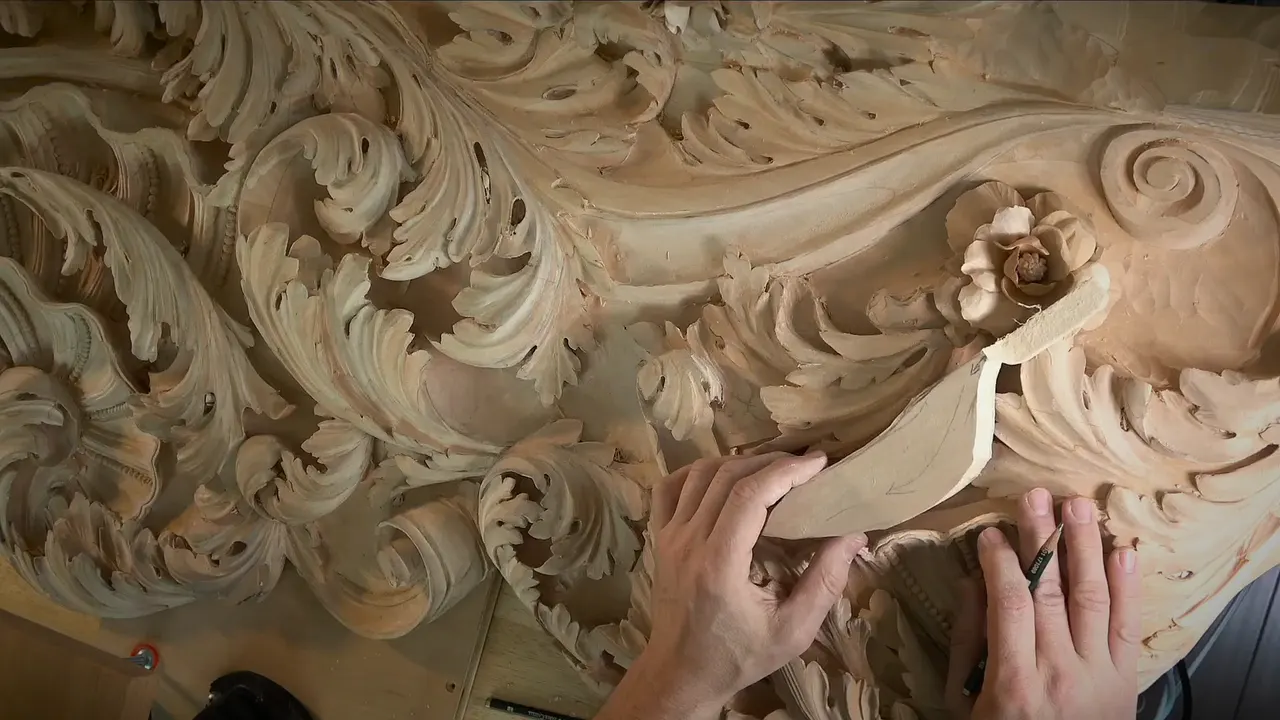

"Modify" is a word I said in workshop 76, part 10, about the inside of a plain vise that holds a piece for me. In other lessons I used the same word about punches, skews, a grinder, a router plane and my bench holes.
Ever wonder how much of a carver's kit comes straight from the store? Walk through part 10 with me first. Then come with me to the lessons where I changed a tool or a setup, each line in my own words and each lesson named.
How does part 10 begin?
With a plan to stick a piece in place: "I'm going to stick that piece right here." Then: "maybe it's little too tall, but I can always fix that problem."
Solid wood was an option. "I could do exactly the same like I've done rest of it, just to do from solid piece," I said, but I wanted to show you a style of wood carving, and I called it "multiple layers, sticking on inside, gluing, and so on."
Where did the piece I was sticking in come from?
Part 9 tells it: "the cut out piece, what I've got from a ceiling part." My plan: cut from it and "stick that inside of that cavity." It is "two inches thick, eight quarter material," which is 51 mm.
A handle came into it there, and I gave my reason: "leave that handle, for I can clamp it easily." The waste stayed on for now, and I said I can chop out that part later on.
What is the special approach to a vise?
Next came an explanation of how I would do it. The piece would not be carved "like stick in place," and a vise would hold it, "but it's a special device or special approach to vice, and that is the setup I'm talking about." Then a verdict: "So that is interesting setup."

The base is "the same Veritas carver's vice," on a piece of plywood "which I'm holding with a couple small clamps." Fastened to my tabletop, I said, and then I corrected myself: "but bench." About the bench: "It's actually the same what you see behind. It's just the drawers pretty much." Jigs come into it too: "multiple jigs I'm using like that."
Which plate sits on the back of the block?
A Veritas plate. I mounted it "on the backside of the block of wood," and the brand wins me over for a reason: "You can buy separate plates, three inches and two inches plates." Three inches is 76 mm, two inches is 51 mm. Spares exist too, and several sit on other pieces: "I've got multiple those plates."
Which vise did I mount on the block?
On the block sits "just not expensive, inexpensive, I should say, inexpensive vice, just a normal clamp vice, which you can take it out anytime." The block has another job as well: "I also use that block for the small details and so on when I'm carving. You'll see sometimes."
What did the inside of my vise get?
The inside. "If you pay attention on inside, I did modify it, okay?" What I did there: "pretty much glued leather, okay, so really thick pieces of leather."

I used Gorilla Glue, and I named the kind: "clear Gorilla Glue, which is not leaving any foam. It's not foaming one."
Why did leather go in there?
Hold more than a handle, and hold it without damage, as I said next. "So that way I can always stick whatever I'm working on." I could "place it right in the vice, even if it would be not just the handle, but somewhat finished design piece."
Why leather: "I can hold it just because I do have a leather right there, so it helps me a lot not to damage it. But it's still solid." It holds, I said, and "I can work with that with no problem, and I can actually apply a little more pressure if I need to." Short verdict: "I think it's a good setup."

Why shave the handle into eight sides?
I said it was "a good idea to make it like octagonal, just to shave little, the edges of it, and that would help me probably a lot." The tool I named was "any straight chisel, I would say, like number one." An octagon has eight sides.
A chisel is optional, by the way: "So you could use just a knife. It would work." The reason came next: "if I would have only four sides, I would be limited to clamp just in those positions. But because I do have a octagonal, so now I can clamp it to whatever the angle I want to."

Does the vise have to cost a lot?
Mine did not. "As far as the vice, okay, you really don't have to buy expensive vice," I said, and "that's Bessey vice from Home Depot." Then: "Just little modification, and it works just fine." After the leather: "that's solid now, okay, it's really, really solid."
Without the octagon it still works: "just because it's a carver's vice, I could always rotate to whatever position I need to rotate, okay, so that I can work from it."

What came after the setup?
"The step number one, what I have to do, I have to create the channel." Then the waste: "that part right here is going to be somewhat waste." And: "So I need to remove that."
My reason for removing it: the piece would be "like folding leaves, going like this, okay, from inside, and just go and open up." The part ends on one line: "I think it's a really interesting project."

Which advantage did I name in part 11?
Part 11 answers it. After repositioning the piece, I asked "see the advantage of it?" And: "I love that it gives me ability to attack and work on that piece from any point." Later: "that setup is good for 3D carving also."
On the technique itself, I said "for the sake of school, I decided to show you that technique." And: "I love that approach."
Where else did I say modify?
Part 10 shows one changed vise, and the lessons below show more of the same, one at a time, in my own words.
Which background punches did I change?
Chamomile and Bow Rosette 4, part 3, opens on a plan for a textured background, and on punches: "You can do your own." About two of mine: "I just kind of modified, and I also modified this one just to get sometimes underneath of the undercut."
The regular punch "has two rows." Of mine: "I left only one row, and I've got a couple notches, and that way I can actually get underneath if I need to, and I create the texture." That piece did not need it. Understanding "the principle behind it" is "a good idea," I said.

Did a punch set get modified too?
Venetian Flowers Rosette 6, part 2, has it too, in a longer passage about my punch sets. About a few: "I had to reshape." For example: "when I bought the set, it had two rows." And: "Two rows of teeth." They were "just not convenient to get into some tight spots." My fix: "I just filed that down to one row. And modify that."
I gave a reason for liking the one row: "I can get an angle right inside of the undercut and create some texture right there." And a plan for the tool: "Just make sure you don't use a regular mallet. I'm going to use just a hammer."

Which skewed gouge got a long bevel?
In Venice Room 60, part 9, I brought up "another specialty tool." About it: "Of course, I modified that. I've got a really long bevel on that, but it's a skewed gouge." Its size: "Equal to number seven, pretty much." What it does: "it gives me beautiful slicing cut right on the push."

Which tool changed on its back side?
In Venice Room 72, part 9, I said "I love back bends and especially this one." Then the change: "It's not sold like that, okay, so you're really not going to be able to buy that. So what I did, I actually modified my tool and made a really long bevel on the back side."
What it gives me: "just because it's a skew, it gives me a much better slicing." And even against the grain: "it gives me a chance to actually excavate much cleaner, create much cleaner cuts."

Did a viewer question get the same answer?
A question came in about one tool during the Livestream April 2020. My answer: "You can actually modify. If you want to do a tool like that yourself, what you can do, you can get a skew, same skew, which is a 22-degree skew."
Other angles exist: "There's a 45-degree skew. There is a 22.5-degree skew." One tool of mine carries both: "This part of a tool has a 22 degrees, and this part has a 45 degrees. You could reshape it." One more line said you do not even have to: "You can use just the 22.5."

A skew you buy works "even without modification," I said. A small one came out next: "I actually modified even small tools." It "did not have that heel side." My change: "I just grind it a little bit on the backside, and now I can use this one. It's also 22 and a half degrees." And: "It was just a normal skew, but I reshaped that."

Which machine did I modify?
A grinder, in Stropping, Honing and Buffing 1. I showed my setup for stropping and honing, and I said "I've got just a cheap grinder, which I modified and made that."
Next came two leather wheels, a "really thick wheel" and a "thinner wheel," and I gave two sizes: "about 10 millimeters" and "about 20 millimeters, I would say, thick." Ten millimeters is about 0.4 in, and twenty is about 0.8 in.

Can a router plane blade be modified?
Carving Furniture Panel 27, part 2, has the line. "On a router plane, if you look on the backside, that is a little too long." My words for the fix: "it's a good idea sometimes to modify those knives and get at this part."
The change: "just remove the heel part, this part just to grind it down." It is "possible," I said. My own call: "I don't wanna do it." For me it is "okay as long if I can just get, you know, the middle part," I said.

What about the pegs and holes on my bench?
In Carving Floral and Molding for the Panel 1, part 1, I pointed to the Veritas brass pegs I like to use with my bench, and then said: "I just took a piece of leather. Just any leather will work. In my case, it's like a single shoulder leather." Pieces of it went "to the brass," glued on, because "I don't want to mar it."
The holes are another matter. "My bench is 19 millimeters holes, three quarters of an inch to be exact." They also make "20 millimeters," which is 0.79 in. Changing mine crossed my mind: "I could actually modify that. I can just make extra holes right between those and make those 20 millimeters. I thought about it."
A plan, not a finished job: "I should probably route that down or drill it down for the 20 millimeters."

Can a carving itself be modified?
Workshop 72, part 11, has the word about a carved shape, and the talk was of depth: "I'm not sure if I've got that deep enough on this side. Maybe I should do much deeper because I still don't see that overall movement yet."
"I know it doesn't look bad, and for lots of people, it would work out just like that." But "I just personally want to get more three-dimensional, if you wish." Then: "even if I have to modify a middle part, this part, I'm okay with that. I have absolutely no problem with that."

Where does each line sit?
Each lesson on this page, with the work I was doing and the words I used.
| Lesson and part (the Venice Room unless named) | What I changed or said I could change | The words I used |
|---|---|---|
| 76.10 (this lesson) | Inside a plain clamp vise, glued with thick leather | Pay attention on inside |
| Chamomile and Bow Rosette 4 | Two background punches, one of them with one row left | I just kind of modified |
| Venetian Flowers Rosette 6 | One punch from my set, filed to a single row | And modify that |
| Workshop 60 | A skewed gouge, its bevel long | Of course, I modified that |
| Workshop 72 | One tool, bevelled on the back | Modified my tool |
| Livestream April 2020 | A skew, plus a small tool ground a bit on its backside | You can actually modify |
| Stropping, Honing and Buffing 1 | A cheap grinder with two leather wheels, one thick, one thinner | Which I modified and made that |
| Carving Furniture Panel 27 | The blade of a router plane, maybe with its heel ground off | Modify those knives |
| Carving Floral and Molding for the Panel 1 | Bench holes, 19 mm now, 20 mm maybe | I thought about it |
| Workshop 72, part 11 | The middle part of a carving, and how deep it goes | Even if I have to modify a middle part |
Where can you watch part 10 and the lessons on this page?
You can watch part 10 in Venice Room 76. Workshops 74 to 85 sit in the Part 7 course. Every other lesson on this page has its own page, linked above, and each is open to you with school access. A workshop number means the Venice Room, and every other lesson carries the name of its own course.
Want to hear me say it in my own voice? Start here.
How it's done
- Mount a plate on the block. A Veritas plate went on the backside of the block of wood. Plates come separately in three inch (76 mm) and two inch (51 mm) sizes.
- Mount a clamp vise. An inexpensive, normal clamp vise sits on the same block, and you can take it out anytime.
- Glue thick leather inside. Leather, the thick kind, went inside the vise, glued with the clear Gorilla Glue that does not foam.
- Shave an octagonal handle. Any straight chisel, like number one, can take the edges off the handle, so it clamps at any angle.
- Start the channel. Step number one is the channel, and the waste section has to go.
Frequently asked questions
Which glue held the leather in my vise?
The clear kind of Gorilla Glue, which is not leaving any foam. Leather sits inside, so I can place even a somewhat finished design piece there, and it helps me a lot not to damage it, I said.
How many sides did the handle get?
Eight, since I called an octagon a good idea. With only four sides I would be limited to clamp in those positions, while an octagonal handle clamps at whatever angle I want, and a straight chisel or a knife can shave it.
Which punches got filed down?
One punch from my set had double teeth, and that was just not convenient for tight spots, so I filed it down to a single row. In the chamomile lesson, a punch I left with one row has a couple of notches.
What to carve next