

Alexander Grabovetskiy, woodcarver, School of Woodcarving · Published 2020
What does a wood carver mean by "most likely"?
Quick answer: In Venice Room workshop 76, part 5, I planned my cuts along a middle line, and then said it was "most likely" what I would do. Elsewhere the two words cover a tool number, a source of light and a view the camera does not catch.
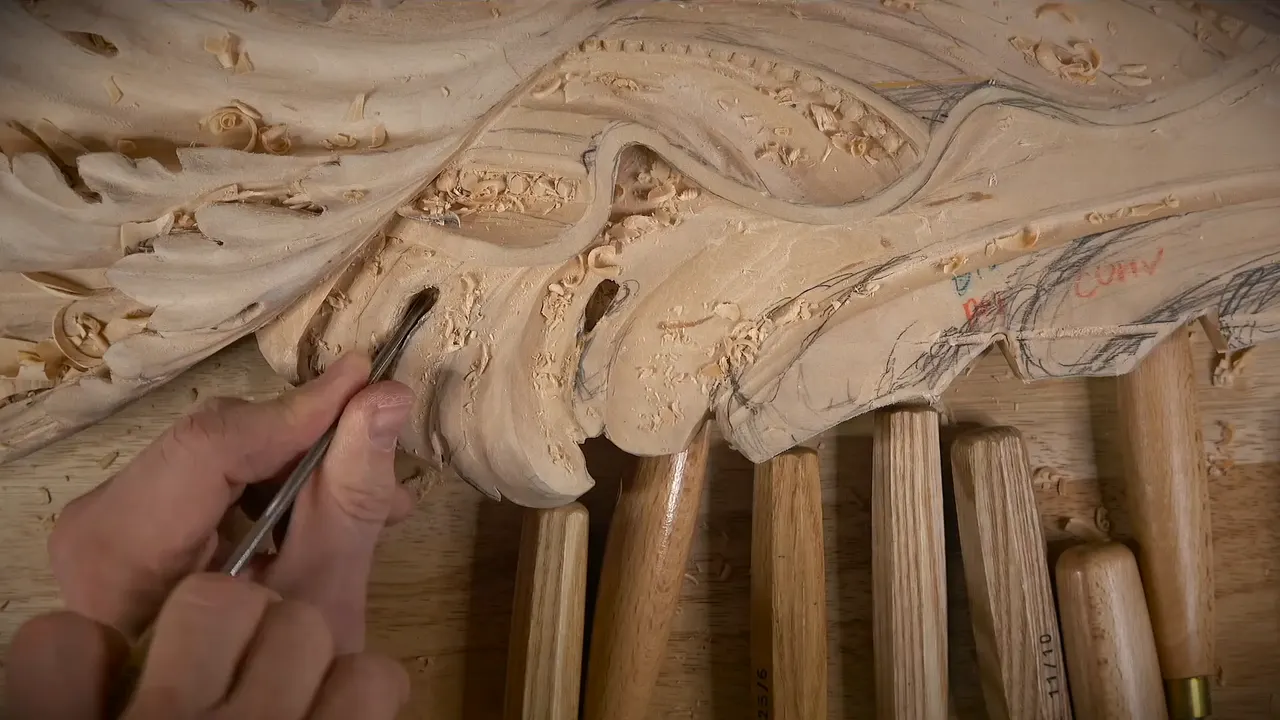

In Venice Room workshop 76, part 5, I worked out a middle line, a separation going up, a curvature and a second separation. Then came the two words, "most likely." Other lessons carry them for an unmarked tool, for the light, and for things the viewer cannot see.
Ever heard a carver say "most likely" over a wood carving job and wondered if he was guessing? Start with part 5 and hear what came right before it. Then come the lessons where I said it again, each one with its link.
What came right before the two words in part 5?
The part opens with "And here you go." Then comes a note about my eyes: "I'll spend a little more time a little later off camera, get a little closer with my eyes, for I would just see much better what I'm working."
Next, a word on my head: "Right now, I'm just trying to keep my head away from the camera, and sometimes it's hard, not really convenient." And "But you should get the idea." I also promised "I will show you the final result."

My first plan was a maybe: "I want to excavate little deeper underneath of here, maybe." Then "But not as much," and a change of mind, "Or, you know what? Maybe not." After it came "So let me work on this section."
I called the section "kind of three different movements" and said I have to make the decision how to do it. About it: "I'm probably going to do just curl it down. Same way like I did that right here." Next came a note that this way is more logical, and that I would need number seven.
Why did I stop to put my tools away?
Tools came next. "But I've got too many tools, which is not okay. I need to place them back where they belong. Otherwise, it just becomes too messy. And when it becomes too messy, I am losing production."

The other side of it was "when my tools in place, I'm always much quicker able to find them." My plan: "I'll try to keep no more than couple tools on my bench." Then a doubt, "I don't know if I'll be able to, but at least I'll try."
Which tool did I try for the rolling motion?
"So let me try to create that rolling motion, and I'll use number seven. Number seven or number six will work. Let me think first." And: "Number seven, and we'll see."
A second thought followed: "Maybe it's not going to work. Number five will do." The mallet came up as a maybe: "I could probably, this could help myself with the mallet." After that came "One, two and three," and "So three movements."

How did the middle line lead to "most likely"?
On the three movements: "I want to make sure they look really good, and I need to make a decision about what I want to see right here." Next: "I really want to break that part kind of underneath of this line and create some kind of shadow." The first cut was a plan too: "just going to create the first cut."
A doubt came in. "It doesn't really make sense for me right there. This movement doesn't make sense too much to me, so I need to do something."

The line came next. "So if there is a middle line, I got one separation go up this way. So that's what I have to do. Then I can do some kind of curvature, and then another separation can go like this. Okay? That way it's going to look much more pleasant."
The two words arrive right after: "But not necessarily I like it. But that's most likely what I'm going to do."

Next came a second idea: "Although, maybe that's going to roll this way." And "that part going to go underneath."
"So that is the middle line," I said, and about the rest: "Then it makes sense. Otherwise, it doesn't."
"Okay, let me create my preliminary cut," I said, and then "And yes, I am cutting against the grain. I should probably change the position." The division, I said, "is actually going to go above," and "a little bit on top of that movement." Then "So that's going to give me a little more interest, or more interesting look, I should say."
So the middle line stays a plan, with a doubt beside it. The same two words turn up elsewhere, and each passage below says where it comes from.
Which tool did I name with "most likely"?
Hashemi Flowers 11, part 1, has a small tool that measures one-eighth of an inch (about 3.2 millimeters). Here is how it went: "It's an eighth of an inch, and it looks like it's number eight. It's not marked, but most likely it's number eight." My next words: "And we'll just start digging, although keep an eye on what I'm doing."

Flower Rosette 3 has a small gouge, number nine, that I could "easily rotate." Of it I said "you can just see if it's half around, it's most likely it's number nine." Then I said I would check and compare, and "it does look the same, and I'm happy with that result."

A bigger tool comes up in Furniture Panel 21, part 3: "I need to use probably a bigger tool, which is going to be, in this case, most likely number 2." The same sentence adds "12 millimeters" (about 0.47 inch). Straight after, "I can hit straight down," with "about 1/64 of an inch" (about 0.4 millimeter) "before I hit the background."

Acanthus over Moldings (its lesson 2) names a smaller blade in part 2, "Most likely to get inside of this cavity right here."
Venetian Flowers Rosette 4, part 3, shows my plan for taking a part off. The part "is going to be erased," I said, and "Most likely" came before "number 11," the tool I named for it: "and remove it like that."
Two plans sit in Floral and Molding for the Panel 5. In part 1: "I can most likely just attack from this side and work that line." And in part 2: "I probably most likely have to attack that from the opposite side as well." And a spoon gouge was an idea, a maybe, not a done thing.
What does the light have to do with "most likely"?
Furniture Panel 35, part 2, has me thinking about where the shadow is supposed to fall before a cut. My words were "the light source most likely gonna come from above." Then "my shadow has to fall on that part right here," and "the overlap gonna happen."

Tools for that cut: "number 11" at "just a half a millimeter" (about 0.02 inch). For blending I named "number three," at "about quarter inch, six millimeters." And "I'll use my tool upside down."
Furniture Panel 33 talks about the top of the panel in part 2, "standing like this." "The light gonna most likely shoot from above." And then "most logically," "I need to lower down this part," "slightly and create that shadow. Exaggerate the shadow with the light."

Grape Onlay 9 (that lesson's page) has a choice of two flips, in part 1. "Because the light most likely going to hit from above. So, which means I think it's gonna be better to create the flip going uphill to create the one deeper shadow." The tool was "number 11," at "four millimeters" (about 0.16 inch).
The Tray of Blessing, lesson 3, part 2, is less sure of itself. Here: "it's not that obvious because the light gonna hit most likely, especially at the evening time on the dining table from above. So it could be either, okay, but what would I like to see?"

About one lobe: "this one is kind of dull. It doesn't give me a really good motion." The idea was to "get this lobe kind of go right underneath of this lobe," with "number seven."
Which cuts could you not see behind "most likely"?
Hashemi Flowers 10, part 12, has my hand in the way: "Most likely, my hand's in the way, and it's almost impossible to see what I am doing underneath. Please forgive me." A finger was supporting a piece: "right now it's fragile, and I can easily break it."

In part 1 of Modern Acanthus 4 I rolled a form "no more than one millimeter on the camera" (about 0.04 inch). Then "You most likely don't see that."
A faster pass sits in part 3 of Venetian Flowers Rosette 5: "Maybe too fast. Obviously, most likely you don't see that sharp. Let me try to make it a little sharper. Okay. Hope it much better."

Last for this group comes Venice Room 64, part 11: "Sorry that I'm covering with the hands. Most likely, you don't see what I'm doing. My apologies. But hopefully, you can detect right now."

Venice Room 84 shows the same trouble in part 2: "I probably most likely going to cover the camera, which I don't want to do, but please forgive me for that." A plan sits in Venice Room 156: I would cover the camera with my hands, and "most likely" was in the line.
What could go wrong after "most likely"?
An edge I had not developed yet sits in Venice Room 7, part 10: "the final detail, most likely, I'm going to damage that end. So that's better to wait." Then: "Maybe we're going to need the heavier mallet." And "attack from two sides."

A circle came up in the Dining Table Apron workshop 11, where the centers are my high points. My words: "if I would just use a gouge and just rotate around my center, so most likely, I would just snap the centers, and I can't because I need to keep my high points." Next: "I got to work little by little."
Roman Acanthus 5, part 4, runs the other way: "Most likely, deeper I go, nicer it's going to look at the end." Then "number 3, just to clean it. But be careful. Don't go too deep, because original design, this section of the leaf goes underneath of that section."

Did I say "most likely" about other people?
Greek Acanthus Leaf 7 has me on carvers of long ago, in part 1: "most likely, the wood carvers actually in ancient times," and that they would have only a knife. "That is why the most ancient forms of acanthus leaf, they would have that V cut on inside of a leaf itself just because it's much quicker and convenient than to do some other technique."

From part 1 of Corinthian Acanthus Leaf 4: "I really love acanthus leaf the most. And most likely, most of the wood carvers in the history, it also applies to them. So it's really, really common."
Lily Box 12 (that lesson's page), part 7, has me on artists, in part 7: "if you look at your art and the piece looks finished, most likely you're not an artist anymore."
Last, the Maine class, lesson 11, part 1. On a darker background: "most likely he used oak if you would ask me. How do I know it? Well from books." Most of the authors of the books agree, I added.
Which lesson said it, and what came next?
Each row is a lesson, what I was deciding, and one word of mine that followed.
| Lesson | What I was deciding, in my words | A word of mine that came next |
|---|---|---|
| This part, 76.5 | The line that the three movements follow | Roll |
| Hashemi 11.1 | An unmarked tool, one-eighth of an inch | Digging |
| Flower Rosette 3.4 | An unmarked tool that is half around, to compare | Compare |
| Furniture 21.3 | The bigger tool for a detail | Straight |
| Venetian 4-3 | A part of the carving that has to come off | Remove |
| Panel 35.2 | Where the shadow falls before the cut | Overlap |
| Lesson 33.2 | Which part goes above and which goes below | Exaggerate |
| Onlay 9.1 | A downhill flip or an uphill one | Uphill |
| Tray 3.2 | Which lobe goes underneath the other | Either |
| Hashemi 10.12 | My hand in the way | Forgive |
| Venetian 5-3 | A pass I said was maybe too fast | Sharper |
| Venice 7.10 | The final detail on an edge I had not developed yet | Wait |
| Roman 5.4 | A deeper cut in a leaf | Careful |
| Greek 7.1 | The tools of carvers in ancient times | Knife |
Where can you watch part 5 and the other lessons?
You can find part 5 in Venice Room 76, inside Venice Room Part 7, which holds workshops 74 to 85. Every other lesson on this page has a page of its own, linked above.
Want to hear me say it myself? Start here.

How it's done
- Name the section. I called it "three different movements" and said I have to decide how to do it.
- Put the tools back. The tools had to go back where they belong, and I would try to keep just a couple on my bench.
- Pick a tool to roll with. I named number seven, then number six, then number five, and said "we'll see."
- Work out the middle line. The plan was one separation up, a curve, and another break.
- Make the preliminary cut. The preliminary cut was my plan, and I noted I was cutting against the grain.
Frequently asked questions
What did my plan in part 5 say?
One separation goes up the middle line, then a curvature, and a second separation follows. Beside the plan I put "not necessarily I like it."
Did I call the plan settled?
Right behind it came a "maybe" about a roll. The middle line makes sense, I said, "Otherwise, it doesn't."
What tool came up in part 5?
For the rolling motion I said "I'll use number seven," then "Number seven or number six will work." Then "Maybe it's not going to work. Number five will do."
Where else did I name a tool number?
What to carve next