

Alexander Grabovetskiy, woodcarver, School of Woodcarving · Published 2020
What does a wood carver mean by "the palaces"?
Quick answer: In part 7 of workshop 93, the palaces come in a talk about a knife, England and the countryside. Other lessons set the same word beside undercutting, moldings, limewood and a few famous names, and each passage has its place below.
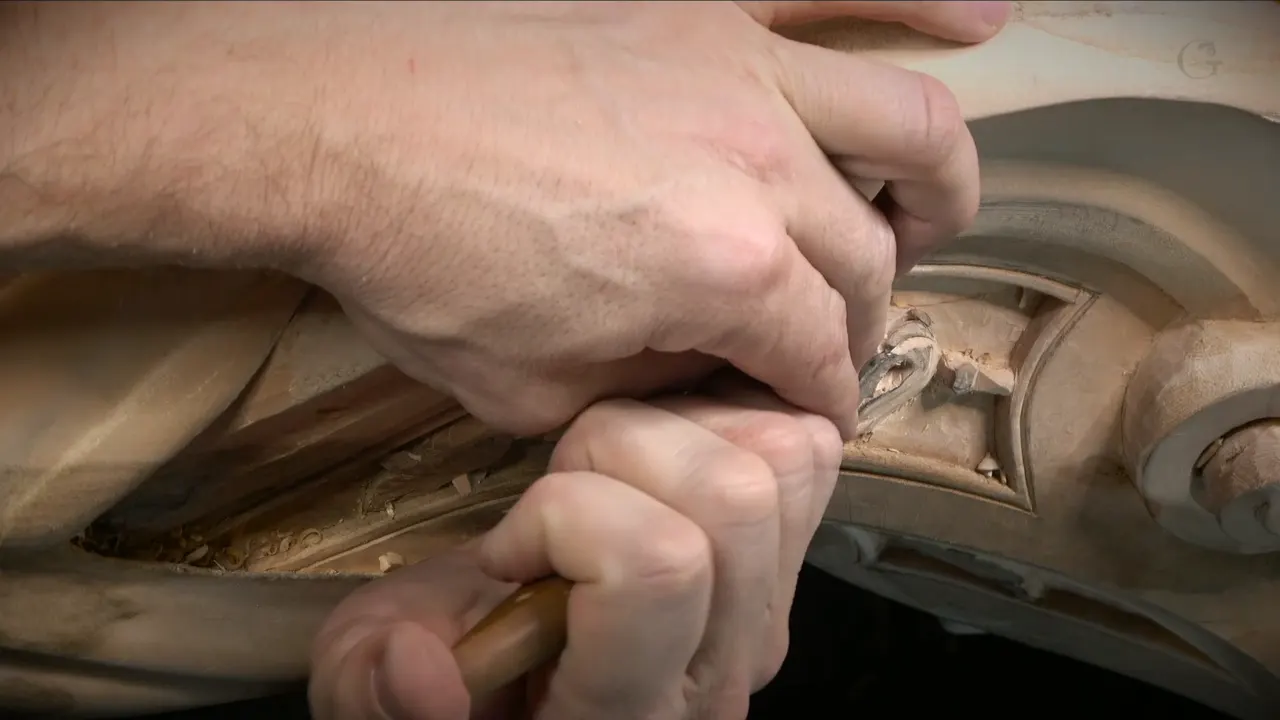

One run of lines in part 7 of workshop 93 is about where a knife was used and where it was not. One of them holds the word palaces. That word turns up in Venice Room, Hashemi and the April 2020 streams, and each passage has its place below.
Ever held a small blade to a carving and wondered who else worked like this? You know where this page begins, then. We start in workshop 93, and then Venice Room 52, the Lily Box lesson, Hashemi 27 and more. Sizes come in millimeters and inches, with my own figure first.
What does part 7 say about the knife?
It opens with "And maybe I can just use a knife right here. It's going to give me a sharp line." A verdict follows, "I guess in this case, it's okay. But I'm not too happy yet."
Next comes the reason. "First of all, this section has to go underneath of this part." The knife gets a job too. "I can also get that underneath." Then "So now it looks like it does go underneath." That ends the stretch.

A short stretch about junk and a roll follows. "And of course, I don't need all that junk inside. But what I do need, I need to roll it a little bit to the left." After it, "And it looks much better now."
Clean-up is next. "Let me clean this detail." Then "Make it more readable, although it's already readable." A plan for the blend closes the stretch, "And make the blend a little better this side. I don't really want to see any sharp ridges in this region."

One breath changes the plan, "I can probably do it with the knife even." Then "And kind of blend everything just like that."
Where does the blade go next?
To the next section. "So that is the main separation line, that line. And I can probably outline it for you. Would you understand? You're going to see much better what is going on."
The blade gets a line to make. "again, I'm going to make a sharp line." A small sphere gets named too, "There's going to be a small sphere. I don't want to lose it." Right behind that, "But you can see a knife is actually an excellent tool for operation like that for the small details."

A small triangle is next. "And let me blend in this small triangle. I want to make it look like it's growing from underneath." Another detail gets a plan, "I do have a little detail I don't really want to lose. It's this one, which actually growing like that."
A frank line sits there. "Again, I know it's kind of looking complicated right now, but once it's done, you can always save that picture and recreate it."

Which places are named in part 7?
The words open on the trade. "And yes, you can do a lot of stuff with knife, by the way. And they used knife a lot back then. It's one of the main tools of the trade, at least."
England is named in the same stretch. "Not in England, though, okay? In England, they didn't use knife too much." A step back follows, "Well, I shouldn't say that. They used it in the countryside, but not for the palaces and so on."
What that means for the tool comes next. "So it wouldn't be even considered as a wood carving tool." A question comes next, "Although, what else am I doing?" Then "Of course, I'm carving."

The last words of the part sit on a word. "You can call it wood cutting because I make cuts with the knife." Wikipedia has a page on the palace.
How do parts 6 and 8 use the knife, one after the other?
The end of part 6 sits on the same tool. After the blend to that cut comes the tool: "I can use probably just a knife."
Sharp lines are the first talk in part 8. "And if you would ask me if I'm worried about those sharp lines, I really don't, especially in this case, because it's going to be a paint grade, so I really don't have to worry about it."
The blade returns in that part, "I can do exactly the same what I've done previously." And "Just create a straight-down cut like that." Then "bevel cut to my straight cut, just like that." A depth follows, "I'll go all the way, like eighth of an inch, like three millimeters deep." See bevel for the plain word.

Is there a palace named in Venice Room 52?
Lines about a finish, "lacquer or something else?", sit before it in part 4. Then "England, Great Britain, I should say, okay, if you go to beautiful palaces, especially Hampton Court Palace, and you can see the work of a really famous wood carver."
A name follows, "His name was Grin Gibbons. Can't even pronounce that correctly, but anyway, he was a famous wood carver." See Hampton Court and Grinling Gibbons on Wikipedia. Just before the place, "Okay, let me tell you a little deeper explanation about it."

Do palaces show deep undercutting?
Lily Box 8, part 8, takes a sideways look at it. "I know some people don't like to use extreme undercutting, because a lot of times when you look at the historical work and you don't see that deep undercut,"
And then "you can see, especially on a classical wood carving, if you go to some palaces, you don't see that deep undercutting sometimes. And there is a reason."
In the next breath comes the reason itself, said plainly. "Not because it looks better. It's just much quicker, and they've done tons of work, and people just didn't want to spend too much time."

Then the money. "The craftsmen, they had to make some money, and they would get paid only after the work is done." Then "And to get that quicker, they would just eliminate some of the details."
Who sees it comes next. "For common people, it still would look nice. Overall movements, they still would look really beautiful and nice. And only people who would know, it's just other tradesmen, they know exactly why they've done it, okay?" The line ends on "It's all about money, all about how quickly you can get the payment for your work."
A turn comes at the end of that stretch. "But upper scale wood carvers," and then "he's done really deep undercutting. And of course, he spent a lot more time working on those details."

Old palaces and their moldings
Part 5 of Venice Room 55 puts the word in a line about moldings. "When you go to the ancient palaces, old palaces, I should say, and see all the moldings applied, the crown moldings, and all the base moldings, all the chair rails, and all other moldings, they about the same." Then "They all would just use about the same details." See crown moldings for the plain word.
The work is named too. "But they would carve one detail day after day." A pattern is named, "like egg-and-dart." The egg-and-dart is a molding pattern.
Then the skill. "So they can carve with closed eyes with no problem. They would not miss even one millimeter. It's perfection." One millimeter is 0.04 in. A limit follows, "But they were not able to create. They would not be able to design."
Just before it sits a line on why the work looks plain, "Why I'm saying that there's not much artistic going on in architectural wood carving because there's not too many details, honestly." Right after, "And that would be another level, like a Grinling Gibbons ability to design, think in three-dimensional world."

A palace in a story from workshop 55
The same lesson has the word inside a story in its sixth part. "It used to be a time, in the Solomon's time, when his house was built from cedar, and then it was just gold-leafed and so on. They used a lot of cedar. And Solomon used actually redwood, really expensive redwood inside of his palace and also some other materials."

Tools are the subject in the lines after it. "Of course, first of all, we even don't know what kind of tools he had."
Medieval pictures and their palaces
Venice Room 81, part 11, has the word in a line about a detail. "It's a really interesting detail, but it's authentic. I looked at some of the pictures of ancient, not ancient, but medieval designs and so on, some rooms in palaces and so on."
A line goes back to the work. "But to create that pipe, I need to create the concaves." Then "I don't want to create the concave too close to the pipe."

Which wood goes with the palaces?
Workshop 2 of the Rosette course has a line on England and Germany, "palaces in England and see all the work there," and then "Germany, in old churches with some old 15th and 16th century carvings, so you'll be surprised. It's all done in limewood, and it looks really nice and fresh."

Greek Acanthus 5 names the wood again, in part 2. "I was using just lime wood, like what we're using right now right here." And "It was the same wood used actually in the palaces in the UK, in England, which was 300 years ago, even more than 300 sometimes." See lime for the plain name of the tree.
More on that wood sits there. "They call it soft wood, but it's not really soft. You'd be surprised, actually, how nicely that wood keeps the detail if people don't damage it."

A flower, carved and applied, in palaces
Three approaches are on the table in Hashemi 27, part 1. "The second approach would be carve separately all the leafage and all the flowers, and I've done it also." Then "It actually looks beautiful when you just take one flower and carve it, and then you apply it."
The date and place follow. "And that was done also in 18th, 19th century on the carvings you can find in some really beautiful palaces." A plan for the joint comes after it. "I'll just take a gouge and carve this out, and then I'll drill through those sockets right in the middle." Then "you can use screw, or you can use a dowel." See gouge and dowel.

About the great carver, one line. "Even Grinling Gibbons, the greatest of the greatest carvers, he used screws, and he had no problem with that."
The word in the April 2020 streams
One talk on carver levels has "level number three, it would be architectural carvers who would just work inside of the houses, inside of the palaces." Before it, "Okay, so it would be level number two."
Then comes "Only palaces they had that stuff." Then "Nobody would let them go in and carve mantel, over mantel, and they would never carve egg and darts, or even on the crown molding acanthus."
The top level in that talk goes to a carver of Gibbons style. "like a Grinling Gibbons style carvers, okay? It would be artists." And "a lot of deep excavation, and that would be the highest level, I would say."
The April 14 stream, in a talk on acanthus books, has an answer. "The best book, I would say it's not the book itself, but if it's possible to go to those palaces and to those ancient places and study. If it's not possible to go, just go online."
A question and answer stream has one more line on the places to see. "nowadays we can travel, and we can see different palaces. We can see different museums and just take pictures and develop the idea."

Which lesson holds which line?
| Lesson | Where the word sits in that lesson |
|---|---|
| This part | A knife, the countryside, and palaces. |
| Room 52.4 | Hampton Court, and a famous name. |
| Lily 8.8 | Deep undercutting in palaces, and a reason why. |
| Lesson 55.5 | Old palaces, the same moldings, and egg-and-dart. |
| Lesson 55.6 | Solomon's house, cedar, and redwood inside his palace. |
| Venice 81.11 | Medieval designs, and some rooms in palaces. |
| Rosette 2 | Palaces in England, old churches in Germany, and limewood. |
| Greek 5.2 | Lime wood used in the palaces, 300 years ago. |
| Hashemi 27.1 | One flower carved and applied, in palaces. |
| April 2020 stream | Architectural carvers who work inside the palaces. |
| April 14 stream | Go to those palaces and study, or go online. |
Does a hollow on your own board ever call for a small blade? You know the picture I mean. These courses sit inside one tuition plan. The rest of workshop 93 waits on the Part 8 course page, with lesson 92 and lesson 94 beside it. For plain words, Wikipedia has pages on the chisel, relief, wood carving, and lacquer.
How it's done
- Pick the line. Part 7 plans a sharp line, and the knife gives it.
- Put the section underneath. A section is meant to go underneath of another part.
- Blend the ridges. Ridges get a blend, and a knife can do it.
- Outline the separation. The main separation line gets an outline.
Frequently asked questions
Which places does the knife part name?
England and the countryside, with the palaces named last, after a step back.
Why do some palaces lack deep undercutting?
In the Lily Box lesson, "It's just much quicker, and they've done tons of work."
Which wood sits beside the palaces?
Limewood, in the Rosette course, and lime wood in Greek Acanthus 5.
What are the moldings like in old palaces?
What to carve next