

Alexander Grabovetskiy, woodcarver, School of Woodcarving · Published 2020
What does a wood carver mean by "play until I like it"?
Quick answer: In part 8 of workshop 93, the line about playing sits after a number seven and two plain lines on an overall shape. Other lessons set the word play beside a new tool, a curl, petals and spare wood, and each passage has its place below.
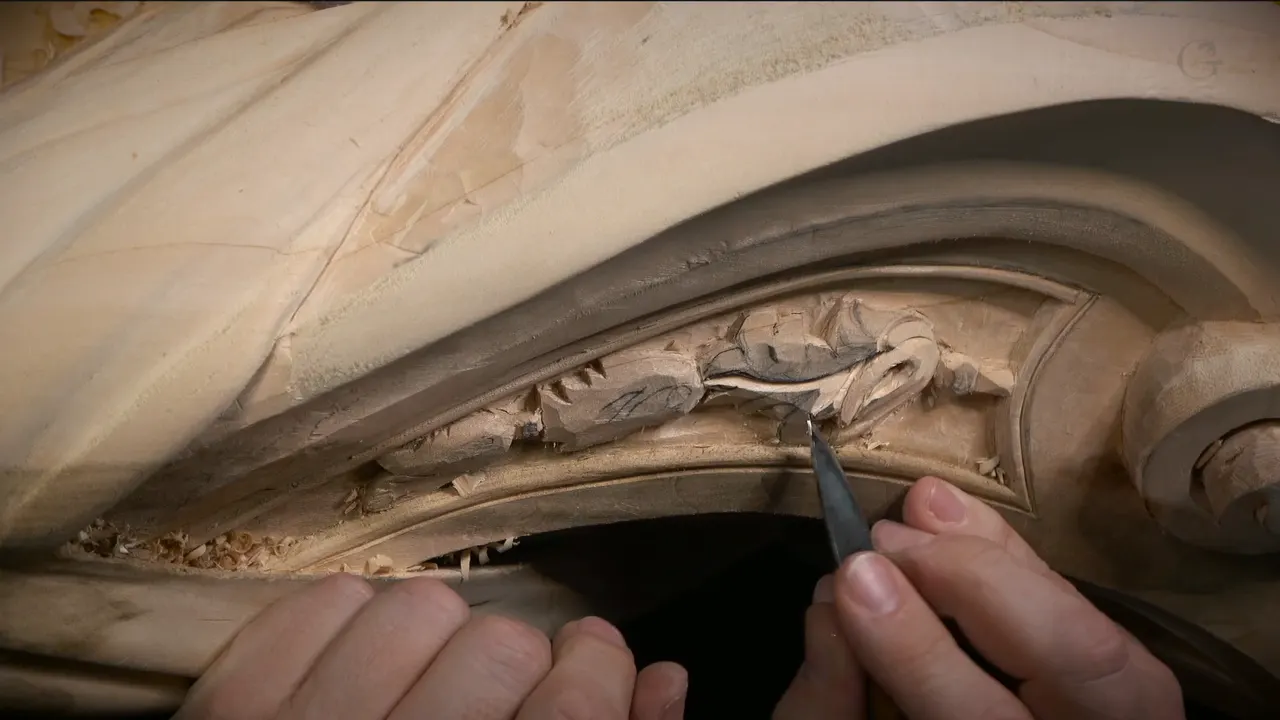

In workshop 93, part 8 holds an overall shape that does not make sense to me yet, and a line about playing with it. The word play sits in other lessons too, beside new tools, curls, petals and spare wood, and each passage has its place below.
Ever stood over a carved shape and not liked it yet? You know the feeling, then. We start in workshop 93, and then visit Chamomile 2, Hazelnuts, Venice Room 9, lesson 33, Venetian Flowers and more. Sizes come with my figure first.
How does part 8 treat sharp lines and paint grade?
The first words of the part answer a question about sharp lines. "And if you would ask me if I'm worried about those sharp lines, I really don't, especially in this case, because it's going to be a paint grade, so I really don't have to worry about it." See paint for the plain word.
A small detail comes next. "But this little tiny detail going to rest right on top of the next detail." Next comes a need, "So which means I need to lower that down much better and much deeper."

More clean-up is named. "And looks like I still need to clean it a little better." A little later the details show, "And I hope you can already see. It reveals the details. Although it's kind of not clean yet, but it should be all right."
Which tool goes upside down for the rounding?
A plan opens it, "Let me get my tool upside down, like number five, and round a little bit this part." Then "And I can round this part also."

One more need follows. "I need to now separate that detail." Wikipedia has a short page on the gouge, if the word is new to you.
How does the knife work in part 8?
The blade returns with a repeat. "And again, with the knife, I can do exactly the same what I've done previously. Just create a straight-down cut like that. And bevel cut to my straight cut, just like that." Plain pages on the knife and on the bevel sit on Wikipedia, in case a word is new.

A depth comes next, in two units. "And maybe I can actually do a much deeper cut because I need to round that detail also. I'll go all the way, like eighth of an inch, like three millimeters deep." The figure is 1/8 in (3 mm).
A second deep spot is named too. "But that, I also need to create much deeper cut right here. And let me cut toward that triangle." A remark on the light sits last, "See, I'm creating lots of shadow."

What gets blended and rounded after that?
A blend comes first, "and I'll blend a little nicer this way." Then the ridge. "So I'll take care right now of this ridge, because I really don't want to see that sharp."
A plan for the rounding follows, and it points back at an earlier spot. "I'm going to round that also. Same idea like I did right here."

Where does the line about play sit in part 8?
After a verdict on the overall shape. "Although, I kind of don't like overall shape of it." A fix is named in the very next breath, "Let me fix it with the number seven." Two plain lines follow, "Otherwise, it just doesn't make too much sense. And it still doesn't make too much sense."
Then the lines about play follow, right after the lines on the shape. "But we can play with that. It's not a big deal. So we can play until we like it. Or I should say, I can play until I like it."

A verdict closes that stretch. "All right. So now it's much better."
Does part 9 carry on with the tools from part 8?
In part 9, a look comes first. "Create a much better look." Later it names a tool and a size. "Okay, let me take care of roundness. I'll take number five again and a quarter inch and do something like that." A quarter inch is about 6 mm. A small undercut comes after it, "I can undercut little bit right away. Not much, but little bit."
Where else does a lesson say let's play?
Chamomile 2, part 1, has the word on its own line. "Let's play. So, obviously there's no rule what I can do."

One option follows. "I can just do open element just like that with the small stem." See chamomile on Wikipedia for the plain name of the flower.
The Hazelnuts course uses the word beside a curl, in workshop 7, part 2. "Later on, I still leave enough material for myself." A curl is the idea after it, "Maybe I can introduce some kind of a curl. For example, right here, it can curl backward." Two more lines on that curl follow in the same part. "I actually like that idea already. I just don't know which part I want to curl first."

A canvas is named next. "Like I'm doing lots of times on the canvases, curl just one on the edge." Then a size, "Maybe not that big of a curl, because right now it's just a little too big." A smaller version is named, "Let me play with a smaller version. I'll use number 11." For the plain name of the nut, Wikipedia has a page on the hazelnut.
A line on the form comes next, "And it's not the final look, okay?" A plain line about the form sits just after it. "I just kind of try to find a form."
Which Venice Room lessons say play?
Venice Room 9, part 11, has the word beside a tool, in a short stretch on an edge. "You can see this edge is rough." A new tool is named, "Let me play with my new tool." The tool itself gets a line, "It's not really new. It used to be new a few months ago, but I still don't use it too much."

A view on the tool follows. "But I think it's a good idea for operation like that, just give a really, really nice and smooth finish."
In Venice Room 33, part 12, sizes are named. "And I think that is enough. I could go extreme and get even deeper underneath and maybe play with three millimeters or maybe four millimeters. Just one millimeter smaller tool and get a little deeper on inside." Those are 3 mm (about 0.12 in), 4 mm (about 0.16 in) and 1 mm (0.04 in).

Next in Venice Room 47, part 1, comes a division. "And that is good. I still did not lose how wide that is because it feels like it does grow from underneath of this one, which I need to exaggerate a little more." Next, "I can start playing around this one. And I'm not sure if I like it or not."

Back in Venice Room 89, part 5, an area gets a frank line, and it sits next to a plan for later. "Maybe I'm going to do some of it off-camera, play around. I kind of don't like, honestly, how it looks. I don't like it, but I have to figure out what I should do." Later in the same stretch, "I don't want to lose the overall feel. I mean, how wide it is. So that is my challenge."

Do other lessons hand the word over to you?
In Venetian Flowers 2, part 3, the other flowers are handed over. "Every petal has to be different." Then "Even if those flowers are flat, for me, I still want to create a 3D look." Another line follows, "And that way you can see how I develop it, and you can play with the rest of them yourself, and you can just develop your own ideas. But once you get a grasp of it, so it should not be any problems."

The second part of that lesson closes on variations. "Just be creative if you're going to do that project and create those guys, some different variations. Play around, and if you don't like it, you can always chuck this out. All right? And just do something else."
In Venetian Flowers 3, part 1, the same thing happens again. "But with the flowers, just play with variations and it's going to be looking good."

In Floral and Molding 7, part 2, the word is put on movements and on your own creativity. "And you can play around with those movements. Okay? So you can get them little more exaggerated." Your own work gets a line next, "That would be up to you, up to your creativity. But don't leave that line straight."
In Butterflies 12, a border gets divided. "But I made a decision to divide that into six parts. And you could see obviously I just tried to just play with that."
A second line there is on a direction. "But if you don't feel comfortable with that type of movement, I mean, in the opposite direction, just go ahead and just do whatever you feel like." A plain page on calipers exists too.

Hashemi 47, part 6, names depth. "Some spots we can create really deep excavations, some spots not so deep. So that's the beautiful thing, that you can play and see how it looks."

Why leave extra material on a molding?
Extra material, in Floral and Molding 8, part 1. "The reason why I left some of the extra material, because I have to carve other moldings. I have to make those moldings." Then "I have some room to play around and make it look really nice." See miter for the plain word.

The next part says it again. "Yes, I know I left it slightly wider at the end for the miter. Now that way I know I have some room for play."
Acanthus over Moldings 9, part 3, has a similar line about a molding's edges, and the page on moldings has the plain word. "But in this case that molding gonna have around its edges and I still have some of the room to play with."

Does the wood itself change what you play with?
Lily Box 5, part 7, names planes. "If I would go all the way down, like lower the whole thing, it would not be a big challenge. But right now, there's different planes I have to play with."
In Lily Box 13, part 2, a grain is named. "Okay, so in this case, it's olive wood and it just has a beautiful grain, and I really wanted to play with the grains of the wood. So that's why I separated those details." Olive has a page too: olive.
What happens to an edge when you play with it?
Acanthus lesson 7, part 1, starts with an edge. "And now I can play." Then an edge option, "With this Edge I can roll it in or I can create some flipping out. So there's a lot of different possibilities."
Later in that same part, the petals get a line about being the same or different. "I don't have to do exactly the same all around overlap. I can just play and some of them gonna be the same some of them gonna be different."
Does the same idea come in one size or many?
Design principles 4, part 4, speaks of a flower repeated, and an earlier line is about depth. "It creates the depth. So you're playing with the depth." Next, "I could just do it three or five spots with the same idea. But they're going to play with a different size."
Which lesson holds which line?
| Lesson | Where the word sits in that lesson |
|---|---|
| Workshop 93.8 | An overall shape, a number seven, and a plan. |
| Workshop 93.9 | Number five, a quarter inch, and a small undercut. |
| Chamomile 2.1 | Let's play, and one option for a berry. |
| Hazelnuts 7.2 | A curl going backward, then a smaller version. |
| Venice 9, 33, 47 and 89 | A new tool to try, a smaller tool, another division, and an area I do not like. |
| Venetian Flowers | Flowers to carve yourself, and variations to try. |
| Panel 7 and 8 | Movements to exaggerate, and an end left wider. |
| Hashemi 47.6 | Some spots deep, some not so deep. |
| Acanthus Moldings | Roll the edge in, or flip it out, and room around the edges. |
| Butterflies 12 | A border in six parts, and the opposite direction. |
| Lily Box 5 and 13 | Different planes, and the grain of olive wood. |
| Design 4.4 | The same idea, and a different size. |
Does a shape on your own board look wrong right now? You know the picture I mean. These courses sit inside one tuition plan. The rest of workshop 93 waits on the Part 8 course page, with lesson 92 and lesson 94 beside it. For plain words, Wikipedia has pages on the chisel, relief, wood carving, and Venice.
How it's done
- Lower the little detail. A detail rests on top of the next one, so part 8 names a need to lower it much better and much deeper.
- Turn a tool upside down. Part 8 plans to round a little bit with a tool turned upside down, like number five.
- Start with the knife. The knife makes "a straight-down cut," then a "bevel cut" to meet it, and a depth is named.
- Round the ridge. A sharp ridge is not wanted, so a plan says to round it a little bit.
- Playing with the shape. A shape that still lacks sense gets a plan to play with it, and the next verdict is "much better."
Frequently asked questions
Which line in part 8 holds the word play?
A line about the overall shape and a number seven opens that stretch. Then come the lines about play, and a verdict of "much better" after them.
Which sizes sit beside the play lines?
Part 8 names 1/8 in (3 mm) as a depth. Venice Room 33 names 3 mm (0.12 in) or maybe 4 mm, with a tool one millimeter smaller.
Does play go with spare material?
Panel lesson 8 has a line in part 1 and another in part 2, both on material left for a molding. Acanthus lesson 9 has a third, around a molding's edges.
Which lessons hand the word to the student?
What to carve next