

Alexander Grabovetskiy, woodcarver, School of Woodcarving · Published 2020
What does a wood carver mean by "wrong position"?
Quick answer: In part 6 of workshop 93, the words "wrong position" go with a concave, and a number eight at 1/8 inch (3.2 mm) comes next. Other lessons use the same two words with attacking and with tools, and each passage sits below.
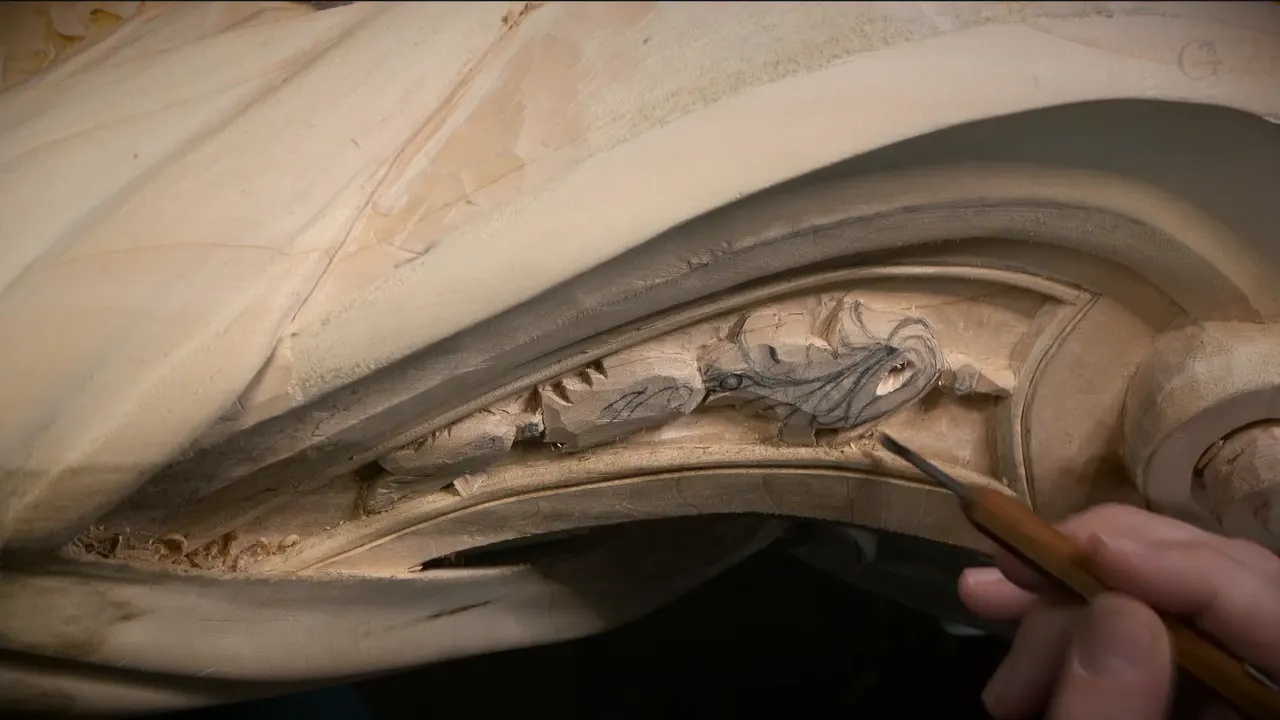

In workshop 93, part 6, I say "this concave is in the wrong position." Right after it, "So which means that concave is supposed to go all the way now this way." The same two words sit in my Venice Room, Hashemi, Floral and Molding, Lily Box and Gibbons lessons, and each passage has its place below.
Ever looked at a carved hollow and felt it sat a little off from where the rest wanted it? Then you know the moment this page is about. We start in workshop 93, then visit Venice Room 55, Hashemi 11, Floral and Molding 10 and more. Sizes come in millimeters and inches, with my own figure first.
Which words open part 6?
Its first words are "Clean it slightly." Next, "I really need to see that much closer to myself, but it's okay." Next, "You will understand at the end how it's supposed to look."
Where does the wrong position sit in part 6?
Several lines sit before it, among them "another detail going this way." Then "So it goes around and goes underneath of this big part." Then "Although, you know what? I just want to change some stuff."
In the same stretch, "I think it's just too many stripes right here, so I can actually change." Then, "I can make this piece as a part of one section." And "Let me make that change."

Next, the separation. "now my separation is going to be somewhere right here. And let me outline that part." A short step is next, "I could probably clean that a little better." Only then do the words of this page arrive.
Which tool goes with that concave?
Next comes the tool, "with the same number eight dockyard and one-eighth of an inch." A check on the size follows. "It's actually a little smaller than one-eighth of an inch. Okay. Just like 3/32nds." In my units, that first size is 3.2 millimeters, and 3/32nds is 2.4 millimeters.
A figure in millimeters follows, "two and a half millimeters, I'd say, approximately. That's what it is." That is about 0.1 inches. The plan is "But I'll make that concave a little bigger."

Then the blend. "make that blend a little bit better, this section, because it doesn't have to have any ridges, otherwise it's not going to look as nice." Another line says "I need to create much better separation in this section. Otherwise, it's not looking good."
Why do I change a detail until I like it?
The reason comes in my own words. "And if you would ask me why I'm changing, because I'm looking from different points of view, and if I don't like some stuff, and it's not too late for me to change it, I would change it until I like it. It just didn't look too nice yet."
Later on, "right here, I don't really like how it looks." Next come "a different number seven." Then "Just give some roundness." Then "if I damage this part right here." Then "Maybe I'm going to change it because I kind of still don't like how it looks right here."

What comes after the concave in part 6?
An option to carry it around. "That looks okay. But what I can do, I can actually carry that concave all the way around. But it's not going to be as deep in this area." Right behind it, "I can actually outline that part right away."
One small detail gets lines of its own, "a small detail" and "I don't want to lose it." So "let me go ahead and outline it with the same tool, that detail also."

Tools for the movement follow. "Out there, what I could do, I could take number seven and create really, really nice movement." Ten millimeters (0.39 in) is the size in "Let me clean that with the skewed gouge number seven in 10 millimeters." The small hollow reads "I'll just create a small concave." Then "That looks better. Looks better in my opinion."
The last lines of part 6 hold an option for a knife. "let me take again number seven and create another cut like this." And "now I need to blend to that cut. I can use probably just a knife."
What do parts 5 and 7 add around the concave line in part 6?
The last line of part 5 is about the convex. "To create that convex, I need to create two concaves." Part 7 opens with "maybe I can just use a knife right here. It's going to give me a sharp line." Soon after, "First of all, this section has to go underneath of this part."
The knife gets praise there. "you can see a knife is actually an excellent tool for operation like that for the small details." Another line reads "I want to make it look like it's growing from underneath." Next, "you can do a lot of stuff with knife, by the way."
The separation line gets a plan in part 7: "that is the main separation line, that line. And I can probably outline it for you." Then "Would you understand? You're going to see much better what is going on." Later, "I know it's kind of looking complicated right now, but once it's done, you can always save that picture and recreate it."

A bit of history comes with it. "they used knife a lot back then. It's one of the main tools of the trade, at least." Then comes a line about England, "Not in England, though, okay? In England, they didn't use knife too much." A correction, "Well, I shouldn't say that. They used it in the countryside, but not for the palaces and so on."
Do the words belong to a shape or to a tool?
In part 6 they fit a concave. So does Venice Room 55, part 12, with "that concave is little wrong position." It adds "because it has to twist."
A bigger tool is on the table in that lesson, "Maybe I can use an even bigger tool. 18 millimeters, three-quarter of an inch almost." Later, "I also want to raise the right-hand side, this ridge right here." And "create a pipe movement on this side."

Which lessons use the words for a tool?
In Venice Room 11 (part 9) comes "I know I'm using my tool" with "wrong position" after it. Next, the talk of "a deep shadow." A limit is named, "about a quarter inch, maybe" (6.4 mm).

In Venice Room 14, part 12, the same words lead to "but that's okay." After that, "I am just trying to establish my form at first and of course, I need to go to the pipe." A need follows, "I still have to create the eye."
Beside it sits a right position in Venice Room 61, part 6. "attack that from the right position, which, in this case, the right position is this way. Cut toward myself."

Its aim is "I really want to see a shadow casting," with the tool "hit just the side with the number 11," and "for me, it makes sense not to rush it." A wood gets named too, "a softer wood, like, in this case, lime wood or basswood" (see basswood).
Venice Room 84 (part 10) has the phrase "wrong position" with a reason, "because I'm covering with my head, the camera." And "I also want to do a little movement like this, just the separation going underneath."

The taper is named there. "Otherwise, if you look at that section and that section, it has the same distance, so it's almost like rectangle, which is not good. So it has to have some taper." On size, "7 millimeters, maybe I'll just use 10 millimeters. We'll see. Try 7 first." Soon after, "7 is much better than what it was before." The 7 is 0.28 inches, and the 10 is 0.39 inches. One more note on size sits earlier, "Just because I used too small of a tool. It wasn't mistake by the way, it's just by choice."
How does an angle fit in?
Next in line is Venice Room 85 (part 11), where the words go with undercutting. "I got to be careful I wouldn't undercut, because it's always a possibility if you're attacking" from "the wrong point" or "the wrong position."

Next comes "14 millimeters" (0.55 in). A gap to the line is named, "approximately one millimeter" (0.04 in). The reference is "right now 90 degrees this way." And behind it sits the idea, "that's actually a really good idea to get this done at the first step than just figure it out later."
In Molding 10, "wrong position" sits just after "roll it." Later in that lesson, "it is really important not to place your tool the wrong position." The line after it ends "90 degrees toward the piece. Really important not to mess this up."

Following the first mention, "I am safe, but just to take a smaller tool like number 11 or number nine, still going to work." For the size, "just six millimeters, quarter of an inch" (0.24 in).
Near the second mention a small area gets a plan, "the triangle area, and I need to relieve it first." The risk is "I would split and it would just create a crack in the wood, so that would not be the safest." And "you really have to make a relief cut. I call it relief cut."

Over in Molding 11 (part 1) comes "sometimes I really have to just attack that from a wrong position, if you wish." Just before it, "it's not really convenient for me."
Then "if you look from the side, it's just a little too straight and I don't really like it." The plan is "get number seven, I guess, the big one, and establish a really smooth transition." And "just a preliminary cut." A curl is planned too, "it's going to curl from underneath." Later, "I'm using number seven on the big one, like an inch and one-eighth or so" (about 29 mm).

Where does a wrong position become a mistake?
In Hashemi 11 (part 7) the words come straight. "Okay. I made a mistake. I attacked it from a wrong position. And now I have to be really careful how I fix that. That's not a good mistake, but it's still fixable."
Ways to fix it follow. "I can just start removing everything and make it deeper. Or I can just follow the nature of what just happened, and I can actually make another subdivision, just like that. Okay. And make a micro detail of it."

Then "definitely on the final piece, nobody will actually know that was a mistake."
Lily Box 2 has "See? I am attacking that from the right-- I mean, from the wrong position. I almost made another mistake, and I don't want to make mistakes. Someday, okay? Someday, I'm going to make a project without even one mistake."

"I know it looks messy, but it's all right." Next, "Get it to the right position so you can see it."
What follows a wrong position in Venice Room 90 and in the Gibbons class in Maine?
Venice Room 90 (part 10) has "That's the wrong position. I need to attack from this side." Right before it, "I need bigger tools" and "I'll try to blend it nicer." Later on, "I can try my new addition and get those ridges out" with "the rasp."

Gibbons, Maine class 16 (part 1) has "I gotta be careful," then "Pretty much working" with "wrong position," and "But I'm okay." Soon, "You could use probably number 11. Or I should say I could use number 11, which I really love."
A caution comes soon after. "I'm gonna place my tool somewhat in undercutting position." Then "That is what I'm after." This is the Gibbons class in Maine.
Wikipedia has pages on gouge, chisel, knife, rasp, relief, bevel, grain, Venice, acanthus and wood carving, for the plain meanings of the words I keep using.
Which lesson holds which line?
| Lesson | Where the words sit in that lesson |
|---|---|
| This part | A concave, and the way it goes. |
| Room 11.9 | A tool and a deep shadow. |
| Room 14.12 | Forming the shape at first. |
| Lesson 55.12 | A concave, plus a twist. |
| Lesson 61.6 | The right position, toward myself. |
| Venice 84.10 | A reason that involves the camera. |
| Venice 85.11 | A point, a position and an angle. |
| Workshop 90.10 | A new side to attack from. |
| Lily 2.1 | A correction in the middle of a line. |
| Hashemi 11.7 | A mistake with two fixes. |
| Panel 10.1 | A tool at 90 degrees to the piece. |
| Panel 11.1 | Not convenient, and a wrong position. |
| Gibbons 16.1 | Okay with it, and careful. |
Does a hollow on your own board ever sit a little off from the shape around it? Then you know the picture I mean. These courses sit inside one tuition plan. The rest of workshop 93 waits on the Part 8 course page, with lesson 92 and lesson 94 beside it.
How it's done
- Spot the spot. Part 6 names a concave in the wrong position.
- Choose the number eight. The tool is a number eight at 1/8 inch (3.2 mm), with a plan for a bigger concave.
- Blend the section. The blend is planned a little better, with no ridges.
- Carry the concave around. The concave can carry around the piece, but not as deep in one area.
Frequently asked questions
Which tool does the concave in part 6 get?
A number eight, with a size check after it: "Just like 3/32nds" (2.4 mm).
Where else does a concave sit in a wrong position?
Workshop 55, part 12, has "little wrong position" for a concave, and right after it "because it has to twist."
Is the wrong position a mistake in Hashemi 11?
As a mistake. "That's not a good mistake, but it's still fixable," with ways to go on.
Which angle shows up in Molding 10?
What to carve next