

Alexander Grabovetskiy, woodcarver, School of Woodcarving · Published 2020
What does a wood carver mean by "a little different"?
Quick answer: In workshop 93, part 9, "a little different" sits beside a part carved with fewer lines than the other side. Other lessons of mine use the same words next to petals, flowers, movements, tools and sizes, and each one is linked below.
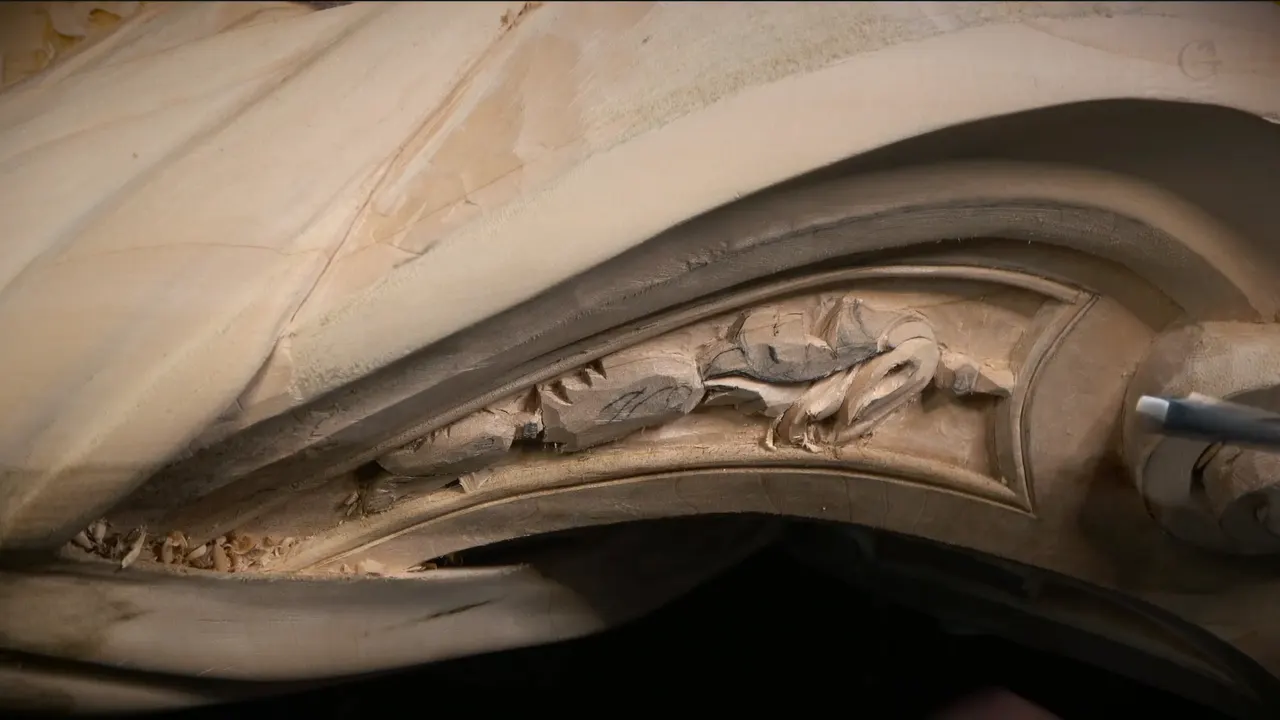

In part 9 of workshop 93 I say "a little different". Those words sit beside one part of the carving that has fewer lines than the other side. Other lessons carry the same two words next to petals, flowers, movements, tools and sizes, and each lesson is linked below.
Have you ever carved one side of a piece, stepped back, and wondered what the other side should do? Must it be a copy? Part 9 of workshop 93 has the words, and the lessons below show them again.
What does part 9 say about chips and texture?
Part 9 opens on "Create a much better look." The plan is next: "Again, with the same knife, I can probably just establish my" and the line goes on, "main form". The next cue reads "a background tool."

The surface gets a plain description. It is "just a bunch of" and then "loose chips." The fix is small, "All I have to do just to blow a little bit and just remove", and the chips are what goes. Texture is the next word: "And the texture going to take care of all the" and, in the cue after that, "fuzz and so on. Okay?"
Which small details come next?
The next area has a plan, "move to the next part." Two items sit on the list, "a small bead," and "a couple more details." About the lines, I say "I know it's just" and the line goes on, "a bunch of small lines, but I did that on purpose, okay?"
The reason follows in "I've done it on purpose because it was done" and the sentence closes over two cues, "before me by those" and "artists." A bead is on the list too.

Law of space comes next: "Again, that's just application of the" and "law of space." Three short lines follow, "Create small details" and "to make it feel" and "like it's a huge surrounding area.", and I also say "Just repeat myself."
How does number five change the roundness?
Roundness is the next job on the list, and the cue reads "Okay, let me take care of roundness." The tool sits in the lines that follow, "I'll take number five again" and "and a quarter inch" (about 6 mm). A small undercut is an option, "I can undercut little bit right away." and "Not much, but little bit."
Blowing chips out earns an apology: "Oh, I apologize if I'm blowing" and "my chips out." One more spot is on the list, "one more on this side to do."

The other side gets a plan: "exactly the same on this side," and, in the next lines, "a smaller version of what" and "maybe just flipped this direction." An even smaller one follows, "even smaller version. But the idea is the same."
What do small details do for a big area?
"Get bunch of small details with the lines," is the cue, and about the result I say "a really beautiful small" and then "detail."

What happens to the sphere and the slip?
A round part comes next, and the cue starts "circle part." Then the word sphere follows. The plan is "And right away outline it." A knife may do the job: "And yes, I can create that sphere also with just a knife" with "very much." after it.

A slip arrives in the same stretch. "And I just made mistake," I say, and "but it's okay." Then I add "I rushed a little bit, but I'll clean it."
Why does one part get fewer lines?
Here is the turn: "I don't know if I can say" and "that I like it," and the next line is "but honestly, I do, except this part right". Then the words that carry this page: "a little different. Okay?"
The reason is "Because it's not going to" and "have a lot of lines like I've done on one side." The part copies the other: "repeat this side. Okay?"
The idea gets a lead-in, "So what I mean by that, I" and "think it's important to understand". "different type of symmetry." follows it, and the subject is symmetry. Near the end I say "somewhat the same, but little different. Okay?"
A plan for another course sits at the end of part 9, and it reads "Of course, I will probably explain that little better in a design" and "course I'm planning to do."
What do parts 8 and 10 add?
Part 8 of the same workshop starts with the sharp lines: "And if you would ask me if I'm worried about those sharp" and "lines,". The answer is "a paint grade, so I really don't have to worry about it."

Part 8 goes on: "rest right on top of the next detail." The depth in the plan is "like eighth of an inch, like three millimeters deep." (0.12 in.) A line about shadow comes later still, "See, I'm creating lots of" and "shadow."

Part 10 opens on a plan, "right in the middle," and "convex." Next come the sides, and the cue is "And those are just sides of my acanthus." For concaves, "I'll take just number 11." and "Number 11, and let me use five" and "millimeters," (about 0.2 in). The look in the plan is "growing from underneath."
After the first hollow, the cue is "a little deeper, but not as deep, okay?" and a second hollow follows, with "really swirling." as the look. The surface gets a blunt line, "It looks really, really, really choppy," and "but it's okay. We'll fix it." A blend follows, "and a quarter inch, and I'll just use it upside down to kind of blend", with a gouge turned over.

Do petals need to match?
Petals come first. In Venetian Flowers Rosette 2, video 3, I ask for it outright, and I say "repeat myself maybe multiple times." Right after it comes "Please don't make them the same. They" and "all have to be a little different."

Shape is next, and the cue reads "prolong them a little bit." Then "that waviness." The order of the petals in the plan is "right underneath of this one," and the reason is "a really beautiful shadow as well." That is shadow again, as in part 8.
Rosette 3, video 1, has "But I kind of like the overall movement." Later: "every petal is supposed to be a little different." A short one follows, "It doesn't have to be the same." Then "as creative as you wish."

Another concave is wanted: "But I want to make another concave on this side of" and "the petal." Next in the video: "Otherwise, it just looks a little too boring." and "Let me get number 11 again."
Hashemi 30, video 3, puts the same words beside a ring of flowers. I say "sometimes they look about the same" and then "look a little different from each other." A smaller tool is next, "Maybe I can use number seven." The shape of a petal then comes in "a boat. At the end, it can look just" with "it cannot be just a true perfect round."

Floral 13, video 3, has "And I'm going to have five petals." and "Just going to eyeball it." Next: "I want to create some shadow. Okay?" Later in that video comes "It's a little different flower." and "variation of it." A tool is named: "This one is a one-millimeter tool." (0.04 in).

Further on: "on outside of those petals are a little different." Then a slope: "slope down." The tool for that: "probably just a small tool, like maybe quarter inch" (about 6 mm).
Can one movement change a little?
One area gets a verdict in Furniture Panel 9, video 1. The words are "And in my opinion, this area is" and "not looking too good." And the plan: "So I think I should develop little different movement."

A cause follows, "The movement itself is really good, but I think just it's too crowded for". Another spot in that video gets a softer verdict, "I like it, but I don't think it's just detailed enough."
A space gets filled in Furniture Panel 13, in its third video. Here are the lines: "some type of flowers. I don't know what type is it," and "I try to fill this space," and "make little different movements."
Workshop 45, video 12, has what I am after in plain words. The lines are "I did not want to repeat the" and "same like I did on other sides." Then "make them a little different," and "the same design as far as the" and "different movements, okay?" Last, "So that's what I'm after."

Workshop 65, video 4, has "different from all other movements,". Later: "difference already. It's already different from what you saw". The result is "a lot more dimension, I should say." and "It just creates more movement," and "So I'm kind of happy with that side."

Hashemi 12, video 5, brings in the grain: "Just because I'm working with the grain, I got to be" and "careful. So now I have to lower this down even more." Then, about the outcome and the fact: "I don't like that fact, but it is what it is."

After that comes "Which is not going to look as bad as you think." and "a little different movement." The last line on it is "go downhill and grow up."
What changes when the order is a little different?
Two parts swap places in Workshop 44, video 2: "that small detail goes on top," and "go below that one, okay?" After them comes "So a little different." Its tool: "3 millimeters, number 11." (0.12 in).
Workshop 43, video 12, has "for this head, I used pretty much" and "Another same plastic piece. Of course, it's moved" and "little different directions, but the idea is".
Workshop 73, video 4, has "It's symmetrical but little different." Close to it: "This is a big eye," and "a lot smaller eye,". A plan sits further on, "go underneath of this line."

Can a view, a finish or a tool differ?
The view is the subject in Workshop 88, video 8, and the lines read "Because the camera is just right above." and "view. Okay? So it's actually made" and "to be visible from the bottom, okay? From downhill up." After it comes "a little different." Next, a plan for later: "Later on, I'll try to make a picture of it,".
Workshop 90, video 3, is about the finish. A rasp is the tool in that line. "And you can see when I use the rasp, the" and "finish of it is a little different. In this case, it's okay." My reason is "all covered with paint." That is paint again, as in part 8 of workshop 93.
Workshop 54, video 5, is about the tool. A number nine is the subject: "I'm using little different number nine." and "and that's a 6 millimeters, and that" (about 0.24 in). Next, "It's a beautiful tool." and "I like it for some reason, this one, a lot."
Workshop 96, video 11: an oak leaf. "And for example, I used to live in Russia." comes first, then "trees, and they look a little different" and "southern oak is absolutely different."
Does the size change too?
In Principles of Design 4, video 4: "But even those, I never put the same size." Next, "We're talking about a 20 millimeter, three quarters of an inch flower." (0.79 in). Then "another one even smaller."
The count changes on that side, and the size too: "a little different also." Next come "It creates the depth" and "And that's a LAW OF RHYTHM" and "It repeats same as in music". A later line about rhythm reads "They still repeat the same idea, but they play with the volume."
Hashemi 42, video 1, says "those flowers, I've got different sizes." and "Smaller, little bigger, and even bigger." and "So all four of them, it's little different sizes." The drawing is by hand: "Just hand-draw that, okay? You don't have to draw a perfect" and "have some kind of waviness."
Which lessons carry the same words?
| Lesson | What sits right beside the words in each video |
|---|---|
| Workshop 93, part 9 | One part with fewer lines on it |
| Workshop 73, video 4 | A big eye and a smaller eye |
| Rosette 2, video 3 | Petals that differ, and a little waviness |
| Rosette 3, video 1 | Petals that need not match each other |
| Hashemi 30, video 3 | Rings of flowers that differ a little |
| Floral 13, video 3 | Five petals, with a slope all around |
| Panel 9, video 1 | A movement that is too crowded there |
| Workshop 45, video 12 | Movements that do not repeat other sides |
| Workshop 44, video 2 | A small detail below, not on top |
| Workshop 88, video 8 | A view from the bottom, downhill up |
| Workshop 90, video 3 | A rasp finish that paint will cover |
| Hashemi 42, video 1 | Four flowers in sizes that all differ |
Is there a part of your own carving that has to answer another part without copying it? You will find workshop 93 inside one tuition plan, with the rest of the Venice Room, Part 8, in the Venetian style. Workshop 92 sits before it, and workshop 94 follows.
How it's done
- Fill one side with small lines. I did the small lines on one side on purpose, as the artists did before me.
- Plan the roundness. A number five at a quarter inch (6 mm) is in the plan, with a small undercut as an option.
- Make the other side a smaller version. On that side, a smaller version, maybe flipped, with the same idea, is the plan.
- Outline the sphere. Outlining comes right away in the plan, and a knife may do the job.
- Clean the slip. A slip happened, and cleaning it is the plan.
- Leave one part a little different. That part gets fewer lines and is planned to repeat the other side.
Frequently asked questions
Which part of the carving gets fewer lines in part 9?
The part after "except this part right" is the one. Its reason is "have a lot of lines like I've done on one side."
What stays the same on both sides in part 9?
Both sides share "exactly the same on this side," and the plan makes the second one a smaller version, maybe flipped.
Which tool is in the plan for the roundness?
Number five at a quarter inch (6 mm) is the plan, and a small undercut is an option: "Not much, but little bit."
How do I describe the slip?
What to carve next