

Alexander Grabovetskiy, woodcarver, School of Woodcarving · Published 2020
What does a wood carver mean by "we'll fix it"?
Quick answer: In workshop 93, part 10, one cue has the word "fix" and sits right after the word "choppy". Many lessons of mine use "fix" for slips, shapes, a flow line and spots that wait, and each one is linked below.
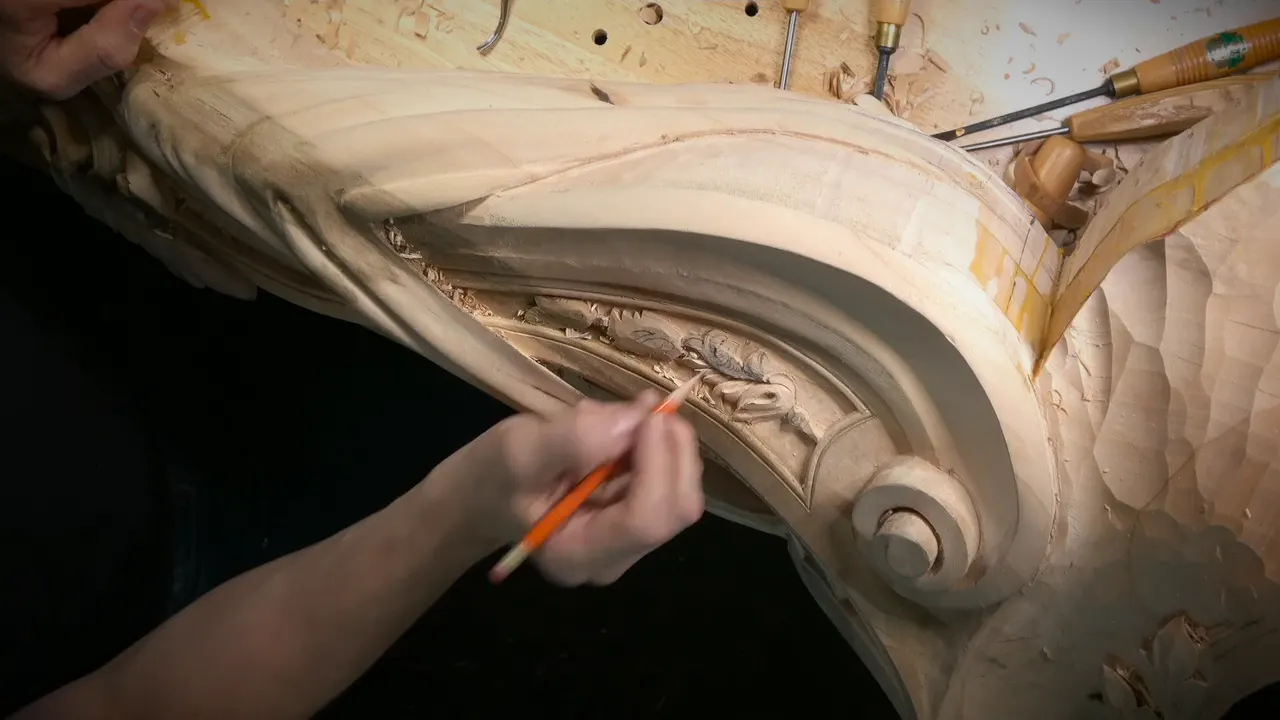

The word "fix" sits in the cue right after "choppy" in workshop 93, part 10. Many lessons of mine pair "fix" with slips and shapes, a flow line, or a spot that has to wait. Each lesson is linked below.
Have you ever looked at a carved spot, felt it was rough, and wondered whether to stop or go on? The words sit in part 10 of workshop 93, with a tool and a look around them. The lessons below show the same word again.
How does part 10 start on the middle of the leaf?
The part opens on a plan for one spot: "What's going to happen, right in the middle, I'm going to have" and the next cue reads "convex." The line has a name in "my central line." The sides get a word too, "And those are just sides of my acanthus."
That leaf is an acanthus. The concaves come after it: "And for the concaves, of course," and "I'll take just number 11." The size sits in the lines that follow, "Number 11, and let me use five" and "millimeters," (0.2 in). The method is "and carefully try to get those concaves in."

A new thought arrives: "You know what? Maybe even bigger than that." The need is "I need to create that concave" with "Let me go opposite direction" beside it.
Why do I swap tools here?
Before the swap comes a verdict, "You know what?" Then "This is not going to work." A new tool is in the plan, "I'll take just a small number eight" and "dockyard tool," then "micro tool, and I'll go with the concave all the way to" and "that triangle." The triangle is the spot the concave is planned to reach.

Another line adds "It's going to make a feel like it's growing from underneath."
How do the knife and a second concave fit in?
A knife is back in the plan: The lines are "And let me use a knife again" and "and clean this section right here a little bit." The waste has a name in "Just get rid of" and "some of the junk."
"that would be one concave," the cue reads, and the depth plan reads "and carry that again" and "a little deeper, but not as deep, okay?" A second concave is next: "And another concave going to go to" and "same spot," then "but I'm going to carry it" and "like this, around and all the way this way."

Two cues finish the thought: "that way it's going to look like it's" and "really swirling."
What sits beside the word fix in part 10?
Here is the stretch with the word. A need comes first: "And in this case, I really need to get a bigger cut," Then "but that's okay." The tool plan reads "I'll just use a small for now, and then I'll just switch to a bigger" and "tool." ends the line.
The look gets its words after that: "It looks really choppy." Another cue repeats the look with more words, "It looks really, really, really choppy," followed by "but it's okay. We'll fix it." Then comes "In just a moment, we're going to fix that."

What is the next tool in part 10?
Here is the next tool: "Okay, I'll take number five" and "and a quarter inch, and I'll just use it upside down to kind of blend" and "in" finishes the line (a quarter inch is 6.35 mm). The plan goes on, "and create somewhat like a convex also" and "right here on this side."

The previous tool is back in the plan: "Okay. Take again" and "previous tool and get rid of some of the fuzz." The middle has a job: "And now I need to blend that middle" and "convex." Next in the order, "Well, let me blend this first, okay?" I also say "go like this" and, in a later cue, "create moment like that."
Another change of tool is planned: "And I need the knife again."
What is left on the list at the end of part 10?
The small tool returns: "And let me also actually clean that first with" and "small, tiny number eight." Then I say "All right." and "Or almost all right."

A plan follows: "Let me create much better separation right here." The next line adds "And I can also blend this part little nicer." For the upper ridge the cues are "just probably number" and "one" and "back bent", and "that upper ridge with the middle part." closes the list.
The last lines of the part are about ridges and light: "I really don't need any sharp" and "ridges, although you do see those because the light source," then "just kind of harsh right now." Those words end on "for I would see what I'm doing."

What do parts 9 and 11 carry?
Right before it, part 9 holds a slip of its own: "And I just made mistake," and "but it's okay." The next line is "I rushed a little bit, but I'll clean it."
Right after it, part 11 opens on "Clean it again." and "Let me leave it like that, at least for now." The cues also hold "and make it even more round with a small tool like that." After it: "Just whatever fits."
Which spots do I plan to fix now?
Other lessons keep the same company, and the first group is about fixes planned for now. Take Workshop 54, video 4. The lines read "See what I've done?" and "Beautiful development. Beautiful." After that, the plan: "It looks chunky right now, but I'll fix it" and "just in a moment." closes the plan. Then a pencil: "but I need to sharpen my pencil." Then "Look again in the overall how it looks," and "and I think it looks" and "really nice." Then "Personally, I think it looks really beautiful."

A shape gets its plan in Furniture Panel 22, video 8: "Okay. Also, let me fix overall shape" with "with the same tool" and "to make it more distinguishable from the background." The first line of the stretch is "It looks like it's done on machine, but it's not." One part has a job, "Okay, now this part right here has to go" and "little lower." The order is "Okay, it has to gradually move down." The shape has a warning, "don't worry about its changing the shape."

Roman Acanthus 11, video 2, has a mistake with its own words: "Okay, I made a mistake." and "Cut too much," and "That's what happens when you're trying to overdo it." The V tool is in the plan, "Let me get the V tool" and "I'll fix what I've just done." Another plan follows, "Let me get" and "small" and "gouge."

A tool that digs in is the subject of Workshop 71, video 8. Three cues set it up: "And I'm okay that one of the sides of my tool is" and "actually digging in, as long if I maintain a really nice" and "middle line," then "so I can fix whatever is digging in." One more line sits near it, "need to create a deeper cut,".

Which spots wait until later?
Timing is in the words of Workshop 69, video 10. "Okay, that is good." opens it, and "convex, and convex." sits near it. Then "Later on I'll fix the final shape," and the next cue is "but now I'll just... Well, actually you know what?" For the tool, the plan is "a different tool, like maybe number three".

Over in Hashemi 12, video 7, the cues are "Okay, later on," and "I'll fix overall the movement right here, because right now" and "doesn't look too good." Then "But" and "after it..."

A longer plan lives in Workshop 63, video 8. It starts with "I'm thinking." and "not." Then "Let me do that." and "And if I don't like it, I have plenty of material." The fix is in "That way I'll fix the problem, what I'm having right now," and then "I can fix that and make" and "extra division on that side,".

A spot I do not like sits in Workshop 82, video 9: "like too much what happens right here." and "but I'm not the biggest fan of what I see right here." The cue after them has "a little later." with the word fix in it, and the next lines are "But now let me just" and "round everything up."
Which words follow a slip?
The plainest words are in Workshop 46, video 12. "Oh, that's bad." and "That is bad what just happened." and "I slipped, and I messed up with my edge." The edge is the spot. The lines also hold "Now I can get much better cut." Tool plan next: "Maybe I need to just go" and "with this tool." The last line there is "And fix it."

A limit comes first in Workshop 78, video 6: "It would be a big mistake for me to get more than that." Next comes a question, "What did I do?" and the answer in "I just broke my separation cut. It's okay, I'll fix it." Beside it sit "It's not a big deal." and "Maybe I was just a little too aggressive."

A pair of slips is in Workshop 73, video 4, and Workshop 56, video 1. The first has "Oh, no, that is not good." and "So I said I have to be careful. I wasn't too careful." with "But anyway," in the cue that has the word fix. The second has "Let me attack this side" and "I just dug inside a little bit of this cut," then "Don't really worry about it." and "I worry about is to make it a really beautiful convex."


In Floral and Molding 8, video 2, a spot opens the lines: "And I see already some" and "problems." Next, the slip, "creating cut right on the side," and "I undercut slightly underneath of this line." Then "That is no bueno." and "but I should be more careful."

Hazelnuts 3, video 1, belongs to the hazelnut course, and it has "That is an unfortunate mistake I made," and "Now you can see, I'm not sure if you can see that" with "husk and husk on both sides." Next in the plan: "excavate a little more" and "Number seven, that is what I'm using".

Which lines put a limit on the fix?
A limit shows in Hashemi 9, video 7: "Same idea." and "Okay. Now I like it, but not" and "quite." Then "should look good from all points of view." and "Sometimes it's impossible, but still," and "and if there is room to fix it," Then "I barely" and "remove any material. But now I like how it flows".

Hashemi 43, video 4, is about waviness. It starts with "just" and "too big" and "space I left." Then "Again, try to make it as wavy as possible" and "from the beginning." After that, "I know you can fix it later on." Then "if you can do that from the first cut," and "preliminary waviness," and "why not to do that?"
The same word has a hard line in Furniture Panel 15, video 1: "Really important because" and "you really have to keep that area high." and "So there's no way you can fix that later. Okay?" Those two videos sit beside different jobs, one with a wavy line and one with a high area.
A flow line is the subject of Workshop 9, video 5: "I don't like how it's" and "moving. Okay? So I don't really like" and "my flow line." Then "Yes, I can fix it. It's not a big deal." A bigger one follows: "get a bit bigger" and "number nine." and "Maybe about 10 millimeters" (0.39 in).

Which lessons share the word, and what sits beside it?
| Spot | Words next to the word fix |
|---|---|
| A choppy look | A bigger tool is the plan, and number five is next |
| A chunky look | Then a sharper pencil, and a look at the whole |
| An overall shape | The same tool, and a little undercut |
| Too much taken | The V tool is next, then a small gouge |
| A digging tool | A really nice middle line, and a deeper pass |
| The final shape | Later on, with a different tool |
| A movement | Right now it does not look too good |
| A problem | How wide one section is against the next, and an extra division |
| A slip | On my edge, with a tool plan |
| A broken separation | No big deal, and maybe a little too aggressive |
| An undercut | I should be more careful |
| An unfortunate mistake | A husk on both sides, then probably a little more excavation |
| A fix that has a limit | If there is room |
| Waviness | Fixed later on, though I ask for it from the beginning |
| A high area | No way to fix that later |
| A flow line | Number nine, maybe about 10 millimeters (0.39 in) |
Is there a spot on your own carving, or on a relief, that looks rough today? You will find workshop 93 inside one tuition plan, with the rest of the Venice Room, Part 8, in the Venetian style. Workshop 92 sits before it, and workshop 94 follows.
How it's done
- Plan the middle. The plan is a convex in the middle, with a central line running one way.
- Pick number 11 for the concaves. Number 11 at five millimeters (0.2 in) is the plan, with a bigger size in mind.
- Swap to number eight when a plan fails. Number eight, in the dockyard tool cue, is what I plan for the concave toward the triangle.
- Keep a bigger tool in mind. A small tool for now is the plan, with a switch to a bigger one after it.
- Name the look. The look is "choppy", and the fix is planned.
- Blend with number five upside down. Number five, held upside down, is how I plan to blend.
Frequently asked questions
Which word names the look in part 10?
"Choppy", in "It looks really choppy." and in a later cue, said before the cue about a fix.
Which tool follows?
Number five, planned upside down to blend.
Which tool is planned for the concave toward the triangle?
Number eight, in the cue "dockyard tool," followed by a cue about a micro tool.
Where else is a fix planned soon?
What to carve next