

Alexander Grabovetskiy, woodcarver, School of Woodcarving · Published 2020
What does a wood carver mean by "like steps"?
Quick answer: Part 4 of workshop 93 has "like steps" for a part that goes beneath a line. Other lessons use step for a level beside a level, and "stepping" for a tool that moves one edge at a time, with each line below.
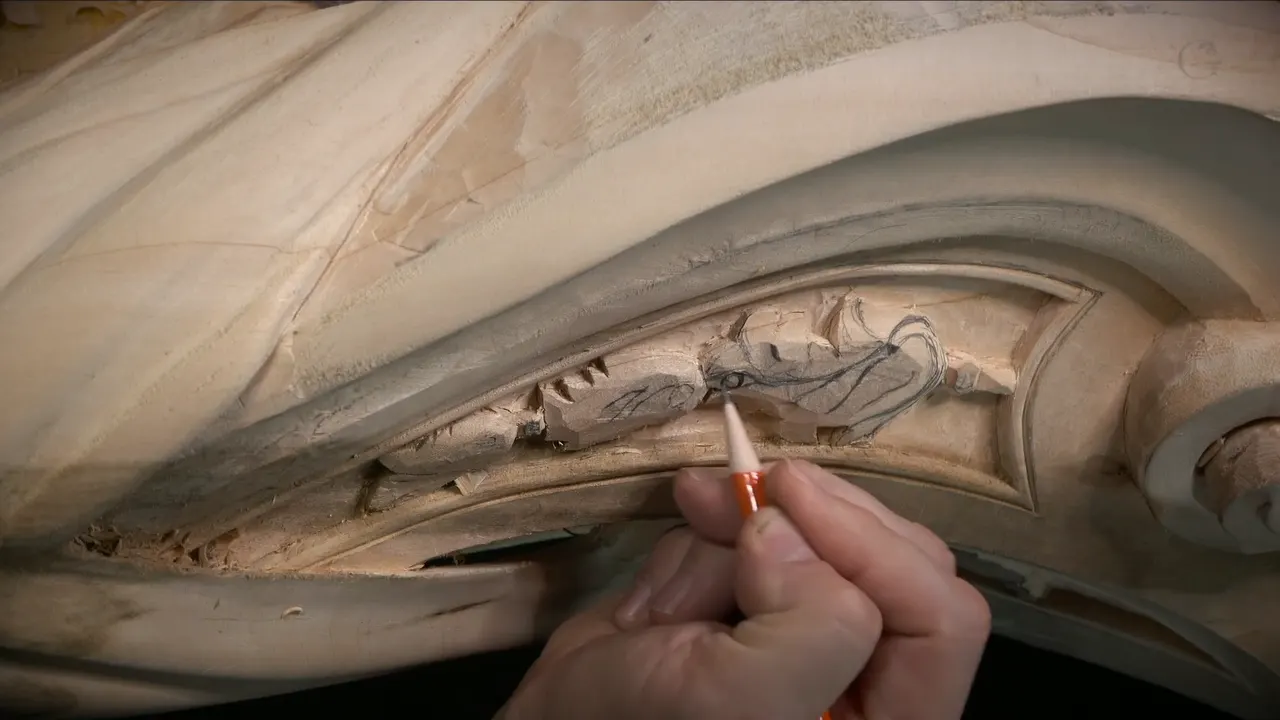

In workshop 93, part 4, my words are "like steps" and then "like stepping down," for a part that goes underneath a line. My Lily Box, Venice Room, Hashemi, Greek acanthus and Furniture Panel lessons use the same word, and each one has its lines below.
Ever carved one level of a leaf and then needed the next level lower? Does a step in wood resemble a step on a staircase to you? Then this page will feel familiar. I start in workshop 93 and visit Lily Box 7, Venice Room 6, Hashemi 3 and more. Sizes come in millimeters and inches, my own figure first.
Where does "like steps" sit in part 4?
It follows movement number one. Before it comes "So next, what I have to do, I have to exaggerate this area." After that, "And that's going to be like steps." One more time, "Okay? It's going to be like steps."

The part itself gets named in the very next lines of the video: "That part right here is going to go underneath this line," and for the reason, "underneath, logically, because it's like stepping down." The verdict reads "that's going to look much better that way."
What comes before the steps in part 4?
The part opens with "And that part is going all the way right here." Next come "a tiny sphere, which is going to happen also in this area," then "the two spheres, like interconnecting spheres, and a small stem going inside on the sides."

Another line reads "But that is the main line which I cannot lose." After it, "And those details are actually really nice, like filling details." Then "And here you go, something like that," with "At least this one," and "And let me work on it."
The next line is "So let me think, what am I going to do right here?" After it comes "another leaf." On the drawing I say "And yes, I am looking right now at my design, but I'm changing." A few words later, "I'm changing some of the stuff."
My start is "I do have a somewhat deep excavation in this area," with "a really good starting point." That excavation has one job: "It's going to separate the movements." Its look right now is "it doesn't look as good."
A smaller plan sits beside it. "I'm going to carve this one, and probably that one and that one off-camera because it's much smaller." Then "So we'll see."
Which gouges does the first movement name?
A number 11 comes first in part 4: "I'll take number 11 and two millimeters" (0.08 in). A change of mind follows: "Actually, you know what? I can actually take right away a much bigger one." The size is "five millimeters 11" (0.2 in), plus "I'm going to excavate first that deep spot right here."

Two sides are next, with "And I'll attack that from two sides." A mention of "a straight down cut" follows. One more size reads "Although this is a little too big, I'll take three millimeters" (0.12 in), and the last one is "two millimeters to clean that" (0.08 inch). The movement closes with "And here you go. That is movement number one."
Which tool carves the part underneath the line?
Here the tool is "the same number 11 and two millimeters" (0.08 inches), with "a cut with the flute approximately, I would say, one o'clock or so." Then "Cut number one."

Another detail is on the list: "But I also have another detail which is going to grow from underneath of that part first." For it, "I can actually use the same tool and do exactly the same operation that I've done before." Also "Same operation," and "Go like that."

What happens to the ridge?
Then "So now I need to blend," with "I don't need that ridge." For the job, "I would take probably a back bend." In this case it's "just a really straight number one," and "almost like a chisel, but it's a back bend." The width is "six millimeters, one quarter of an inch."

Then "let me blend this one" comes before "round a little bit this part, too." My note on the look is "But it doesn't look too good yet. It will." And "It doesn't yet, so I need to make sure the detail is readable."
How does the part end with an undercut?
The last plan is "You know what I'll do? I'll just undercut right away." A depth follows, "And I could use pretty much right away half a millimeter" (0.02 in). A second thought adds "Or maybe I should use one millimeter first" (1 mm is 0.04 in). The closing size is "One millimeter and number 11, of course," and the line ends with "a much cleaner look."

Which other lessons use the word step?
Step is a word I use for a level next to a level, and for a tool that moves one edge at a time. The levels come first. The tool follows.
Where else is a step a lower level?
Lily Box 7, part 2, has "Let me recreate the line," with "much easier to see" after it. Next, "So I can actually make this lower than that part, okay?" Then "of course, higher." The ending is "like a step."

In workshop 6 of the first Venice Room course, part 1, the line is "what I want to see before I do my bead mouldings, I want to create a step down." A marking plan follows, to "draw approximately 3 millimeters away from this detail, a line" (0.12 inches).

Venice Room 92, part 12, has a profile that starts with "What I mean by bead, let me try to explain to you." A phrase on the surface reads "and then just the steps down, and there's a design." The profile starts with "a cove going in like this." It ends with "So that is pretty much the profile of it." The widths are "about three-quarter of an inch" (19 mm) and "about maybe five-eighths of an inch" (16 mm). After them, "And then I've got step down like this, which is that section," and "the background and the main design on inside."
Roman Acanthus 16, part 4, has "You see, we just created that step." Beside it sits "I'm talking about this step." The picture for it is "Like in a Roman ogee, but right here it's a smooth transition."

What does "stepping" mean in my Greek acanthus lesson?
Greek Acanthus 8, part 1, has the longest run of it. Before it, "Right now, I'm across the grain." The line is "That is called actually a stepping cut. So I'm stepping." Its motion is "I start with one edge, and then rotate, and then move, then rotate, then move." Also "move my tool, rotate, and again, step, step, step, step."

A closing line adds "I know some people don't call it that way, but for me, it makes sense because you can see what I'm doing."
In Hashemi 3, part 3, the plan is "Hopefully, you can see the results," and "Use the number five again," then "I'll make step cuts" and "I can start on one side." Over in Hashemi 8, part 2, comes "There's the stepping cut. Let me clean that."

What is a step cleaning with a chisel?
Workshop 8 of the Dining Table Apron course has "What I'm doing right now, I'm actually doing a step cleaning," plus "It's how I call it" and "It just looks like it's stepping." The tool is "the flat carpenter's chisel," with "I'm establishing one point."

The hand work reads "I'm resting my chisel on just the one end of it, and I'm kind of moving toward, like making a step." Then "Moving, make a step." Later in the same workshop come "Let me do a step cleaning" and "Step to the main line." A single bevel chisel adds "I create the pressure only on this side, and that's what I need," plus "I need to remove the fibers from this side," and "use it like a stepping."
How does stepping sound in workshop 145?
In Venice Room 145, part 1, I start with "And yes, I need to undercut right away, pretty much this side, since I'm not going to change too much." Next, "I'm doing like a step. Okay, so I'm starting with one side of the tool and pushing like that, okay? And pushing."

The count is "One step, step two, step three, step four, so on." A closing beat adds "Just like that, okay? Just stepping." Following it, "let me take number 6, like half an inch" (13 mm), "and remove whatever I don't need anymore from underneath."
Which gouge makes a step carving in the Furniture Panel?
In Furniture Panel 19, part 14, the plan is "I should use just probably number three," with "eighth of an inch" (3.2 mm). The angle is "More like on 45 degrees, I would say." The lines are "Make a step carving" and "Step cut, I should say, because I'm stepping in."

Furniture Panel 15, part 10, has "I'm digging that kind of a little an angle." Its next lines are "That gives me little bit of slicing. Not much." Also "I call it step carving. You're just creating some type of steps." The size plan is "two millimeters" (about 0.08 in) and "maybe I should use one millimeter" (0.04 inch).
Part 6 of Furniture Panel 22 has a plan "to use a small number three and one-eighth of an inch gouge" (3.2 mm). Its moves are "step carving. I use one edge and kind of go in, press in," and "clean whatever is left." The ridge is "only like a half a millimeter higher than the background" (0.02 in).

Furniture Panel 38, part 2, has "I really wanna see some kind a wall right there, which is the angled wall." Then "I'm not stepping that straight down, like 90 degrees, but slightly, slightly angle it that way." The payoff is "It's gonna give me a wall."
Part 3 of Furniture Panel 39 names "number two and 10 millimeters" (0.39 in). A position follows: "I'm gonna go right on the line." The stroke is "It's like a stepping cut, gonna step, remove, step, remove, straight down."

Does grain change the way I step?
Butterflies 2, part 1, has "right in the middle of my previous cut." And "I'm stepping this way just because of the grain. Okay, it's easier for me." And "you can see I'm slicing through the fibers with no problem."
In The Tray of Blessing 2, part 1, comes "I call it a back stepping cut." It goes "adjust the cut, step back, cut, step back." The comparison is "Same like you would do a molding with the molding plane."
Where does a step press the back of the gouge?
Roman Acanthus 10, part 3, has "Just be really careful because when you're doing a step like this, you're always pressing with the backside of the gouge in this area, and you're kind of smashing it." My caution is "But still, just try not to press too hard." The same lesson adds "Which is okay in this case, because we still have to create some other movement on the pipes later on."
In Grape Onlay 10, part 3, I have "I can use different tools." Next, "I'm just stepping down." And "you probably don't see that really well."
For plain meanings of the words I keep using, Wikipedia has pages on gouge, ogee, staircase, spheres, relief and wood carving.
Which lesson holds which step?
| Lesson | Lines |
|---|---|
| Workshop 93.4 | A part set underneath a line. |
| Lily 7.2 | One part lower, one higher. |
| Venice 6.1 | A step down beside a detail. |
| Room 92.12 | A profile with steps down. |
| Roman 16.4 | A smooth transition, like an ogee. |
| Hashemi 3.3 | Start on one side, then step. |
| Greek 8.1 | One edge, rotate, move, repeat. |
| Apron 8 | A chisel resting on one end. |
| Venice 145.1 | One step, step two, step three. |
| Panel 19.14 | A step carving at 45 degrees. |
| Carving Panel 15.10 | Creating some type of steps. |
| Furniture 22.6 | One edge goes in and presses. |
| Carving Panel 38.2 | Not straight down, but angled. |
| Panel 39.3 | Step, remove, straight down, again. |
| Butterflies 2.1 | Stepping this way because of the grain. |
| Tray 2.1 | Back stepping, with a molding plane comparison. |
| Roman 10.3 | Light pressure on the gouge's back. |
| Grape 10.3 | Stepping down, with different tools. |
Does one part of your board sit below a line? Then you know the picture I mean. These courses sit inside one tuition plan. For gouge care, the sharpening course has its own lessons. The rest of workshop 93 waits on the Part 8 course page, with lesson 92 and lesson 94 beside it.
How it's done
- Excavate the deep spot. The plan in part 4 is to "excavate first that deep spot right here."
- Work both sides. Next, "attack that from two sides," followed by "a straight down cut."
- Exaggerate the area. The words are "exaggerate this area," and "like steps."
- Send the part underneath. One part goes "underneath this line."
- Blend the ridge. "So now I need to blend. I don't need that ridge."
- Undercut. "start undercutting right away," for "a much cleaner look."
Frequently asked questions
Where in workshop 93 does like steps appear?
In part 4, soon after the first deep spot. The lines are "like steps," then "stepping down," for a part that sits underneath. The same stretch ends with "look much better that way."
Which sizes does part 4 name?
A number 11 at 2 mm (0.08 inch), 5 mm (0.2 inch) and 3 mm (0.12 inch). Later come one millimeter (0.04 inch) and a back bend of "six millimeters, one quarter of an inch" for blending.
How do I describe stepping?
Greek Acanthus 8, part 1, gives it as "then rotate, and then move, then rotate." After that comes "step, step, step, step." Dining Table Apron 8 names a flat chisel resting on one end.
What to carve next