

Alexander Grabovetskiy, woodcarver, School of Woodcarving · Published 2020
Do you need math to design a wood carving?
Quick answer: Math in my carving design is "a big deal" in workshop 93, part 1, where I also plan a course on design only. Other lessons put the word beside a middle line at six parts of ten, petals of one length and a straight line that is "still curve."
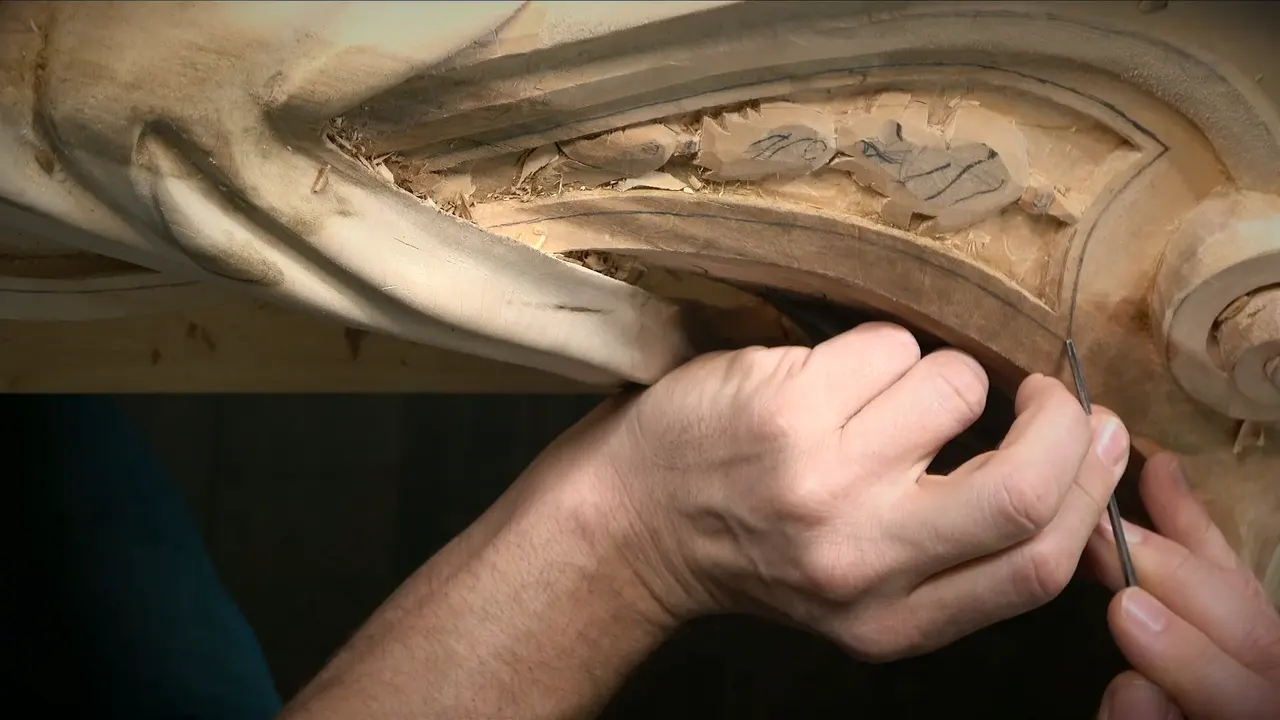

In workshop 93, part 1, I say "that is a big deal actually in design the math," and then "I don't wanna lose you in the mathematics." In my other lessons the word sits beside a middle line near the golden ratio, a lily petal, a gouge picked by eye and a straight line that is still a curve. Each one has its lines below, my own words first.
Ever drawn a line on a board and wondered where it should sit? Do you pick up a ruler, or do you trust your eye? Then these lessons will feel familiar. I start in Venice Room 93. After it I visit Venice Room 72, Venice Room 73, Hashemi Flowers, the Lily Box, Modern Acanthus, Roman Acanthus and a few more. Sizes come in both systems, inches and millimeters, with my own figure first.
Where does the word sit in my own part?
The video opens with "We do have straight lines and we are doing just by hand, which means I can not make any mistakes." One section goes first: "But I'll just do one section to show." A size follows: "Again, I've got about the three-sixteenth of an inch. About five millimeters." That makes 0.2 in.

Next, a plan for a course: "I am planning to do one of the courses on design." The rules are many, and the golden ratio is one of them: "But that's not the only rule." A next step is planned: "just learn how to draw what you intend to carve."
Of the drawing process for carving, the line is "It's absolutely different." A request comes after it. Comment below if you like the idea of a course on design only, which would be "somewhat in-depth."

Now the word: "I can overcomplicate stuff especially like a math, mathematics, and I know what I'm talking about because that is a big deal actually in design the math." Right after it: "And I don't wanna lose you in the mathematics."
Students belong to this too: "When I'm teaching in-person in Marc Adams School or other schools, you know, people like on the design process." Online, "we can take it to the drawing to train your hands." That thought closes with "a really, really good idea."

What does the work at the board look like after that?
The task is "a really nice cut with the one-millimeter veiner and not wiggle. That is the challenge." The tool is "the number 11 and one millimeter" (0.04 in). Then "Let me do it."
Placement: "I'm placing on the left side of my line closer to this ridge." A limit: "I'm not going to touch outside of the line on the right hand side." The pace: "Let me start and I have to do it really slow." And the light: "Usually, I really like to see through my lamp."

One gap gets watched: "this section is exactly One-eighth of an inch, Ok three millimeters." Then "That is what I'm after." In metric, one-eighth is 3.2 mm, and three millimeters is 0.12 in.
The motion is "I am doing little by little, I am creating a cut and then I'm stepping back a little bit." Another figure is "approximately about half an inch from the edge" (about 13 mm). Both sides get a look: "I am looking at both sides." And "this distance right here, really important."

Then "That is my first cut." More of the line has a place too: "the rest of it I will do off-camera." The reason given is "the same thing and that is not really interesting."

How does a middle line get its place?
In lesson 72, the plan for a middle line is "When I establish my middle line, I'm also trying to be authentic to golden ratio." Steps follow: "you divide that in 10." Then "Five parts on one side, five parts on another side, and you move six parts out of 10 either to that direction or that direction."
This time the move has a reason: "In this case, I move that direction because it makes sense." The number is "So 62 out of 100 to be exact." Next, "Let me write with something more comprehensible. So that would be 62 parts out of 100. So math is easy. So that is my middle line."

A tool follows: "I'll use number 11 and 5 millimeters, 3/16 of an inch. And I'm going to start my separation." The separation is a plan in that line, and a plan is all it is there.
In lesson 73 the numbers come with an eye. There I say "I'm not going to get too mathematical or geometrical", and then give the shares: "38%, and this would be 62% of 100." About the look: "This is a big eye, and there's going to be a lot smaller eye." And "really pleasing to the eye."

How much math goes into picking a gouge?
In Hashemi Flowers 11, the ninth video, the question is "how do I determine what tool should I grab". The reply is "I actually look at the piece of wood and approximately by eye, trying to guesstimate what tool is going to work the best in this section."
The word sits here: "There's not too much math involved in that." And "Just whatever looks good in this case." The tool that follows is "#5 and probably about 7/16 of an inch" (11 mm).

A flower is another matter. In Hashemi Flowers 35, the third video, I use "number five, by the way. One inch" (25.4 mm). A question about five parts gets this answer: "You can subdivide as many parts as you wish." My taste follows: "I like to be really close to nature, and it looks like in nature, the flowers, it's the really complicated math."
Next, the Fibonacci sequence: "I'm not saying that's the absolute truth, but as far as I know, it's always close to the Fibonacci number. At least if it's a small subdivisions like this." The door stays open: "If you don't like the idea of Fibonacci numbers, just feel free, create whatever you feel is going to look better."

Does a lily petal need mathematics?
In Lily Box 10, the second video, the lengths of the petals get this line: "all the petals, they're supposed to be really accurate. It's like mathematics." And "So there is no such a thing in a lily flower as one shorter, another one longer. They all have to be the same length." What differs is "how it curls and when it's going to stop."
The first video of that lesson has "we're going to measure from the central point all the way to the endpoint, and they're supposed to be absolutely equal." The word follows: "Mathematics, actually." And "it's true geometry."

In Lily Box 12, third video, the flowers are small: "My concern is to get equal amount of lines because it's like mathematics. Should say it's like a micro mathematics."
In the fourth video: "more geometrical, more mathematical, I would say, than just whatever the shape is." It ends on "So it's actually based on a true creation by the laws."

Is a straight line still a curve in math?
In Modern Acanthus 6, third video, my tool is "at the 45 degrees toward that line", used with "just the edge of my tool." A rule follows: "Remember what I said that the first day nothing is straight."
The match for "We do have straight lines" from my own part is "Even a straight line is a still curve in a nature even in math. There's no straight line in math. It's still curve." And "if it's a math based program, it's going to be called Curve." The last line there is "that is actually really important to understand."

Where does a grid come in?
In Roman Acanthus 1, the first video, I start with "I already applied paper right on the top of my piece of wood, and the block is about six inches by eight inches" (152 by 203 mm). The approach is "I call it the 10 parts division." Then "10 by 10. 10 parts by 10 parts." About it: "I think it's an excellent approach. It's almost mathematical, so easy."

A boundary follows: "I mark about 3/8 of an inch or 10 millimeters" (0.4 in), with "about 1/8 of an inch on the sides." The lines get numbers: "I'm going to number my lines." Next: "a lot easier actually for me to find the right space."
In Greek Acanthus 1, first video, a sheet of paper gets divided "in three parts". Of this plan: "the real simplistic way to find some golden ratio. Although it's not true golden ratio, okay? So it's a more mathematical way."
In Furniture Panel 2, the first video, a size is "3/16, half of the 10 millimeter, 5 millimeters" (0.2 in). Then "This approach, I would say, it's a more mathematical approach to the design." And "all the artistic people, the true masters of art or music, everyone is utilizing that principle."

Did the old carvers work from formulas?
In Curly Cutting Board 11, the second video has "don't take it too philosophically." Then "I don't think those ancient people, they thought about philosophy or math, how that curl's supposed to start and finish." A turn follows: "Yes and no, okay, so I have to take it back. In ancient Greece, they did." And "But in ancient Scandinavian countries, they did not. They didn't know anything about mathematics and the formulas."
Yet "if you look at those ancient carvings" they "still look really organic because you do have that feel inside of you, that feel of flow, all of those lines." A second view on the same ground sits in Furniture Panel 5, in the second video: "the true art is the real math, the real geometry, okay? And that's a true craft and that takes some knowledge."

Where else do I put numbers on a design?
In Tray of Blessing 8, third video, a question asks how many grapes to put in a bunch, and Fibonacci is part of it. My words are "a lot of people, they have no idea about Fibonacci." On the look: "pleasing to the eye. It's a golden ratio."
A size sits on that spot: "If it would be 10 units, let's say if it's 10 inches in the middle, it's gonna be five inches. Move it little bit, that's gonna become your six inches." Ten inches is 254 mm, five is 127 mm and six is 152 mm. My note: "Uh, just simplification." A caution sits there too: "Is it really important for people? Not really for a second." And "Most of the people don't even care about it."

In The Law of Creation, Golden Ratio 2, from the design course here, the question is "How to calculate the golden ratio?" My answer is "It's everything math. I'm not taking you to the level of depth." The class: "Because I've done it in one class in Mark Adams, about four years ago. We did all the design based on math. Everything was just calculation."
The Law of Rhythm in Nature lesson has "Everything based on math." It follows the Fibonacci repetitions and a comparison with music. A caution sits in the same lesson: "I do not want to overcomplicate, but there's one more law I want to tell." The school has a whole Principles of Design in Wood Carving course now.
Who taught me the math, and who asks for it?
During my April 2020 livestream, the lines in the questions and answers are "design process for me, it's a big deal. And I really am big about the spaces, the negative space, positive space, golden ratio, all the mathematics and stuff like this."
A story about a class follows: "I actually told about mathematics of design right in class. And with the whole class, we developed on a blackboard the design and design for woodcarving." And about my teacher: "My teacher, he was really big on design. All the mathematics, all the golden ratio, Fibonacci numbers, sequence, and all the movements, all the armature, law of space, law of rhythm and so on."
Teaching in person has a length: "It takes the whole week when I'm explaining the whole process of development." In another video of that livestream, about people who frame houses: "there's a lot of mathematics involved in a framer."
For plain definitions of the words that keep coming back here, Wikipedia has pages on mathematics, geometry, the golden ratio and the curve.
Which lesson holds which line?
| Lesson | Lines |
|---|---|
| Venice Room 93 | A big deal, and a design course. |
| Workshop 72, Venice | Middle line, six of ten, then 62. |
| Lesson 73, Venice | Not too mathematical, with a big eye. |
| Hashemi Flowers 11 | Not too much math in a gouge. |
| Hashemi Flowers 35 | Really complicated math in flowers, and Fibonacci. |
| Lily Box 10 | Petals of one length, and mathematics, actually. |
| Lily Box 12 | Equal amount of lines, and micro mathematics. |
| Modern Acanthus 6 | No straight line in math, only curve. |
| Roman Acanthus 1 | A 10 by 10 grid, almost mathematical. |
| Curly Board 11 | Scandinavian carvers who did not know formulas. |
| Tray of Blessing | Fibonacci for a bunch, and six inches. |
| Principles of Design | Everything just calculation, plus a design class. |
| April 2020 livestream | My teacher, big on design and mathematics. |
Is there a line on your own board that you would trust to a pencil before a gouge goes near it? These courses sit inside one tuition plan. The rest of workshop 93 waits on the Part 8 course page, and every part there has its own video.
How it's done
- Set the tool beside the line. I place the veiner on the left side of my line, closer to the ridge.
- Stay inside the line. I do not touch outside of the line on the right hand side.
- Go slow. The pace is "I have to do it really slow." Usually I like to see through my lamp.
- Watch one gap. The distance I am after is three millimeters (about 0.12 in), and I look at both sides.
- Step back between passes. The motion is a little at a time, with a small step back.
- Leave the rest for later. The rest is the same thing again, so I plan to do it off-camera.
Frequently asked questions
What do I say about math in workshop 93?
The line is "I can overcomplicate stuff especially like a math, mathematics." That is the line in my own video. A design-only course comes before it. Students at Marc Adams School come right after it.
How big is the gap I watch there?
One-eighth of an inch, which my part gives as three millimeters (3.2 mm). The veiner is a number 11 at one millimeter (0.04 in), and the line after it is "That is what I'm after."
How do I place a middle line near the golden ratio?
Lesson 72 divides the line in 10 and moves the middle six parts of ten one way. The exact share is 62 parts of 100, in my words "to be exact."
What to carve next