

Alexander Grabovetskiy, woodcarver, School of Woodcarving · Published 2020
What does a wood carver mean by "the big idea"?
Quick answer: Part 5 of workshop 93 puts the big idea after a talk about two concaves and one convex in small acanthus. Other lessons use the same words beside a first movement or a main shape, and for the frame around a flower, with every passage below.
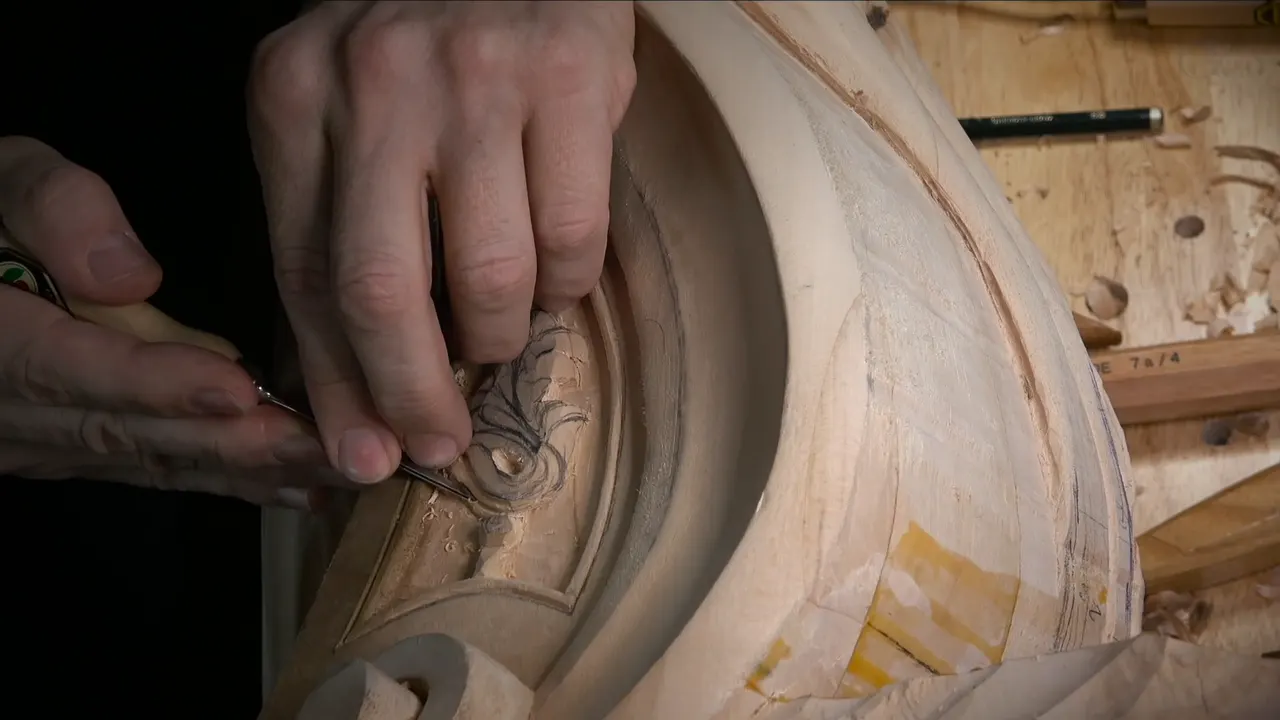

In workshop 93, part 5, the line "the big idea of acanthus" comes right after "To create that convex, I need to create two concaves." My Venice Room, Lily Box, Hashemi, Greek acanthus and Furniture Panel lessons carry the same words, and each passage has its place below.
Ever looked at a small carved detail and lost the large shape behind it? Does a frame of tiny marks ever hide what sits inside? Then you know why this phrase matters at my bench. We start in workshop 93, then visit the Lily Box course, Venice Room 110 and more. Sizes come in millimeters and inches, with my own figure first.
Where in part 5 is the big idea?
Close to the end. Before it, "it's still acanthus, and it is still the same Italian style acanthus, which means I have to have some kind of convex right inside." Right after, "To create that convex, I need to create two concaves."

One line names "the main idea." Then, in the next breath, "That is the big idea of acanthus." Smoothing comes last, "And to make it smoother, that convex, I'll just use a back bent."
Ahead of those sits "And if you would ask me why, it's the same idea what I've done on the big pieces."
What opens part 5?
The opening is "Now let's create a deeper undercut." Next, "And yes, that detail is actually a really nice detail." Columns enter the talk with "and yes, I still have to carve columns, inside of the columns, that's going to be exactly the same detail."

Which tools does part 5 name?
A small number three comes in the first plan, "So let me now take a small number three and create better detail." Another tool follows, "maybe a number five," at "like a quarter inch" (6.4 mm). A change of mind arrives with "I need something smaller than that," and the pick becomes "number five and 3 millimeters" (0.12 in).

"Just a stabbing cut" is the next beat. After it, "And I need to clean carefully," and for that job, "Let me use a mallet." The mallet sits beside "And number one, double bevel."
A new plan reads "maybe it's a good idea for me to use a background tool, which is called grounding tool." Its size is "1/16 of an inch, so it's 1.5 millimeters" (0.06 in). Then comes the verdict, "So it looks good" followed by "It does look good."

A bigger tool is next, "I need to clean it with a bigger tool," also a grounding tool, at "6 millimeters, quarter of an inch." Right after, "And I'll go right underneath of it." Next comes "I can probably undercut right away and hook out whatever the material is there."
What happens at the small notch?
The mood is "I'm somewhat happy with this part, even if it's not done yet." Next, "But let me kind of blend that first." A new spot appears with "And I do have a small notch in this small area."

Next comes "I'll take 1 millimeter, number 11, and make a relief cut" (0.04 in). After that, "probably the smaller number five." A knife is next. "I could use actually just a knife." Then "Number 12 knife," with the reason "That's going to give me much quicker result."
Why slow down for the concaves?
Two shapes are named, "the concaves and convexes," and one more line adds "such a small, tiny detail." A warning follows. "If I concentrate too long on it, I'm going to break it."

The tool is "just a micro tool," then a second thought, "Maybe I should take" one "about 1/8 of an inch, number eight" (about 3.2 mm). Light matters too: "I also don't see that well, so I need to make a little more lights shining in this area." One more line adds "kind of hard area to control."
The long plan reads "I want to carry that concave all the way almost to the end on one side," with "exactly the same thing on another side." Only after those two plans does the line about the big idea arrive.
Do the details wait for the big idea?
Lily Box 2, part 5, sets two ways side by side. One is to "concentrate on a small area like that and work on it until it's done, and then move on to the second area." The other is "I just think it's much better if you just concentrate on the overall picture, okay, on the main big idea."
Three short reasons sit nearby, "you can visualize all together," then "you really don't need to change the tool all the time," and "you're actually saving some time."
A void inside the wood shows in Lily Box 4, part 4, with "although I have inside of the wood, the void, so I need to make sure I deal with that." Then the words "let me recreate my main idea," and in the next breath "The big idea, the main movement." A little further on, "a little separation cut, and I can actually attack this side."

Furniture Panel 11 opens with "maybe I can start working on this area on the bottom of this panel just to get the big idea first." Smaller work waits. "we're going to move to the smallest details and all the flowers I want to add in this area."
Greek Acanthus 2 (part 3) gives the stage a name. First, "just attacking that from both sides, just removing the chunks," and "Later on, it's going to be undercut." Then "this stage called just setting or setting in" and "we're just establishing the main idea, the big idea."

Does the big idea start as a first movement or a main shape?
Byzantine Acanthus 1, part 1, has "we're going to create the first movement." The next words are "My first swirl, or the first big idea, if you wish, the movement." The leaf gets a mention too. "I don't want to overcomplicate, but it's still a leaf, just a normal leaf. It just twists." The picture ends on "full 3D."

Part 3 of Venice Room 20 has "the main idea is to catch the main shape." It continues with "The main shape of the movement." The line that closes it is "That's the main big idea."
A preliminary pass shows in Venice Room 58, part 8, with "those cuts are preliminary cuts. So they are not clean." The aim is "just trying to establish the big picture, if you wish. The big idea."

Which leaf, stem or flower gets the big idea?
Grape leaves vase 1, part 5, has "the stem," and right behind it, "the big idea." Later, "this leaf goes up and the opposite direction."

Dining Table Apron, workshop 14, has "Just to follow the main idea, whatever the original carver did. Main idea is the big idea." Close by, "this leaf, this one goes underneath of that one."
Venice Room 103 (part 2) has "So it has to make sense. Now it doesn't." Then "The big idea, what I have, this has to just continue underneath of my drop." A later line reads "I need to figure out what's going to look good."

In Floral and Molding for the Panel 10, part 1, comes a plan, "let me work on that movement first," with "pretty much wrap all around that molding." Another line says "The big idea is it's just going to follow pretty much whatever the curves, whatever the shape I have of this clover molding."
Hazelnuts 3 (part 3) holds "dramatic letter S curvature" as a line of its own. Then comes "The big idea without the details yet." And later, "each lobe going to have its own multiple subdivisions."

Lily Box 11, part 4, offers two lines. The first is "on this flower, I really should not do any mistakes because this is a central focus point. It's like a big idea for overall." The second sits later. "We're getting the big idea in place, and I'm really happy that we really got close to the original."
Over in Hashemi 28, part 1, comes "I hope everybody does understand what I do have in mind, like a big idea." Next, "the biggest one, and the three smaller ones." Then "Idea is the same."
How do I frame the big idea?
Venice Room 110 (part 3) has "every little detail helps." Then "I told you the main, the big idea is here, and those flowers are big, and I need to frame it somehow." After that, "a lot lesser details than on the flowers" that "just work as a frame around."

A lighter side is the plan in Venice Room 142, part 3, with "I want to make this side a little lighter." The reason given is "bunch of flowers" and "the main guy in this section, the big idea in this section, and I don't want to overwhelm with that detail."
On the shadow, Venice Room 56, part 4, has "that the shadow around the big idea," and "a framing for fine art piece." The lines "So it just surrounds" and "So shadow's really important" come one after the other.

Over in Venice Room 109, part 2, comes "the big idea, the big hero of this part is this." A few lines on come "I can actually create that separation cut" and "this part going to go underneath of that line," one after the other.
Does the carving show the big idea?
Next in line is Venice Room 146 (part 1), with "Number seven," and then "And that is the big idea." Then a deeper plan follows, "get that excavation deeper and cleaner," then "But not too deep," and the note "It's already giving me beautiful shadow."

Plans for 3D form sit in Venice Room 152 (part 1), with "let me establish 3D form first." Next, "probably just the number 2," then "you should be able to see the big idea." Earlier, "That's what I'm after, architectural look."

What moves the big idea to the board?
In Venice Room 104, part 1, the line is "especially for the big parts because sometimes it's challenging just to transfer the big idea right on the board." The old way reads "long time ago, like few years ago, I would take a big piece of paper and stretch it and just draw everything by hand." Then "Lately, I am using technology, okay?"
What does the letter S have to do with the big idea?
Design Principles for Wood Carving 4, part 2, asks "So should I put my arc right here or should it be on this side?" The answer is "Absolutely on the bottom." After it, "It's going to go like this and letter S." And "why do we do that letter S? To support the big idea." Its last line says "I know now this one grows down just because of that letter S."
Design Principles 2 (part 3) offers "There's the two more golden spots." Then "They're not the big idea," "but they're still important," and "We can't ignore them."
For the plain meanings of the words I keep using, Wikipedia has pages on gouge, chisel, knife, columns, relief, bevel, grain, Venice, Byzantine work and wood carving.
Which lesson holds which big idea line?
| Lesson | Lines |
|---|---|
| Part 93.5 | Two concaves for a convex, in small acanthus. |
| Lily 2.5 | Overall picture first, fewer tool changes. |
| Lily 4.4 | A void inside the wood, then a movement. |
| Lily Flower 11.4 | A flower with a central focus. |
| Panel 11.1 | The bottom of the panel, before small details. |
| Greek 2.3 | Chunks removed from both sides at setting in. |
| Byzantine 1.1 | A swirl that twists into full 3D. |
| Room 20.3 | The main shape of one movement. |
| Venice 56.4 | Shadow around the piece, like a frame for fine art. |
| Room 58.8 | Preliminary work that is not clean yet. |
| Venice 103.2 | One shape continues underneath a drop. |
| Workshop 104.1 | The old paper way, and technology now. |
| Lesson 109.2 | A hero part with a separation beside it. |
| Workshop 110.3 | Smaller details placed around big flowers. |
| Lesson 142.3 | One side planned a little lighter. |
| Class 146.1 | Seven comes first, with a deeper excavation planned. |
| Class 152.1 | A plan for 3D form, with a number two. |
| Apron 14 | Following what the original carver did. |
| Molding 10.1 | A movement wrapping around a clover molding. |
| Hashemi 28.1 | Flowers, one large and three small. |
| Hazelnuts 3.3 | Each lobe, then its own subdivisions. |
| Grape Vase 1.5 | A stem, then leaves in two directions. |
| Design 4.2 | An arc on the bottom, shaped like an S. |
| Design 2.3 | Two golden spots that still matter. |
Does one big shape on your board ever sit under a pile of small details? Then you know the picture I mean. These courses sit inside one tuition plan. For gouge care, the sharpening course has its own lessons. The rest of workshop 93 waits on the Part 8 course page, with lesson 92 and lesson 94 beside it.
How it's done
- Deepen the undercut. Part 5 opens with a deeper undercut.
- Pick a smaller tool. The number five is picked again at a narrower size before the stabbing cut.
- Carry the concave. A relief cut at the small notch is planned, with a concave carried almost to the end on one side after it.
- Make two concaves. Two concaves are needed to create the convex.
- Smooth the convex. A back bent is the planned tool for a smoother convex.
Frequently asked questions
Which lines come before the big idea?
A line about a little detail that is still acanthus comes first. Then a line about two concaves and one convex. The words "the main idea" follow, and straight after them the words about acanthus. A back bent for smoothing the convex is next.
Which sizes appear in part 5?
Five at a quarter inch (6.4 mm) and again at 3 mm (0.12 in). An 11 at 1 mm (0.04 in), a 12 knife, and an eight near 1/8 inch (about 3.2 mm). Two grounding tools show up too, at 1.5 mm (0.06 in) and 6 mm (0.24 in).
Which choice does the first Lily Box lesson make about the overall picture?
In part 5, one small area at a time sits beside the whole piece. The choice goes to the overall picture. Three short reasons follow, among them fewer changes of tool and some saved time.
What to carve next