

Alexander Grabovetskiy, woodcarver, School of Woodcarving · Published 2020
What does a wood carver mean by "much bigger"?
Quick answer: In workshop 93, part 3, I draw a boat, then a dot, then a bigger boat, and I say "much bigger" in the same part. My Lily Box, Venice Room, Furniture Panel and Grinling Gibbons lessons use the same two words for flowers, shells, curls and screens, with the lines for each below.
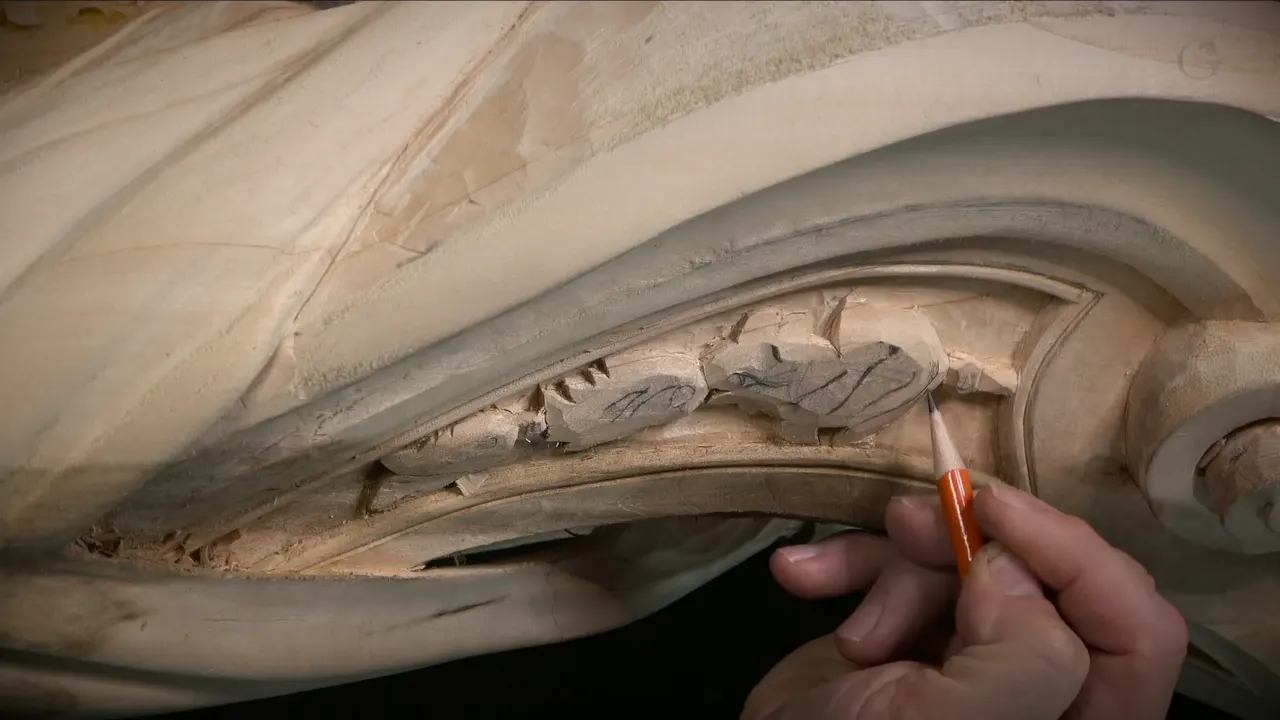

In workshop 93, part 3, I draw a boat on my canvas and say "a much bigger object," and then "look and feel a much bigger." My Lily Box, Venice Room, Furniture Panel and Grinling Gibbons lessons use the same two words, and each one has its lines below.
Ever held a carved leaf at arm's length and wondered how big it really is? Do you judge it by whatever sits beside it? Then this page will feel familiar. I start in workshop 93 and visit Lily Box 8, Venice Room 26, Butterflies 4 and more. Sizes come in inches and millimeters, my own figure first.
Which lines come before the boat?
The part opens with "I am ready to work very much in this area right here." Two plans come next, "I want to create the details" and "I am going to work just on this part." One reason follows at once, "because it's for me, it's easy to get the camera angle."

Another line reads "I will follow whatever I had in mind on my computer, that is exactly what I'm going to do." I also say "I want to make sure I'm not losing any details" and "I will have to fix some stuff."
Drawing comes next, "let me draw that and I'll see you after that." The rules, in my words, are "exactly the same, what they've done on the big details, except this is kind of a somewhat tiny, tiny detail."
Why does a tiny detail matter on a big piece?
My own question is "why is that important?" Then "if you follow my logic of feel of space or law of space, you will understand exactly what I mean." In my words it is "one of the rules and design," with "positioning certain sizes inside of the space you want to feel."
For a picture I point to the work of Chinese fine artists, "antique work, not today's work." One scene has "a huge, huge, huge, like nature like mountains and a lot of trees," and then "just the small, small, small, tiny house somewhere right in the corner."
How does a boat show the size of a boat?
My example is "just like a boat." The plan is "let me draw just the boat all right," and then "That is just the boat." Then comes my question, "what size is that boat?" My note on the boat is "just like fisher's boat."

Again I ask, "can you tell from that picture how big is that boat?" Then "I use just a small amount of space on my canvas right now."
Before the boat I say "those of you who took my lessons in person," and then "they know what I mean by that." When I was teaching, I asked that question multiple times, and "some people say, oh, it's 12 feet boat" (3.7 m) and "like 14 feet boat" (4.3 m). My reply is "But how do you know, maybe it's not that big, maybe it's not that small."
What happens when I put a dot beside it?
A plan comes first, "Let's see if I going to put the small DOT just like this," and "Right, right on side of it." After the dot, "this big boat becomes huge," and "that becomes really, really big." The reason is short, "Just because they have a small item."

The other way round starts with "on the other hand," and then "if I will place another object, a much bigger object." The next words are "On the background, much bigger boat, let's say," and then "let's make some fun, huge boat."

Next I say "then the previous boat, the first, but this one is a small boat, but you really can't tell a size until you place another object." My line for two objects is "if you place a small object like object number two, like a small object, then becomes big." The other case reads "But if you put a bigger object, besides that, it becomes small."
Where do the small leaves fit?
Near the end I say "That is exactly what I'm trying to do in this section," and my plan is "placing just the small objects inside to make it look like it's huge." Then "It's huge itself, but I can make it will look and feel a much bigger."

My words about the leaves are "those small acanthus leaves, they really tiny," and "They're going to just, you know, fulfill my LAW of space." My last line of the part is "They're going to work for me."
Which tool in part 4 gets much bigger?
The same words reach a gouge in part 4 of workshop 93. The first plan is "I'll take number 11 and two millimeters" (0.08 in). Then "Actually, you know what? I can actually take right away a much bigger one." The size is "I can take five millimeters 11" (0.2 in), with "excavate first that deep spot right here."
A smaller gouge follows, "Although this is a little too big, I'll take three millimeters" (0.12 in), and then "And two millimeters to clean that" (0.08 in).
How do small notches make a flower look much bigger?
Lily Box 8, part 5, has "there is a law in design. If you have to make a focal point, like a big item," with a flower as the big item "in my case."

Then "in real life, this flower is bigger, much bigger. So all I have, maybe about three inches right here" (76 mm). My line for the work is "I want to make sure the appearance of this flower is much bigger, and I have to surround all around with the smaller items."
The result, in my words, is "the bigger item going to pop out a lot more." My reason is "That's why I'm putting a lot of subdivisions, a lot of notches, and so on." The close is "It's going to make sense once you see altogether how it looks."
Can an undercut make a curl look much bigger?
Lily Box 10, part 8, has "Let me get my marker, and I'll try to figure out what I can do." My plan for the sides is "remove and undercut underneath both sides." The line for the result is "visually that is much bigger just because it curls."

A gouge size follows, "I'll take 3 millimeters. No, it's actually 3/32nds. I apologize." A 3/32 in gouge is 2.4 mm. Then I say "A couple millimeters," and last of all "Number eight."
Does a gouge ever feel much bigger?
Part 10 of Venice Room 26 has "I'm using number 11 and 10 millimeters, three-eighths of an inch" (0.39 in and 9.5 mm). Then "At least that's what it's marked, but it feels much bigger. It feels more like a half an inch" (13 mm).

Then "Well, it is three-eighths, if you get closer to the edge, that's three-eighths right there, but it's wider a little bit on the outside."
Which other tools do I call much bigger?
Carving Hazelnuts 3, part 1, holds "So I need to get little bigger number 11." Then "Still number 11, but 12 millimeters" (0.47 in). In Hazelnuts 4, part 2, I say "I probably should use a much bigger tool." The size there is "still number nine, but that would be 10 millimeters" (about 0.4 in). Then "it's a fishtail."
The words "And I could actually use a much bigger back bent" are in Venice Room 38, part 2. In Venice Room 20, part 5, comes "this eye could be much bigger," and then "I can use number nine and a quarter inch" (6.4 mm).
Where does much bigger mean scale?
Carving Grape Onlay 8, part 3, has "But it's a much bigger scale." Then "But you can obviously see all of those separations."
Which Venice Room lines use much bigger for a hollow?
In Venice Room 14, part 12, I say "But I still think I should give a much bigger concave right here. I want to raise this edge even more." Over in Venice Room 16, part 10, comes "just to create much bigger concave right here," and "I'm not going to lose overall picture."
In part 5 of Venice Room 25 I say "Maybe it's a little too high. Maybe I should move this direction a little more. But that way, this leaf is going to be much bigger."
What goes on top of the shell?
Venice Room 24, part 10, has "Originally, I want to leave like a half an inch extra material" (13 mm). Next come "It looks like I have about 3/8 of an inch, the max, 10 millimeters" (0.39 in) and "just leave a 10 millimeters."

About the shell I say "this is going to be a much bigger shell," and about the movement "but much bigger." Then "this going to go on top of my shell."
Where do 60 and 40 come in?
Butterflies 4, part 2, has "And this one goes opposite direction." The curls get "about 60%" and "about 40%." After that, "And you can feel a lot of space with movements like that."

About a small curl I say "I can make this one a little bigger actually much bigger." Then "And this one's gonna be little slightly bigger, too," and "again 60 40." Then "there's gonna be some space between each of those."
My plan for one line is "going to go to about 1/8 of an inch about three millimeters to this line" (3.2 mm).
When does an opening become much bigger?
Grinling Gibbons class 13, part 1, has "I am all the way through." Then "Can you see that became much bigger?" followed by "that opening" and "much bigger."

Next I say "look from above I see that dark spot. That's what I'm after." I add "just gives me an extra shadow." And "But it's not enough for me."

Grinling Gibbons class 14, part 1, has "I would like to create much bigger opening maybe even," and then "Just to create dark spot." From Venice Room 45, part 1, comes "Maybe I have to create a much bigger opening," followed by "Do I have to?"
What do I say about a screen and real life?
Furniture Panel 24, part 4, has "And remember, that is a really low relief. What you see on the camera, it's much bigger than in real life." The depth between the highest spot and the low spot gets "like 1 millimeter, I would say, like 1/32 of an inch maybe" (1 mm is 0.04 in, and 1/32 in is 0.8 mm). Then "Really not much," and "that's why I'm just trying to be as careful as I can, because I do not want to damage it."

Furniture Panel 20, part 11, has "even if you looked at on your phone, and it looks huge, much bigger than what is in real life." Next, "But we're talking about tiny spots." And "Even if it looks huge on TV or computer, I really don't have too much in real life."

In Acanthus over Moldings 7, part 1, I say "my apologies people what you see, it's not what I see." Then "If you watching of course on full screen," and "It's much bigger."
What happens to a big flower beside a much bigger flower?
Design lesson 3, part 2, has "What surrounds cannot be the same size" and "You should not repeat the same size on one canvas." I add "But what surrounds makes big difference." Then "Now you can see that flower is a big flower." The last picture is "if I would put much bigger flower around that flower, that would become a small flower."

For plain meanings of the words I keep using, Wikipedia has pages on gouges, boats, flowers, relief and wood carving.
Which lesson holds which line?
| Lesson | Lines |
|---|---|
| Workshop 93.3 | A boat, a dot, and small leaves. |
| Workshop 93.4 | A much bigger gouge for a deep spot. |
| Lily 8.5 | Small notches around a big flower. |
| Lily 10.8 | An undercut on both sides, and a curl. |
| Venice 26.10 | A gouge that feels bigger than its mark. |
| Venice 24.10 | A shell on top of a shell. |
| Hazelnuts 4.2 | A fishtail of 10 millimeters (0.4 in). |
| Butterflies 4.2 | Sixty and forty, with space between. |
| Gibbons 13.1 | An opening, a dark spot, and a shadow. |
| Panel 24.4 | A camera, and a low relief. |
| Panel 20.11 | A phone screen, and tiny spots. |
| Design 3.2 | A big flower and a small flower. |
Is there a leaf on your own board that looks small beside a big one? Then look at what sits next to it before the tool goes in. These courses sit inside one tuition plan. For gouge care, the sharpening course has its own lessons. The rest of workshop 93 waits on the Part 8 course page, with lesson 92 and lesson 94 beside it.
How it's done
- Draw one boat. I draw one boat, and then I ask what size it is.
- Add the dot. A small dot goes right on side of it, and then "this big boat becomes huge."
- Add a bigger boat. If a much bigger boat goes "On the background," then "this one is a small boat."
- Place small objects inside. The plan is "to make it look like it's huge."
- Set the small leaves. Those leaves are "really tiny," in my words.
- Surround a big flower. In the Lily lesson, a flower is the big item "in my case," with smaller items around it.
Frequently asked questions
Where in workshop 93 does much bigger appear?
In the boat talk of part 3, near its end. Part 4 has one more, "I can actually take right away a much bigger one," and it is about a number 11 at 5 mm (0.2 in).
How big is the boat in my drawing?
My question is "what size is that boat?" Some people guess "12 feet boat" (3.7 m) or "like 14 feet boat" (4.3 m), and my reply is "But how do you know." The picture carries the point, in my words "you really can't tell a size."
Which painters do I point to?
I point to "the work of Chinese fine artists," "antique work, not today's work." The small thing in that picture is a "tiny house somewhere right in the corner."
What to carve next