

Alexander Grabovetskiy, woodcarver, School of Woodcarving · Published 2020
What does a wood carver mean by "one of the techniques"?
Quick answer: In workshop 93, part 11, one cue reads "it's just one of the techniques" and the cues after it read "to exaggerate" and "the scale." Many of my lessons say these words beside a tool, a shape or a plan. Each lesson is linked below.
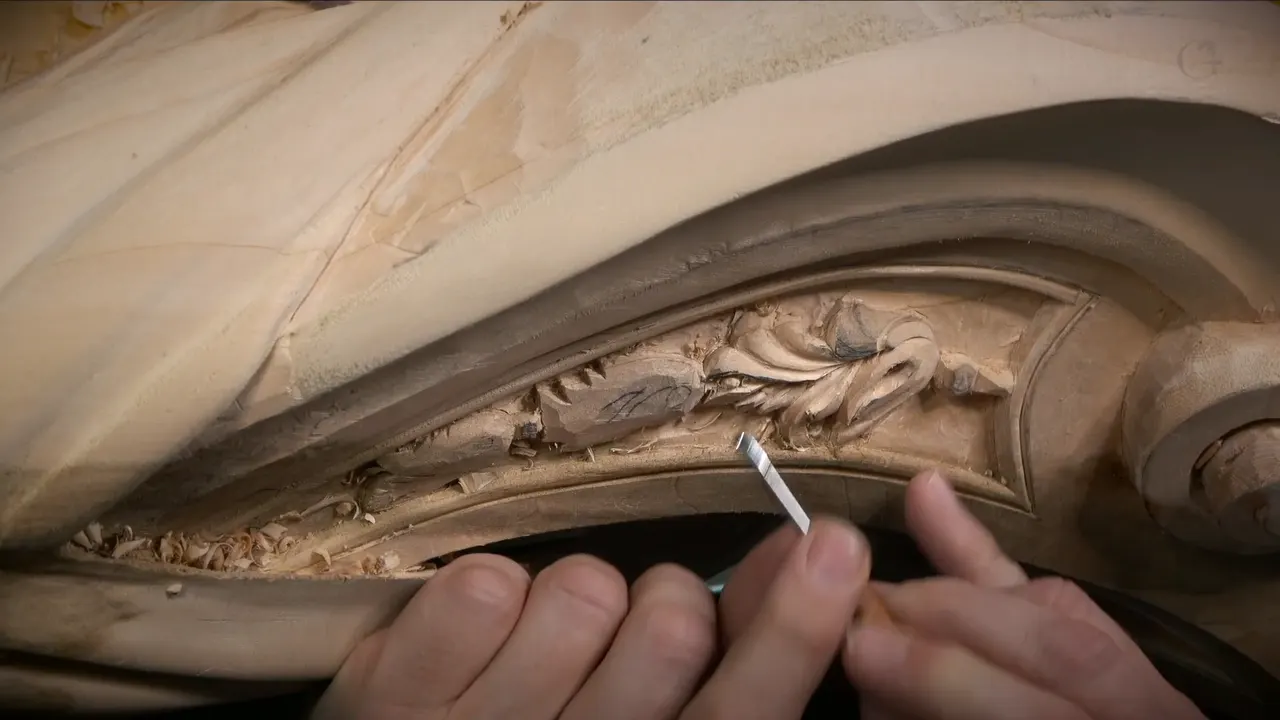

Workshop 93, part 11, has a line about techniques in the stretch about an eye and a pipe. The same words sit in many lessons of mine, next to tools, shapes and plans. Each lesson is linked below.
Have you ever finished a shape and wondered what the last part of it should get? You can find them in part 11 of workshop 93, with a tool and a spot around them. The lessons below show the same phrase again.
How does part 11 begin?
The part opens with "Clean it again." Then comes "Let me leave it like that, at least for now." A small sphere is in the next lines: "detail, small sphere, I can probably take care" and "and make it even more round with a small tool like that." Another tool has a word of its own, "Just whatever fits."
A knife is in the plan next: "Let me also use the edge of my knife" and "and clean this edge."

What is the last part, and what is planned for it?
A turn follows: "There you go. So now, what I do have," and then "I have the last part." Another cue adds "But this last part," and "I don't want to mess it up. What I could do with this" so the options come next: "I could create some kind of eye."
Two tools get their own words: "same tool, like number eight," and "and then I'll switch" and "to one millimeter," (0.04 inch) and "number 11."

Two more options are named before the eye gets its depth: "details underneath right here, but I really don't need to." Then "What I can do, I can actually bring this part" with "toward" and "bigger section." after it. A gouge is in the plan too: "Just use number five" and "do a movement like that."
What does the harsh line change in part 11?
A verdict sits at the start of this stretch: "It looks like my previous cut was too harsh." Then "The knife cut. See that line? Which is okay, I guess, because" and a wish, "I wish I didn't" and "do that harsh cut, but I did because" and the cue "detail." closes it. A short pair goes with it: "So because of the change." and "That's all right."

How deep does the eye go?
Depth is in the cues "Okay, let me use again," and "one millimeter" (0.04 in) and "and excavate much deeper." A smaller size follows: "And maybe even half a millimeter." (0.02 in) The end of the pass sits in "And excavate all the way to the background." Then come "All right, then I'm right there." and "Okay, that's good."

Why does an eye get a pipe?
The reason is in "And just because it is eye," and "so logically, I have to have a pipe." The spot is "here." with "my concave cut" and "going to be my" and "pipe." The limit is "But I don't want to create too" and "deep of a" and "cut." The line goes on with "concave cut all the way," and "somewhere right there."
Blending comes next, in "And let me blend" and "upside down." and "I'm using this number five."

What sits beside the phrase in part 11?
Before it sit "And now it feels like it's actually growing from underneath." and "because I had a bunch of small cuts on this side, but I had to." Then come "Again," and the phrase itself, and then "to exaggerate" and "the scale."
The lessons below keep the phrase company with other spots.

What happens to the round part at the end of part 11?
A new spot starts with "And what I'm going to do now," and then "and round this part. It's also like a separate" with "part almost." Another tool is in the plan, "But how I want to do it," and "maybe with the knife again."
The knife meets a limit: "it's not" and "really" and "convenient for me" then "because you can see, this part is really high and I really" and "can't do anything with the knife pretty much." A turn and a new plan follow: "So I have to think differently." and "So I'll use probably just the back bend."

Size and spot are in "All right. I can use just the back bend of six millimeters" (0.24 in) and "and going to use just the corner of it." The cues "Just the" and "corner." close the line.
Near the end: "use the same tool. My apologies if you don't" and "see that." Later "And kind of use that same back bend just to create" and "cut like this." The part ends on "And I'll take number five again" and "and kind of blend everything."
Part 12 of the same workshop starts with "At least I'll try." Then "So now you should be able to see" and "the overall idea." Later comes "But anyway, so this is the idea,"


Where else do the words show up in my lessons?
Take Furniture Panel 21, video 4. The lines read "think which tool I should use for scraping" and "this side," and the reason is "and I'll be able to see the high spots and low spots." Next is "Do I need to scrape it? Oh, no, absolutely not." The phrase follows, with "don't use it a lot, but I think I like it."

A size is named first in Furniture Panel 16, video 12: "Number seven and 14 millimeters is what I'm using, okay?" (0.55 in) Then "It's not exactly the same profile." and "That's much bigger, but just because I" with "angle" after it, then "my tool like this, so I'm able to use just a part of" and "my tool, and I can actually get really close to" and "the profile I need to. Okay?" After "So that's" comes the phrase.

The plan in Furniture Panel 20, video 4, is "Going to use the same tool," and "Going to start" and "undercutting process." Next is the cue with the phrase, then "There's multiple ways you could do that," and "but I like that technique." A size comes next: "Use half a millimeter and cut" (0.02 in) and "all around." One more line says "It's not too many spots I can undercut," and the result is named in "but it does create a" and "beautiful" and "shadow, I should say. Okay." A shadow is what the words point to.

A volute is the subject of Furniture Panel 9, video 3: "this volute look a little thicker." The goal is "We're going to give it a more three-dimensional feel." Then "That's" and the phrase after it, and "in 18th, 19th century, and even later, just to make it" and "look like" and "it's a 3D."

Shadow shows in the words of Byzantine Acanthus 10, video 3: "What's going to happen, it's going to cast some shadow, okay?" Then a cue with the phrase ends "by the way." Two cues after it name a wood: "You could use just a different species of wood," and "like a darker wood, like oak or cherry." The oak is in the words.

Modern Acanthus 7, video 2, sits in a start: "Okay. All right, and I gonna just start my" and "excavation just like that." Right after "excavation just like that." comes the phrase. The tool and the angle are in "number seven and present that also" and "somewhat like an angle and you start your" and "excavation process like this." A thickness plan follows: "later on no more than" and "maybe a quarter inch or maybe a" and "3/8 of an inch overall thickness, but everything" (6.35 mm and 9.5 mm).

A design with two sides is in Workshop 60, video 12: "side of that design, I'm talking about in" and "about the same, but it's going to flip. Okay?" A few cues later the phrase is said. A movement is named next: "I think this is going to be" and "really interesting movement. This one, okay? This." with "It is not acanthus," beside it. The acanthus is the leaf the words rule out.

A mid-moulding starts in Workshop 6, video 6: "I am ready to create my mid-moulding." Two cues set it up, "A couple of ways I could do." and "Let me try first" and then the phrase, spoken in the singular. Next comes "quick way." with "number eight" and "backbend," in the tool list. The mid-moulding is the shape the words are about.

The subject in Roman Acanthus 16, video 3, is furniture: "By the way, in furniture carving," and "in the furniture, and if it's a low relief carving," Then one cue carries the phrase and "to make it more", followed by "three-dimensional." The move is in "hit the edge," The relief in the words is a low one.

Hashemi 49, video 8, has a plan: "Let me also do multiple concaves at" and "the same time. It's also another technique" and "when you're working on the flower, and if you're doing commercial and you have to" and "do a lot of work." One cue has the phrase and ends "use same tool as", and the next reads "much as possible until there's nothing to cut," and then "and then move on another one. Okay?" The size is "five millimeters, number eight." (0.2 in) Then "I'll come back and undercut".

Another volute plan sits in Furniture Panel 14, video 4: "And again, I'll do a small volute." then "A lot of volutes." and "common techniques," with "to put a lot" and "of volutes." Then "I still kind of don't like how empty that spot" and "is. And maybe I can just create another" and "twist."

An eye gets a spot in Workshop 162, video 3: "my eye, the eye of acanthus," and "of that separation, my future separation," and "going upward, just uphill underneath." Next come "this area. Okay?" and then "And that is just" and then the phrase, with "they used just because it looks beautiful" and "and it actually simplifies the job of" and "undercutting."

Gold leaves are in the words of Workshop 163, video 1: "inside of the cracks of the gold leaves, you can see the red" with "clay." after it. Before them sit "But to get inside and make it smooth," and "they didn't want to do too crazy underneath." A cue holding the phrase comes before "And I think it's really interesting that they developed" and "that approach" and "So I think it's really, really smart what they did."
A dome is the spot in Furniture Panel 23, video 6: "But there is another technique," and "which I think is a really cool technique." The spot is a dome: "And I could leave" and "this dome just like how it looks right now." After the dome comes "So I can create a small excavation" and "where that flower pointing." The tool is "gouge, like one millimeter, number eight," (0.04 in) and the result is "It just gives me" and "extra movement, I would say. Okay, if you wish."

Video 9 of the same lesson has a plan too: "So in this case, I'll take" and "one eighth of an inch" (3 mm) and then "Yes, there is a couple techniques" and "possible to use in case like that. You can actually" and "place your tool straight down like that" and "make the rotation movement" then "but don't do too much, and crank it, and" and "take it out. Okay? Those are like small plugs." A depth is named: "a 16th of an inch" (1.6 mm) and "deep cut." A last line reads "So I use that technique a lot actually, on".

These words are also in Furniture Panel 19, video 1: "And I like that way better than the sandpaper" and "because it doesn't leave any" and "abrasive inside of the wood. Okay?" After them come "I'm just demonstrating that for the sake of just showing the different" and "techniques, not that I'm going to do that everywhere, but" and "still, if you like really smooth look, that's probably the way" and "to go."
Tool numbers are named in Workshop 46, video 3: "number 11 technique, you can go really deep," Then "finishing it."

Which lessons share the phrase, and what sits beside it?
| Spot | Words beside the phrase |
|---|---|
| A pipe on an eye | A line about the scale, and a blend upside down |
| Scraping | Which tool, and the high and low spots |
| An angled tool | Held so a part of number seven reaches the profile |
| Undercutting | A shadow, and a pass all around |
| How thick a volute looks | A more three-dimensional feel, as in the 18th and 19th century |
| Wood for a background | Some shadow, and a different species of wood |
| Starting an excavation | Tilted like an angle, with number seven |
| A flipped design | About the same, but it flips |
| The quick way | A mid-moulding, a couple of ways, and a backbend |
| A low relief | A furniture carving, and a hit on the edge |
| Many concaves at once | The same tool as much as possible |
| Lots of volutes | How empty a spot is, and another twist |
| An uphill separation | The eye of acanthus, and less to undercut |
| A smooth inside | Not too crazy underneath, and the gold leaves |
| A dome | A small spot at one side, and extra movement |
| Plugs | Straight down, turned, and taken out |
| Going deep | A number 11, and a really nice transition |
Is there a spot on your own carving where one way of working is not enough? You will find workshop 93 inside one tuition plan, with the rest of the Venice Room, Part 8, in the Venetian style. Workshop 92 sits before it, and workshop 94 follows.
How it's done
- Plan the eye. An eye is the plan for the last part, starting from number eight, then number 11.
- Go down toward the background. A deeper pass is next, then a still smaller size, down to the background.
- Add a pipe to the eye. A concave is the pipe, planned not too deep, and taken to a spot right there.
- Blend upside down. Number five, held upside down, is the tool for the blend.
- Round the high part with a back bend. A knife does not work on a part that is really high, so the plan is the back bend.
Frequently asked questions
What is said right after the phrase?
Two short cues, "to exaggerate" and then "the scale."
Which tool is planned for the round part, and which part of it?
A back bend of six millimeters (0.24 in), with "just the corner of it" in the plan.
Which tools are planned for the eye?
The first is number eight, with a switch to number 11 in the plan.
Where else do the words sit beside a tool and an angle?
What to carve next