

Alexander Grabovetskiy, woodcarver, School of Woodcarving · Published 2020
What does a wood carver mean by "magnifier lamp"?
Quick answer: In workshop 93, part 12, one cue reads "We're going to use probably magnifier lamp and clean it a little" and the cue after it reads "better,". Other lessons of mine say the same words beside dark wood, tiny details, color, sound and filming. Each lesson is linked below.
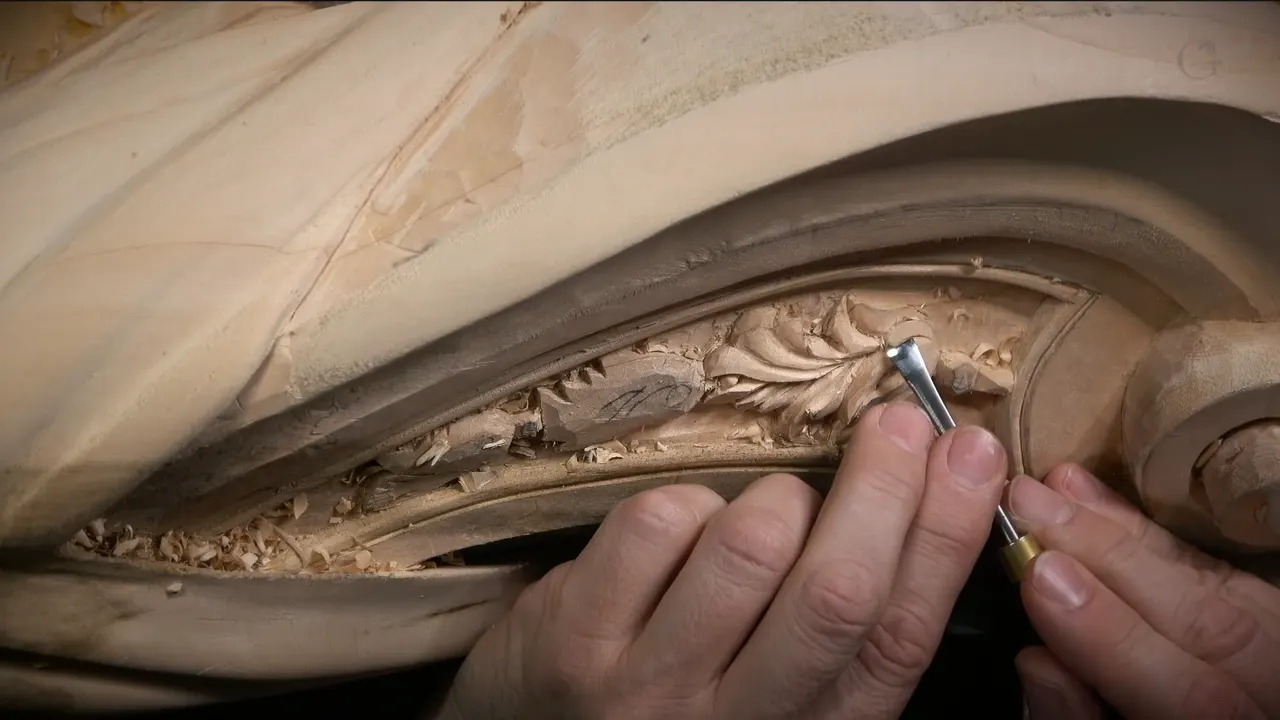

Workshop 93, part 12, plans a close clean-up under the magnifier lamp. Other lessons of mine hold the phrase beside dark wood, tiny details, sound, color and filming. Each lesson is linked below.
Have you ever looked at a small spot on your own piece and wished for a closer look? The plan sits in part 12 of workshop 93, and it names a lamp. More lessons follow.
Where does the magnifier lamp sit in part 12?
More time is the first plan, "a little more time, a little closer." The lamp is there in "magnifier lamp", then "better," and after a short gap "you'll see that a little" and "cleaner", with "after that." to close it.

The same move is planned for other spots, "exactly the same right here, right there, and on that side." A result is named too, "That is the result" with "I'm after." beside it. Next: "There's a bunch of chips yet I need to", "clean."

What was done off camera in part 12?
Short lines carry this one. "What I did, I actually changed slightly. Okay." Next, "I did that off camera, and there's a reason why." The change is "I actually got rid of those extra lines in this area." Three small cues spread the reason, "I just" plus "didn't like" with "how it looked. It was just a little too sharp."
Two pieces are named, "And I've done those two pieces also." A clean-up still waits, "Yes, of course, I will clean it" then "before it's going to be final look." Next comes "I tried a little bit to soften up in this area, and" and "I think it looks good. I think it just", "looks absolutely fine." The last check is "I checked from different angles, and I like it."
How does the background get its texture?
A new job opens with "work on my background. Okay." About the ground itself the lines read "I lowered that down," next, "but I didn't really worry about" and "make it super clean" and the cue "texture." closes the thought.
Tools come next. "And to give that texture,", "punches what I used previously," then "those four punches. Actually,". The set is spelled out: "So there's, like I said, four of them," plus "there's a square one and--" with "No, rectangular, and the two round ones. Okay."

The round ones and a small one are named for each punch. "most of the time," then "and this small one, okay, to get inside of the" and "corners." Then the work begins: "And let me start.", "There is nothing special about it." During the taps the lines are "Just punch the background. And while I'm punching, I'm" next, "actually making rotation movement, okay," and "just to get my pattern different directions."

A smaller tool is needed later: "And right here,", "smaller punch," plus "and I'll use just the rectangle one." Two sets enter the talk too. "Maybe" with "it's a good idea to get" then "two sets" and "reshape some of them to make it smaller" The stretch ends on "It fits pretty much", "in most of the visible areas."

How does the ground look after the punches?
The lines come in pieces. "But you can see it gives me a really beautiful" next, "textured background". Later come "And see, it's already" and "giving me much cleaner look,", "on inside. And yes, I will have to work". One spot is named, "and I'm talking about the stem". After it, "But besides that," plus "it just" with "looks really nice. Right."

The look is named in "and that is" then "the look I'm" and "pretty much after. Okay?", "that is the look I'm after." follows. The last lines hold a plan: "work on more details, of course," next, "do on the side, which is you don't see, and that's" and "exactly the same. But I'll make pictures, okay?"


What does the lamp help with in other lessons?
Seeing is the first answer. Lily Box 11, video 10, has "I decided to use a magnifying", "or magnifier lamp." The reason follows, "a lot easier for me to see" plus "what I'm working on."
Lily Box 2, video 8, says it in other words, with a lamp that may be too bright. "If it's going to be too bright, please forgive me," with "but for me, it's more convenient to see through the lamp." One cue later: "Magnifier lamp is what I'm using."

Dark wood is the subject of Furniture Panel 22, video 8. "Can't see without magnifier lamp." is the first line, and "Dark wood," with "and it's hard to see sometimes, okay?" come next. A groove follows: "Now I created a too deep of a groove, and" then "take care of it." A tool is named after that, "1/8 of an inch crowning tool." (3.2 mm).

Hashemi 49, video 7, has this. "that type of lamp" beside "magnifier glass," then "and I could see" and "much better." Small places come next: "I can just get to the tiniest of", "details" next, "with no problem."

What leads up to picking up the lamp?
The lead-up changes with each lesson. Here is Furniture Panel 21, video 6: "And maybe I'm going to need the magnifier lamp." A few cues on, "work on detail," with "I really want to see" after it.
Another case is Furniture Panel 20, video 8. "I think I'm going to need to use a magnifier lamp" comes with "because we're talking about dark wood that's" and "really hard to see sometimes." Further on, the plan turns into "Okay, let me get my magnifier lamp."
Video 5 of Furniture Panel 22 has its own line: "Get little closer with my lamp", "magnifier because I don't want to mess up."
Video 10 of Furniture Panel 19 has "Still not too happy about what happened right" plus "here." Then comes "magnifier glass again." with "especially on the dark wood," then "going on."
What happens to the video when the lamp comes closer?
Two things change, and the first shows in Furniture Panel 19, video 14: "I apologize for the light" and "when it changes, or color, I should say, in the", "video." A reason is given: "The reason why, you know why, because I'm using magnifier lamp right now." Then "And when I bring that lamp closer," next, "it just" and "automatically changes the color", "and exposure, of course." That last word, exposure, belongs to the picture.

Sound is the second. Video 8 of the Lily Box 2 lesson holds "And also, when I'm using my lamp and talking, I'm" plus "losing quality of the sound." Then "Please also keep that in mind and" with "forgive me for that, okay?"
Noise belongs here too. Furniture Panel 20, video 1, has "that squeaky sound, that's actually from my" then "magnifier lamp." "So please forgive me" and "if it bugs your ear." follow, and after them "It just helps me a lot, okay, that magnifier lamp." Furniture Panel 21, video 1, has the noise again, "And I apologize for that squeaking noise.", "That is just my magnifier lamp." Next, a move, "And if I don't need to use it, I'll just" next, "move it away."


Why does the lamp stay away from the video?
One answer is in Hashemi 49, video 7. "definitely when I'm doing that off" and "camera, when I'm not", "talking, when I'm not" plus "trying to teach anything, I am using lamp. Okay?" The other side of it follows: "But it's not practical" with "when I'm filming it."
Zoom is the word in Lily Box 6, video 8. "And that's one of the things" then "in wood carving, you really can't zoom in unless if you're using" and "magnifier lens, but I", "can't always use magnifier lamps when I'm filming." Then: "So it creates some limitations for me."

A big screen comes in Lily Box 11, video 11. "And I remind you, on a camera, it's super" next, "huge," and "and you can see on a big screen," and then a line about surgery: "today's medicine, when they do an operation, surgery," It ends with "better than what you see,". Right after it: "Right now, I'm actually", "looking not through magnifier because I'm working from the" plus "side."

A set is named in Grape Onlay 10, video 3. "Usually I get, um, you know, an area like that" with "get really close to it." Then comes "just because of the camera set, I'm not able to do that."

Plans for later appear elsewhere too. Venice Room 24, video 2, plans it for later on, "magnifier glass," then "and get an even better" and "cut." Where will the work happen? Venice Room 101, video 8, says "show you just one side and the rest of", "off-camera" next, "because I really want to bring my magnifier glass" and "closer to my face."

A line from video 2 of workshop 93 ends "lamp, magnifier lamp closer to me." and the next cue reads "I really don't want to mess up right now at this stage."
Grinling Gibbons, Maine class 12, video 3, swaps one word for another. "most likely gonna spend a little longer." comes first, and after it "magnifier glass. I mean magnifier lamp". Then, in Maine class 14, video 3: "unfortunately", "I don't see as well.", "without a magnifier glass".

Finishing is planned in Furniture Panel 27, video 1: "with the magnifier or magnifying glass" plus "or lamp I should say. I'm talking about this thing." After that: "but obviously it's gonna be much easier for me" with "I hope it makes sense."

Is the lamp close to the work in every lesson?
One lesson puts the lamp elsewhere, Furniture Panel 26, video 3. The words are "I gonna take care of it with the magnifier glass," plus "which in this case it's away from me for now," then "but I get to get closer and I'll, you know, clean it." Later in that video comes "let me try, if I can, if I'm able to see it without" then "magnifier,".
Floral and Molding 13, video 3, opens with a plan for the magnifying glass, "use my magnifier" and "or magnifying glass and", "clean a little more." Next come "But now I can attack" next, "my outside petals,".

Part of the answer is the lens. In Floral and Molding 7, video 3, the lines are "magnifier. By the way, if you missed my video about" and "those magnifiers, they're not really", "expensive," and next come "It comes with" plus "different lenses," with "I can actually get" then "really thick". It ends on "But for now," and "I'm okay with the lens that I have".
A wish shows up in Venice Room 146, video 2. "just on the line," sits before it, and then "Of course, for me, that would be good idea to use" plus "a magnifier lamp," with "but it's okay." after it. Later: "Of course, ideally, like I said, that would be really nice for me to use", "magnifier lamp." next, "I could see much better." The hand gets a line too, "I'll try to be as steady as possible."

What do two lamps give a bench?
The April 2020 livestream has a talk about a lighting setup. "I like to use" and "magnifier lamps, and I do have two of them,", "And those are LED." The LED is a light source in those words. Then "So those lights," plus "I can position from any point", then "on my workbench, and I can cast any type of shadow and just" with "check whatever" then "I wanted to."

A reason is named in the same talk. "Because sometimes if you're just using natural light, and especially" and "the worst light, if you're using just above light,", "able to see all the cuts and all the facets on your" next, "work." Natural light is daylight here. The count is in "But I encourage you, if you can" and "afford to get", "Two lights because it's always better to use the two lights."
The glass itself gets a line. "it's actually just a normal" plus "magnifier glass, you can buy them" with "really cheaply,". Is there a bench of yours where a lamp like that would fit? That is a question for your own light.
Which lessons share the words, and what sits beside them?
| Spot | Words beside the phrase |
|---|---|
| Clean-up plan | Closer, and chips still to clean |
| Later plans | Later on, a glass, then the lamp |
| Bright lamp | Too bright, and more convenient to see through |
| Seeing better | Easier to see what I'm working on |
| Zoom limits | You really can't zoom in, and some limitations |
| Big screen | Surgery, and working from the side |
| Picture changes | Lamp brought closer, and a micro volute |
| Tiny detail | Little space, and a squeaky sound |
| Squeaking noise | A squeaking noise, and moving the lamp away |
| Deep groove | A groove that went too deep in dark wood |
| Lamp distance | Away from me, and the glass later |
| Finishing touches | Some stuff to finish, and a hope that it makes sense |
| Teaching talk | Off camera for the tiniest of details |
| Closer view | A plan done off camera, with the glass closer to my face |
| A wish | A good idea, and as steady as possible |
| Fixed word | Glass, then lamp, and five divisions |
| Poor sight | I don't see as well, without a magnifier glass |
| Outside petals | A magnifier, then the outside petals |
| Lens choice | Different lenses, and a thick lens |
| Camera set | Get really close, and the camera set |
| Two lamps | Magnifier lamps, both LED |
Is there a small spot on your own carving that wants a closer look? You will find workshop 93 inside one tuition plan, with the rest of the Venice Room, Part 8, in the Venetian style. Workshop 92 sits before it, and workshop 94 follows.
How it's done
- Blend the other areas. A plan in part 12 reads "Let me also kind of" next, "blend a little bit and roll it," and then "all other areas."
- Spend more time up close. More lines follow, "better," and then "cleaner".
- Clean the chips. A need is named: "There's a bunch of chips yet I need to" and "clean."
- Punch the background. Punches come next, "punches what I used previously,", "those four punches."
- Use the small punch in the corners. The small tool is for "inside of the" plus "corners." and, for the spot named "right here," a smaller one is needed.
Frequently asked questions
What is said right after the words?
The next cue is "better," and then "cleaner" then "after that."
Which punches does part 12 name for the background?
Four, "a square one and--" and then "No, rectangular, and the two round ones. Okay."
Which words in video 7 of the Hashemi lesson are about the lamp?
"I am using lamp. Okay?" is one cue, and then "But it's not practical" follows.
Where does a lesson name two lamps?
What to carve next