

Alexander Grabovetskiy, woodcarver, School of Woodcarving · Published 2020
How do you fix a pipe movement that looks wrong by recutting it in one long pass?
Quick answer: A pipe movement gets fixed by recarving the line in one long, steady pass. In Venice Room workshop 18, part 1, I took a number 11, started the new line at the spot I chose, kept my hand stable, and allowed myself to recut as often as it took.
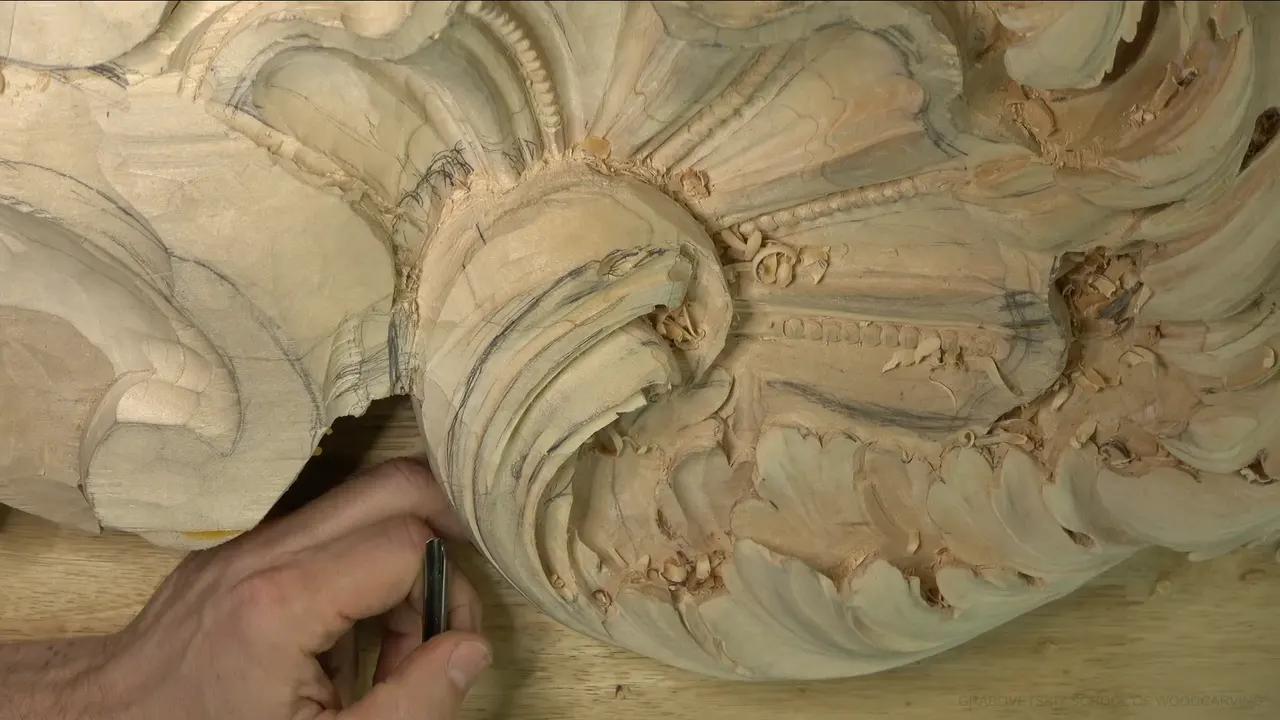
Fixing a wrong pipe movement is recarving the line with one long, steady pass, and in part 1 of workshop 18 I do exactly that on my Venice acanthus head. My first words on camera were "I need to fix my pipe movement." Right after that came the word for it: no bueno.
This part is short, about seven and a half minutes of transcript. So I went back through my other courses and pulled in the places where I said something about the same thing, a long cut that has to run clean. Each one sits in a public lesson that I link.
Ever looked at a carved line and known it was wrong, but could not say why? Did you reach for a small tool to patch it? Then give the long pass a try first.

What did I do to fix the pipe movement in part 1?
- I named the problem first, out loud.
- The tool was a number 11, and the line could begin even farther along.
- A really stable hand mattered for one long and nice movement.
- Each side needed a slightly better shape, plus a little exaggeration.
- One light pass with the previous tool cleaned the mess, and I reminded myself not to overdo it.
What tells you a pipe movement needs fixing?
You look at it and you do not like it. That was my whole test. Fixing the pipe movement came first (00:04), and the word for it was no bueno (00:08).
Next, at 00:55: "I really want to see this pipe." It has to be the right look for this pipe, I added.
The first fix came quickly. Around 00:13 I said I had to do something like that, and by 00:22 I was choosing a tool.

Where do you start a long pass on a carved pipe?
The plan, at 00:22, was to take the same tool again, probably a number 11. The place to begin came at 00:31: "from all the way right here."
Then came "and probably even farther, a little bit" (01:11), followed by a couple of preliminary cuts (01:16) before the long one.
Last came the long pass. "And go all the way," I said at 01:37.
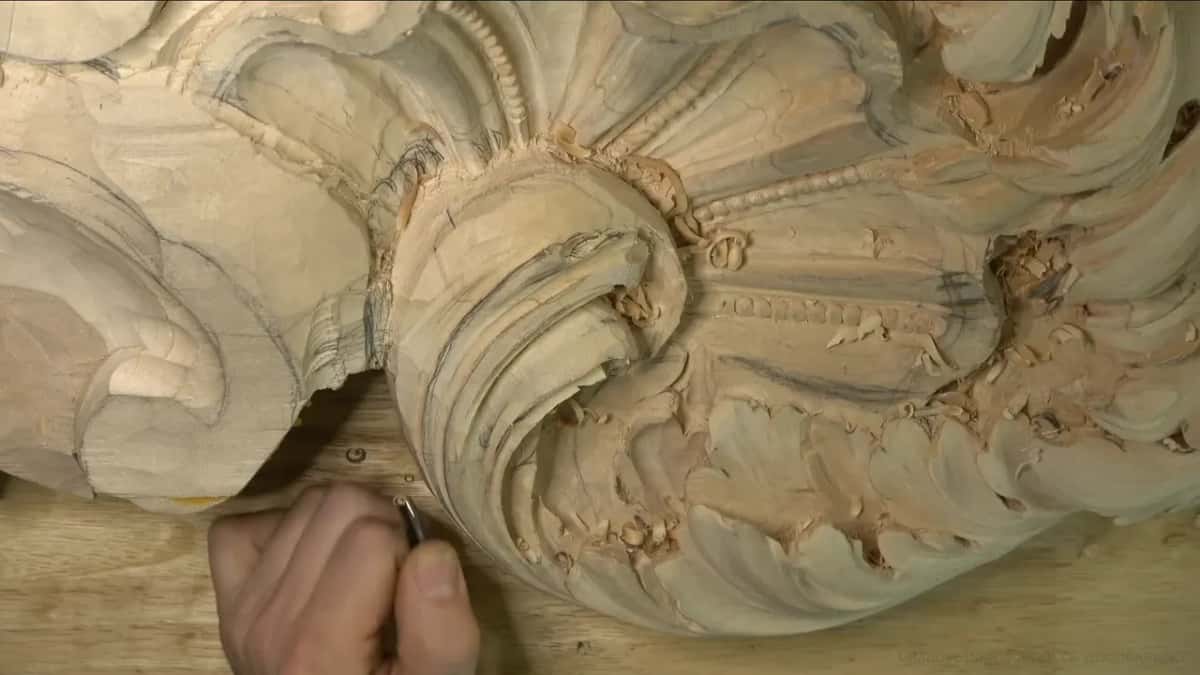
What keeps one long pass steady?
A stable hand, and I said so out loud. This case has a long movement, I explained around 01:41, so it is really important to be really stable with the hand.
I gave myself permission, too. If I need to recut multiple times, I'll do it (01:53). My goal was one long and nice movement, and I said that twice. By 02:16 it was "probably good."
Notice what I said and what I did not. The recut is allowed. The long, nice movement is the goal.

How much shape do you add after the long line goes in?
A little. I wanted a better shape on one side, slightly better on the other, and I said both around 02:19. Two small words carried the plan: better, slightly.
I stopped myself in the middle of it: "No, not too much. Don't want to lose it." And right behind it, the line I like best from this part: "But little exaggeration."
Three short lines hold the whole plan: not too much, do not lose it, a little exaggeration.

What cleans up a long pass without losing it?
Take the pressure off. Near 04:31 I said I needed to take care of whatever mess I had, then added that it was not a mess. One pass, with the previous tool, "almost no pressure at all, just cleaning."
The side of this eye could go a little farther. One more spot waited at 05:17, and I said it twice again, with an okay between.
By 05:23 I said I thought I was somewhat happy.

The last minutes ask for restraint. At 07:14 I said it needed a little cleanup, and six seconds later came "Do not overdo it." I could use the number 11 again, I said at 07:24, the one I used before, and touch it a little bit.
Can every line run in one pass?
Sometimes the wood says it is not. Workshop 5 of the first Venice Room course shows it, because I was carving against the grain. Near 02:45 I said I was supposed to go from the other side, but absolutely no way, because I could not use the tool the right way there. I really had to break the rule.
I watched the grain, so it would not split the wrong direction, and that is why I was pulling sometimes backward (03:30). Cut, pull, cut again. I called it the pulling cut, and I do it quickly, though you will know what I mean once you try it.
The part that matters here came at 03:48. Professional artists say to draw with a pencil in a single long line, I told you. "Yes, it's true, but not always possible." Then, at 04:07: I can do one long cut also, once I get closer to the result I want to see.

What is a long cut with a gouge?
I explained it in the Floral and Molding course, around 10:19. A long cut starts on one corner of the tool, and by the end you are on the other end of it. Just like it sounds, I said, the long, long way.
It is still a slicing cut. I noted I am not pushing, I am always creating a slicing cut, even if it is a short one (10:07). So the difference between short and long is how far along the edge you travel.
Left or right does not matter at all, I said at 11:03, as long as every cut you make is a slicing one.

When do I choose short strokes instead?
For the first cuts, and wherever the grain needs watching. In Acanthus over Moldings, lesson 3 I made really short strokes around 16:35, not pressing and running the full length with a long cut. And I told you there is a reason.
There are lots of different opinions, I said: do only long strokes, or only short ones. I mix. With a U-shaped tool, one side of the cut comes out clean and the other comes out rough, so I watch the wood. That is why, for the initial cuts, I make short strokes (17:33).

The boxer cut in workshop 57 is the same idea with another name. Boxers do one jump forward and two jumps backward, I said near 00:10, and my cut works like that. Before I just do a continuous long cut, I cut forward, go back, cut forward, go back. Little by little, and careful because of the grain.
I told a story about all this in lesson 16 of the Furniture Panel course, around 19:27. A carver showed his work to another master, who asked who told him to make a long cut and said to use short strokes. A third master said medium to long ones. The carver took one look at the fourth master's face, understood he was in trouble, and walked away.
Where does it end? At 23:22: there are no perfect masters, so you learn from all and still develop your own approach.
Why go for a long cut at all?
What the leaf looks like when it is done is the reason. In Corinthian Acanthus Leaf, lesson 4 I pointed at the lines the gouge leaves behind. The lines left after the gouge make the movement beautiful (05:21).
Then came the gap between really short cuts and really long, beautiful ones, which I named. Long cuts create a really nice movement, especially on this type of acanthus leaf. A previous, little bigger number nine took the next lobe, since that lobe was a little bigger (06:03). Slicing is really important, I added near 06:39, and so is controlling your tool while you rotate it in your hands.

A second reason shows up in workshop 7 of the first course. Near 03:12 I said I am after a really consistent long cut, beginning to end. So I slide my tool and let it catch if there are some high spots.
Small chips that do not fly out did not worry me. I can always clean that with a different tool, I said around 02:58, and I used just the side of my tool.
Is the line fluent after the long pass?
Look at it, and be ready to change your mind. Over in workshop 55 I said near 00:24 that the cut was down already, and I would go this direction and create one long line. Once more, "One long line," and then "Let me see how that line is fluent."
It looked okay (00:47). But I did not really like this development. The overall movement was meant to run one way, with a piece below it, yet I did not like the feel. Maybe, I said, I will have to incorporate this movement in the main one, my middle point movement.
The line passed my look, and the plan was still open to change.

Part 1 of workshop 56 has one too. I said near 02:11 that I could actually get a single long cut. I dug a little bit on the side. "I'll fix it. That's okay. So it's not a big deal."
What I worried about, a little earlier, was making a really beautiful convex (01:56).

Part 12 of workshop 50 opens with a preliminary cut. I made it somewhat deep because I wanted to cast a shadow. By 01:02 came one long cut, just like that.
A quieter case sits in workshop 15, part 5. It was not that bad at all, I said near 04:09, except I could probably get a really nice and long cut. Let me see if I will be able to. Around 04:46 it was nice and long and clean. "That is good."
Does a long movement belong on a Venetian leaf?
The Venetian style says no, I said. In workshop 66 of the Venice Room, part 8, I told you near 06:56 that maybe I would just keep one part long, because I was explaining it to you. Beside you, nobody else will know that on a Venetian style you are not supposed to have long movements like that. "Okay. It's okay."
I still wanted a long movement in workshop 22. I wanted to keep my middle line, since everything is supposed to go to it, and I called it "a long movement" (07:38). Back in workshop 26 I said originally I want to make it a long movement, at least here, just to stick to the original.

What do I do when I come back to the line later?
I look again after a few days. In Acanthus over Moldings, lesson 6 I said I really like to (about 01:00). When you work all day on the same piece, I said, I have a tendency not to see mistakes.
Around 01:20 I described coming back the next day and looking at the piece. The movement is not right, I said, and you grab your chisel and start fixing those mistakes.

A short record of where I said what
These five moments share one idea, and my answer sits in the right column of each row.
| Where | The trouble in the wood | My answer |
|---|---|---|
| This video, 18.1 | A pipe movement I called no bueno | A plan for one steady, long pass |
| First course, 5.12 | Grain against me, so no way in one pass | Pulled back between passes, then went long near the result I wanted |
| Part 5 course, 55.7 | One line, checked for how fluent it ran | Wondered about a new middle movement |
| Workshop 56.1 | A dig on the side after the first pass | Called it no big deal, with a fix to come |
| Room 2, workshop 15.5 | A leaf that looked okay, yet a longer pass looked possible | Tried it, and it ran clean |
What about your own pipe?
Is there a line on your piece that bugs you right now? Can you name which end of it is wrong, and where you would start a new one? Then take your gouge, keep your hand stable, and recut as many times as the line needs.
This video is one part of the lesson. Workshop 18 holds the rest, workshop 17 comes before it, and workshop 19 carries on. The course page is Advanced Carving: Venice Room, Part 2. The craft is wood carving, my sizes are in millimeters and inches, and a gouge belongs to the chisel family. The fibers I watch are the wood grain, and the leaf is an acanthus. The room is in the style of Venice. Pencil lines, curves, shadows and relief all come up in this lesson.
Which line on your piece needs one steady pass today?
How it's done
- Name what is wrong. I called it no bueno at the start.
- Start the line and go a little farther. The tool was the number 11, and the start could go even farther, a little bit.
- Stay stable and recut. Movement this long asks for a stable hand, and a recut is allowed.
- Add only a little shape. Slightly better shape on each side, plus a little exaggeration.
- Clean with almost no pressure. A single light touch, using the previous tool, and do not overdo it.
Frequently asked questions
What do you do first when a carved pipe line is off?
Name it first: no bueno. Then I began with a number 11, where I decided. My goal was the long movement, with a recut whenever it took one.
Does a long cut need a steady hand?
Near 01:41 in workshop 18 I said so. Because the movement is long, it is really important to be really stable with the hand.
How much should you exaggerate a shape?
Little. I did not want to lose the line, so I allowed only a little exaggeration. After that, the previous tool cleaned up the mess in one light pass.
Can every line be carved in one pass?
What to carve next