

Alexander Grabovetskiy, woodcarver, School of Woodcarving · Published 2020
Is a number 2 gouge from a European maker the same as an English number 2?
Quick answer: A European-made number 2 is a gouge, and its curve is slight. English makers put the same number on a skewed chisel. I said so while I carved in Venice Room workshop 18, and my other courses give the matching numbers for both.
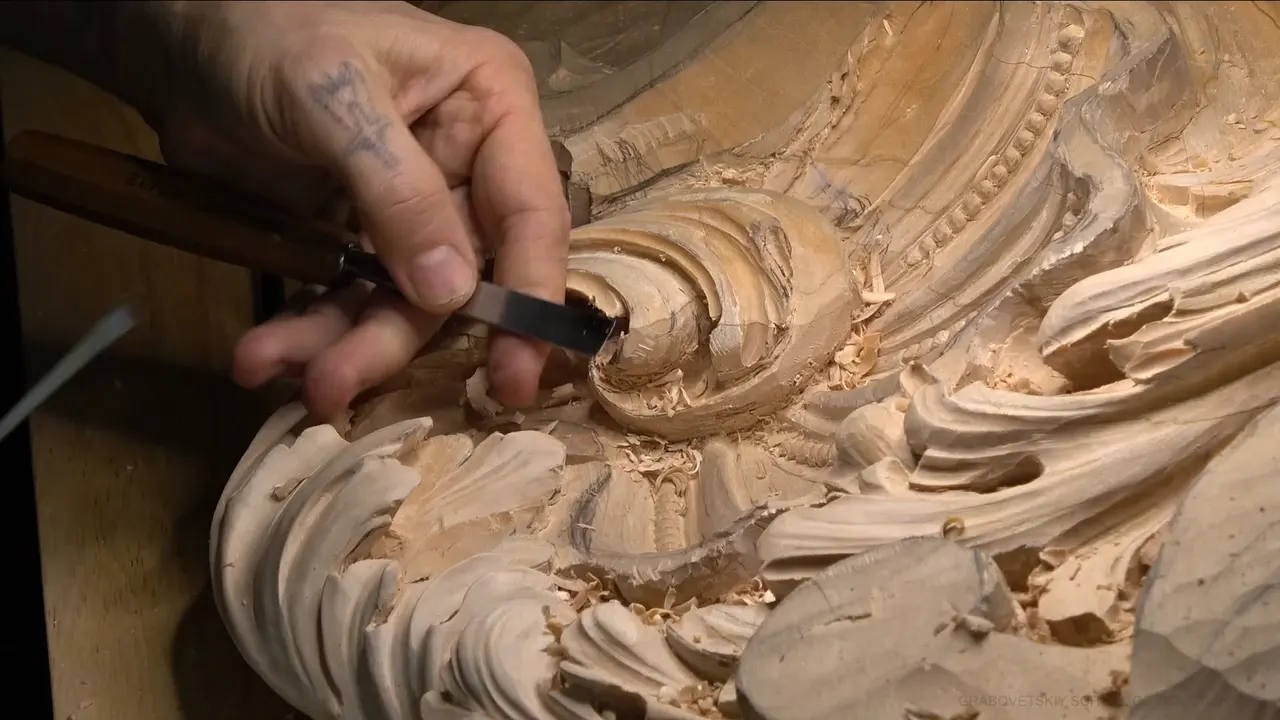
A number 2 from a European maker is a gouge, and an English-made one is a skewed chisel. In part 3 of workshop 18 I stopped mid-pass at 02:04. The two I was holding, I said, "is not equal to English-made tools."
Have you ever read a number two in my lessons and wondered which tool I meant? Do your tools come from more than one country? Then turn one over and read the number on the steel, because the same number can name two different tools.

The short version on number 2 tools
- Gouge is what a European maker gives you at the two, with a slight sweep.
- An English two is a skewed chisel.
- Europe numbers that skew one, with the letter S for skew.
- A flat gouge that is number three in English tools matches a European two, a gouge that is almost flat.
- I name both numbers in the Venice Room, grape onlay and Maine class lessons, and one table lists ten of them.
What did I say about the two in this part of workshop 18?
It came up while I was reaching for a flatter gouge. I told you I was using a number two, and then I stopped to give you a warning. England's two, I said, would be a skew. Four seconds later I called that tool number two European, "just a gouge." Then I said "here is an English-made" one, and called it a skewed chisel.
Next I named makers. In England a two, like Ashley Iles or Henry Taylor, would be a chisel. I know for a fact about Ashley Iles. About Henry Taylor I said "I suspect" it is marked number two as well, and I print that as a suspicion because it was one.

The steel came next. It comes from the same place, I said, Sheffield steel, beautiful, and for some reason I think it is the best. Right after, I said not to get me wrong, because the German and Swiss-made tools are excellent too, with really nice steel and an excellent shape. I actually like some of them. My example was the number 11 and its more pronounced U shape, and workshop 17 has what I said about brands of that one tool.
What kind of tool is a European maker's number 2?
It is a gouge. The chalkboard in Roman acanthus lesson 16 shows the first two lines of my list. Chisel number one is there, and under it a chisel number two marked UK. Number one is a chisel, I said at 03:01, absolutely flat. England and the UK also have a chisel number two, a skew, which could lean one way or the opposite, and its sweep is still really flat.

After the chisel came the European side. In Germany and in Swiss-made tools, a two comes as a gouge with a slight curvature. I exaggerate the curve when I show it, I said, but it's almost flat, with some radius, some sweep. Near 04:41 I put it in one line. From number two if it's in Europe, and from number three if it's in the UK, it is all gouges.
The Hashemi flowers lesson 10 says why this happens. All manufacturers are different, I told you, and they all mark differently. A UK two means a skew chisel, and a European two is just like a number three sweep, a slight sweep. Still a gouge. Gouge versus a chisel.
Corinthian acanthus lesson 6 says it too. A London pattern has no number two like the European brands have, I said. Its European cousin is still a gouge, closer to flat, and in England it is already a skew chisel. There is a difference.

A chart can fool you in the other direction too. Working on the chamomile and bow rosette, I wanted a flatter tool. Number three, number four or number two will work if it's a European chart, I told you. If it's an English chart, number two is not going to work, because the London pattern makes it a skewed chisel.
Which English makers mark a skew as number 2?
Ashley Iles is the maker I can name. Back in workshop 62, part 9, I picked up a big skew to give a slope a little rounding effect, and said it is marked number two, since it is Ashley Iles, English marking, London pattern marking to be exact. That fits my video in workshop 18, where Ashley Iles was the one I know for a fact.
Other skews bring the same words. Over in workshop 52, part 2, I used a tool about the same as a normal skew chisel. The English or London pattern marks it two, I said, while a German and Swiss-made pattern marks it one. A beefier skew in part 12 of workshop 50 I called number one, actually two for England, and one in Swiss-made tools.

What does a number 3 mean when you cross the border?
A flat gouge changes its number. In hazelnuts lesson 4 I took a number three gouge, about seven-eighths of an inch (about 22 mm), made by Ashley Iles. If you want to buy an equal tool by the European brands, I told you, it's got to be number two, because it's almost flat.
The lily box lesson 4 has the same idea at 10:14. At 12 millimeters (about 0.47 in), a European number two equals a number three if you are using English brands, like Ashley Iles and so on. Almost flat, I said, but it still has a little sweep.
Something straighter came up in workshop 27, part 4, maybe just a number three, and I told you that is English-made tools, with a different number for the other kind of maker. In furniture panel lesson 21 I said a straight number three in a London pattern, or a two in a European pattern, can get you by when you don't remove much background. I like those grounding tools for their curvature.
What is a European number 2 good for in my hands?
My flatter gouge is a number two. I needed a flatter gouge in the third video of workshop 110, let's say like number two, as I did not want to leave those ridges. It was 12 millimeters, about half an inch or so, and I used it to blend toward the curvature.
After that came a number 11 of 4 millimeters, a little bigger than an eighth of an inch. I undercut with it and made a shadow cut. I think that shadow came out gorgeous, and then I took the number two again to blend a ridge I did not need.

The size can get big. Over in workshop 123, part 3, I said a big number seven first, then thought maybe a number two, like 50 millimeters (about 2 in) or even 60 millimeters (about 2 3/8 in). "Huge," I said, and that way I can just scoop it and make it gradual. One number 11 of 2 millimeters (about 1/16 in) made a preliminary cut first, and the number two followed after it.
Next, workshop 140, part 2, gives the plainest line about its shape, said while the same tool fit the inside with no problem. Number two is almost flat but not flat. It just has a slight sweep to it.
What did I call a skew when I carved with it?
Both numbers came out of my mouth in many videos, and here are ten of them, in the words I used, with the lesson and part beside each one.
| Where | Tool I named | What I said about its number |
|---|---|---|
| Venice Room 6, part 10 | Skew number one, for notches toward the cut | In England that's number two |
| Part 2 of workshop 35 | Skew for a better cleanup in a choppy spot | Number one, actually England calls it two |
| Workshop 38, part 5 | Skew near the eye I was after | Two, or one for a European maker |
| Venice 50, part 12 | A normal, beefier skew for the main shape | One in Swiss-made tools, and England's two |
| Workshop 52, part 2 | A tool about the same as a normal skew chisel | London pattern says two, European says one |
| Venice Room 55, part 6 | A favorite tool of mine, for some roundness | In Germany it's a different tool, and a gouge |
| Grape onlay 4, part 1 | The number one chisel with no sweep, flat | Number two if it would be in England |
| Grape onlay 11, part 3 | Skew for a better movement, the number one | I like number one chisels, which work pretty much like a knife |
| Maine class 14-2 | Skew used upside down to work my way in | The number one, England says two |
| Moldings 7-2 | A small skew of one-eighth inch, to get right underneath | England's two is Europe's one |

The skew in workshop 38, part 5, came right after I told you that this detail would be seen from the bottom, and that I was not afraid of losing the eye I was after. For marks, workshop 49, part 4, gives the clearest line. Skew chisel is just a normal chisel with a double bevel, and in the UK it is number two. Europe would not carry a two. It would be number one with the letter S, and most of the manufacturers say number one and mark it S, which means skew.

The reason comes in workshop 55, in one line. One of my favorite tools, I said at 06:26, is a skew chisel, and in Germany, I said, number two would be already a gouge. It's a different tool. My notches in workshop 6 went toward the cut from both sides with a skew. In part 2 of workshop 35 a spot looked choppy to me, and I said I could probably use a skew there and go in a little more for depth and shadow.
The grape onlay lesson 4, the grape onlay lesson 11, the Maine class lesson 14 and the acanthus over moldings lesson 7 come from other courses, so I give them only in the table. The Moldings line has a size, maybe an eighth of an inch (about 3 mm), and I said I could get right underneath with it and make the initial cut.

What else happened in part 3 besides the numbers?
The video starts with me moving the light to the other side so I could see much better, because this is more detailed work than anything else. Only the right side, I said, since I was blocking the upper part. That side did not look too smooth to me, so I made a little nicer movement there.
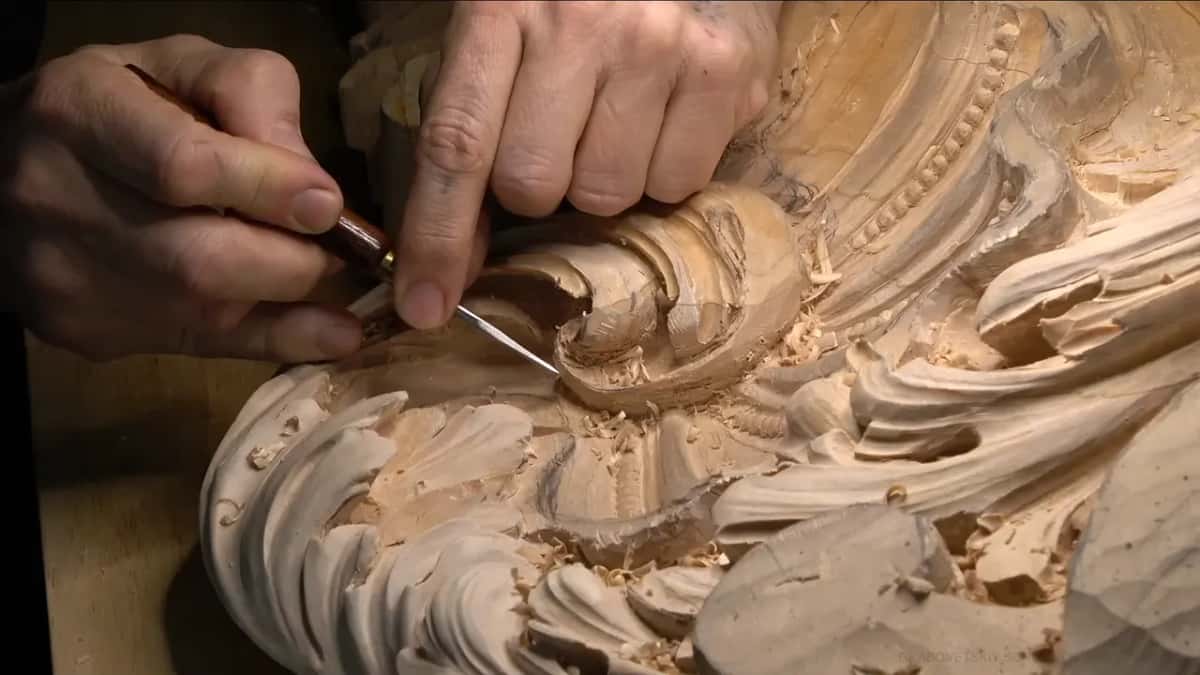
Soon I called that good, and told you to double check how nicely it rotates and flips. My tool was a number seven. I would probably cover the work with my hands sometimes, I said, so you would not see exactly what I am doing. The main point is that this detail will be visible from below, as a really important extra something.
Around 04:09 the work got finer. The cuts were not so aggressive. My number seven was half an inch, or 14 millimeters to be exact (about 0.55 in), and with the same tool I went underneath and made a full rotation inward. There was a really deep cut right there that you cannot see, I said, and I would clean it a little later.

By 06:09 that tool had become a little too big. I said I needed to switch to probably a smaller number seven, maybe 10 millimeters or so (about 3/8 in), but that one needed to be sharpened first. After that I went in again really carefully, because my previous cuts had already put too much stress into the wood.

Near 07:00 I needed to use just the hand, not the mallet, and carefully remove that waste. It looked like I was cranking too much against an edge, with a kind of weak point there. I was not going to force it more than I needed, I said.

What would you check on your own flat tool?
Pick up the flattest tool you have. Does the edge curve a little, or is it straight across with a slant? Then look at where it was made. A slight curve and a European mark point to a gouge in my words, and a straight edge and an English mark point to a skewed chisel.

That video is one part of the lesson. The rest sits in workshop 18, and the course page is Advanced Carving: Venice Room, Part 2. The borrowed lines above come from Part 1 of the Venice Room, Part 5 of the Venice Room and Part 6. The craft is wood carving, part of woodworking. A gouge and a chisel are cousins, a bevel is the angled face of the edge, and Sheffield is the English city I named for the steel. Germany and Switzerland are the other two places in this story, a mallet drives a tool, and I give my sizes in millimeters and inches.
Which of your tools will you turn over first?
How it's done
- Find the maker's country. England marks a skew two, and Germany or other European countries mark it one, I said in workshop 55.
- Read the curve. Look at the edge. The European two curves just slightly, and an English two means a skewed chisel with a sweep that stays really flat.
- Look for the letter. Europe says one and adds an S for skew.
- Match the flat gouge. An English three from Ashley Iles has a European match in the two, almost flat with a little sweep.
- Sharpen the smaller tool. I changed from a number seven of 14 millimeters (about 0.55 in) to one of about 10 millimeters (0.39 in), and sharpened it first.
- Set the mallet down. On wood already stressed, I used just my hand, carefully.
Frequently asked questions
Does a number 2 mean the same in England and in Europe?
No. Around 02:16 in my workshop 18 video I called the European one just a gouge, and then I said "here is an English-made" one and called it a skewed chisel. One number sits on two different tools, so check where yours was made.
What is a number 2 tool from an English maker?
A skewed chisel. In workshop 62 I picked up a big skew, and it carries a two because it is Ashley Iles, English marking, London pattern marking to be exact. Henry Taylor I could only suspect, and I said so on camera.
What number does a European maker put on a skew chisel?
One. In workshop 49 I said a European maker would not call it number two. Most of the manufacturers would just say number one and add the letter S, which means skew. Workshop 55 adds that a German two is a gouge already, a different tool.
What to carve next