

Alexander Grabovetskiy, woodcarver, School of Woodcarving · Published 2020
Why switch from a number 11 to a number 9 when you wiggle the gouge?
Quick answer: Picking a number 9 over a number 11 for wiggling is a call I made in part 4 of workshop 18. An 11 has a U shape, while the 9 has a half circle shape, without sides that stretch out, and I judged it the better tool for the job.
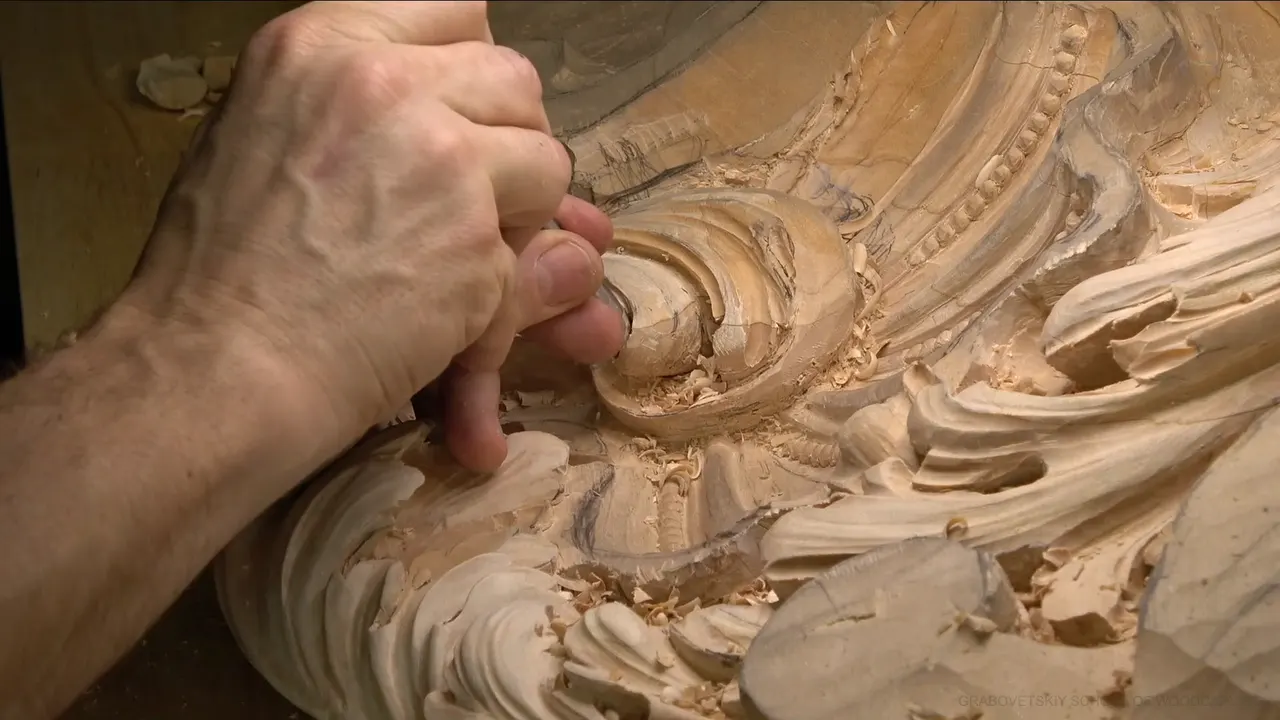
On this acanthus head I swapped my number 11 for a number 9 once I began to wiggle the gouge, because a 9 is a plain semicircle and an 11 is shaped like a U. I say it in Venice room workshop 18, part 4, in about a breath (03:30 to 03:50). I was going up from one point, I wiggled a little, and I changed tools on the spot.
My captions for part 4 run to 07:53. I smooth the inside of the carving, dig a hollow deep, and start a darker shadow beneath one leaf. The page follows them in order. Wherever I say the same thing in another course, I bring that line in and link its lesson.
Ever held two gouges with different numbers and wondered why? Would you like a hollow to come out smooth, with no ridge left behind? Then watch which tool I pick.

Why pick a 9 over an 11 as soon as you wiggle?
This stretch opens with the 11. At 02:43 I wonder aloud whether to go even smaller, then add: let me see if wiggling will help me a little. "Yes, it will" (02:43 to 02:55).
The swap came less than a minute later. I was going upward from one point (03:23 to 03:30), and I said maybe I should use a number 9 if I'm wiggling (03:30 to 03:34).
My thinking has two halves. A 9 has no sides that stretch out the way they do on a U, I say, and it is a half circle (03:34 to 03:45). Then comes my verdict: "I think that would probably be a better tool." Then: let me use number nine, and the tool changes (03:45 to 03:54).

I give no other reason in this part. How much better a 9 wiggles, I don't measure, and I offer no rule. What I do is look, choose a tool, and keep going.
What did I do before the swap?
I cleaned. "Finish inside," I say at the start, and I keep going until all of it looks nice and clean (00:12 to 00:40). One edge still did not look too good to me, and the same tool could take care of it (00:44 to 00:51).
A doubt comes next. Maybe this is a little too weak, I say, but here I can do that with no problem, even if I make it a little weaker still (01:08 to 01:24). Short answer: nobody will touch it, but I want to be sure, because people will look at that focal point (01:24 to 01:40).
I reach for the 11 to clean from the inside. I want a really, really smooth transition (01:49 to 02:01). The tool is a number 11 spoon, and I say maybe 4 millimeters (about 5/32 in) to start (02:04 to 02:10).

The next lines are slow ones. Little by little, I say, I'm going to remove (02:20 to 02:29). Those lines say that much and no more, and I add nothing to them.
Why dig deep where people will see the transition from below?
Plain words, then. The transition I am making will still be visible from the bottom (02:55 to 03:09). In this case, I want to make it deep (03:09 to 03:12).
Right away I say why: the deeper I go, the less of it is going to be visible, so it is more forgiving for me (03:13 to 03:20). The whole idea fits in that line, and I leave it there. More on shadows is in workshop 17.

How did the 9 go up the hollow?
With a test width. "Let me try first with the 5 millimeters" (3/16 in, about), I say (03:54 to 04:10). A few seconds later it is settled: yes, and 5 millimeters is good (04:10 to 04:23).

Slow work follows. Just a little by little, go up, I say, and again I am wiggling a bit, this way (04:23 to 04:33). Okay, I say, and I can go around this (04:59 to 05:05).
The width matters here. The 4 millimeters I mentioned for the 11 was a maybe, and the 9 I try is a touch wider, since I pick a width by trying it.

What happened to the shadow beneath that leaf?
An idea came by the way. I probably should take an 11 and go underneath, to make a lot more exaggerated shadow between the bottom part of the leaf (05:05 to 05:22). The first width was 3 millimeters (about 1/8 in) (05:27 to 05:35). The 11 was wiggling again a little bit, side to side (05:54 to 05:58).
Next is a warning I'd like you to hear. Be careful not to press too much on this side, I say, because we don't want to break that edge (06:07 to 06:19).
My answer was to work both sides. For me it's better to attack it from two sides, I say, and go deep and deep, until it is almost impossible to get deeper (06:19 to 06:32).

Now I check it from underneath. "And it casts a really beautiful shadow," I say (07:01 to 07:04). I could use 2 millimeters (5/64 in), or even 1 millimeter, because right there it is still possible (07:04 to 07:14).
The last lines of the part are an apology. I take the 1 millimeter number 11 and get even deeper (07:16 to 07:32). That area I can't show you, so please forgive me (07:32 to 07:46). Back to 4 millimeters on the number 11 comes next, going up and a little bit underneath of this (07:46 to 07:53).
| Moment | Gouge | Cue | Note |
|---|---|---|---|
| Smoothing the edge | Spoon number 11, perhaps 4 millimeters first | At 02:04 | Smooth, and still seen from below |
| Wiggling upward | Number 9, trying 5 millimeters to begin | Near 03:54 | That width works well, I say |
| Darker shadow, leaf bottom | An 11 opening at 3 millimeters here | Past 05:27 | I wiggle a little, left and right |
| Deeper still | Same 11, down to 1 millimeter now | By 07:16 | It gets even deeper right there |

Do other lessons of mine wiggle with a 9 too?
One says it almost as plainly as part 4. In the Part 6 Venice Room course, in workshop 70, I take the same 9 as before, 10 millimeters (about 3/8 in), to clear some of the mess on one side (04:10 to 04:17). Next I ask myself why a 9, and answer: "Because I can wiggle, and that's a half-a-round" (04:27 to 04:32).
I really wiggle it, I say, and an 11 will work also, but with a lot less ability to wiggle (04:34 to 04:44). This is part 11 of that workshop, from a different course.

Is wiggling a gouge allowed at all?
In the furniture panel course, in lesson 21, I wiggle a little bit because that is kind of a dangerous area, and I don't want to push it too hard (05:31 to 05:38). Sometimes just a little wiggle helps. Not all wood carvers would approve of the wiggling technique, but it works (05:41 to 06:00).
I call the movement a jewelry-making technique (06:07 to 06:14). It doesn't give me too clean of a cut, but I can always come back and clean it (06:20 to 06:25). Then my own words: I can control much better by wiggling, I'm not creating too much pressure, and I let the tool do the work (06:28 to 06:36).
The Hashemi flowers course says it again. By lesson 40 I am slightly wiggling, and I know some of you probably don't like the idea, yet it actually helps (01:49 to 02:05). Over in lesson 21 I admit you're not supposed to wiggle, but I do sometimes, and I think it's all right (02:41 to 02:45).

When does the grain make me wiggle?
Another Hashemi lesson gives me a reason. Back in lesson 10 I am working against the grain, or trying to, and I have to be really careful, so I'm actually wiggling (00:56 to 01:06). The grain goes this direction, I add, and it can crack on the inside (01:13 to 01:17).
Part 4 gives no grain direction, so I won't put one on this page. The reasons I do give there are the smooth transition I want and the edge I called a little too weak, and nothing else.

How do you tell a number 9 from a number 8 by its shape?
I can tell you what I say about the numbers on other panels. In Hashemi flowers lesson 12 I name a half inch number 8 and say a 9 will work also, and they are really close (05:22 to 05:30). A true half round, I say, is the 9, and an 8 is a little less (05:33 to 05:39).
The Roman acanthus course gives me the same test from the other side. Take lesson 10, where a tool is not marked as an 8, but it looks like an 8 to me. It could be a 9, I say, and if it is a half circle all the way, then it's a 9 (00:52 to 01:03). I don't see that in this one, just a touch less than that (01:08 to 01:16).
The same course adds where the names stop. Further on, in lesson 5, I say that a tool with no sweep is called a chisel, and one with a sweep is a gouge, up to number 9, the half round itself. If it is more than a half round, more like a U shape, then it is already a veiner (04:56 to 05:24).
So there is a field test with no calipers. Look at the sweep and ask whether it is a half round. The 9 passes, and an 8 comes close. These lines come only from those lessons.

Where does a 9 go when it does not wiggle?
It turns. Workshop 54 of the Part 5 Venice Room course has me using a number 9 and call it a half a round, the true one (04:49 to 04:57). Rotate it, and it is going to create a perfect round (05:00 to 05:04). I go carefully, without pressing too much, with a rotation movement, and I call it plug cutting, because you are removing small plugs (05:04 to 05:13).
It opens a hollow too. Over in workshop 42 of the course for workshops 38 to 49 the tool is 3 millimeters, a 1/8 inch tool, and I ask why a 9 (07:19 to 07:27). My answer: because it's a true half round in this case.

So the 9 serves me three ways on these panels, a wiggle in part 4, a plug in 54, and a hollow in 42. The shape stays put, and what changes is how I move it.
What does a number 11 do that a 9 cannot?
It gives me a side. In workshop 50 of the Part 5 course I take an 11 of 18 millimeters (about 23/32 in), and I want to blend a ridge (04:21 to 04:44). What I like about an 11, I say, is its shape, like a letter U, with no half round about it (04:48 to 04:57). Its sides are just equal to a number 3 tool, so I can use the side as a 3 gouge and need no other tool (05:01 to 05:12).
The grape vase course says it a little differently. Its lesson 2 has me liking the 11 because of its U shape. I can use just one of the sides, or wings if you wish, and make a really beautiful cut (00:49 to 01:04). It is too early to undercut, I say, so the side does the work (00:40 to 00:49).

Put the two together and you have the choice in part 4. A U gives you a side, a half circle gives you a turn, and a wiggle seems to want the turn. That last step is my reading, and I do not say it as a rule in part 4.
What can you take from part 4?
Pick the tool at the spot, and say why out loud if it helps. I switched to a 9 when I wiggled, then went back to an 11 for the shadow, so no single favorite carries across the part.
Count the widths and the pattern shows. The 11 comes up at 4, 3, 1 and 4 millimeters, with 2 offered as a possible, while the 9 comes up once, at 5 millimeters. Four small steps of the same tool, and one change of shape in the middle.
What the part leaves out shows too. The part states no pressure, no angle and no count of passes. The captions give me widths, a tool shape, and a reason. When I say a number, I print it.
The panel sits in Advanced Carving: Venice Room, Part 2. The workshop before this one is workshop 17, and workshop 19 comes after it. Which hollow on your bench would turn better with a half round? Shall we carve?
How it's done
- Smooth the edge with an 11. I take a number 11 spoon, perhaps 4 millimeters to begin, and remove a little at a time for a really smooth transition.
- Test a little wiggle. I wonder about an even smaller tool, then try the wiggle first. It helps.
- Choose the half circle. Going upward with a wiggle, I pick a number 9, whose sides do not stretch out, unlike the 11.
- Try 5 millimeters. I try the 5 millimeters first, find it good, and climb the hollow bit by bit.
- Go gently by the weak side. I don't push hard there, and I work it from both sides, going deeper each pass.
- Return to the 11 for shadow. Under the bottom of the leaf I take 3 millimeters first, wiggle sideways, then try 2 and 1 millimeter where the area still allows.
Frequently asked questions
What is the difference between a number 9 and a number 11 gouge?
The 11 has the shape of a letter U. The 9 has a plain half circle shape, with sides that stay put instead of stretching out. Of the two, I name the 9 as probably better for wiggling, and that is the only difference I name in this part.
Is it okay to wiggle a gouge as you carve?
I do it a little. Not all wood carvers would approve, I say, yet in my furniture panel course I add that it works, that I control the tool much better, and that I let the tool do the work.
What width of number 9 did I try first in part 4?
I try 5 millimeters first, about 3/16 inch. A few seconds later I tell you it is good, and I go on up the hollow bit by bit, wiggling a little. The width comes from trying one.
What to carve next