

Alexander Grabovetskiy, woodcarver, School of Woodcarving · Published 2020
Should a carved movement run the opposite way to the one that already crosses the area?
Quick answer: Opposite movement is a movement that runs against the one already planned for an area. In the twelfth video of workshop 18, I said it would look wrong next to the acanthus movement there, then stopped to think. The video closes with the question still open.
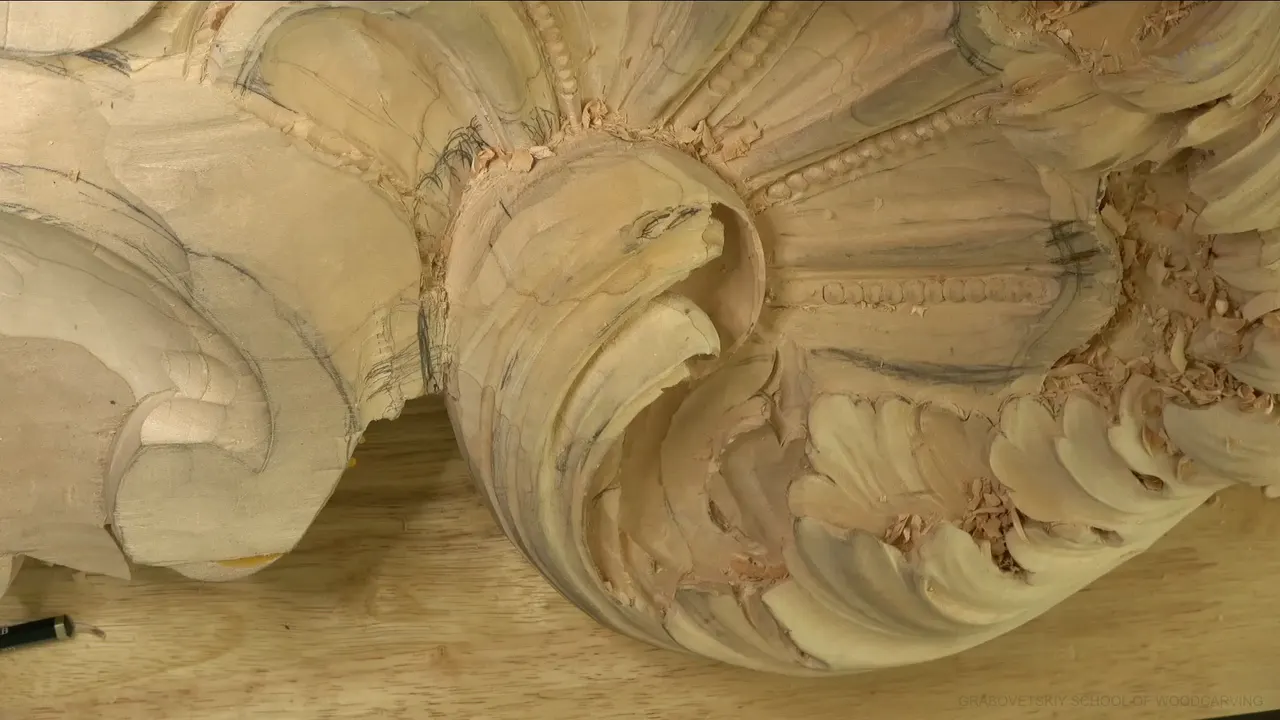
An opposite movement is one that runs against the movement already planned for the same area, and in part 12 of Venice Room workshop 18 I said it would not complement the acanthus movement there. I stopped to think, and the video ends on that.
The part closes at 07:25 with the question still open, so I went looking elsewhere. Other Venice Room lessons, my furniture panel course and my design course all hold a place where I said something close, and I pulled those in. Every lesson I quote has a public page, linked where I use it.
Ever looked at a spot on a carving where one movement is planned and wondered if another could run the other way? Would you carve it to find out, or think first? Come along and watch what I do at 06:15.

Opposite movement in six lines
- Part 12 ends on the question with no answer (07:24).
- The reason I gave was short, and it was about how the two movements would sit together.
- Two roads stayed open: wait on this spot, or start on the movement.
- Workshop 72 shows opposite pipes in old work, and I said the overall design decides what looks right.
- Turning a side the opposite way in lesson 84 made more sense, I said.
- Lessons 43, 47 and 58 say which movement I protect when I say no.
What was I doing before I started thinking about direction?
I was cleaning. I told you I did not like how that one felt overall (00:17), and I said I should probably spend a little more time and clean it (00:29). Out loud, I asked what tool to use. I used the micro number three, I said, not the big number three (01:06). Let me brush this out again, I said, and then, beautiful (01:47).
A rasp came after that. I could use one right now, I said, to give the spot a little nicer, cleaner look (01:58), and then maybe a finer rasp (02:57). I saw I could even go a little with the concave and blend it nicer, though I had just destroyed my edge (03:00). Not something I wanted to do again. Later I said maybe even with the finer, and this one is a diamond (03:45).


That was probably it for this part (04:30). Now the job changed. The upper part needed my attention now, I said, and I switched the camera again to the top view (04:41).
Why does the top view not show how the carving will look?
You are looking straight from above, I told you, and maybe a little from the backside (04:51). The camera sits where I put it. So it does not look exactly how it is supposed to look once it is done and you face it from below and a little from the front (05:00 to 05:09).
I say nothing about direction in that stretch. The camera line and the direction line sit a little over a minute apart in one video, and I will not tie them together for you.
Around 05:13 I said I would probably attack that area and finish it a little bit. A big rasp came out to give a really good shape to the area, and maybe that was a little too extreme and too big (05:28). Next, the old way, just the gouge (05:52).


Why did I say an opposite movement would look wrong there?
The thinking started out loud. Am I going to do this side or not, I asked, and then, let me just think about it first (06:15). What I saw came next. A movement would go all the way from one direction, with some kind of acanthus movement too (06:21 to 06:32). Do a movement the opposite direction, and it is not going to complement it, I said. It is going to look wrong (06:34 to 06:40).
That is the whole reason I gave, and I gave no rule for every opposite movement. I talked about this side of this head, with that acanthus movement coming.
Two roads followed. Maybe I should just stop at this point and develop another area until I am ready for this one (06:40). Or I could actually start on this movement (06:59). By 07:12 it looked like I was able to go a little bit of movement like that. Right after came, but let me think. The last line of the video asks it again, what I should do (07:24).
Both roads are plans, a maybe and a could. Neither road got taken on camera, and I will not tell you one did.

| Lesson | Question | Move |
|---|---|---|
| Workshop 18.12 video | A second movement beside the acanthus one | Kept thinking |
| Workshop 72.7 video | Old work had opposite pipes, I said | Normal way |
| Workshop 84.3 video | Outline first or the section looks bad | Opposite way |
| Workshop 47.2 video | One choice put the movement at risk | New pipe |
| Furniture Panel 14.6 | A filler seemed to contradict this movement | Remove it |
Do opposite movements ever look right on a Venice panel?
Workshop 72, part 7, answers half of it. It was just a matter of developing the details now (01:13), and the details would be the same, I said, although logically it just works opposite (01:17). Logically it was supposed to be the opposite direction. I had pipes in other areas raised up, I said, but in the area of pipes it should be almost concave. No, I am not doing it (01:34 to 01:39).
Nobody will know it except you and me, I said (01:45). I saw some of the historical work, I told you, and on some of the works they did an opposite direction pipe (01:56 to 02:01).
Sometimes it looks good, sometimes it does not, I said (02:06 to 02:08). It all depends on the overall design. Once more, it just depends on overall design (02:18 to 02:21), and in this case I would not do it (02:25 to 02:27). The normal way was my plan (02:30), pipes convex and a concave beside each one.
That one is about pipes, raised or hollow, and not about a curl, which makes it a cousin of this question and not a twin.

When did I turn a side the opposite way on purpose?
Lesson 84, part 3, has it. I wanted to make sure it made sense in the overall movement (01:57). The section needed an outline, I said, or it was not going to look good (02:13).
I put the question to myself (02:25). What I could do is actually the opposite direction. I could lower that side instead, and make that part flip a little above. Probably what I should do, I said (02:37).
Not the right way of doing it, I guessed, but okay, because I still had plenty of material (02:46). Wonderful, I called it (03:28). Fixing it was the next step, and that was actually okay (03:32 to 03:35). A concave would still go in, I said, so it was not like I made a huge mistake (03:35 to 03:39). At least this was going to be a lot more logical movement this way (03:45).

What movement am I protecting when I say no?
Workshop 43, part 4, names it. Nothing had to be developed completely, I said, but I still wanted to give it some form (00:08 to 00:16). Every eye is supposed to have some type of pipe, I said (00:21 to 00:27), but I cannot break my movement. That is the movement I am after (00:34 to 00:36). I needed a concave on the side, I said, and I wondered if a number seven at 4 mm (5/32 in) could go in just like that (00:53).
Lesson 47, part 2, says no in other words. I looked at one choice and said it does not look good if we do that, and called it no bueno (04:34 to 04:46). Going that way, I said, I was losing the movement (04:48 to 04:54). I am not looking for a bunch of acanthus movements (05:07), and I am trying to tie everything together, to create the logical movement (05:14 to 05:17), I said.

The logical movement had not happened yet in that spot (05:21 to 05:29). Probably the pipe would go that way and blend. A slight concave would come right there, not a really pronounced one (05:40 to 05:49).
My furniture panel course makes the same call in lesson 14. I said in part 6 that I still would like some kind of fillers (05:28). Next I called it a little messy, but it contradicts this movement, I said, and so it is no good. No bueno. Let me get rid of it (05:42 to 05:52).
Why does a movement have to stay unbroken in 3D?
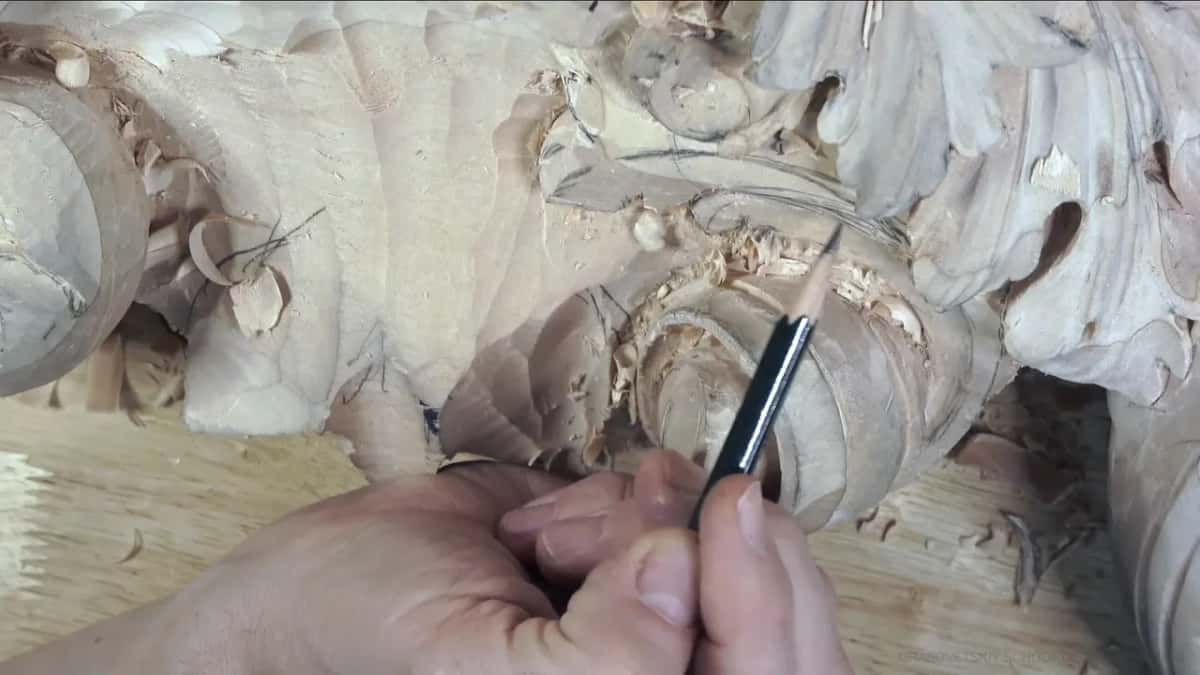
Workshop 58, part 4, gives the reason. A long bent tool helped with a high detail on the left-hand side, because a straight tool would not let me carve in that direction (06:12 to 06:23). I was just establishing the 3D form (06:54 to 06:58).
The goal is a really tangent, really continuous movement, even in 3D, I said (07:08 to 07:17). Not breaking the movement matters to me, since it is visible from all over (07:21). Keep the tangency, I said (07:32).

Lesson 45, part 10, makes the same demand of a barrel. It looks a little confusing at the beginning, I said, but all will make sense (06:33 to 06:45). The barrel was preliminary, like a square block (06:55), and now it has to make sense and follow the movement (07:03). Again I said it (07:07), and a third time (07:23).
What if a piece looks like it wants to go one way?
Workshop 96, part 2, shows a piece that did not go the way it looked. Logically, when you look at it, it looks like it is supposed to go this way and follow that direction (02:29). But that is not the case, I said twice (02:39 to 02:44).
Actually this movement wraps out and carries on another way (02:46). On the other side of it, a secondary movement goes in its own direction (02:53 to 02:58). That meant a really, really, really nice movement, made real smooth (03:02 to 03:10). Before that came a plan to draw a little nicer movement and use a smaller tool (02:16 to 02:26).

How did I judge a movement by the word logical?
Two short lines show it. In lesson 44, part 1, I said maybe I should remove a little more in this area (04:54). The preliminary would be a number three, chopping down this direction. It is still visible, I said, but it is going to be a more logical movement (05:28 to 05:44).
In lesson 40, part 3, I had to decide how wide I wanted to see this movement, because it has to be logical, and supposed to go underneath somewhere (03:23 to 03:38). Even bigger, maybe 10 mm (3/8 in), would make a much cleaner pass, I said (02:58 to 03:07). A number three would not work, I did not think (03:43).

Can two movements run opposite on purpose?
My design course shows it. The flowers in that class have a main movement going uphill, and it is growing, I said (02:09). The second movement falls (02:24), on the opposite diagonal (02:31), and starts from the same point (02:45). The leaves grow up too, uphill and on one diagonal (03:51 to 03:56).
In that design I did the opposite direction (01:41). It was a flower design, not a leaf in the round, so I will not stretch it onto a carved head. Still, one line fits our question. "Not always you have to be opposite," I said (04:06), because movements can go one direction and still fight each other (04:09). No fight, no life (05:28).

What would I do at my own bench?
Is there a spot on your carving where two movements could meet head on? Could you carve another area for a while, the way I said I might (06:44)? You are standing where I stood at 06:15, with the movement you are after in one hand and the question in the other.
The part I described is one video of lesson 18 of the Venice Room. The whole room is on the course page, Advanced Carving: Venice Room, Part 2. The craft is wood carving, a branch of woodworking. A gouge is a kind of chisel, and a rasp files the surface instead. A relief is carved from a flat ground, an acanthus leaf throws a shadow, and the room I am carving is in the style of Venice. My sizes come in millimeters and inches.

Which spot on your own carving would you stop at and think about first?
How it's done
- Name the movement that is coming. Between 06:21 and 06:32 I said a movement was going to run all the way from one direction, and an acanthus movement of some sort.
- Ask what the opposite one would do. At 06:34 I said that a movement in the opposite direction would not complement it, which meant a wrong look.
- Weigh the two roads. At 06:40 I floated stopping to work elsewhere, and at 06:59 starting on the movement.
- Say that you are thinking. At 07:24 the video ends with me still thinking.
- Name the movement you are after. Workshop 43 has me saying I cannot break my movement, and that it is the movement I am after.
Frequently asked questions
Do opposite movements ever belong on a carved acanthus?
Sometimes, I said, because old work I had seen showed an opposite direction pipe on some pieces. Sometimes it looks good and sometimes it does not. It all depends on the overall design, and in that case the normal way was my plan.
Should you stop and carve another area when you cannot decide?
I said in the twelfth video of workshop 18 that I might stop at this point and develop another area until I was ready for this one. Starting on the movement was the other road. The video ended while I was still thinking about what to do next.
How do you keep a movement from breaking in 3D?
The goal in workshop 58 was a really continuous, tangent movement even in 3D, because the piece is visible from all over. Establishing that movement really nicely was the job, and I told you to keep the tangency.
What to carve next