
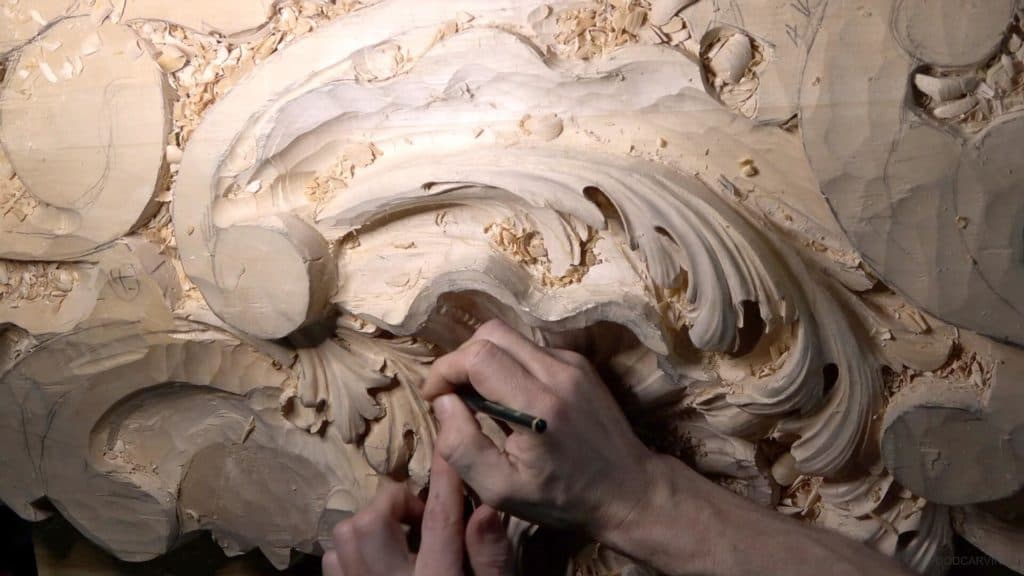
Alexander Grabovetskiy, woodcarver, School of Woodcarving · Published 2020
Should you stop a carved movement with gouge cuts, or blend it with a skew chisel?
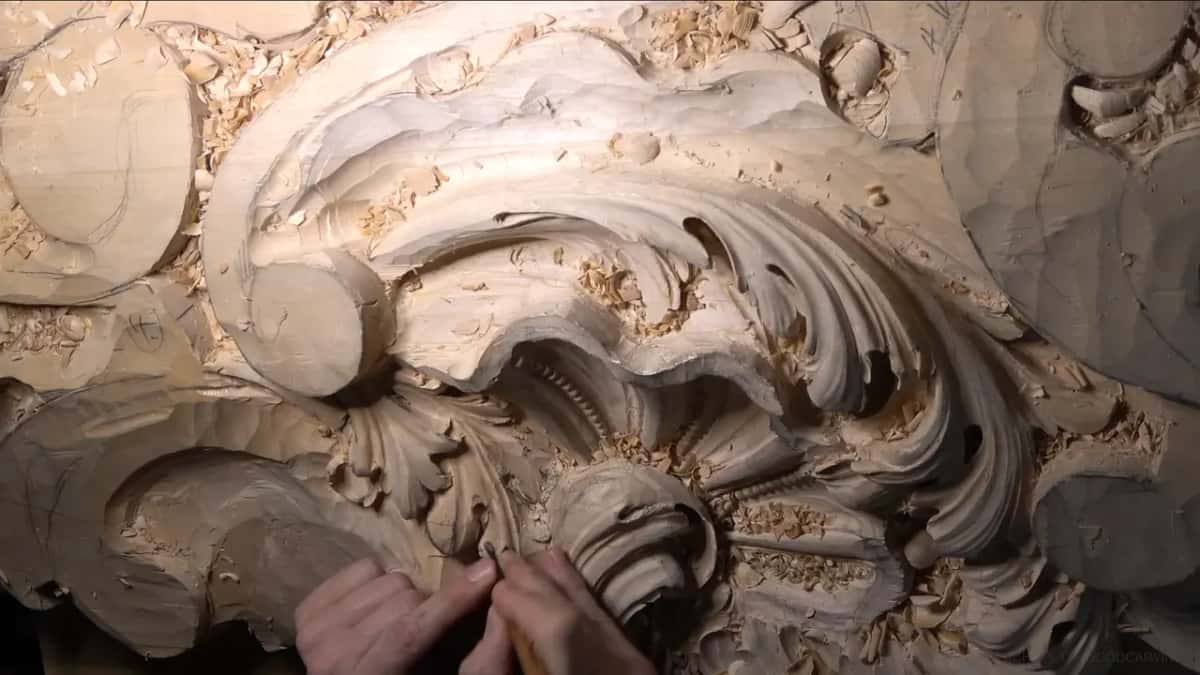
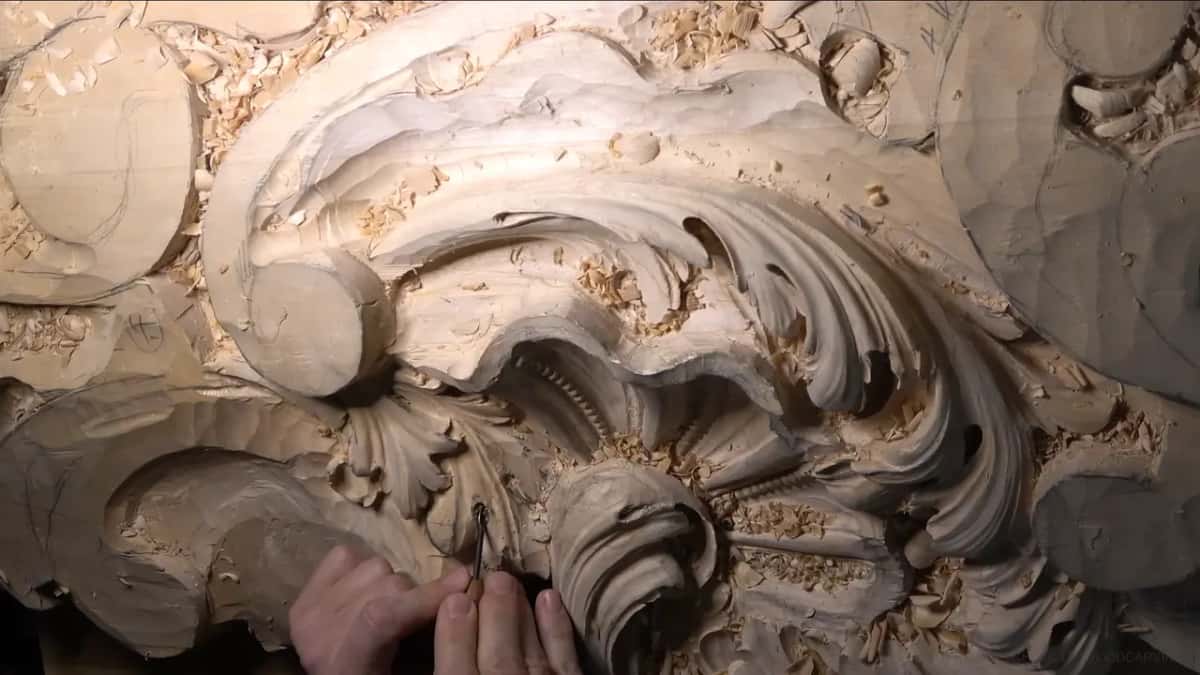
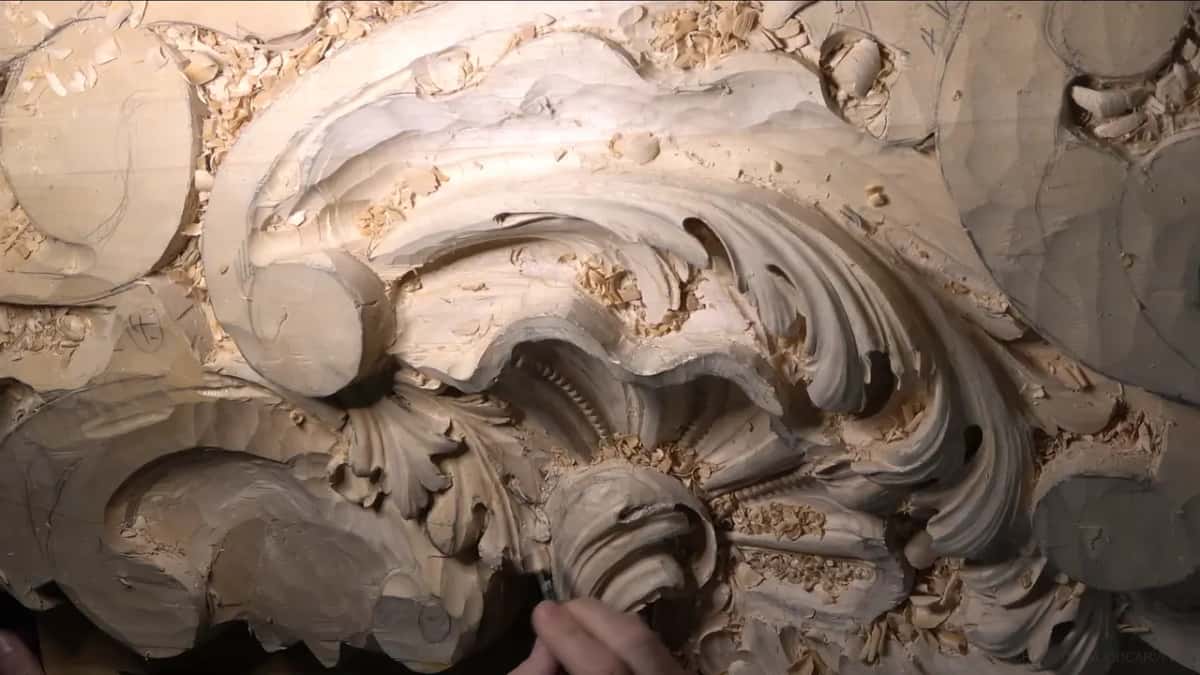
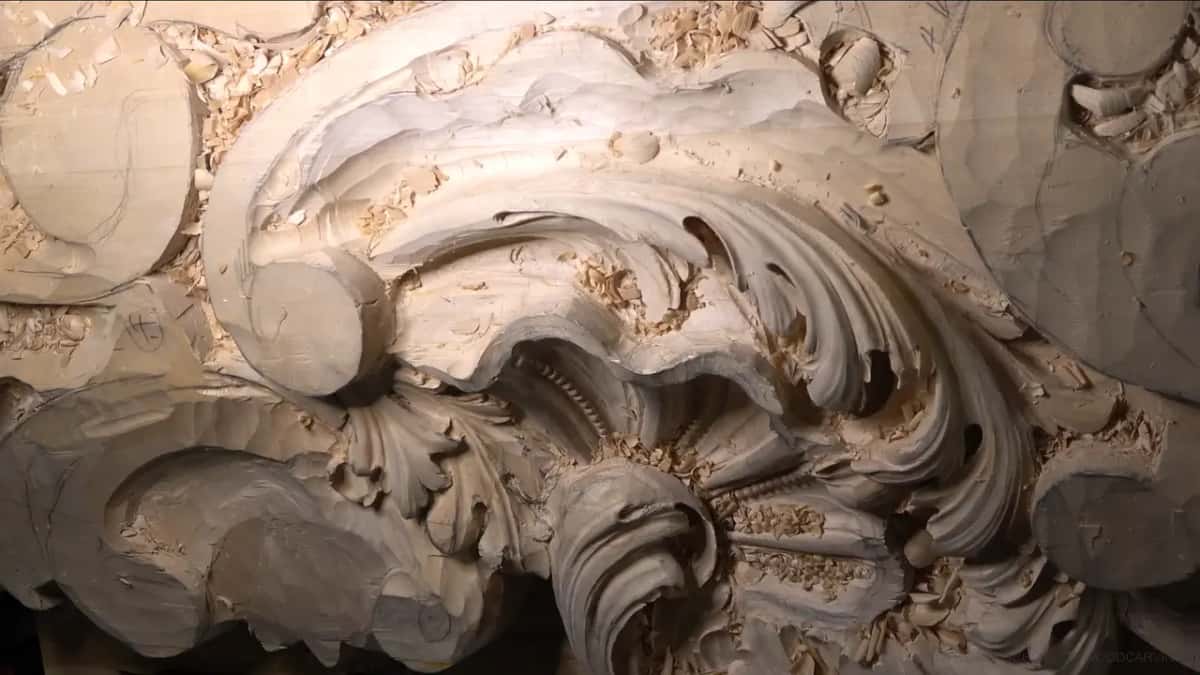
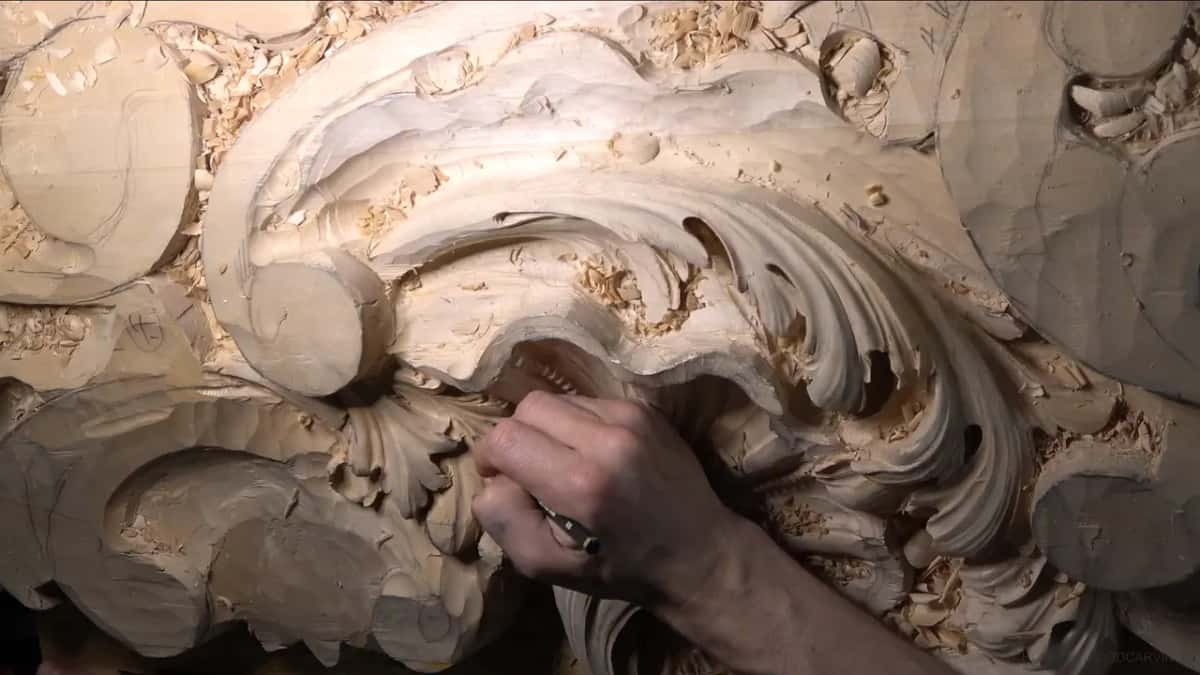
Quick answer: A skew chisel blend is a pass along a knocked down side to make it more gradual. Part 4 of Venice Room workshop 22 has me working with gouges first, then saying a skew would be nicer, cleaner and more gradual.
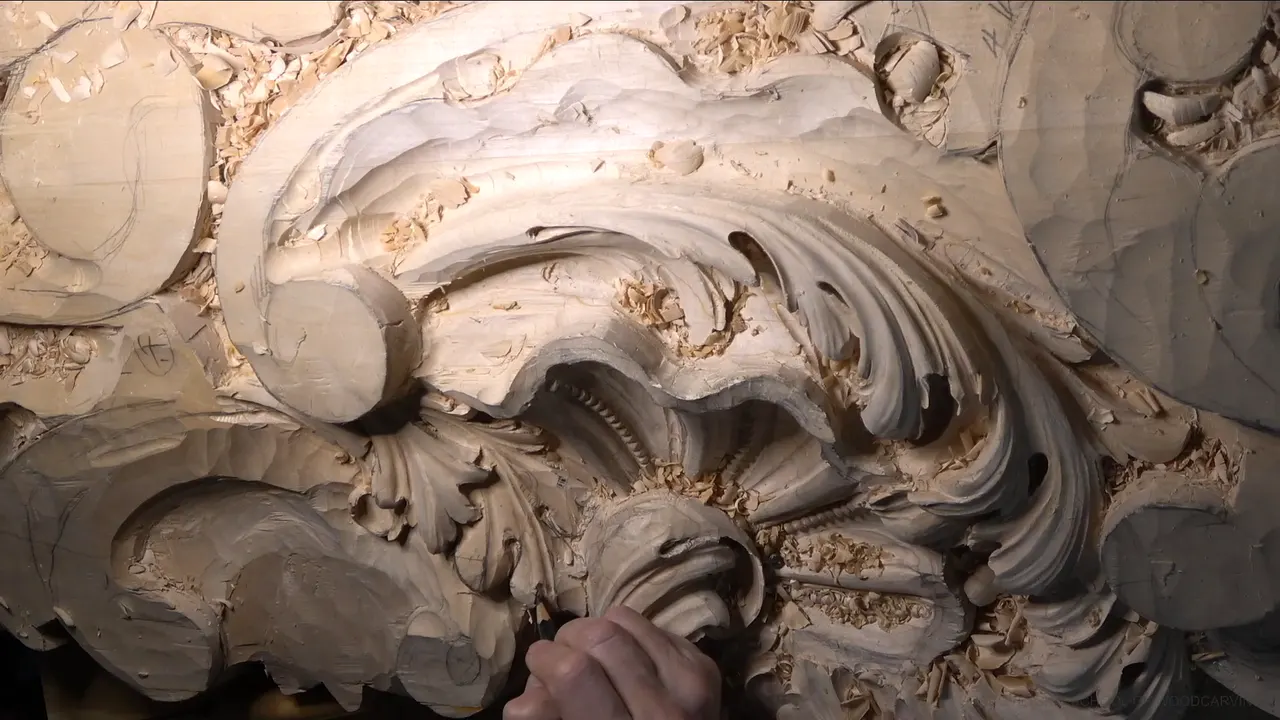
Blending a carved movement using a skew chisel is a way to make a knocked down side more gradual. Workshop 22 of the Venice Room, part 4, has me working with gouges. Out loud, I changed course. The skew chisel, I said, would leave things cleaner and more gradual.
Ever knocked a side down with a gouge and found steps where you wanted a slope? Do you reach for another gouge, or for a different tool? This page follows my hands in that video, in the order I spoke. Then come my words from many other lessons, where a skew did the same job, and a few where it did not.
What did I carve before the skew chisel blend?
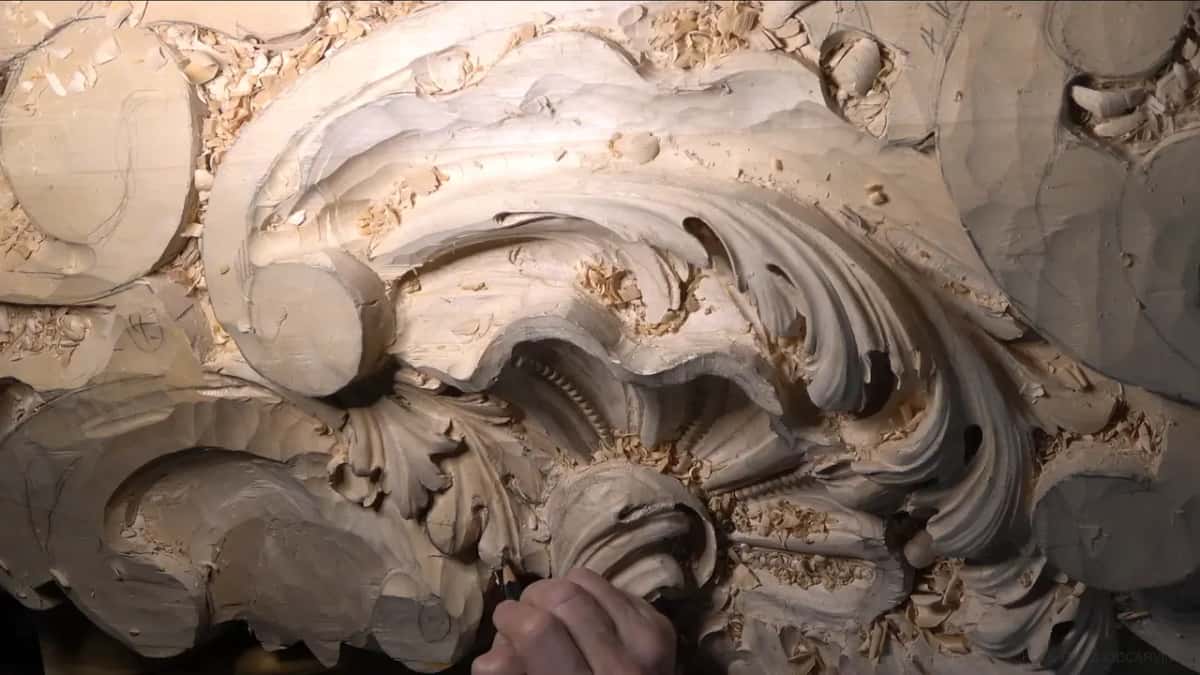
The part opens with cleaning the overall movement, how it was supposed to look (00:04). A couple of separations were coming. Maybe one would sit a little farther along, not too close (00:23). Knocking one side down was still ahead, so a double-check came first, "Let me double-check how it's going to look all together" (00:34). Then, "I think it looks good" (00:39).
Next on my list was a number 3 at a quarter inch (about 6.4 mm), for a couple of straight down cuts. The goal, in my words, was to "just indicate or preliminarily just pre-establish my movement" (00:50). The same move was coming again, right there (00:57).
What went inside the movement first?
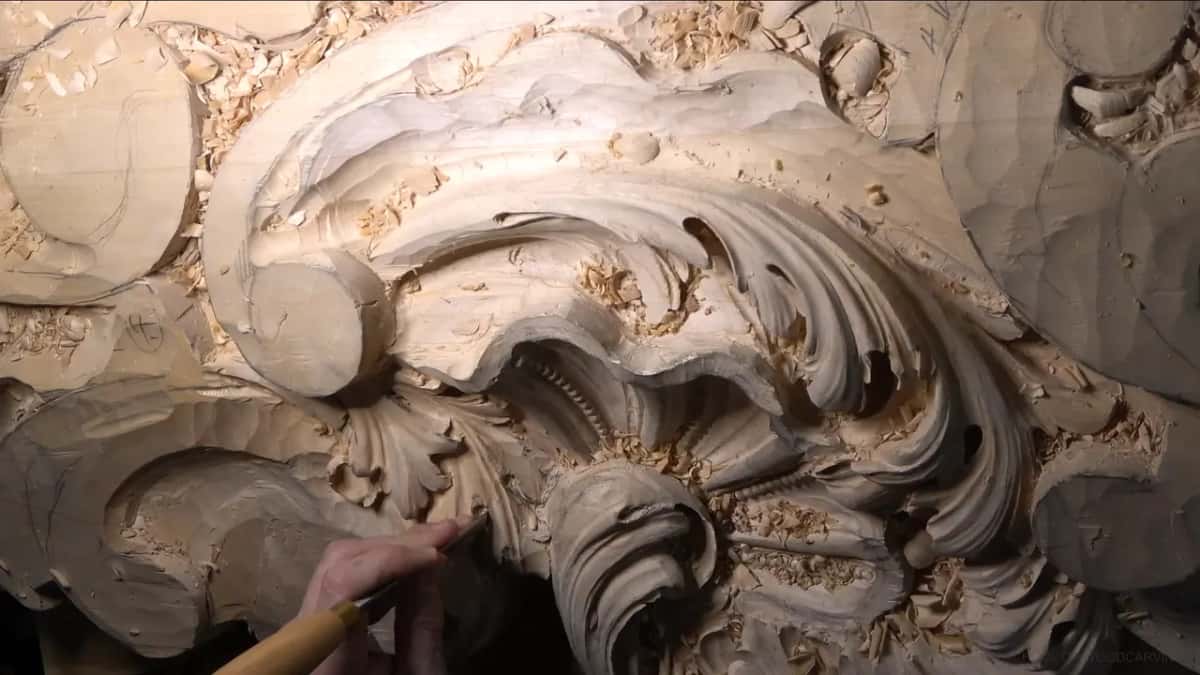
"Nothing stops me from cleaning inside," I said at 01:09. A 4 millimeter (about 5/32 inch) number 8 could go in first, I added, and the eye could get some work too, although it needed a really nice shape.
The shape came in my own words at 01:36, "in my experience, not too round, but like a U-shape almost." That would look nicer. Going deeper could wait. I would spend a little more time on it later, and for now the movement of my acanthus and this eye was clear to me (02:06).
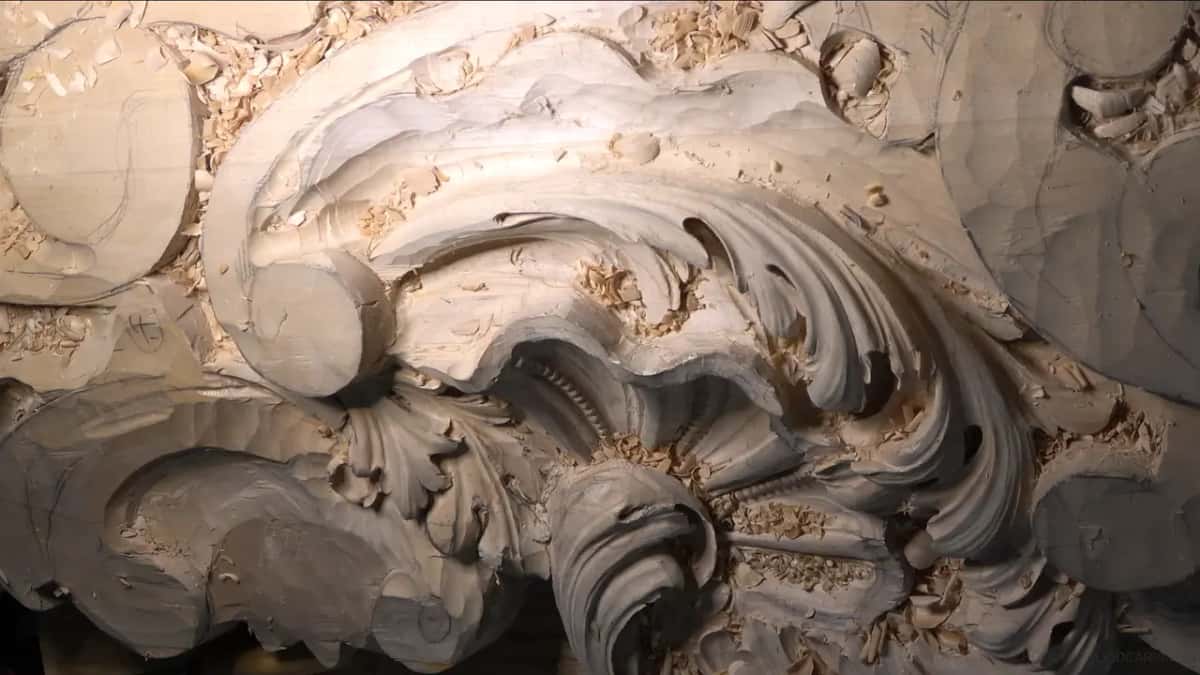
Then I named the tool in my hand, a number 8 gouge by Dockyard, 1.5 millimeters (a 16th of an inch) (02:16). A lot more tools could do this operation, I added (02:30).
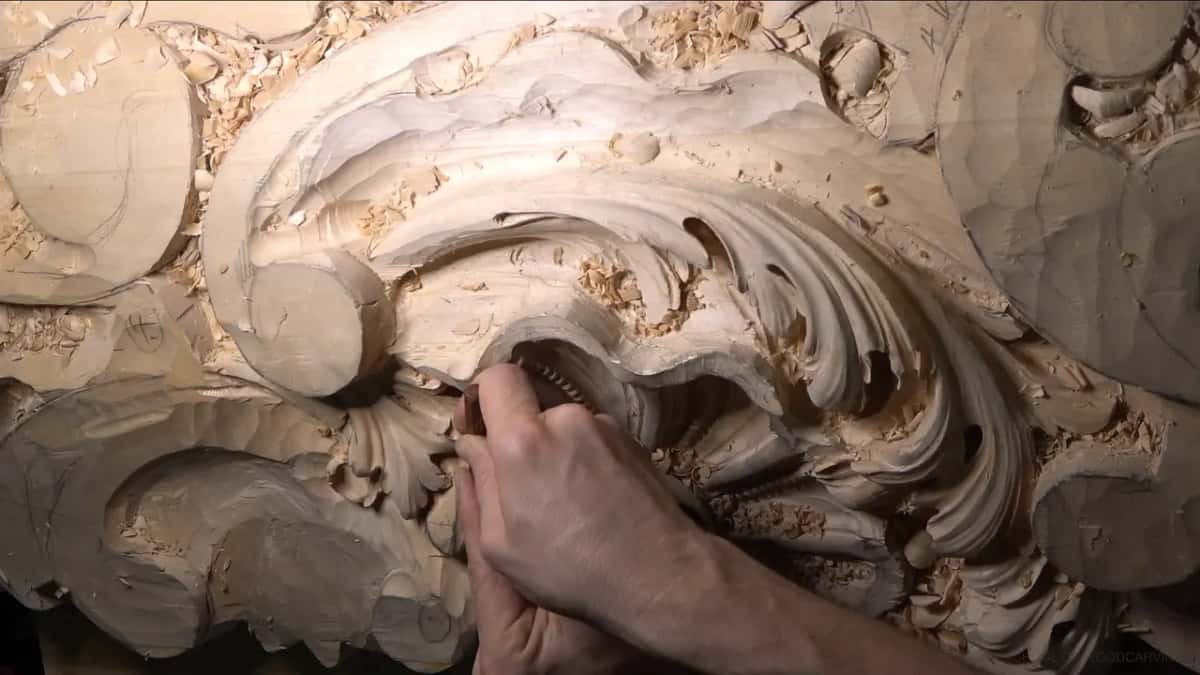
When did the number 5 come out, and where did the skew take over?
Next came a comparison of two spots. One was the main movement. The other should be a little thicker, about the same width as the first (02:50), and it would look better wider (03:06). So the plan was "number five and maybe 16 millimeters, 5/8 of an inch, and pre-establish the main movement here" (03:16). A short "Knock down" followed at 03:36.
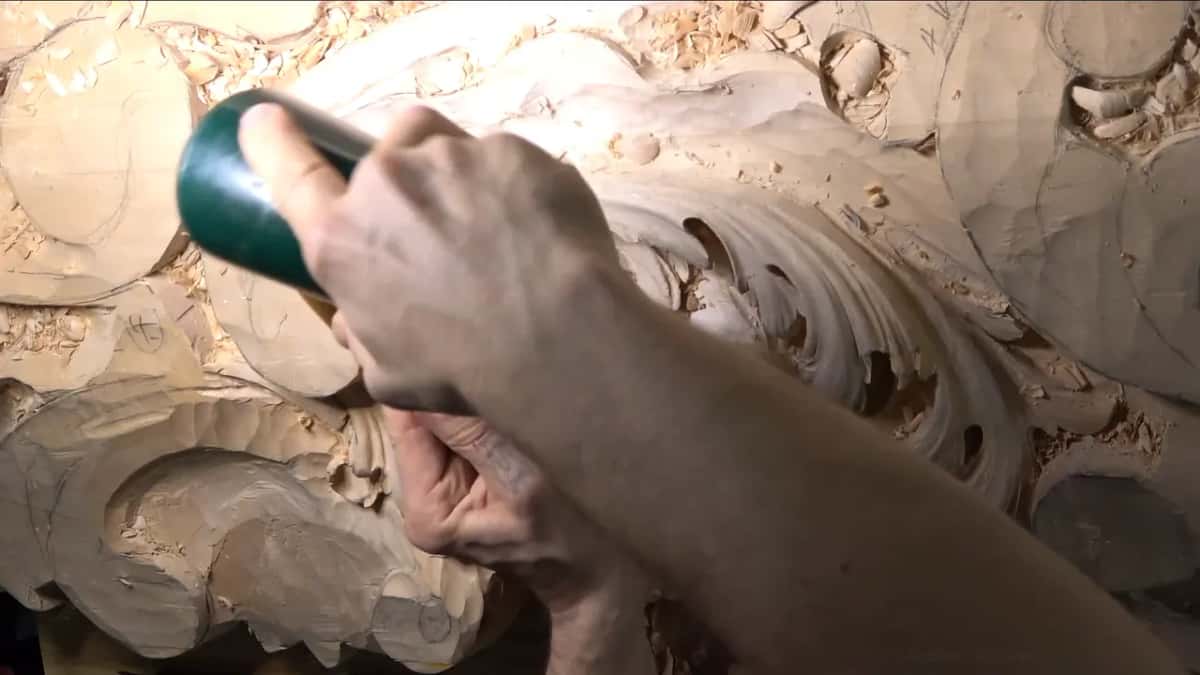
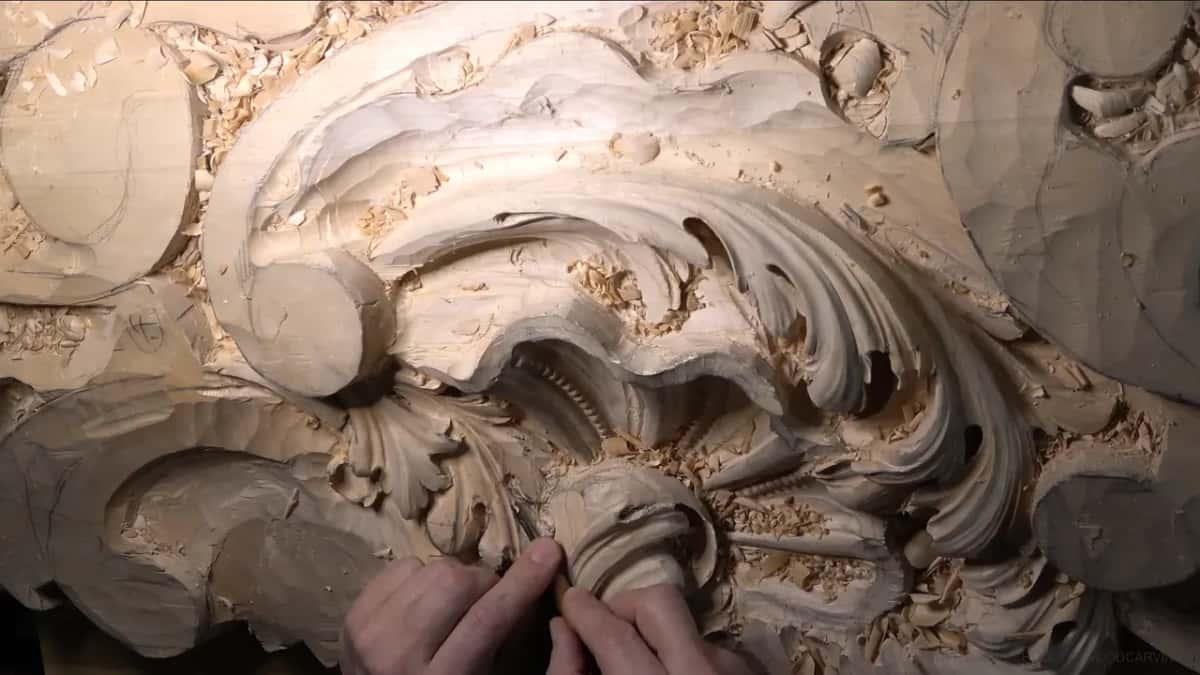
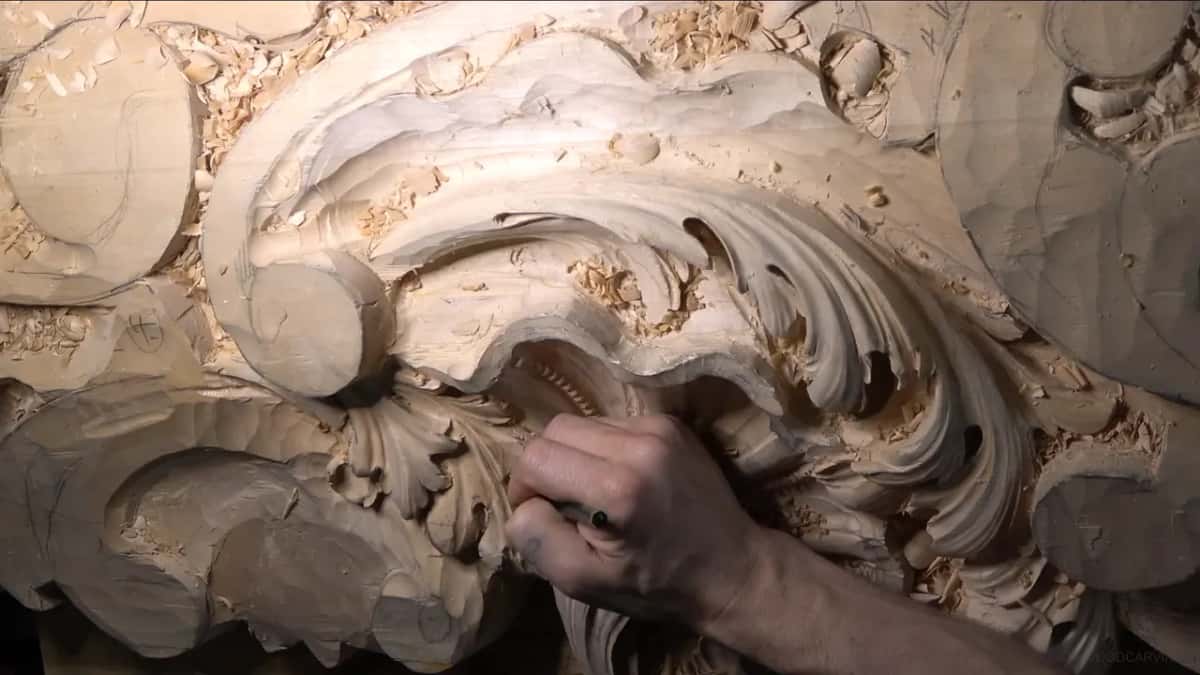
Then came the turn this page is built on. "Well, actually, you know what? I should use just a skew chisel and kind of blend this way" (04:03). The reason came next. "It's going to be much nicer and cleaner, I should say, and more gradual" (04:23).
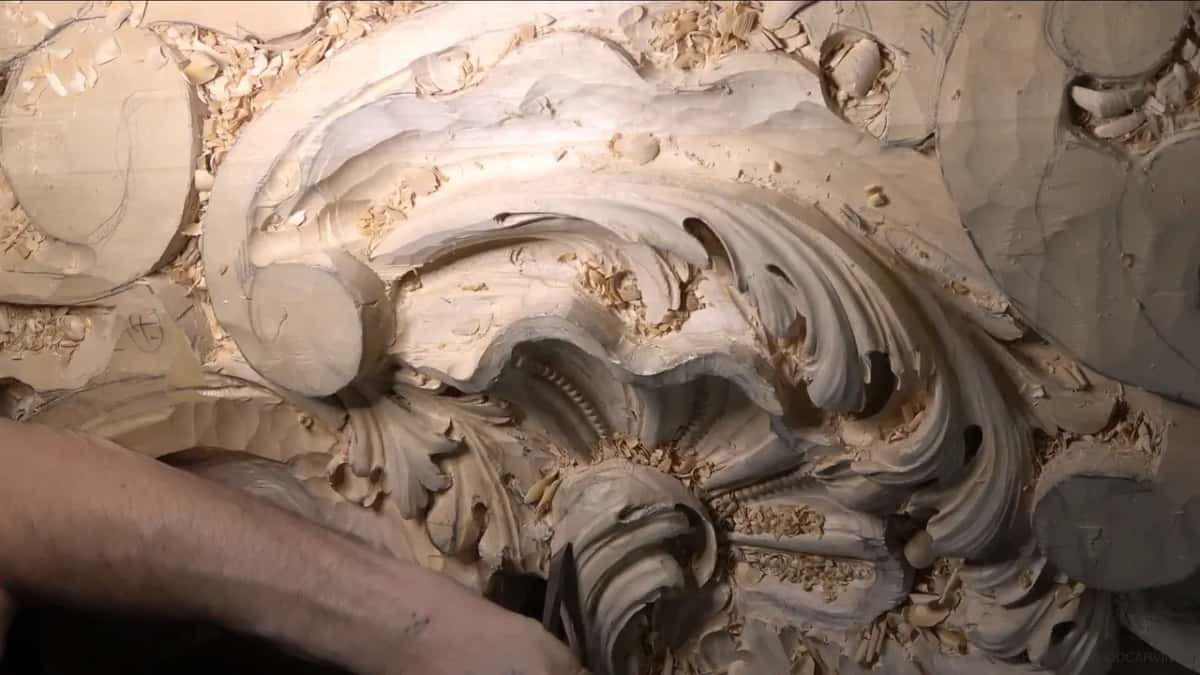
A little more could come off this way, too. "I could knock a little bit this way, too," I said, and later I would take even more, because of a movement I had not worked on yet (04:41). Only slightly, though. Some of the material there I still needed (05:00).
The verdict came at 05:09, "really beautiful, gradual movement," and then, a little later and a little shorter, "Really nice and gradual" (05:26).
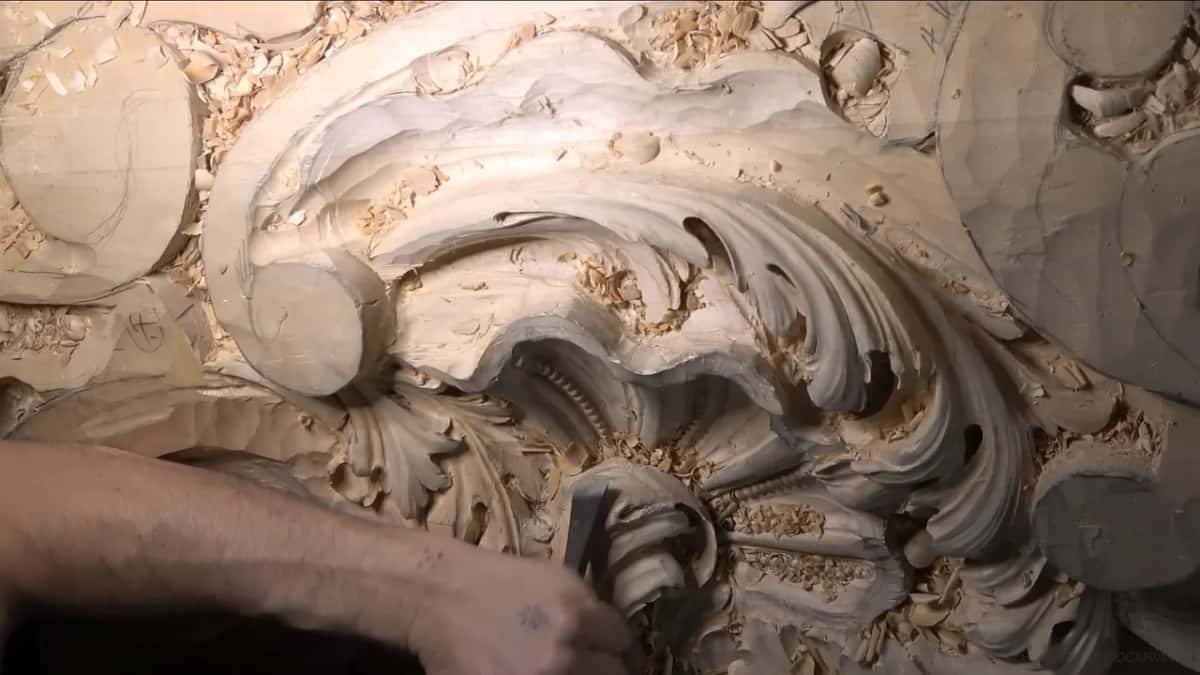
Can a carving knife blend the same slope?
A simple carving knife can do it too, by my own words in that video. "You could do the same operation with the knife, too, by the way," I said at 05:36, "with just a simple knife. Carving knife I'm talking about, not kitchen knife." With this tool, I added, the point of it gets right inside, and pretty much it cleans right away (05:49).
I wanted to stop right there, because I still needed to establish this movement, which I would do a little later (06:04).
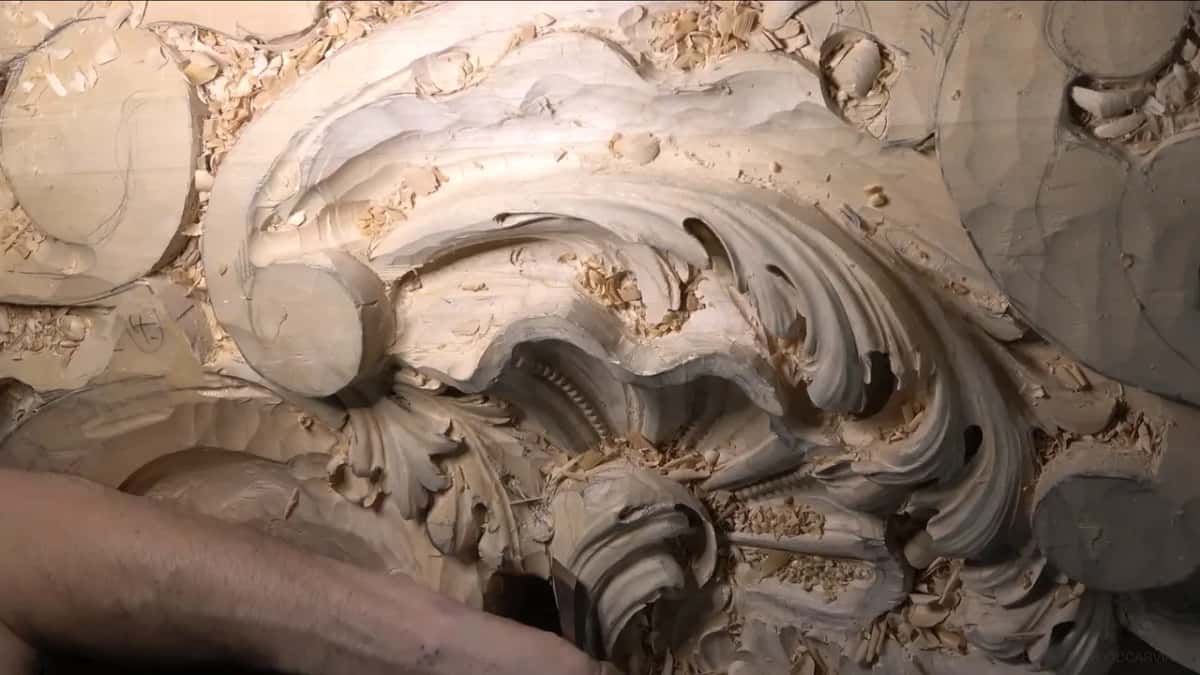
What came after the blend?
My middle line was next. It should shift a little bit inside, because the pipe needed some space (06:18). A pass would go right on the side of that middle line (06:35), and the pipe would shift slightly to the right, too (06:45). A side still needed knocking down a little more (06:53). Then, "Let me reestablish the main movement" (07:16), which should sit somewhere right there (07:24).
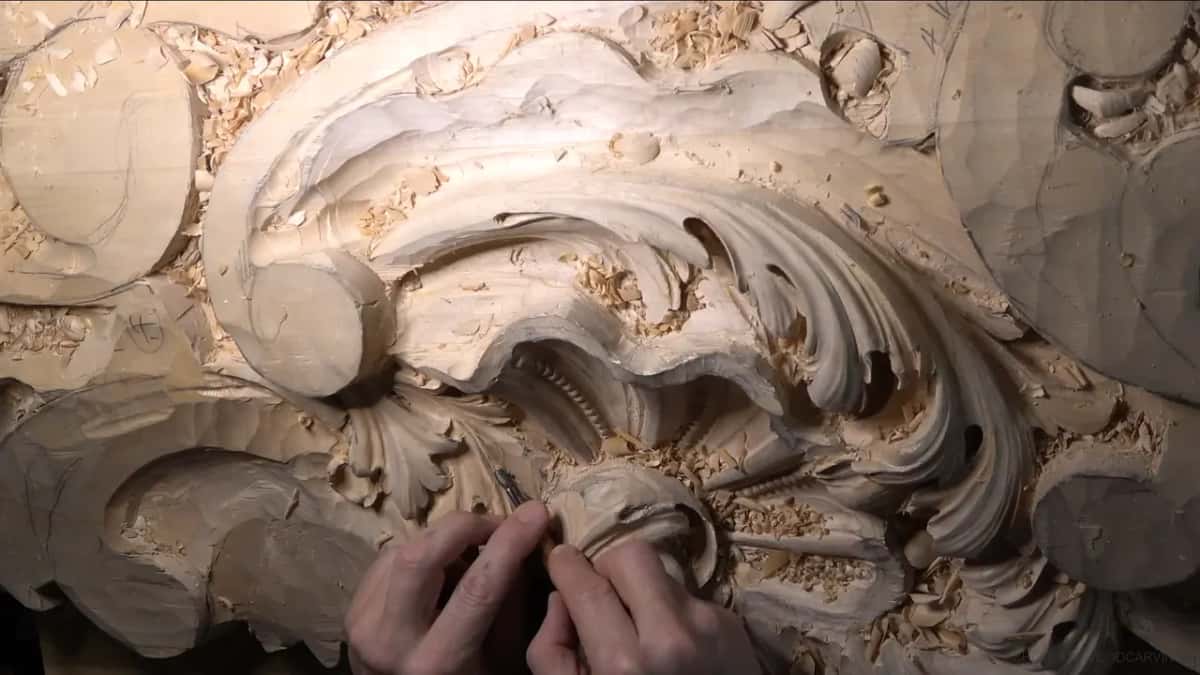
Where else does a skew blend things in my lessons?
This part is short, so I went through my other lessons for the same job. Many of them bring in a skew, usually with a reason attached. Some reasons match this video. A few say the opposite.
Why ride a big skew along an edge?
Venice Room 17, part 11, has the plainest reason. Probably even a skew or a knife would work, I said, or pretty much any tool (06:25). Still, I wanted the big skew, "because it has a leverage point, so one of the parts rising on the edge, and it creates a lot smoother cut for me."
Part 12 of that workshop adds more. A big skew chisel would ride along the edge (06:39). Different techniques exist, I explained, but one side of this tool is leveraging, cranking against the edge, and my cut comes out much smoother. It gives me much better control (07:10), though a warning followed, "your tool must be sharp" (07:41).
A smaller job shows the habit in workshop 19, part 7. An edge had to be really smoothly transitioned down. "I'll take just a big, again, skew and carefully touch the edge," I said, "and feel with the finger if it's really gradual and nice, which is the case" (00:43 to 01:04).
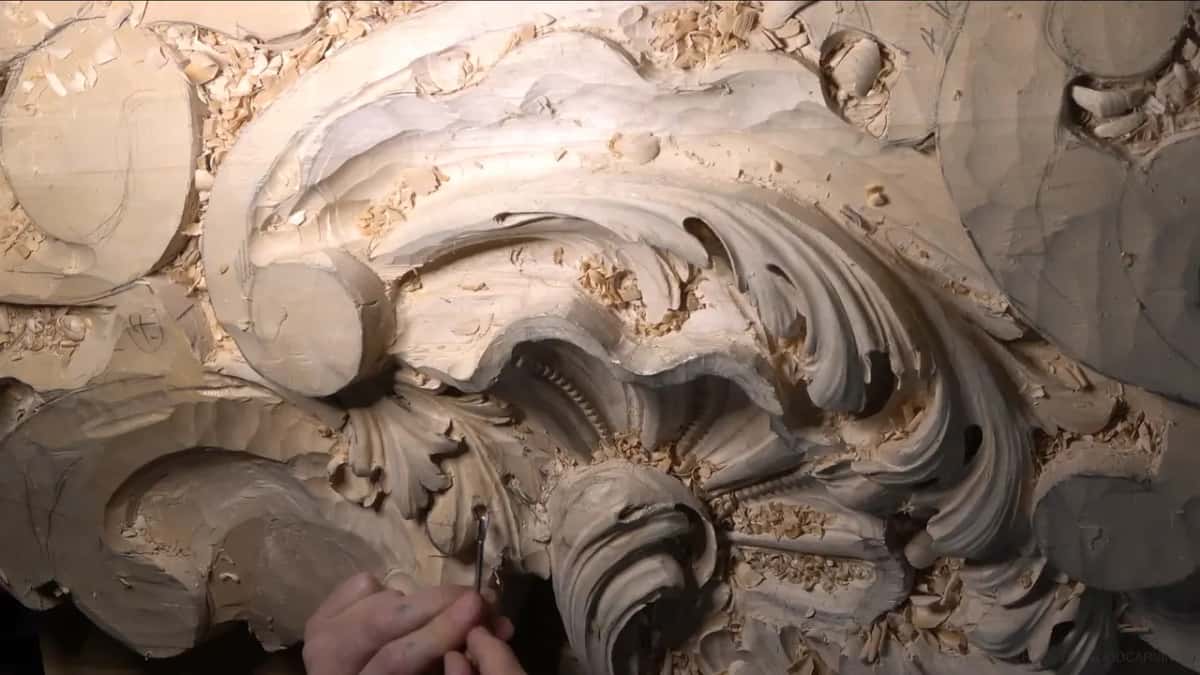
When is a skew the quickest way?
Workshop 34, part 6, says it flat out. A flatter gouge was the first idea, maybe the number five or so, or even number three. Then a change of mind, "The quickest way and just use a skew chisel" (00:55). It gave "a really nice slope." Quickest, and "sometimes it's the cleanest" (01:30). Clean results come "especially when you don't do a lot of details, let's say" (01:45).
Fewer words do it in workshop 29, part 3. There are multiple ways to blend a cut, but quickest, "probably for me," would be a skew (00:17). The easiest in workshop 61, part 12, turned out to be a skew, too (04:17). It let me move downhill almost to the line, and I kept maybe about three millimeters (about 1/8 inch), I would say. "Skew gives me just a clean canvas," I added (05:11), a clean surface to work with.
What does the skew give me that a gouge does not?
A swerve comes in workshop 36, part 3, at 06:57, "Let me use number three. Or actually, no, I don't need to." I could use just number one, or number two if you are in England. Skew chisel. Held in the same position, "all the high spots going to be gone," and the movement turns gradual. Then, "that's why I love using those tools" (07:24).
A hedge sits in workshop 39, part 2. "Maybe sometimes it's a good idea to just use a skew." Then, "With a skew, I can give actually any shape I want to" (04:24). It was "just gradually moving like that, which is beautiful" (04:58).
Venice Room 46, part 1, calls for a skew to create really nice edge. "Almost no cutting. It's just shaving pretty much" (04:51). The goal was a gradual movement, "beautiful and gradual." Maybe a skew chisel, in workshop 27, part 9, would "give an overall shape," and it would "move gradually downhill like that, which is what I'm after" (03:12 to 03:44).
Seen from the bottom, a detail in workshop 38, part 5, would bring me a really beautiful movement (03:56). In England a skew is number two, I said, and number one "if it's in Europe." Gradually move this way. "That's actually looking really good."
What if a gouge came first and the movement still looks wrong?
That is the same turn as in 22.4, and it happened in workshop 39, part 7. "Number five, that's what I'm using right now." One inch (25.4 mm). Then the verdict on the result, "doesn't look too good. Not too gradual." Another skew pass would take care of it (02:53). After it, "Now it's better. Now it is much better" (03:03).
Over in workshop 101, part 8, the order flips. Together, a number 7 and a skew would go in, and "just going to give me much cleaner cut" is how I put the skew's job. Another skew pass was needed on the other side too, and later I would blend that side also (04:01 to 04:59).
A "preliminary blending" using a skew starts in workshop 53, part 4, from the right position (02:10). The blend was preliminary, since "it has to roll, and I have to make it lower, much lower, actually, this ridge later on." Even so, "I can see exactly how my development develops" (02:43 to 02:49).
When is a skew the wrong tool?
There were too many ridges in workshop 21, part 10, and that was not good. A small skew would blend nicely (00:38). A curl was another matter. One side needed a little curl, and a skew was not going to do it, so number three or five would be the tool (01:05). Number three, I said (01:16). The curl would be visible from the bottom (01:21).
A caution comes in workshop 94, part 7. Quick, I called it, "actually a really quick way, but I have to be careful with the skew" (00:26 to 00:30). A convex was still the goal there. Part 3 of that workshop wanted a smoother slope, and not a lost feel of "a changing slope" (04:33). Maybe the skew, I said, and probably a good idea, a skew chisel one inch wide (25.4 millimeters) (04:52 to 05:04). That would give "natural movement."
Part 9 of that workshop puts a hand on the wood. Sometimes you do not really see what is going on, and "you really have to use your hand" (05:25 to 05:32). So "you can get a small skew, about a quarter inch skew" (about 6.4 mm). "Get rid of hump. I can feel. That shouldn't be there" (05:47 to 05:57), and the movement should be "really gradual" (06:05).
What if you own no skew at all?
Workshop 96, part 10, answers it. "At least just get the big skew," I said at 05:09, "because you can do a lot of stuff with just a skew." This one was one inch wide (25.4 mm), and good for a lot of "cleaning and shaping" (05:17 to 05:21).
The Venice Room is not the only course that says it. In Byzantine acanthus leaf 4, part 1, a ridge needed a smooth transition, with "no sharp facets" (03:37). I said a skew works also (03:50), and a number 2 is the same idea. You "just hold it on an angle," and "you don't push it, remember."
Leaf 6, part 3, starts from nothing, "if you have a knife or if you have a skew, what you do, just from nothing, from absolutely nothing," then you "just start blending" (04:53). That side stays kind of high yet while the carving goes downhill. A flatter tool follows the same idea when there is no knife. In leaf 8, part 3, a knife or a skew is "exactly the same operation," and you "just attack that from the right point" (02:18 to 02:26).
Not every ridge needs the skew. In the Hashemi flowers course, lesson 47, "Let me just blend all those ridges" (07:48), and then, "I don't have to blend them, by the way," I said, and "If you wish to leave them like that, it's up to you" (07:53 to 08:00). Those ridges "actually create a beautiful movement" (08:04), I added. My tool was a skew gouge, "probably sweep number five, I would say" (08:36), used backward. In the Grape onlay course, lesson 6, I grabbed my "big number one skew chisel" to "blend it nicer in three dimensional space" (04:24 to 04:32).
| Where | Use | Verdict |
|---|---|---|
| This video (22.4) | Blend the side being knocked down | Much cleaner |
| Workshop 34.6 | Give a slope in place of a flatter gouge | Quickest way |
| Venice 36.3 | Take every high spot down from one position | Gradual movement |
| Lesson 39.7 | Fix a one inch number 5 pass that was not gradual | Much better |
| Part 46.1 | Give a really nice edge, almost no cutting | Just shaving |
| Class 61.12 | Clear a ridge and move downhill to the line | Clean canvas |
| Room 21.10 | Blend ridges, but not curl one side | Number three |
| Byzantine leaf 6 | Start blending from nothing with a knife or skew | Same idea |
Where does this sit in the Venice Room?
The panel is carved in the manner of Venice, a city of the Italian Renaissance. The Republic of Venice was a state of its own, and the craft here is wood carving, a branch of woodworking.
A gouge is a kind of chisel. The skew is a chisel with an angled edge. Workshop 36, part 5, has me saying I took little out with a rasp. The other tool in this video is a knife, and a mallet shows up in one frame of it. Sizes on this page run in inches and millimeters both, with my own figure first.
What would you ask yourself at your own bench?
Is that side gradual yet? Part 4 has me saying a skew chisel would make it more gradual, and a simple knife could do it too. More of this lesson sits in workshop 22, and the course page is Advanced Carving: Venice Room, Part 2.
Which side of your carving needs a blend first?
How it's done
- Mark the movement with straight down passes. My plan was a number 3, a quarter inch (6.35 mm) wide, to indicate the movement before anything else.
- Clean inside the movement. A 4 millimeter (about 5/32 inch) number 8 could go in first, and I could even get inside the eye.
- Widen the second spot. A number 5 came up next as a plan, and I floated 16 millimeters (0.63 inch) for its width.
- Blend the side after the gouges. My pick for the blend was the skew, a nicer, cleaner result with a more gradual slope.
- Stop where the next movement is not set. I would establish the next movement a little later (06:04).
Frequently asked questions
Why reach for a skew chisel after a side is knocked down?
My reason in part 4 was a nicer, cleaner result with a more gradual slope. Afterward I called the movement really nice and gradual. Workshop 34 adds a plain note: a skew is the quickest way, and sometimes the cleanest.
Can a carving knife do the same blending?
Part 4 says a simple knife works too, a carving knife and not a kitchen knife. The Byzantine acanthus course says that with a knife or a skew you can start blending from absolutely nothing.
How wide was the number 5 before the skew?
Maybe 16 millimeters, or 5/8 of an inch, was what I said as I planned the main movement. Then the skew came up for the blend.
What to carve next