

Alexander Grabovetskiy, woodcarver, School of Woodcarving · Published 2020
When you are not sure a detail belongs on a carving, how do you decide whether to add it or carve it out?
Quick answer: Deciding on a doubtful detail is a short trial in the wood. In Venice Room 25.8 I tried a smaller gouge on one section, blended it, and judged it afterward. In other lessons I said a try could be removed, and in one I called this an art of deduction.
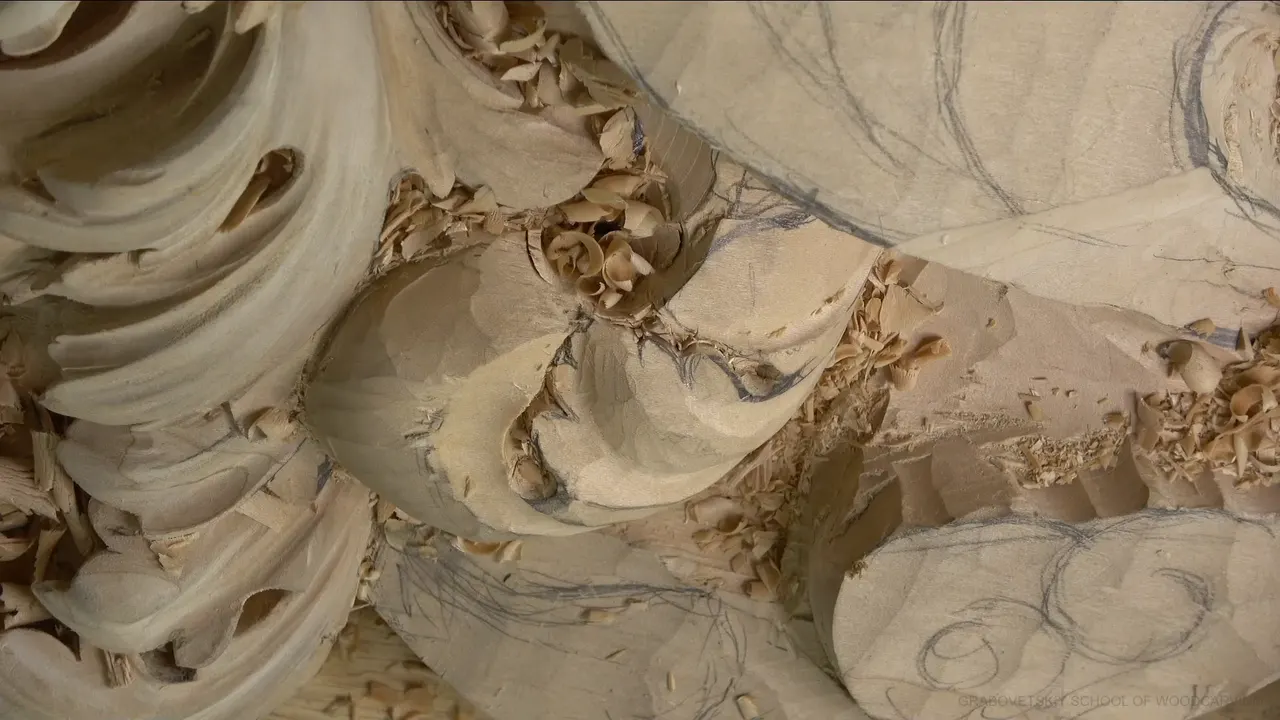
Deciding on a doubtful detail is a small trial I run in the wood, and in this video I run it out loud. Mine is a small try with a gouge, a blend, and a judgment only after the blend. My other lessons show the same habit, and every one I quote is linked on this page.
Ever stood over a carving with a tool in your hand and no idea if one more detail helps or hurts? Do you wonder how someone who carves every day makes that call? This part is eight minutes of me not knowing, and you get to watch what I do about it.

What do I do when I doubt a detail on a carving?
Five habits came up.
- I put the doubt into words before the next pass.
- I count the wood a new detail would take out, and I weigh that against what the detail would give the carving.
- Before any commitment I make a try.
- A blend comes first, then my judgment of the result, and not the other way around.
- When it looks wrong I say so plainly.
What happened in this part when I could not decide?
Shadow comes first. My first words were that maybe I don't want to go too deep right there, but I could exaggerate a little on one side, "not much, but a little bit" (00:05, 00:17). The tool I named was a number 9, a quarter inch (6 mm), with a plan to go gradually from almost nothing to a little deeper, "for just the shadow's sake" (00:20, 00:45).
No reason to go too deep, I told you, since I could blend it, deeper first and then going shallower (00:56, 01:19). On the tool marks my words were to knock them down right away, since I don't really need that, I need to blend (01:21, 01:28).

Next I named a number 5 for a slight cleaning, because I didn't want to create too deep a concave on that side. "It's going to be enough" (01:44, 02:01). I was happy with the overall movement and could probably start subdividing (02:04, 02:11). One subdivision came into view right there. I could make a separation, or I could make it look like it goes inward, which I probably should do (02:15, 02:27).

Here the doubt begins. "I'm not sure should I or not," I told you, about a micro eye that would flip a little bit of one piece above another (02:36, 02:51). I wanted the triangle relieved first (02:53, 03:04). Would it look good? "Maybe yes, and maybe no" (03:06, 03:20).

The cost is on camera. An extra eye needs an extra concave, and an extra concave takes extra material out, "which I'm not sure if I want to do or not" (03:20, 03:42). Even so, the spot was "almost asking me to do something about it" (03:44, 03:48).
One way out was to get this one on the inside of that one, and it would "probably" look much better (03:53, 04:07). For that I named a number 11 and a smaller one, so as not to overdo it. My edge was another worry, because I wanted to keep it, which meant starting from the position of this eye (04:07, 04:44).

Sizes came out loud as I went. Maybe the smaller number 11 at 2 mm (about 5/64 in), maybe 1 mm (about 0.04 in), or one and a half (04:47, 05:20). At 05:20 I still doubted that I was doing the right thing in that section.

A blend came next, and the test was simple. Once I blend it, I'll see if I like it, and if not, "I can always take care of it and remove it" (05:27, 05:37). The flatter number 3 and a number 11 at 1 mm (0.04 in) cleaned "that mess that I just created" (05:52, 06:01).

At 06:32 the section "does not look too good." My thought was that I had made a mistake I should not do, and then I took it back. "It's not really a mistake." I had made the decision to do that type of movement, and my question was whether I should (06:32, 07:04).
Maybe it was not that bad yet. I would do the next subdivision and see (07:04, 07:16). You are watching me work in real life, I reminded you, and I have to think at each step what the next move will be and how it will look (07:16, 07:38). I wondered about going a little deeper than this one, but I was still not too happy with what I had just created (07:38, 07:55). It ends on "That is not good" and my thought that I need to knock the whole thing out (07:57, 08:04).

How do I try a doubtful detail without committing to it?
The habit is a try with a way back. Lily Box lesson 4 shows it on a part that could take a concave or a convex. I thought a concave would look really good, and "let me try" led to a small one with a number 5. A bad result could be redone, I told you. The concave pleased me, but the overall movement of that edge did not yet, and I meant to revisit the area later (05:54, 06:49).

Later in lesson 4, a smaller concave right inside an edge came up. "Not sure if I should or not. But let me see," and "if I don't like it, I can always remove it" (26:44, 27:00). A magnifier lamp came to mind next (27:12, 27:18). Then I liked what I saw: "I really like that concave on inside." Shells are where I usually use those inside concaves, especially for furniture, and they give "a really nice touch" (27:20, 27:39).

Beside the same sentence in lesson 12 sits a number. A movement on one side called for a complement on the opposite side, so I could create a huge convex, and "let me do that and we'll see." Removal stayed possible, and I still had about three or four millimeters (about 0.12 to 0.16 in) of wood left (06:00, 06:35).
One part in lesson 6 looked too high and "doesn't look too appealing to me," though a high detail stood on the opposite side. Keep it, I decided out loud. For now, yes, and a disappointing result later could be reworked in that area (12:51, 13:15).
The Venice Room workshops carry the same sentence. Workshop 15 has "Let me try it," and "I can always shave it," because "I really need that shadow right there" (03:32, 03:59). Over in workshop 19 the doubt returns, and so does the line about removing it, but "I don't want to remove anything." Lowering one part would keep the same overall movement and make the other one more visible (04:24, 04:52).


When do I leave a doubtful detail alone?
In places the answer is maybe not. The start of lesson 8 in the Lily Box course has "1 millimeter first" (about 1/25 in), and at 07:59 comes "Maybe not. Maybe just a smooth transition" (07:45, 08:06). That spot stayed as it was for now, with my marks to clean and the next move to think about (08:10, 08:19).

One side in workshop 20 might have been knocked down a little. "Maybe I just should not touch it," because the deeper I go, the more material I'm removing. Then came a compromise, "maybe just a little bit" (04:06, 04:28).
A glued-on part came up in workshop 136. At the beginning I wanted to glue up right on top of a flower and pop it a little higher, but I wasn't sure about that. I thought I would be okay without it (05:04, 05:16).

The second Lily Box lesson holds the strongest case of a want I did not need. Plenty of meat was there. Beautiful movement for sure, I thought, enough to go all the way through if I wished, but "I really don't need to," and I could not tell whether to (05:05, 05:29). My plan was to go as deep as possible and see how it looks (05:31, 05:34). Fear came after that, "kind of afraid of doing it," and a note to myself that I should not go all the way through both sides (05:52, 06:01).

As for the reason, "it just creates the shadow, and that is the whole idea in the wood carving, lights and shadow" (06:28, 06:38).
What makes me say yes to a doubtful detail?
Taste came first in lesson 6. Plenty of thickness was there for an even deeper undercut, and I wasn't sure about it, but "I really like extreme undercutting," and that is "just my personal taste." On an everyday item it's not too practical, since the more material you take out, the more fragile you make it. A piece of art on a wall is another matter. People won't touch it all the time, and it just hangs there (05:55, 06:53).

Later in that same video, one edge made me hesitate until I reasoned, "maybe I should because this leaf is a part of overall movement." The tool was a number 5 at 12 mm (about 15/32 in), angled just a little bit, and the result was "a really nice transition" (11:32, 12:25).
Light decided it in another part of workshop 19. Even deeper looked possible, and the spot would be visible from below, so I hesitated twice. I leaned yes, because an opening on that side would let the light hit in that direction and give extra shadow. A bigger number 9 at 5/16 of an inch (about 8 mm) crossed my mind (02:07, 03:08).
The honest version is in workshop 163. A pass of 1 mm (about 1/25 in) was possible there, and I was unsure about that too. "Maybe it's overkill in this area. Really don't need to. But it gives me a beautiful shadow," even if you can't see much of it on the camera (02:36, 03:10).

A flip in workshop 20 was a want, not a need: "I don't have to, but I think it could create even more interesting movement." Time to think twice, with "let me double think" (01:24, 01:50). At 02:10, "really nice movement" (02:10, 02:16).

What do I say when the doubt does not go away?
The long version is in workshop 152. A section didn't look too good, so I planned a division right away to fix that problem. Next came "I don't know, should I or should not?" and maybe the division belonged somewhere else, or maybe I could get a nicer shape instead. "I'm kind of having doubts. I am having doubts." Logic said a couple of divisions should work, so I leaned toward placing it more toward here and excavating an eye (04:53, 06:28).

A shorter one sits in workshop 157. "I still have doubts if I should create a separation, but I'll do it." And if it fails, "so what, it's okay" (04:28, 04:40). A look at the whole piece afterward made me think about moving my center line (05:10, 05:18).
Another separation showed up in workshop 144, one I could do or skip. A big S curve was another idea. "Let me think about it," I said, and then, "But meantime, I can move on this side" (01:07, 01:34).
There is a limit, and workshop 152, part 3 names it. Unsure what to do, I thought I would probably open up and make a shadow effect. "If I don't like it, nothing I can do, because this is an art of deduction" (00:33, 01:10). That section was somewhat a focal point, right in your eyes. Still, "I think it's actually a good decision I made" (01:29, 01:41).
Which doubts did I answer, and how?
Five of them sit in the table, each with the place I said it.
| Doubt | What I did about it | Where | Words |
|---|---|---|---|
| Concave inside edge | Unsure at first, so tried it small | Lily Box | Removing it later was my plan |
| Deeper undercut question | Fragile on everyday items, art hangs there | Lesson 6 | Not practical when more wood leaves |
| Extra shadow below | Deeper excavation, since light hits that side | Room 19 | Visible from below, so maybe yes |
| One millimeter overkill | Tried it, since it gives a shadow | Venice 163 | Maybe overkill, no real need there |
| Glued part idea | Unsure, then I'd be okay without it | Room 136 | Wanted it higher at the beginning |
The table does not say who won. The last column is my own plain summary of what I said, not a quote.
Where can you see more of this?
The Lily Box course gave me most of the lines above. The Advanced Carving: Venice Room, Part 2 covers workshops 13 through 25 of the 15th-century Venice panel. Its leaves are acanthus, carved in relief.
Light and shadow carried most of my yes answers above, and painters have a word for that play of light and dark, chiaroscuro. The wider craft has pages on sculpture, woodworking, hand tools and furniture. If a detail on your bench has you doubting, one row of the table may already be yours.
How it's done
- Say the doubt out loud. In 25.8 I wondered about a micro eye, asked if it would look good, and answered maybe yes and maybe no (02:36, 03:20).
- Count the wood it costs. Adding an eye means adding a concave, and that costs wood (03:20, 03:42).
- Try it with a smaller gouge. A number 11 and a smaller one, so I would not overdo it, and I did not want to hit my edge (04:07, 04:37).
- Blend first and then look. Blend, look, and remove the try if it disappoints me (05:27, 05:37).
- Admit when the try is off. I said I think I made a mistake, then took it back (06:40, 06:52).
Frequently asked questions
Do you decide before the gouge touches the wood?
First comes a try, then the judgment. In this part I blended a little and said the blend would show whether I liked the new detail. A failed try, I added, could be taken care of and removed. Other lessons on this page say the same thing, each with a cue time.
Can you take a doubtful detail back out?
Several lessons say yes, and each one is linked on this page. In one, about three or four millimeters (about 0.12 to 0.16 in) of wood were still left. In another I said there was nothing to do about a result I didn't like, and I said it plainly.
What if you do not need the detail at all?
On camera, yes. In the second lesson of that course I did not really need to carve through at all, and I said I should not do it through both sides. In workshop 163 I did not need an extra pass in one spot, but it gave me a shadow.
What to carve next