

Alexander Grabovetskiy, woodcarver, School of Woodcarving · Published 2020
Which carving rules does a carver break on purpose, and how does he say he knows it is safe?
Quick answer: Breaking a carving rule on purpose is a choice I say out loud, with my reason beside it. In workshop 25, part 1, I carved toward myself with my hands locked tight and worked a spot where the grain looked wrong. In other lessons my condition was locked hands or a sharp tool.
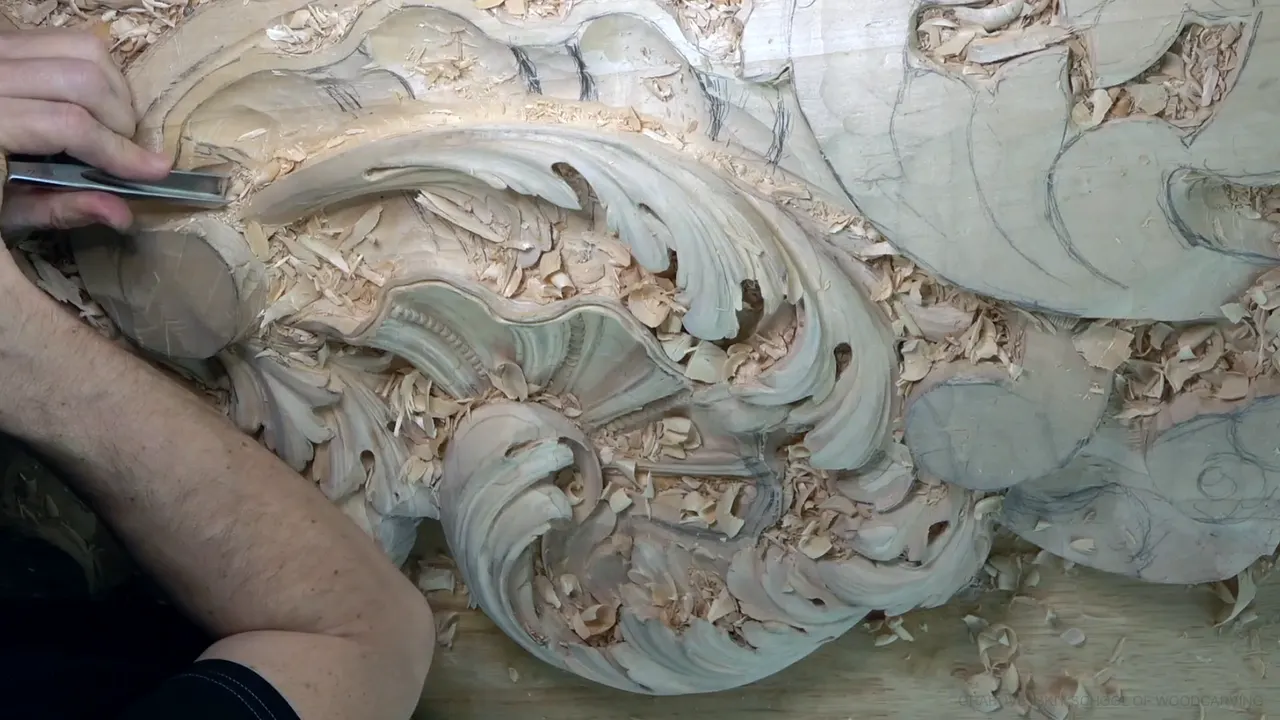
Breaking a carving rule on purpose is a choice I say out loud, with my reason and my condition beside it. In Venice Room 25.1 I carved toward myself with both hands locked on the wood, and I worked a spot where the grain looked like it was against me (05:09, 06:44). I also left lines off the back of a leaf, for a design reason. When I tell you something is off limits and then add a but, this page is about the but.
This part is short and mostly quiet work, so I went through my other courses for the same sentence, and every lesson I quote is linked where it comes up, with each condition just as I gave it.
Ever stood over a piece with a rule in your head and no good way to follow it? Do you wonder whether the carver teaching you ever bends it? Watch what I say just before I do.

Which rules was I not supposed to follow in Venice Room 25.1?
One rule I named, and a few habits I stepped around. The part opens with fast work. I could use a number 1, the big one, three inches or so (about 76 mm), and chop down as much as I could. I called it 80 millimeters (about 3.1 inches), and it just gives me a much quicker result (00:03, 00:34).
I said I could clean it now, and then use a number 11. Next I thought a straight number 11 gouge of maybe 12 millimeters (about 0.47 inch), the bigger one, could work if nothing got in my way, and I wanted to see whether I could get in (01:26, 02:01).

Around 03:42 I said maybe a mallet would help me a lot more. Then came a plain yes, I should use a mallet a lot more (03:42, 03:50).

The rule came at 05:05. I was not suggesting that anybody do what I was doing, I said, since you are not supposed to carve toward yourself and I was carving toward myself. Both hands were locked really strongly on the piece, and I added that I was not doing it from the air (05:05, 05:34). As a rule, normally, you would not do that (05:35).

At 06:44 it looked like I was against the grain, and it would help to attack that spot from the right position (06:44, 07:05). The word rule did not come up there. I carried on carefully (07:11, 07:19).
Next, the back. Looking straight at the leaf, you would probably run those lines all the way down the backside, I said. But the back would be visible from the bottom, and I really did not need that. It would be destructive to the eye, and not a good design decision (07:19, 07:47).

Then the wall. Maybe I could go a little bit in, but not much, since I did not have too much thickness. I had maybe about an eighth of an inch (3 mm) of wall right there, and I wanted to stay clear of going through (08:03, 08:18).

The part ends on the sections that go inward. I wanted them heading the right direction, and one looked a little too big. Same distance, approximately. That was what I wanted to keep (09:03, 09:05).

Why did I carve toward myself when the rule says no?
The clearest version is in workshop 67. I was working toward myself, I said, and I would encourage you not to, because it is not the safest way. You can slip and cut yourself, and that would be a big mistake (03:36, 03:51).
A minute and a half later came the rule I follow when I have to. Lock your elbows and your hands right on the piece, so even if you slip, the hand is not going to let you cut yourself. Then it's kind of safe, or safer, I should say (05:16, 05:42). Right after that came the plain line: if you don't have to, don't do it. Every carver does it, I said. Every carver also says don't (05:47, 06:05).

The Byzantine acanthus course turns it into a joke, and I told you not to do what I do. Never carve toward yourself unless you're a dentist, and lock your elbows, or really your forearm (01:26, 01:46). That was for the camera, I said, so you would see, and so I would not rotate the piece too often (01:55, 02:03). And I admitted I still do it myself, as everybody does (02:07, 02:11).
A limit of my own shows in workshop 53. Advising anybody to do it was not what I was doing. If you lock your hands, really placing your hand right on a piece of wood and holding that strongly, I believe it's safe enough (04:18, 04:41). My reason was that I could not rotate that piece (04:47).

Shortest of all is workshop 82. Not the best position to carve in, I said, and no pass should go toward yourself, but locked really solidly, my hands should not create any problem (06:39, 06:52).
Sometimes the camera made the call. I asked you to forgive me in workshop 62, because I had no better position without sticking my head to a camera (04:54, 05:20). The Acanthus over Moldings course gives another reason: on really complicated projects you do not get a comfortable position all the time, and you have to attack from different angles (11:24, 11:46).
Not one condition came with workshop 37, only a shrug. Sometimes, what can you do (01:14, 01:25).
What makes me carve a direction the grain rule forbids?
I tell you what the tool has to be like, and what is in my way. Workshop 81 has me saying I had to work sometimes against the grain and going uphill. If the tools are sharp, sometimes it's okay (00:06, 00:20). Uphill work in workshop 82 says it again (02:28, 02:35), and workshop 83 adds the condition: okay, as long as my tool is sharp (02:02, 02:14).

Sharpness comes first in workshop 5 too. The tool must be absolutely sharp if you want to do it that way, I said, because I really could not carve from that side, and no such tool would fit in it. I kept an eye on the grain of the wood (06:08, 06:25). Lighter still, workshop 16 of the Furniture Panel course says that with sharp tools you do not have to worry too much about it (01:33, 01:55).
Often the reason was the table and the camera. Turning the table in the Floral and Molding course meant redoing my cameras, and that takes time. So for me, if the tool is sharp, sometimes you can break the rule (06:10, 06:33). Furniture Panel 18 goes further. I am breaking some rules, I said, not because I like to but because of the camera position, and avoiding it would probably be much better. With sharp enough tools it should not be a problem (02:46, 03:19).
A piece can box you in. A ceiling stood on another side in workshop 49, and I could not use a tool from the opposite direction. That broke the rule of working with the grain, and only one direction was open (06:34, 06:48).

Other reasons are smaller. Hashemi 42 came with a plain reason: that part was going to be invisible anyway and just goes inside a socket (01:02, 01:28). The Greek acanthus course shows going that way gave me more control on the flow (05:26, 05:36). With the flowers in the Grinling Gibbons class I asked you not to judge me, said I know what I'm doing, and told you there was no other way with a stem in the way (03:18, 03:39).
Number 3 came out in Furniture Panel 22, a quarter inch (6 mm), little by little. I called it breaking my rule and said it's okay, I should be fine (06:40, 06:59). Furniture Panel 21 is the plain one. A rule broken, and I was fine with it (19:15, 19:20).

The other direction shows in workshop 85. You might ask why I do not come at it that way. The grain ran so that it was uphill, and way uphill at that, so I could easily break the piece. So I carved with the grain. That, I said, is why I was breaking the rule, which I encourage you not to do. I guess everyone breaks the rules, you have to (00:07, 00:41).

What were my words beside each rule I named?
Five of them are below, each with its lesson and my own words.
| Rule | Move | Where | Words |
|---|---|---|---|
| Carving toward yourself | Elbows and hands locked on the piece | Workshop 67 | Don't do it, I said twice |
| Grain direction rule | Going uphill, sometimes, with a sharp tool | Workshop 81 | But if the tools are sharp |
| Wiggling the gouge | A little wiggle, carefully, carefully going in | Panel 22 | But I do that a lot |
| Small tool mallets | A mallet on really tiny tools, carefully | Lily 5.9 | Sometimes it's helpful to use one |
| Long Venetian movements | A long separation piece in Venetian style | Venice 66.9 | That's okay, I hope it's okay |
The first two rows have the most lessons behind them. The last three lean on control, or on looks.
What do I say about wiggling and about a mallet on small tools?
Panel 22 had me going in carefully, carefully, with a little wiggle, which some carvers say you should skip. I do it a lot, because it gives me much more control (00:49, 01:13). The same habit shows in Hashemi Flowers workshop 21. I know you should not wiggle, but I do sometimes, and I think it's all right. Please do not press too hard, I added, since it can break easily (02:41, 03:22). Over in workshop 22 of that course I was supporting the piece by hand, because no matter how careful I am, I still create some pressure, and I did not want to press too much and break it. I know it is frowned on, but it's okay (05:28, 07:28).

The Lily Box course covers the mallet. I had said it many times: a mallet on really tiny tools is a no. But if you're really careful, even so, sometimes it's helpful, and you gain a lot better control (17:57, 18:19).

On a livestream someone said mallets are great for fine cuts. I use one even on micro tools, though when you buy them it says do not use mallets. Maybe I'm breaking the rule, I said, but I never had any problem (29:23, 29:49).
The dining table apron course has a palm V tool. Hitting a palm V tool with a mallet is frowned on, I said, but I was barely touching it, and the mallet gives me better control (04:43, 04:54).

Do I leave any rules in place?
In that same course I called it better not to hit with your hand, because you develop a problem they call carver's or carpenter's disease. I try not to. It is better to hit with the mallet than with the hand. But sometimes, in a rush, I do hit with the hand, and I know it's not right (13:11, 13:48).
Hand and blade come up in Hashemi Flowers workshop 25. You kind of break a rule when your hand sits in the way of the blade, and you can really badly cut yourself. Keep an eye on the pressure, I said, don't force it, and feel how much pressure you use and where to stop (05:41, 06:25).
Some rules are about looks, not safety. Part 8 of workshop 66 had me saying nobody else would know that Venetian style does not call for long movements like that. It's okay, I said, we'll develop something new (07:06, 07:24). Part 9 comes back to it: logically I should not have that long a separation piece, but that's okay, and I hoped it was (01:44, 01:54).
Even drawing has one. Professional artists say to draw in one long line and nothing else. Yes, it's true, I said, but not always possible, and I can do one long pass too once I get closer to the result I want to see (03:50, 04:11 in workshop 5).
More stress shows up in workshop 4: too much on both sides, which I said I should not do, but it would give me an indication, and that was why I was not hitting heavily (03:40, 03:50). Two parts later I said I was at it again, since I am supposed to attack from a particular side. Barely any material was coming off, I was pretty close to the shell line, and I did not want to make the mistake. My next move, I said, was to change position and attack inward (02:08, 02:48).
Advanced Carving: Venice Room, Part 2 runs from workshop 13 to workshop 25, and workshop 25 holds the other parts around this one. Late in this part my plan was maybe a skew to clean the side a little (06:25, 06:32). Wood carving, woodworking and hand tools are the wider craft. Pick one leaf of your own and look at which way the grain runs before you touch it.
How it's done
- Name the rule. At 05:09 I named the rule against carving toward yourself and told you I was doing it anyway (05:09, 05:16).
- Give your reason. In other lessons my reason was a piece I could not rotate, or a camera with no better position (04:47, 05:20).
- State the condition. Mine was locked hands, or a sharp tool when the grain was wrong (05:24, 06:19).
- Say what you would rather do. Avoiding the break would probably be much better, I said in Furniture Panel 18 (03:09, 03:12).
Frequently asked questions
Which carving rules do you break on purpose?
Four kept coming up: working toward myself, going uphill, wiggling a gouge, and tapping a mallet on tiny tools. Each came with a reason, like a sharp tool, a piece that would not turn, or a camera in the way. I advised against it in workshop 85 (00:38).
Do you call it safe to work toward your own body?
I did not call it safe. Workshop 53 had me saying that with a hand placed right on a piece of wood and held strongly, I believe it's safe enough, and then that I was not advising anybody to do it. My plain line about avoiding it, if you can, is in workshop 67 (05:47).
Does the grain rule still apply when your gouge is dull?
A dull gouge does not appear in these lessons. My condition was sharpness. Workshop 5 had the tool absolutely sharp for that, because I really could not carve from that side. In workshop 83 I put it as okay with sharp tools (06:15, 06:21, 02:10, 02:14).
What to carve next