

Alexander Grabovetskiy, woodcarver, School of Woodcarving · Published 2020
When should you undercut a carving: right away, or after the main shape is set?
Quick answer: Undercut timing is a choice I make for each area of a carving, and my own lessons go both ways. At depth, an undercut can break a leaf point, so I wait there. A part that must sit below its neighbor can take a light one early. In this part it stays a plan.
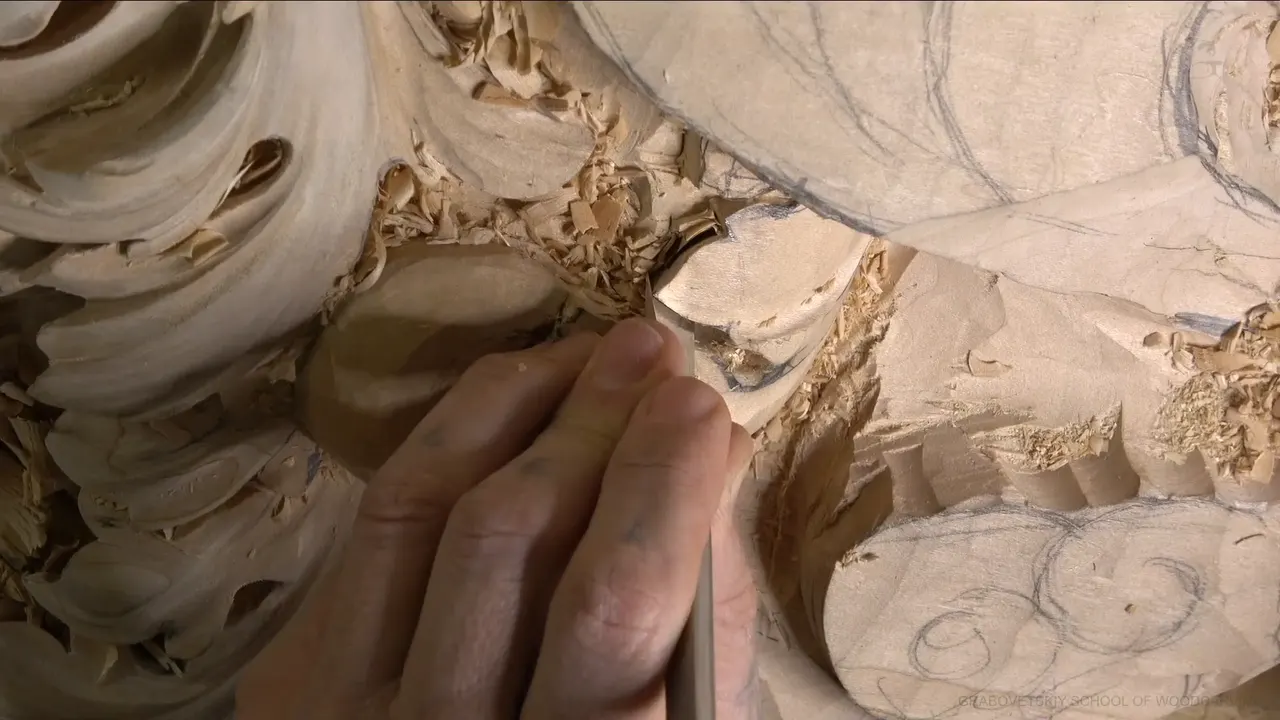
Undercut timing is a call I make area by area, and in my own lessons it goes both ways: sometimes I undercut early, and sometimes I hold it until the main shape is set. In Venice Room 25.11 I talk through both on one S movement, as a plan: maybe at once, and then I can (00:21, 00:36, 00:56).
I went through my other Venice Room lessons and a few other courses for the same choice. Each lesson I quote is linked where it comes up, and my cue times sit beside it. Both lists turned out long.
Ever started an undercut and wished the shape on top had stayed whole a little longer? Do you wonder if a gouge goes under a leaf first or last? Here are my own answers, one lesson at a time.

What was my plan for the S movement in this part?
The part opens on a plan. I'll use a number six, I say, to get that letter S movement (00:04, 00:15). Then comes a hedge: maybe pretty much right away undercut (00:21).
One side is going to be a little too big of a tool. For that side, I say, I should use a number five and a smaller one, down that side (00:25, 00:33). Early on, I tell you, I can undercut, and probably from this side I can go a little more (00:36, 00:47).
Every one of those lines is an I can or a maybe. By 00:52 you already should see how it's forming the shape. Then once more: I can actually undercut right away, too, right here, and maybe pre-establish the main movement there (00:56, 01:01).

How does the order change once the form shows?
Next it's all about cleaning and doing the details. I plan a number five at a quarter inch (6 mm) and go in like that (01:08, 01:19).
Then comes the plan for underneath. Next, probably a number 11 spoon gouge can excavate under that spot, which is logically, I think, the right thing to do (01:36, 01:52). The size I name is 7 millimeters (0.28 in), little bigger than a quarter inch (01:57).

By 03:04 you probably should see it from above, I tell you, with the main form already showing, and I'm really happy with that (03:04, 03:15). I'm ready for the next step (03:15, 03:19). The final details are still to come, and we can do them later (03:37, 03:43).

Which part goes below and which part goes up?
The second detail gets its plan in words before a tool touches it. One part will sit on a lower level, below the main part. The main level gets some kind of movement, and another part grows from underneath and goes all the way up (05:16, 05:59).
I want to double-check how it looks and be sure it makes sense (05:51, 06:08). The first side has to come down, then the other, and I plan to separate that at once (06:20, 06:35). Then I think this movement should move up the whole way, because it will make more sense (06:46, 06:56).

At 07:04 I give the order. First I establish it to the point where it's supposed to look, and then I will create my subdivisions (07:04, 07:16). There won't be too many, but still some (07:18, 07:26).

The last minute adds one habit. I start to say separation cut, then fix the word: separation notch, because it's not really a cut (07:35, 07:46). The part going underneath needs excavation around it, and the other part will be higher (07:46, 07:55). Nine would do, but I'll use just number 11 (07:59, 08:06).

When do I hold an undercut back?
I hold it back when my own tool could hit the piece or the main movement is not set yet. In Roman Acanthus lesson 9 the reason is the tool. When I dig that way, I can always hit the points of my leaves. A leaf that is not undercut I won't break, but with an extreme undercut already there I'll break it for sure (03:50, 04:05).
So undercutting is done later in the process, I say there. I add that it depends on the area. It's not always a hard rule, and sometimes you do have to undercut and just be careful (04:09, 04:25).

Vase with Grape Leaves lesson 2 shows the same patience on a flute. I clean it without undercutting, because it's too early. We will undercut, I say, but it's a little too early (00:37, 00:45). The number 11 helps there, since its U shape lets me use just one of the sides (00:49, 00:57).
The Byzantine Acanthus course says it to students: the triangles and separations should stay vertical, because we'll undercut them later (06:24, 06:33).

Over in Venice Room 88 I'm butting against one of the sides and trying not to undercut. On the volute part of the design, one side rises (05:30, 05:46). For now, I say, later I will undercut, but not much (05:57, 06:41). A number 23 macaroni tool gets me close to the design and makes a wall without undercutting (06:01, 06:28).
My order shows in plain words in Venice Room 57. Later comes the undercut underneath those beads I make (04:09, 04:14). I'm never attacking right away all that mess before I finish the main movements and the main establishments (04:26, 04:34). Sometimes I have to crank against the edges, and I need solid spots for leverage (04:38, 04:49).
The shortest version sits in Venice Room 84. I'm happy, so no undercut yet: don't need to, don't have to (02:53, 02:59). Develop the movement first and figure out where it ends (02:59, 03:07).
One line in Venice Room 70 holds the plan: I will need to undercut later on, because I want to make sure it feels like it's actually wrapping (02:49, 02:59). Later on, I say in Venice Room 47, I will undercut, obviously (03:01). After that comes the original work, where stone carvers and wood carvers left the wall, the space, without undercutting it, or only a little, not much (03:08, 03:32).
On the furniture panel, lesson 20 has my warning about timing in a different spot. I used the tool at once to remove the background and almost lost the part. I saw the movement, but I kept it (18:52, 18:58). I call that not too wise, with the background gone and the part almost lost (19:07, 19:12). Later on I'll undercut it (19:41).
Where do I undercut early?
The early undercuts in my lessons come with small tools and light pressure, on spots that have to sit below the next one. Hashemi Flowers lesson 40 shows it in a V groove. A normal straight V is one choice, and a semi-undercut, not extremely, is the other (02:36, 02:52). From the very first cut I'm going to undercut it (02:58, 03:04). I cannot create too much pressure, and I call that a big mistake (03:08, 03:14). You can see it's already creating the shadow (03:32).

Lesson 19 of that panel has a 1 millimeter tool (0.04 in). I say let me go under it straight off, and it's going to look like this one has grown a little upward, uphill (14:51, 15:15). In lesson 21 a number 11 at 1 millimeter (0.039 in) can get extremely underneath, so I can start undercutting early. That side gets undercut later on anyway, but not all the way yet, because we still have to establish the overall movement (18:12, 18:33).

A half millimeter is the next step down in lesson 23 of that panel. Maybe it's a good idea, I say, to take a number 11 in that size (0.02 in) and create the deeper undercuts early (02:13, 02:25). Then I correct myself: it should give us beautiful shadow, and we'll see (02:39, 02:55). I've got kind of deep on the inside, and I do not want to break my tool, so I say I should use a mallet (03:04, 03:44).

The movement in Venice Room 44 continues in one direction, so I need to excavate underneath and go below it. The only tool I could fit is a number 11, just on the side, and undercut early, pretty much (01:33, 01:55). A 4 millimeter number 11 (0.16 in) looks a little too big, so I plan 3 millimeters (0.12 in) or even 2 millimeters (0.08 in) (02:23, 03:07).

The concaves in Venice Room 45 are slight, so I don't worry about undercutting at once (06:58, 07:06). Probably I can give a nicer undercut, and a deeper one (07:24, 07:30). To clean it I name a number 11 veiner (07:32, 07:36).
Separations come first in Venice Room 51: right away separations, I say, at 3 millimeters (0.12 in), number 11. After that I can go under it early (07:17, 07:37). Half a millimeter (0.02 in) is the plan in Venice Room 93, or maybe 1 millimeter (0.04 in) first and then the half. I will start undercutting early, and it's going to give me a much cleaner look (06:15, 07:01).
Maybe I can somewhat undercut at once, I say in Venice Room 89 (02:47, 02:52). But it has to look really good in 3D (03:02, 03:07). Venice Room 127 has me planning to undercut early at one area, with a number 11 at 7 millimeters (0.28 in) first (05:14, 05:25). Going against the grain is not the best idea, I see, so I attack from the opposite direction (05:32, 05:38).
A spot goes underneath in Venice Room 40, and I could pretty much undercut it early (00:22, 00:25). The Lily Box lesson 6 adds a warning. Going under early is possible there, but really carefully (11:36, 11:39). I feel safe, I say, and I'm just taking time (12:01, 12:25). The Chamomile and Bow Rosette course has one short line: with a small tool, I can undercut at once (19:35).

The same workshop 25 has it once more as a statement and not a plan. In part 25.7 I raise an edge slightly, with my finger as the leverage point (06:49, 06:59), and I plan to continue to the backside (07:29, 07:41). Because it will be visible from the bottom, I want it going perfectly inside, and that's why we undercut almost at once (07:44, 07:56).
Look at the sizes in those lines. The tools run small: tiny ones in the furniture panel lessons and in Venice Room 93, and a bigger one in Venice Room 127 and in this part.
What does an early undercut cost?
It costs me the choice to change my mind, and Venice Room 144 says it in plain words. I have to undercut, otherwise it's not going to look as nice, but I can always undercut a little later (03:43, 03:55).
That is also a lesson for myself, I say. Sometimes I'm rushing and create undercuts at once, and later on I see I want to change something, but it's already too late because I already undercut (04:00, 04:13).

The other side of it shows in Venice Room 66. I point out why I did not undercut that one early, not too much, because I really need that depth (04:44, 04:49). I can always undercut, but it would be a big mistake (04:51). With extra material I'm able to create something beautiful and get this eye (04:57, 05:05).

How do my own lines on undercut timing line up?
Five of them sit in the table, each in my words from the cue I gave above.
| Name | Line | When | Reason |
|---|---|---|---|
| Roman Acanthus 9 | Undercutting is done later in the process | Held back | Extreme undercut would break leaf points |
| Venice workshop 84 | I'm not going to undercut right away | Held back | Don't need to, don't have to |
| Hashemi Flowers 40 | I can right away pretty much undercut | Early start | A semi-undercut, with not much pressure |
| Venice workshop 144 | I'm rushing and create undercuts right away | Too early | Later I wanted to change something |
| Panel lesson 23 | Create deeper undercuts pretty much right away | Right away | A half millimeter gouge, used carefully |
Two of the five hold the undercut back, two go early, and one is my own warning about rushing.
What do I do with this in my own carving?
Read together, my lines say the undercut waits when a leaf point could take a knock from my tool or the movement is still open. It goes early when a part has to sit below the next one and a small tool fits, and then carefully.
That is how the S movement in Venice Room workshop 25 reads to me: plans, maybes and I can lines, with the main movement and the subdivisions coming before the final details. Pick one spot on your own carving and ask which list it belongs to.
The gouge, the mallet and the rasp are the tools in these lines, and a chisel does the same work in other hands. Pages on wood carving, relief, wood grain, the volute, shadow and Venice cover the wider craft, and the Advanced Carving: Venice Room, Part 2 course holds workshops 13 through 25.
How it's done
- Call it a maybe. I open with a maybe on undercutting right away, and a few lines later I say I can (00:21, 00:56).
- Plan the spoon gouge. Underneath was to get a number 11 spoon gouge, 7 millimeters wide, a little bigger than a quarter inch (01:41, 01:57).
- Set the movement. I establish the main form first and make my subdivisions after (07:04, 07:16).
- Leave the details for later. The details wait until the main form is where I want it (01:08, 03:37).
Frequently asked questions
Should you undercut early or wait?
Area by area, and I do both. Where a leaf point could take a hit from my gouge, I wait, as in the Roman lesson. Where a part must sit under its neighbor and a small tool fits, I go under sooner, as on another Venice panel lesson (04:25, 07:37).
Why would I hold an undercut back?
A deeply undercut leaf can break when a gouge lands on it, and a plain one will not. Before the overall movement is set, I say in furniture panel lesson 21, I go only part of the way. The shortest line, in Venice Room 84, says no need yet (18:30, 02:59).
Which tool goes under a leaf early?
A smaller tool should go down the tight side, I said, then a spoon gouge underneath (00:29, 01:41). Other lessons name tiny sizes and add a warning to go carefully (01:36, 11:39).
What to carve next