

Alexander Grabovetskiy, woodcarver, School of Woodcarving · Published 2020
What do you do when a carving is too heavy for a carver's vice to hold still?
Quick answer: Carving a piece that no vice holds still is carving it anyway and saying what the setup lacks. In workshop 25, part 2, the carver's vice could not be used (00:37). On other heavy pieces I used one, said sorry for the wiggle, and went on (workshop 87, 02:07).
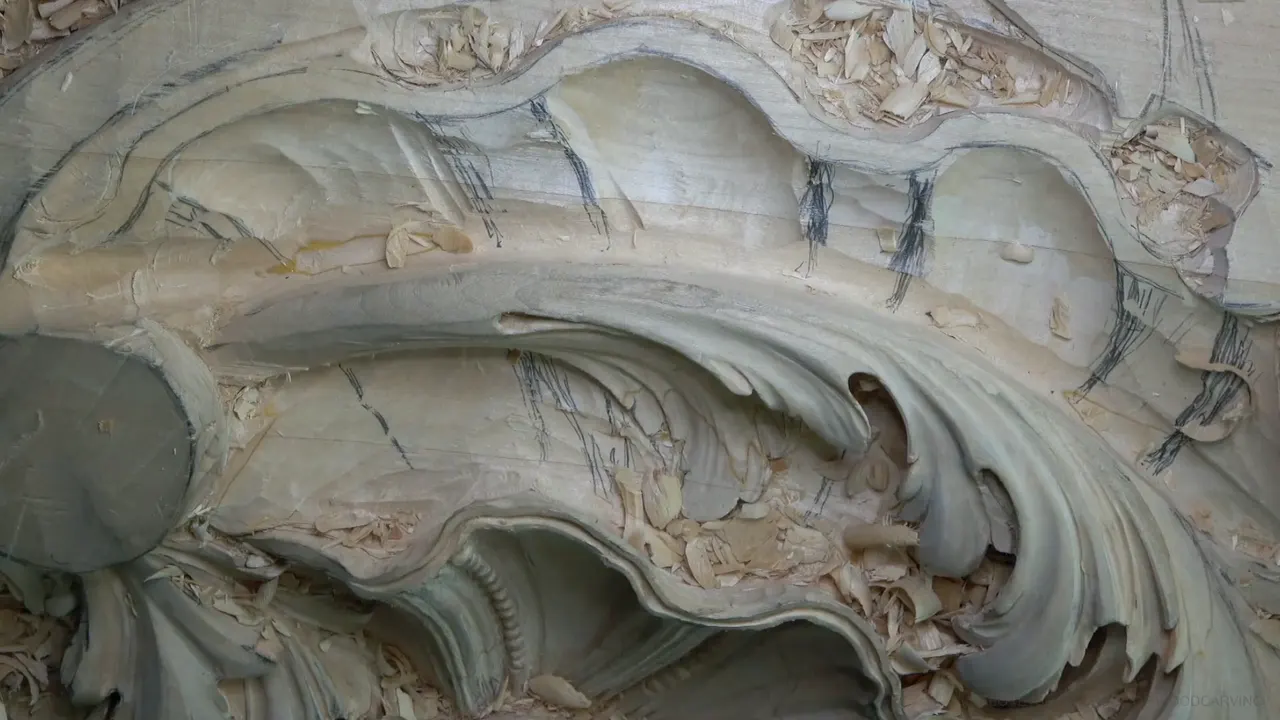
A carving that is too heavy for a carver's vice still gets carved, and in part 2 of Venice Room workshop 25 I said so right away. "Unfortunately, I cannot use my carver's vice on this project," I said (00:37, 00:41). Other heavy pieces in my courses did go into the vice, wiggle and all, and below you will hear what I said about that. Those days at the bench went like this when I carve wood with a gouge.
The video runs about ten minutes, and most of it is quiet work. So I also went through my other courses for the times a vice would not grip the way I wanted, or I took it out, and what I did next. Every lesson I quote is linked where it comes up, and the numbers in brackets are the times where you hear the words.
Have you ever clamped a heavy piece and felt it shift under the gouge? Does a wobbly bench make you want to put the tool down for the day? Here is my day at the bench, wiggle included.

What did I do in part 2 when I could not use my carver's vice?
Before any gouge touched the wood, I said it. Early on I said I had to be careful, because something was in my way (00:17, 00:20). The line about the vice came next. "I really love to use a carver's vice, but I can't do it because it's really heavy" (00:44, 00:47). The caption does not say whether "it" means the vice or the piece.
Next I said I am able to use those vices "to a certain degree sometimes" (00:54, 00:58). Then again: "like I said, to a certain degree only" (01:04). So those vices do have a place in my work, within limits. On this project I could not use mine.
The first work was cleaning with a number 3 spoon gouge. My first words on it were "let me clean a little bit with the number three first," and the overall movement "has to be really gradual and nice" (01:08, 01:23, 01:25). At 01:40 I called it: "See? That's perfect."

Which gouge do you reach for when the first one cannot get there?
On the next line I wanted exactly the same idea, a really nice movement, and I wondered whether I would be able to move upward like that (01:49 to 02:04). The answer was no. "I have to use number five to attack this area," I said (02:09, 02:13).
My words while I carved were plain: "nice and gradual, nice and tangent" (02:39, 02:42). The same went for the next line (03:00, 03:02), and for one where I asked myself whether I could do exactly the same, and then said "and yes" (03:22, 03:27). At 03:46 I said "nice and gradual" again, and at 03:49, "maybe a little bit right here, too."


How do you redraw your lines once the movement is in?
"Let me redraw those lines so we are getting somewhere," I said (04:11, 04:17). I named each one as a boundary, "this boundary" and "a boundary right there," and said "it's going to go in" (04:26 to 04:37). Two more followed, "this one" and "that one" (04:41, 04:50). I looked at the set and said "they look about the same, I would say, and just moving all the way like that in those directions" (05:01 to 05:09).
What was still ahead, I told you: "Later on, I have to reestablish inside also the movement. But everything goes kind of to the center" (05:10 to 05:20). And: "I hope it makes sense" (05:25).

How deep do you dig beside those lines?
The digging came next: "let me excavate on the sides of those lines, and I think I could probably use number 11 spoon gouge, and I'll use 7 millimeters" (05:28 to 05:44). Seven millimeters is about 0.28 in. My plan was to go "right on the side of those lines," and my depth rule had a hedge on each side: "I don't want to go too deep, but still deep enough, but not too deep" (05:47 to 06:03).
Between 06:03 and 06:34 I did not speak, and the frame at 06:30 shows both hands on a gouge. At 06:34 I said "maybe a little deeper," and at 07:11, "all the way to the line" (06:34, 07:11).


How far do you take a part that still has to be developed?
Another area had to come down. "This needs to be also lowered down, because that is also the part of a shell. So it's got to be gone" (07:49 to 08:01). Next in line was a little more excavation with the number 7, I said, and I first thought of the same spoon gouge. A moment later I changed my mind and said I did not have to: the number seven straight one could attack that from the side (08:14 to 08:30). Treat that as a plan.
I held back on purpose. "I'm not going to go too extreme on this side because I still have to develop that. So that's also important for me not to overdo it" (08:30 to 08:44). Soon after: "Yeah, a little bit" (08:50). And at 09:35, "maybe I can get a little deeper. I don't have to" (09:35 to 09:41).


What did I say about carving by hand?
Near the end I stopped and said something about my hand. "And yes, I know I am carving with my hand, but I have to. Otherwise, I can't create the cut." (09:49 to 09:59). Then: "Sometimes it's just the only way," and "please forgive me for that" (10:03, 10:10). The caption does not say what I mean by it here. The frame at 09:52 shows both hands stacked on the end of one gouge handle, so I will only say what the words and the frame share.
After that I said "okay, that is good" (10:33). My last words in the part were "let me think what's next I need to do" (10:39).

What happens when the vice cannot hold a heavy piece still?
My other lessons say more about the weight problem. Venice Room workshop 87 has my apology: "I apologize for that wiggling" (01:58). Right after it came "I can't make it tighter because the piece is super heavy, and there's just no vice on the market that can hold without wiggle" (02:07 to 02:17). On that, I said "Maybe there is one, but I couldn't find any," and "maybe there is some heavy-duty one" (02:20, 02:36).

Workshop 81 had a piece that was "super huge and super heavy," and I was "holding it only with the vice pretty much in the thickest part, which is really thick" (00:44 to 00:57). The stem that held was "only about a half an inch" (13 mm) (01:03). My answer was "I have no problem with that whatsoever" and "I've done a lot of work with that" (01:06, 01:09).

Two other parts of that workshop go the same way. "Please accept my apology, it's going to be a little wobbly, but it's really convenient for me to work with that Veritas vice because I can rotate with no problem any direction" (part 7, 07:20 to 07:34). For anyone not used to a wobbly workstation, I said, it would be hard, but "for me, it's okay" (07:38 to 07:50). In part 5 I remounted my piece, said it would be a little wobbly and "hard to watch, probably, on TV," and added "for me, it's a lot more convenient to work around" (06:37 to 06:53).

The Roman acanthus course has the same honesty. "When I'm carving, my workpiece is kind of shaky a little bit," I said, and the vice sat on "just a small workbench," which "definitely it creates some movement" (03:52, 04:11, 04:16). I said, "When I started this school, I promised I'm going to teach you the way I do it" (04:19 to 04:27). If you have a really stable workbench, "that is absolutely fine" (05:28 to 05:34).
A movie story followed. In Russia, I said, I saw a movie about a school of spies, where the table would float and move, and the students had to learn to write accurately on it (04:54 to 05:20). "Just imagine yourself that you are learning the same skills" (05:24). And about my own bench: "it doesn't bug me" (05:52).
Not every vice day goes well. Roman acanthus lesson 16 has this line: "I am creating too much pressure, I guess. And for some reason, my vice is not holding today" (48:35 to 48:39). A bigger number 9 came next on my list, 20 millimeters (about 0.79 in), "twice bigger" (48:43 to 48:46). A later part adds: "My vice is becoming older, I guess. Not holding as nicely" (11:04, 11:07).
Sometimes the fix is only a turn of the screw. Workshops 86 and 92 have the simplest one: "I need to fasten a little better my vice" (86, 01:19), and I needed to crank it a little better, and I apologized (92, 05:41 to 05:55).
What else holds the work when a vice does not?
Workshop 77 has a quick change of mind: "let me place that inside of the vice. Or actually, you know what? I can probably just clamp it and just attack this side... Any clamp will work. Doesn't really matter what kind of clamp you're going to use. Just whatever I found" (02:57 to 03:14). It was a Festool clamp, "what I have close by," and I said "that's pretty solid" (03:20 to 03:37).

That piece had "a handle, a little leg extension, so you can fasten it multiple ways," and I said "you can put that in a vice, or you can clamp it to a surface" (03:46 to 04:00). The same piece could be butted against pretty much any surface, I said, and "that's really safe" (04:03 to 04:08). A piece in workshop 76 got the same kind of handle, for this reason: "this handle is really important to hold it in the vice" (07:03, 07:07).
The leg shows up in the lily box course too. "It's not that I only can clamp it and fasten to some kind of vice or even clamps, I'm using Festool clamps, but I also can hold it just by my fingers and work on that piece also more safely" (07:16 to 07:34). I called that "the idea behind those legs" (07:36). I called it an authentic technique, and said carvers of the 17th and 18th centuries did use those legs (07:42 to 07:50).

For a pierced piece in the Hashemi flowers course I said I could take it from the vice and apply it "to my MDF board with the 20-millimeter holes" (01:46 to 01:55). Twenty millimeters is about 0.79 in. My point was that I can clamp the piece on that board, and flipping it over is easy: "just unclamp it," and the result is "really stable" (01:55 to 02:13). Then: "So why don't we do that?" (02:13).

Part 2 of that lesson adds that there are areas "we really can't force if we just using some type of vice without the support." You could "glue like a sandwich," a piece of plywood, then paper, then the carving, and "carve it like that. That's not a problem at all. It is possible" (06:24 to 06:56).
The vice in workshop 76 was a Bessey clamp vice, lined with thick leather glued inside, "so it helps me a lot not to damage it" (05:55, 03:48 to 03:56).

Some of you work on a dining table, I said in the Roman course, and "you limit it how you can rotate. You just clamp that down, and it's just kind of hassle all the time, unclamp it, and rotate, and carve" (05:09 to 05:22).
The Maine class gave me one more habit. I placed a piece in my vice and said "please don't squeeze it too hard," then "just enough pressure, but don't overdo it." Pressing too hard, I said, can break some of the legs (06:55 to 07:16).
When do you hold the work in your hand?
In part 8 of workshop 78 I said I would take my vice out. "I'm probably going to take my vice out. I don't need it as of now, and I'm going to just use holding by hand this piece and just finish up. It's actually just the finishing up touches" (00:05 to 00:16). Then: "let's see how easy it is." A moment later: "I think it's a smart way to work, but again, it's my personal opinion" (00:24 to 00:31).

One thing to keep in mind, I said: "the more I take out, more fragile it becomes" (01:19, 01:24). I said I would use a 1 millimeter number 11 (about 0.04 in) (01:49 to 01:52). Earlier, in part 1 of that workshop, I said the piece would go in a vice later, so I could clean everything (00:28 to 00:33).
Another part of workshop 77 has this: "sometimes I think it's safer to use smaller tools, maybe like this, just the Micro Tools by Dockyard or something like that" (01:37 to 01:46). Then: "even by holding by hand, little by little... it's probably going to take a little longer with the smaller tools, but on the other hand, it could be much safer" (02:08 to 02:21). I used five millimeters, which I called a Dockyard, 3/16 of an inch (02:27 to 02:35).

The chamomile rosette course has a hand grip. I had to attack from the opposite side because of the grain direction (18:34 to 18:43). "Check what I did with this finger. This finger goes underneath and kind of protects from make it even more flimsy. And I'm holding it by fingers, somewhat steady" (18:46 to 19:01). Then: "please use smaller tools. A smaller tool going to give you a lot more flexibility" (19:19 to 19:29).

How did I hold the piece in each case?
The short list below shows what held the piece, with the minute where you hear it.
| Where | What held the piece | Time | Note |
|---|---|---|---|
| Venice Room 25.2 | carver's vice not usable on this project | near 00:41 | The part carries on to 10:39 |
| Venice workshop 87 | vice, but no vice stops the wiggle | around 02:17 | I apologized for that wiggling there |
| Workshop 77 clamp | a Festool clamp, whatever was close by | about 03:20 | The clamp type did not matter |
| Lily Box 13.3 | clamp, vice, or just my own fingers | from 07:27 | Fingers worked more safely, I said |
| Hashemi Flowers 15.1 | I could clamp it on a board | by 01:51 | Easy to unclamp and flip over |
Advanced Carving: Venice Room, Part 2 holds workshops 13 through 25, and workshop 25 has the parts around this one. Gouges and clamps are hand tools, and woodworking has used them for a long time. The bench is where all of it happens.
How it's done
- Say what the vice cannot do. The carver's vice could not be used here, and those vices work only to a certain degree, I said (00:37, 00:54, 01:04).
- Pick the gouge for the reach. I cleaned with a number 3, and where I could not move upward, I said a number 5 had to attack the area (01:08, 02:09, 02:13).
- Redraw the boundaries. I redrew the lines and named each boundary, then said everything goes kind of to the center (04:17, 04:37, 05:16).
- Dig beside the lines, not too deep. My plan was a number 11 right on the side of the lines, deep enough (05:47, 06:03).
- Hold back where more work is coming. On one side I held back, since that spot still had to be developed, and I said it was important not to overdo it (08:30 to 08:44).
Frequently asked questions
Can you still carve well when a carver's vice cannot hold the piece?
Workshop 25, part 2, had no vice on that project, and I carried on. I shaped the movement using a number 3 and a number 5, then planned a number 11 spoon gouge beside my lines, deep enough (00:37, 05:47).
How do you carve when a heavy piece wiggles in the vice?
Workshop 87 gave me the wiggle: I could not make the vice tighter, because the piece was very heavy, and I had found none on the market that holds without wiggle (02:10 to 02:20). Workshop 81 had a wobbly setup, and I said I had no problem with it (01:06).
What can you use to hold a piece when you have no vice?
Any clamp will work, I said in workshop 77, and it does not matter what kind, just whatever I found. A Festool clamp was close by. A little leg left on the piece let me clamp it to a surface or butt it against one (02:57 to 04:08).
What to carve next