

Alexander Grabovetskiy, woodcarver, School of Woodcarving · Published 2020
Why put a carving tool back in the chest the moment you finish with it?
Quick answer: Returning a carving tool to the chest right away is how I keep it from mixing with the others on the bench. In Venice Room workshop 25, I said a tool left out gets mixed up, and then I can't find the right one.
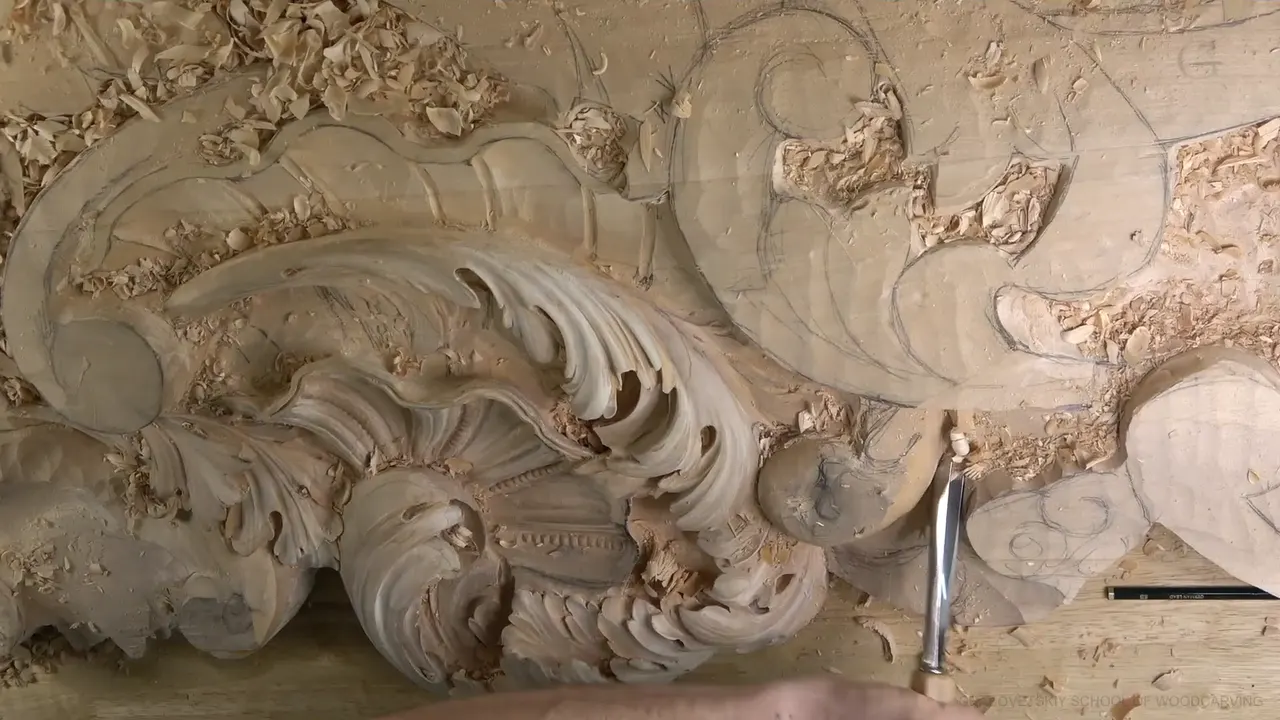
Putting a carving tool back in the chest the moment you finish with it is a habit I keep because a tool left on the bench gets mixed up with the others, and then I can't find the one I need. The line sits in part 4 of workshop 25 in my Venice Room. I'm placing my tools back right away, pretty much. The reason was time.
The video runs about eight minutes, and the tool talk takes under one of them. So I added what I said on the subject in other lessons, each with its place and a link to a public lesson page.
Is your bench covered with gouges right now? Ever hunted for a tool that was lying in front of you? Then read on.

What do I do with a gouge at the end of a pass?
- Away it goes after the pass, pretty much.
- Left on the bench, it mixes with its neighbors, and I lose the right one.
- Hunting for a tool costs me time.
- My aim is a couple on the bench.
- Every tool has a known position in my drawers, so I find it quicker.
- A put-away can still cost a trip, and once I wanted a tool again right after.

Why did I put a tool away at 02:58 in part 25.4?
A clean-up had just ended, and I said, let me put my tool back. Within seconds I gave the reason. Tools that stay out on a bench lead to a moment when I can't even find the right one, because they all get mixed up. That slows me down.
So the tool goes inside where it belongs, inside the tool chest, in this case. It used to be a shelf, but the chest works really good for me. The exact location of a specific tool is something I know. Near 03:47 I said I can always go back and grab the right profile, size and sweep, with no problem.

Where do my tools live?
Mostly in drawers. In my first Venice Room course, part 9 of workshop 1 has a stop before I start carving, and there I explained my tool organization. As of that day, just the drawers, and I knew exactly the place for every tool. Probably the most convenient way to organize, I called it.
Numbers come from workshop 49. My bench moves for a reason, and part 6 gives it. So many tools, I said, and I organize them in drawers. Half a thousand tools, and drawers I can open and reach on both sides. That bench has about eight foot in one direction (about 2.4 m), and behind me stands a second bench with all my sharpening systems, also about eight feet long, and all drawers. The bench under my piece sat on wheels, a tool chest with drawers as my bench, which I said was working really good.

Earlier I explained the wheels. My workbench in part 2 of workshop 1 was a tool chest with a top on it, on wheels, and I could move it if I needed to. An apology for a squeak opens the second part of workshop 4. The bench makes it, I said, a tool chest on wheels. Why not a normal workbench? I really have to be really mobile. "I do have actual wheels, but usually they're still not convenient for me."
Lesson 21 of my Hashemi flowers course describes a shelf system. With a thousand tools, I told you, you can't lay them all on a workbench, because you can get lost really quickly. My answer there was a shelf system. Every tool sits on a shelf, and I know all the numbers and the position. I know what I'm grabbing, and I place it back.
How many tools do I leave out on the bench?
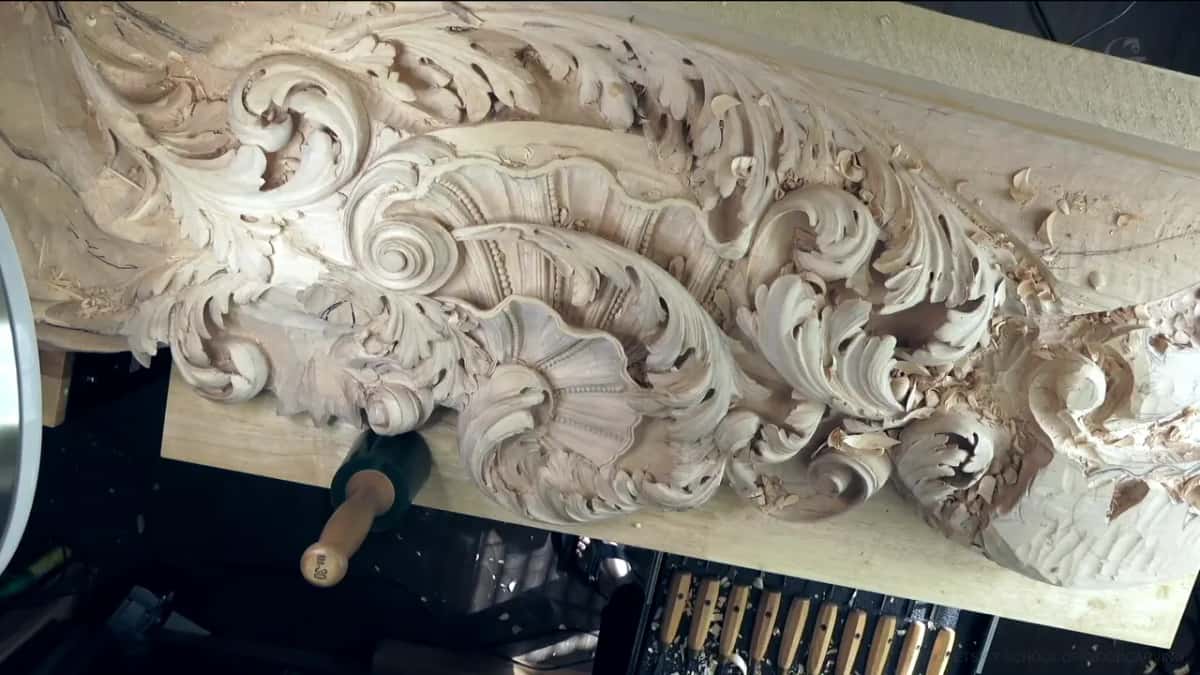
A couple, and I try. Over in workshop 18, part 9, I gave the plainest version. I really don't like to keep tools on my workbench, because I own so many. Once they're out, finding the right one later is hard. Two, three, maybe five tools sometimes.
I corrected myself right after. Well, I try, and I shouldn't say I do that. A long session can fill the bench with all sorts of mess, and then I'm losing my tools. I don't know where one is, because it's buried. Just before that I had named number seven for going in from the side.

After a really deep excavation, workshop 27 has a similar beat in part 8. One spot did not look too good, and I said I probably should take care of it with number seven. Then came the tidy-up. "Get out about four tools, and I usually don't like to keep them out." Two reasons followed. First, they create a messy look. Second, I'm losing them sometimes when they're out.
In the moldings course, lesson 4, I returned a tool and told you I try not to keep many on the bench. It gets confusing really quickly. Not that I never done it, I said. I've done it multiple times, and once tools pile up, I get lost. Three, five, seven is okay, I said.
What does a crowded bench cost me?
Production. I spelled it out in part 5 of workshop 76. Too many tools were out, which is not okay, and they had to go back where they belong. Otherwise the bench gets too messy, and then I'm losing production. I'm not sure how about you, but I do.
Time goes to hunting. I spend time looking for tools that sit right in front of me, and I can't see them because of the mess. With each in its place I'm much quicker, and since I know the position of every tool in my drawers, I become a lot more productive. My stated plan was a couple of tools on the bench at most. I don't know if I'll be able to, I told you, but at least I'll try.

The other half sits in lesson 11 of my floral panel course. In part 3 I put away my back bent and the other tools I used, since I'd rather not keep them out on the workbench. Too many out, and I get lost, hunting for one. Now I know where each one is. In every drawer I do have the tool, and I know where to go.
Modern acanthus lesson 6 shows the same trouble. I had to find a tool first, I said, and then see what happened right there. When a lot of tools cover the table or workbench, you get lost.
Is returning each tool a habit I had to learn?
On camera I said so. Back in part 6 of lesson 16 of the furniture panel course I got rid of the tools I didn't need right then. Placing all tools back constantly is one of my habits I had to develop, I told you. Work all day long, and of course tools accumulate. That's not going to be good.
The why comes in lesson 15 of that course, part 8. Let me get my tools back to my drawer, I said, so it's not creating any problems later on. Pull too many tools, leave them on the bench, and it just creates a lot of mess. So it's better to take a tool, use the tool, and put it back. A number 11 veiner at 3 mm (about 1/8 in) was my next pick.
Does putting a tool away ever cost me a trip?
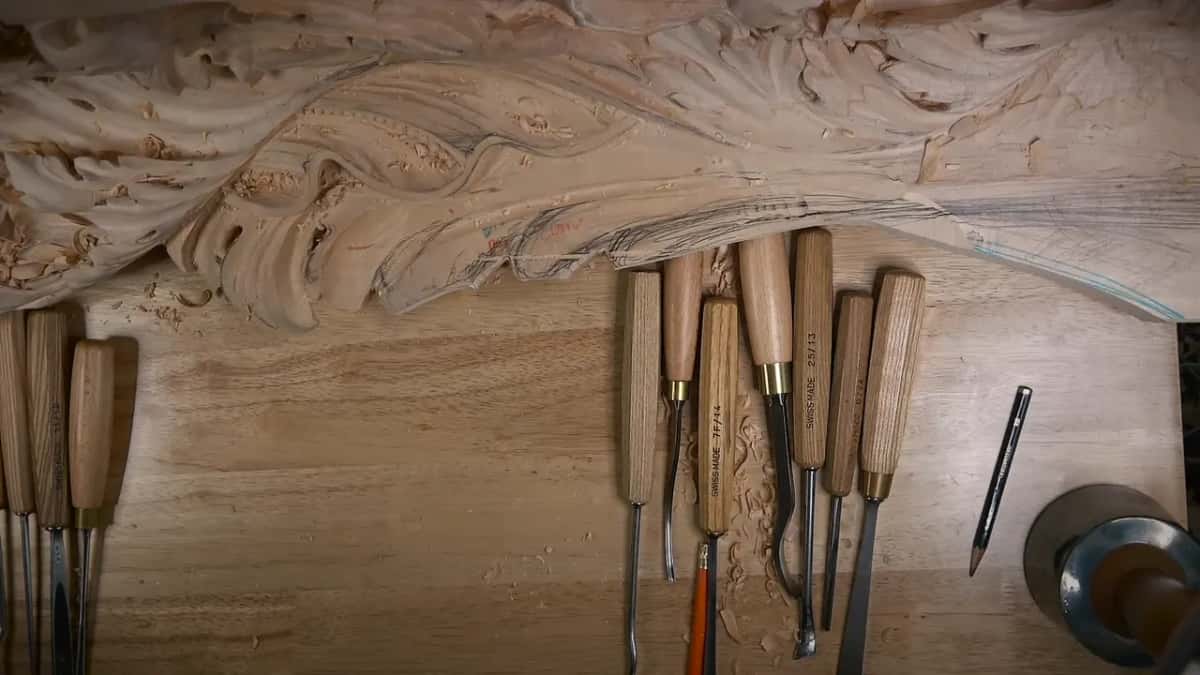
Yes, and I admitted it. A spot looked good to me in part 2 of workshop 46. Oh, you know what, I spoke too early, I said. The tool was already back in its place, and I could use the same tool and clean that. Next I reminded myself to keep an eye on how deep I go.
The order flips in workshop 43, part 11. I had a sphere that was almost perfect, almost, because part of it was going to develop. So the tool went away, and it was time to reestablish my movements. Back in part 6 of workshop 51, I added a hedge. Tools go back, I said, although I'm probably going to need one of them, and maybe number seven, to clean a little bit. Over in workshop 28, part 11, I took the lot back and added that I could probably start on a big, round element next. That way I could work my way in for the shell.
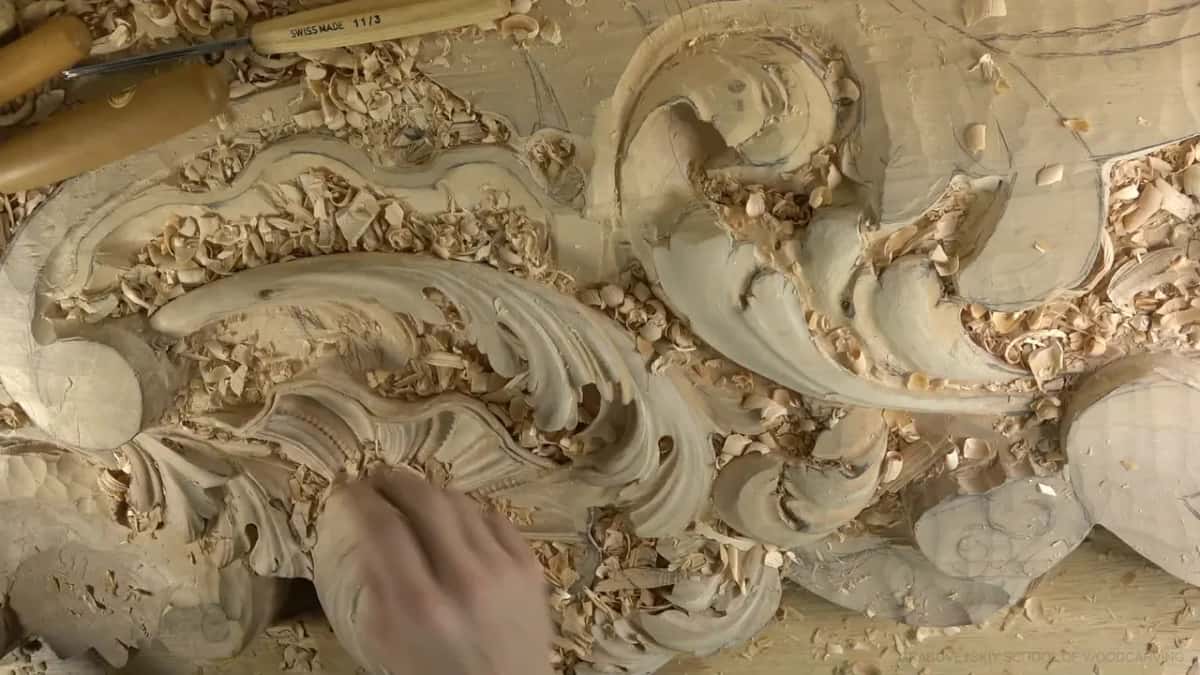
Workshop 21, part 11, answers a fair question. Why don't I list my tools in these workshops? Listing means using a minimum amount of tools, since not every one of you has a lot. And sometimes it takes me time to think which tool to grab.
Here I open the tool chest and grab whatever looks right for this operation without even thinking. Don't have to think twice, I said. The pick was a number five at 8 mm (about 5/16 in) for a letter S shape that goes like a wave. After that I would probably need a number 11 at 2 mm (about 5/64 in), and I told you I'd check whether it works or not.

Where should a tool not lie while I carve?
On the board. The furniture course says so too, in part 3 of lesson 15. Let me get my mallet away and my tools away, I said, because it's not good to leave them on the board anyway.
A second reminder sits in lesson 7 of my Tray of Blessing course, and it is short. There I said to try to place the tools away from "here." My reason was "Sometimes it's just too close and you can butt against." My plan was a number 11 at 3 mm (about 1/8 in), the tool I would probably take for the outlining.

What did I carve in part 25.4 while the tools went back and forth?
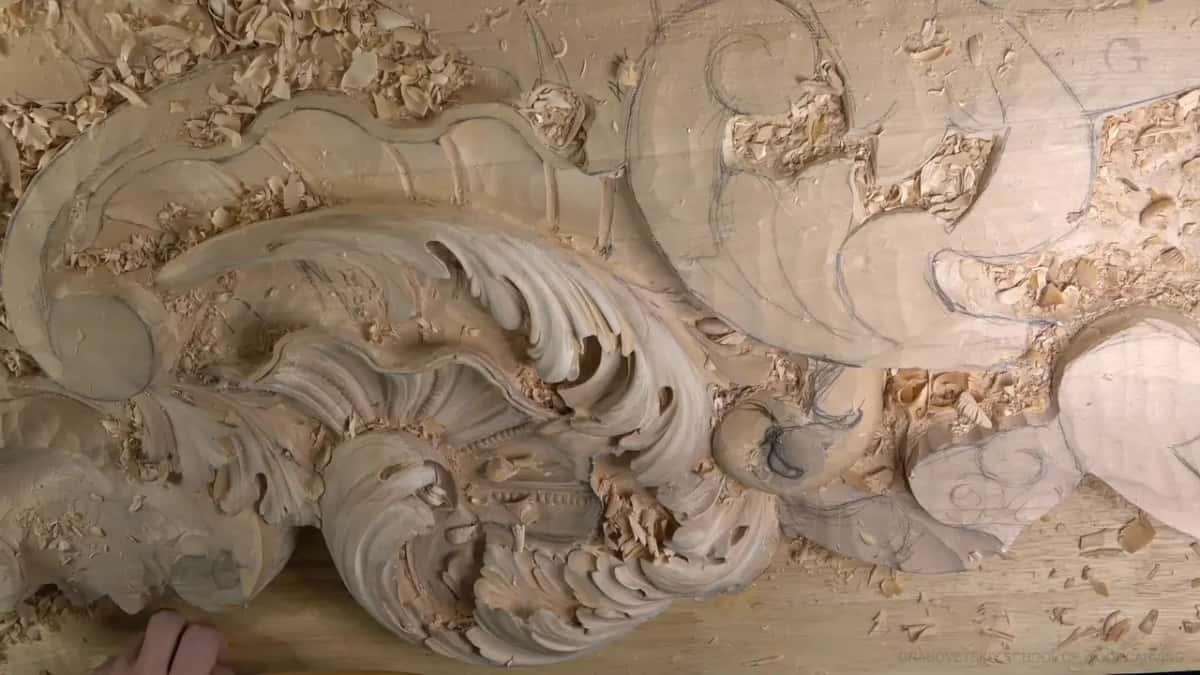
Before the tool talk I was working a leaf. Around 00:42 I said a little chopping on the inside was possible, with the smaller one, I guess, at 7 mm (about 0.28 in). Soon I added that number nine and number eight would work too, by the way.
By 01:06 I had told you what I like about a certain tool. It has a U shape, like a letter U, and I can always use just the side without digging too deep. Next came a little cleaning with a number five. Five or six, I wondered, and after a moment of thought I settled on number five.

Near 01:57 I said now it goes all the way like that. A few seconds later came the thought that I could actually go deeper, "but do I need to? That's the question." Soon it was good, I would say, and the tool went back at 02:58.
Then I read the leaf. Close to 04:03 I said that is good, kind of what I want to see. A subdivision would go right there, the eye somewhere right here, and another subdivision beside it, I said. I could make one higher and the other a little lower, and it doesn't really matter. What matters now is the main movement of my pipes, although I wasn't too happy about the overall roundness.

So I kept on. Some more had to come down, just for a little better shape. Around 05:47 I said I didn't want to rush too much, because a section nearby was almost done. It's better just to slice and get little by little. Later I said I needed to probably round one side a little bit too, since it did not look too good.
The last minute set up the next pass. I wanted to reestablish the movement where I wanted the point, somewhere right there. A subdivision was coming, and so was my letter S. Then the movement downhill, how it's supposed to look, and all the way. "That is going to be my pipe."

A short record of where my tools went
Six of those moments sit in the table below, and the right column holds the reason I gave on camera.
| Where I said it | What I did with the tool and where it went | The reason I gave |
|---|---|---|
| This video | I put each tool inside the tool chest right away | They all get mixed up on a bench |
| Venice Room 76.5 | They need to go back to their spots, I said, and I planned to keep a couple out | A messy bench costs me production |
| Venice Room 27.8 | I took them back to their places | They create a messy look, and sometimes I lose them |
| Furniture panel 16.6 | Back they went, constantly | All day long you can accumulate tools, and that is not good |
| Floral panel 11-3 | My back bent and the others went away | I get lost, and I know where each tool sits in the drawers |
| From Venice 46.2 | A tool in its place, wanted again right after | It still needed cleaning |
What would you put away on your bench?
Count the tools within reach of your hand right now, and ask yourself whether more than a couple are out. Could you walk each one to its spot?
The part I described is one video of the lesson. The rest of it sits in workshop 25, and the course page is Advanced Carving: Venice Room, Part 2. A gouge belongs to the chisel family, and a mallet drives it. Any workbench or toolbox is an answer to where a hand tool lives, and a chest of drawers on a caster is just one answer. Every workshop has its own way to store each tool, and clutter is what it fights. The craft is wood carving, part of woodworking.

Which tool is lying on your bench right now?
How it's done
- Finish the pass. A clean-up ended in this video, and I called it good, I would say.
- Put the tool back right away. Place it in the chest, where I know its location, so it does not get lost among the others on the bench.
- Keep a couple out at most. On the bench, a couple of tools is my aim, and when more come out, they go back to where they live.
- Reach for the next tool by its place. Each tool has a known position in my drawers, so I go straight to it.
- Read the leaf before the next pass. After the tool went back, a subdivision, the eye and the movement were next on my list.
Frequently asked questions
Why return a gouge to its place right after one pass?
On a bench, tools mix with each other, and then comes a moment when I can't even locate the right one. That costs me time. This video says so, and each tool goes in the chest, where I know exactly where it lives.
How many carving tools can sit on the bench at once?
My aim is a couple. Two, three, maybe five sometimes, I said in workshop 18, then admitted I shouldn't say I do that, since a long session buries the bench in mess. In my moldings course I called three, five, seven okay.
Does a messy bench really cost me anything?
It costs production. I spend time looking for tools that sit right in front of me, I said in workshop 76, because I can't see them in all the mess. With every tool in its place, I find it much quicker.
What to carve next