
Alexander Grabovetskiy, woodcarver, School of Woodcarving · Published 2017
What is the difference between a gouge and a veiner in wood carving?
Quick answer: The difference between a gouge and a veiner is the shape of the edge. Gouges run from number three to number nine, a half circle, and a gouge turned in the wood draws a perfect circle. A veiner, a deeper U that starts above nine, will not.
A gouge is a carving tool whose curved edge ends at the true half round, number nine, and a veiner is the deeper U shaped tool that starts above number nine. I tell them apart with one turn. Stand a true gouge on the wood, rotate it, and the edge draws a perfect circle. A veiner won't.
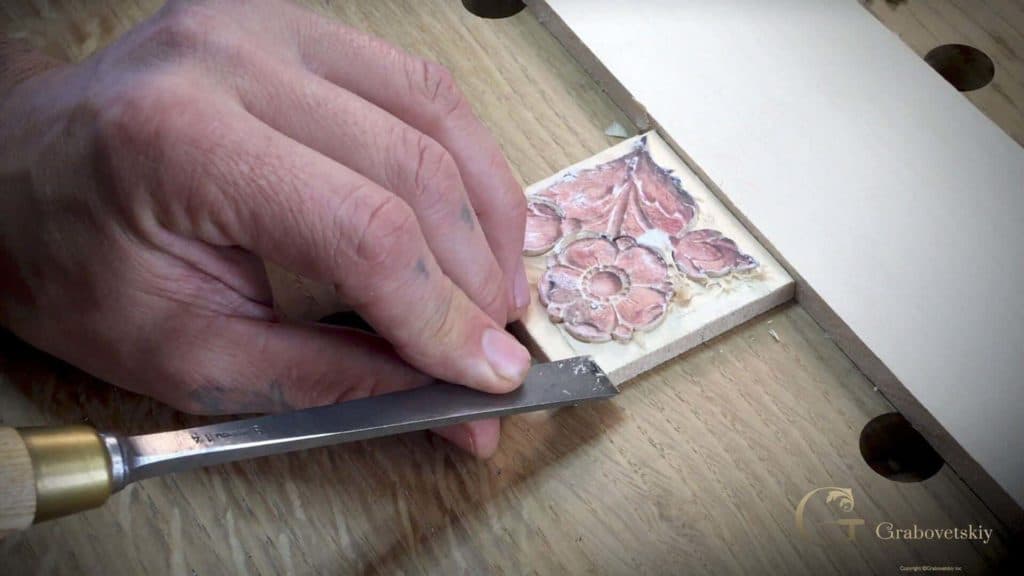
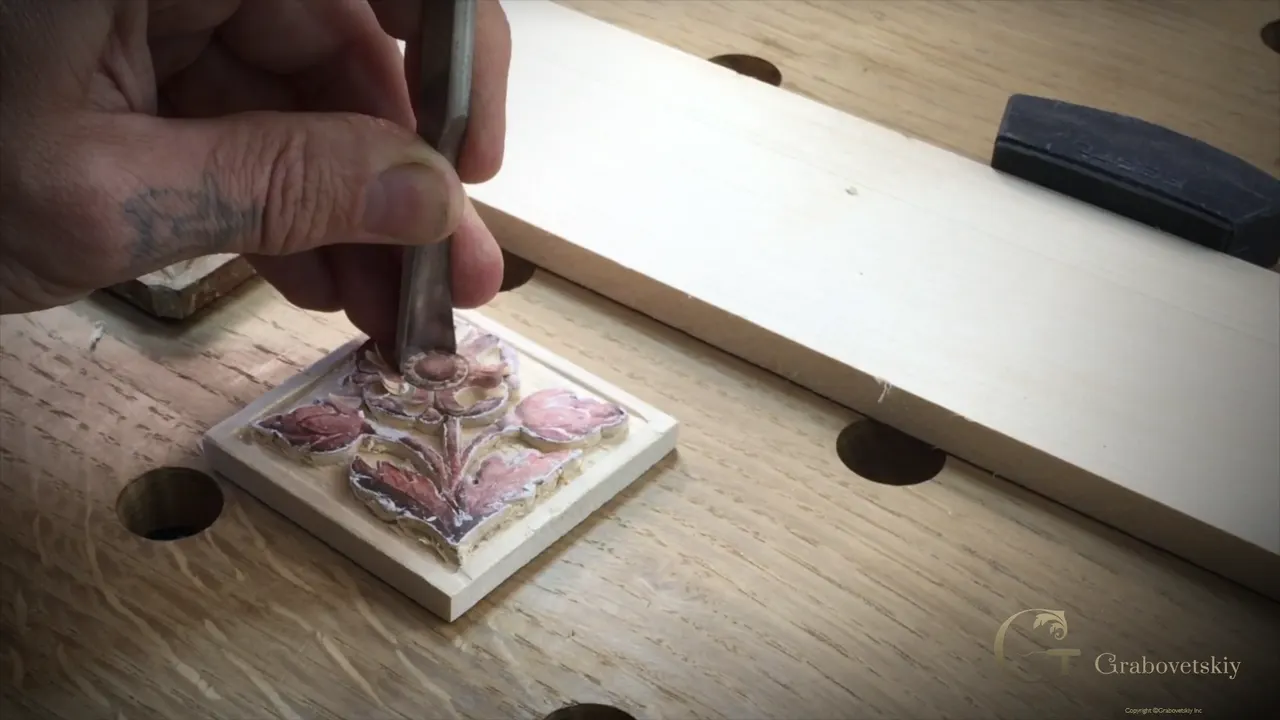
Do you have a tool in the drawer with a curved edge and no number on it? Could you stand it on a board and turn it all the way round? That turn is the test, and I did it on camera in Flower Rosette 3, with a small flower half carved under my hand.

Gouge and veiner at a glance
- Every gouge has a sweep, and the sweep runs from number three, almost flat, to number nine.
- The number 11 is a veiner, a U shape with the wings higher than a half round, though some makers label a number 10 a gouge.
- Rotate a true gouge in the wood, and it makes a perfect circle.
- V tools and veiners cannot make that circle.
- Veiners got their name from the veins of an acanthus leaf.
- With no sweep at all the tool is a chisel, and numbers 12 through about 16 are V tools.
How did I tell a gouge from a veiner in Flower Rosette 3.2?
I used my eye first, and then I showed the turn. I had gone looking for the right sweep for the inside of the flower, one a little bigger than quarter inch (6.4 mm). I checked one, wanted a little smaller, and then it looked like I had found it. Number eight, approximately half an inch (13 mm). No marking on that tool. By eyeballing, I said, I can identify it.
With it I made my initial pass on the inside and connected that side. After that I stopped and said it is probably good to know how a gouge differs from a veiner and the U-shape tools.

I said a true gouge you can place and rotate, and that gives you the true circle. A V tool, you can't rotate and make the perfect circle. Usually gouges go up to number nine, while number 10 and number 11 are already a veiner.
I own up to one thing here. I still call them gouges, since that is easy to remember, but the gouges go only to number nine.
What does the turn test show on the wood?
A perfect circle, but only when the tool is a true gouge sitting right on the wood. See what I'm doing, I said in that video. I can place it, rotate, make my rotation moves, and make a perfect circle. I would not be able to do that with the number 11 or the number 10.

Roman Acanthus 16 shows the same move with a nine. On a board, going downhill, I took it through a full turn, and it made a perfect round. Veiners come later.
A livestream on sharpening a veiner took the test further. A good gouge, I said, will always end up at the same spot when you rotate it. I also own gouges that are not too good, mostly antique. One is a good looking tool, don't get me wrong. It should be a number nine, but the woodcarver who carved before marked it number 12, and it is not. Half round, yes, but turn it and it rocks. It just steps, and that creates a mess. Not a true gouge.
Then I took a number seven. Not a half round, yet it lands on the same location when you rotate it on a board, and I called it a really good gouge. Whatever sweep you have, the spot stays put, even with a huge gouge of three inches (76 mm), which I called like 80 millimeters.

The other side of that test is the veiner. In Venice Room 42 I said it flat: I cannot rotate the veiner, because it is a U shape. Veiner is always U shape.
Where does a gouge end and a veiner begin by number?
At number nine. The first veiner is a number 10 or 11. In workshop 16 of the kitchen cutting board course I put the chisel beside the gouge. A chisel is straight. Every gouge has a curvature, or sweep, which is the right way to say it. In most countries the numbers begin at three, almost flat but with some sweep, and run through four, five, six, seven and eight to nine, the true half round.
Ten and eleven look more like the letter U, with sides that just go straight up. The most useful are the nine and the eight. I took an eight that day, about 10 millimeters (3/8 in), made in England by Ashley Iles.
Makers draw the line in slightly different places. Some stretch it to number 10 and still say gouge. In the Greek acanthus lesson 4 I mentioned the UK pattern and the European pattern, and in the livestream I said a UK number 10 is a half round, pretty close to a European nine. Lesson 5 of the Roman Acanthus course draws the whole line. No sweep is a chisel. A sweep that stops at the half round is a gouge. Anything beyond a half round, shaped like a U, is already a veiner.
After the veiners come the V tools, numbered from 12 to about 16 depending on the maker, and they come in different angles. I named 60 degrees and 45 degrees in the Roman lesson, and 35, 45, 60 and 90 in the livestream.
| Edge | Name | Number | Source |
|---|---|---|---|
| Flat straight edge | Called chisel when there is no sweep | Number one | Part 2 of Roman Acanthus 5 |
| Half circle edge | Gouge, and it turns a perfect circle | Number nine | Roman Acanthus lesson 16, part 2 |
| Half round, UK | Some makers keep calling a ten gouge | Number ten | April 2020 livestream on sharpening veiner |
| Deep U shape | Called a veiner, and not the gouge | Number eleven | Venice Room lesson 34, part 7 |
| Looks like V | Called V tool, twelve up to sixteen | Twelve onward | Same livestream, and Roman Acanthus 16 |

The Flower Rosette video said the same about the V tool, which I told you can't be rotated to make the perfect circle.
Why does a number 11 carry the name veiner?
The name comes from the veins of an acanthus leaf. In Venice Room 34 I told you, as you probably know by now, that number 11 is not the gouge. It was made for acanthus. Woodcarvers use the word veiner because you work your acanthus details, the concaves and convexes, like veins.
I used the same line in Venice Room 60, and I fixed my own words there: the veins go on your project, I said, and not on the wood. Workshop 52 gave it a size. My number 11 was 7 millimeters (0.28 in), a little bigger than a quarter inch, and I told you it is a veiner, designed for those acanthus movements. That one is at Venice Room 52.

Another livestream took me back to the fifteenth and sixteenth century Italian style I wanted to stay true to. They used a lot of gouges and veiners, I said, and the U shaped number 11 was developed pretty much for carving acanthus. April's livestream put it more plainly: they actually designed those tools around the acanthus leaf.
The Antique Style Rosette, workshop 5, puts a small number 11 in my hand. You can use a 9, a 10 or an 8, I said, but I used the 11. It goes by veiner too. Really handy tool to make veins on a leaf.

Does a veiner carve like a gouge?
It shares one habit with a gouge, and does a few things a gouge does not. The shared habit is the clean side. In the Greek lesson I said that with a veiner the grain runs two opposite directions. One side you carve against the grain and one with it, and you just watch which side comes out cleaner.
The same habit shows in Venice Room 57. With either tool only one side is going to be clean, and the other tears. My right hand side was with the grain, and the left side, see, it was tearing. In Roman Acanthus 15 I added that one side is going to be always cleaner than the other, which is why I sometimes attack from two sides.

Now the differences. On the sharpening livestream I called the veiner a multi-tool. The bottom is the gouge part, the curvature, and on both sides you have number threes. Use it straight and it works like a gouge. Rotate it as you carve, and it makes a stroke that a gouge cannot, because a gouge goes only straight down, and even if you rotate it, it will not make that type of stroke. Or use just the side as a number three, for a blend.
Lesson 15 of the Roman course gave me words for a spoon veiner. It works approximately like a number nine gouge, but different because it is a U shape. Like a double tool. Along the sides it makes a sweep of about a number two, I said, or a number three if you are in England. Attack from the side, and the nine part carves the inside while the three part carves the opposite side. Two tools in one. Use only the side to clean, and you get a beautiful pass with nothing left to clean after it.

Which gouges did the rosette flower need?
Mostly an eight and a five, with a few tries in between. The eight made my first pass on the inside. Then I took a smaller gouge, just the number five, the same one we used before, a quarter inch (6.4 mm), and cleaned the flower right to the center without forcing it.
I constantly have to keep an eye on how deep I am supposed to go, I said, because I don't want to overdo it. I cleaned it, and cleaned it, and cleaned it. This type of flower is actually simple, but still excellent design-wise, because those flowers fit any types of carving.

After that I took out the ridges and said I was happy with what I saw. Then came the center part. The idea stayed the same: find the gouge where I can rotate it. Number eight, a little too big. Number nine, too small. I checked a different nine too, and then it looked like my number five. The small five would do the job, I said, just carefully, without overdoing it.

The ring around the middle had to be somewhat lower. I stayed with the quarter inch gouge and went around carefully, because I still needed some material. I took just a little, maybe about 1/32 of an inch (0.8 mm), below the middle part. Barely remove anything.

With the tool in my hand I made the other center part dome-like, rotating around to establish the dome. The outside ring needed to come down a lot more, but at least I could see the initial shape. There was another approach, I said. A bigger gouge could establish the dome first, inside and outside, including the outside ring, and a smaller gouge could reestablish the middle part.

Part 3.3 went the same way. I placed the gouge about 1/32 of an inch (0.8 mm) from my center point and made a groove around it. Next I cleaned the center little by little, because I am not planning to use any sandpaper on it. The ring had to go deeper, so I took it lower with that same five, and for the middle of one petal I changed to a number six, a little smaller.

In part 3.4 a tiny Dockyard gouge came out. The first one I tried was not tiny enough, so I took a smaller one, a perfect size. Not marked, I said, but a nine, because I can easily rotate it. If the edge is half round, it is most likely a nine. I compared it, and it looked the same.

Should you call the number 11 a gouge or a veiner?
I say gouge for every one of them because that word is easy to remember, and the tools beyond number nine are not gouges. The rosette video says that, and other lessons gave you the strict version.
The Greek lesson was the bluntest. The 11 should not be called a gouge, I said. It is not a gouge. Once your wings rise higher than a half round, you have a U shape, and that is a veiner. Corinthian Acanthus 6 took a middle road. Veiner, I said, is actually not really a gouge, but sort of a gouge. Round too, with extensive wings, so you cannot take it down and make the true circle. On that leaf I used a really tiny gouge, about one millimeter (0.04 in), on the side of the high ridge in just some spots.
One livestream asked me to be careful with the words. Chisels are chisels, veiners are veiners, and gouges are gouges, and you are not supposed to mix them together. People in the UK commonly say carving chisel and mean all the carving tools. In another livestream I told people who did not know the difference that both are not a chisel, and a veiner is a letter U shape.
The stamp can be wrong, like the antique gouge marked number 12 that was not. The turn shows what the steel does. The number 11 stops you at once, and my unmarked number eight went right around.
Which tool in your drawer has no number on it? Will it turn a full circle on a board? Come and find out at the bench with me, and bring that tool along. Tuition opens the whole rosette course. All About Tools for Wood Carving lays out the tools behind these numbers, and Carving Tool Sharpening covers their edges. This part sits in lesson 3 of the Carving Flower Rosette course page.
How it's done
- Look at the edge. Judge the curve by eye first, the way I did with my unmarked number eight.
- Set it on the wood. Place the edge on a board, going downhill, the way I placed my nine in the Roman course.
- Rotate a full turn. A true gouge ends with a perfect circle on the spot where it started.
- Name what you hold. Edges up to number nine are gouges. A deeper U above nine, a ten or an eleven, is a veiner.
- Compare it. I compared my unmarked Dockyard with what a nine should look like, and I said it looked the same.
Frequently asked questions
Is an eleven a gouge or a veiner?
Veiner, in my words. My gouges stop at nine. Past that, the 11 is a veiner, and some makers keep the word gouge for a ten. In a lesson I use the word for the lot, just to keep it simple.
How do you test for a true gouge?
Rotate it on a board. A good gouge lands back on the same spot, and the circle comes out perfect. A nine, an eight and even a seven did it for me, while an old antique tool rocked and stepped, so I called it not true.
What number is a half round gouge?
Nine. A UK number 10 can sit close to it, I said, so makers differ, and some stretch the word gouge to a ten. With no mark on the steel, I judge by eye, and an edge that looks half round is most likely a nine.
What to carve next