
August 28, 2024 · Updated August 19, 2026
By Alexander Grabovetskiy — Master Woodcarver · Founder, School of Wood Carving · 19 min read
What does wood density mean?
Wood density is mass divided by volume, always read at a stated moisture content, usually 12 percent. American basswood weighs 26 pounds per cubic foot in the Wood Database tables, and white oak weighs 47 in the very same column. I have carved both for years, and that gap decides how a whole day at the bench will go.
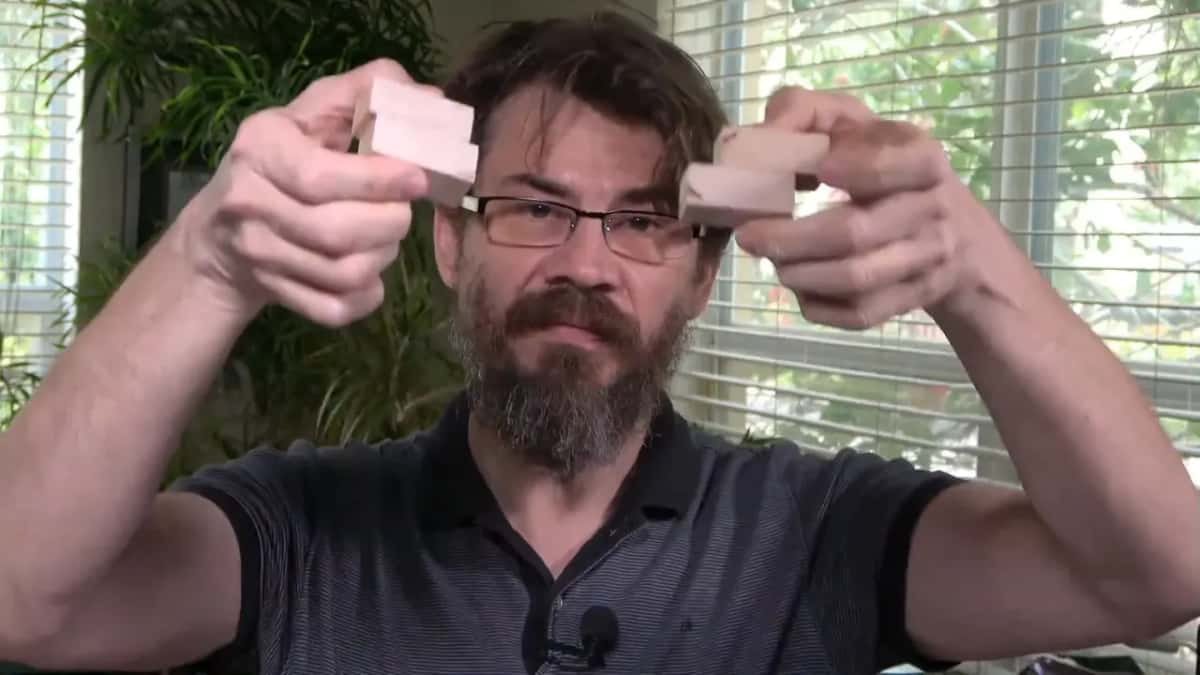
Two blocks held up, and my hands are the scale.
Somebody handed you a chart. Sixty rows of species, four columns of figures, and not one word about which column matters while you stand at the rack with a board in each hand.
My grandfather gave me my first chisel when I was six years old. I carried it outside, found a brick, and carved a face into that brick until the edge was gone. The tool never carved anything again. My first lesson in density cost me a chisel.
Over forty years later the same number still runs my bench. Sharpness, the weight behind my handle, the thinnest leaf tip I dare carve, all of it answers to how much solid material the tree packed into a given space. The figure also lies to you more than any other line in a wood book. Not through any fault of the books. Five different honest answers are hiding behind one term, and every one of them is legitimate.
So this page has two jobs. First the plain arithmetic, then the reason one species can carry two different figures in two good references while neither reference is wrong.
- Mass over volume, and the figure means nothing until somebody names the water a board held on the scale.
- Two honest references can print unlike figures for one species, because the term specific gravity hides five separate standards.
- Every cell wall on earth sits near 1.54, which means what changes between species is how much air a tree left inside.
- One species swings roughly a tenth either way, putting oak and hard maple inside each other's range.
- Times 62.4 changes a gravity reading into pounds for a single cubic foot, so no printed chart can bluff you.
What does wood density actually measure?
Mass divided by volume, and nothing else. Weigh the board. Measure how much space it fills. Divide.
In America the answer comes out in pounds for every cubic foot. Most of the world reads the same board in kilograms per cubic metre instead. Basswood at 26 pounds is basswood at 415 kilograms, one wood and two languages, and both figures sit on the same Wood Database species page.
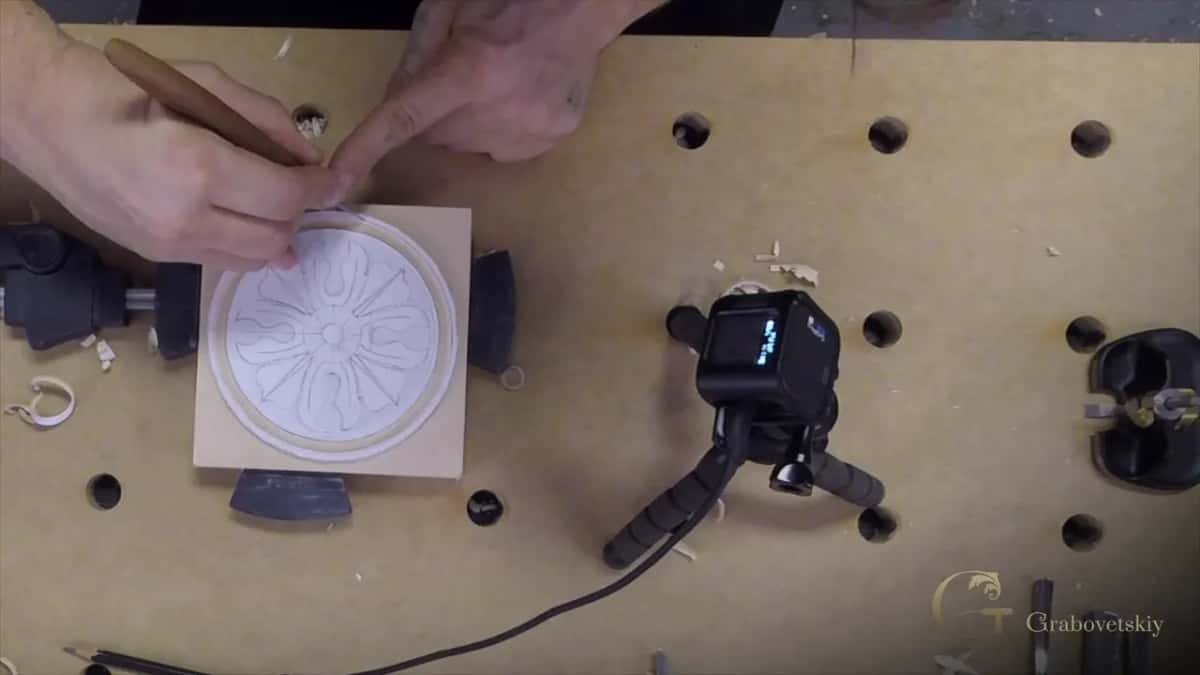
Penciled rosette on a round block, and the drawing says nothing about weight.
Specific gravity is that same idea written as a ratio instead of a unit. Ohio State University Extension defines it as the density of wood divided by the density of water, and water weighs 62.4 pounds in a cubic foot, or 1 gram in a cubic centimetre. Multiply any specific gravity by 62.4 and pounds per cubic foot fall out. One piece of arithmetic, and now you can check every chart you meet, this page included.
Here is the part that surprised me when I finally understood it. Wood substance itself, the cell wall material, runs about 1.54 in every species on the planet. The USDA Forest Products Laboratory prints that 1.54 figure and treats it as a constant. Oak and balsa are built from the same stuff. What differs is how much of the block is hollow.
Down inside the hollow.
You are measuring air. A dense board is one where the tree left less room, and a light board is one where it left more. Once you see it that way the subject gets simple, and it also explains why almost every wood floats. Nothing gets past 1.54 unless somebody fills the holes.
One more clause, and people skip it every single time I explain this. A density figure is worthless without a stated moisture content. Wood holds water, water has weight, and the same board weighs different amounts in July and in January. Standard tables read at a moisture content of 12 percent. When a chart stays quiet about that, ask. We keep a separate page on what gravity means for a piece of wood for anyone who wants that side alone.
Why do two good books print different numbers for basswood?
Five valid definitions of specific gravity are in daily use, and most sources never say which one they picked. Both books can be right at once.
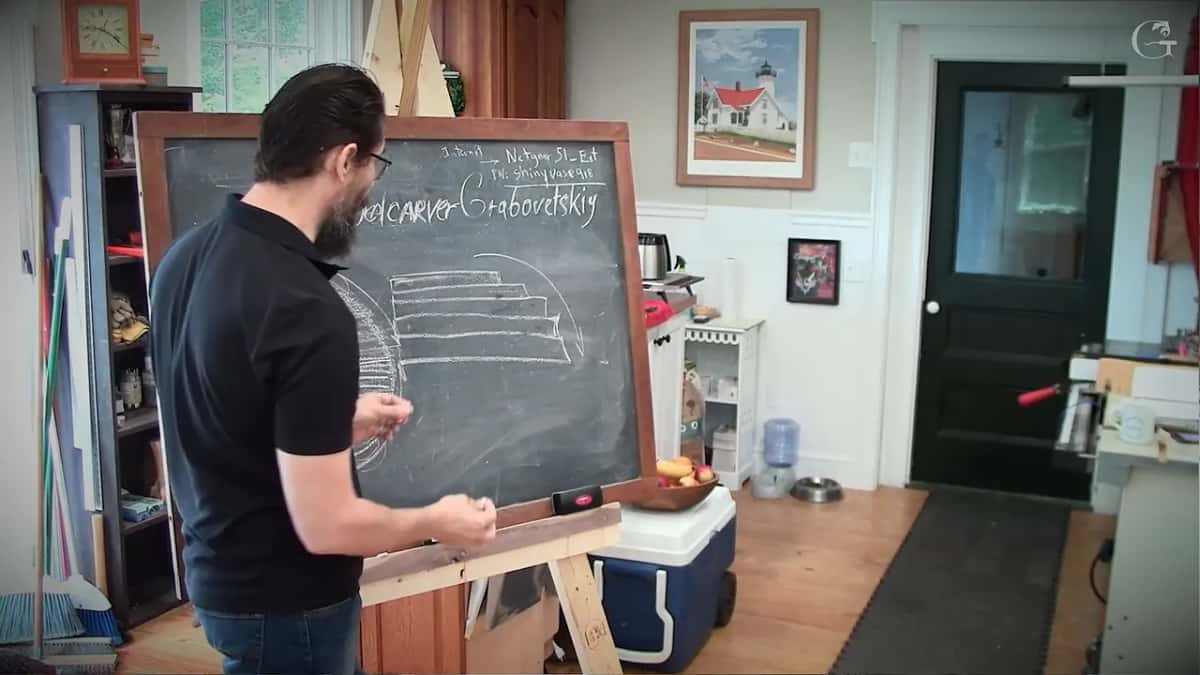
Chalk on a board is how I explain most things, better than any table.
The Wood Database says it flat out. Specific gravity is the single most abused and vaguely used term in woodworking terminology, and that site is not being dramatic. It goes on to say there is no standardized way between woodworkers and botanists to express the thing at all.
Botanists took a strange road. Their standard weighs a board bone dry, then measures the volume of that same board back when it was still green off the saw. That pairing is a real-world impossibility, since no single piece of timber is dry and green in the same moment. Calculation, not weighing.

Paper pattern glued flat to the shaped piece.
The Forest Products Laboratory is stricter about labels. Chapter four of the 2021 Wood Handbook gives each basis a symbol of its own. G with a zero means ovendry weight over ovendry volume. The botanical basis, dry weight over green volume, gets written as Gb. G twelve fixes the volume at a moisture content of 12 percent, and G with an x lets you name whatever moisture level you like.
Watch what all that does to one species. Basswood shows up as a pair on its Wood Database page, 0.32 basic and 0.42 at the 12 percent mark. The federal laboratory prints 0.37 for basswood on its own basis. Three figures, one tree, and none of them wrong. They answer three different questions, and nobody wrote the questions on the page.

Both hands on the gouge, following the blue lines I drew on the leaf before starting.
A written test method sits behind the good figures. ASTM D2395 covers density and specific gravity of wood, and it exists so two laboratories weighing one species land in the same place. A number with no method and no water content behind it is a rumour with a decimal point.
Which specific gravity are you actually reading?
Four bases carry proper names, and a fifth one just floats around the shop with no label at all. Read the row that matches your question.
| Name and its symbol. | Weight that goes on top of the fraction here. | Which volume counts. | The question this basis was actually built to answer for a reader. | Where basswood lands on it. |
|---|---|---|---|---|
| Ovendry over ovendry, written G0 in the handbook. | Bone dry weight. | Volume of that very same bone dry board again. | Strictly laboratory work here. | No basswood figure for this particular basis appears anywhere in my source pack. |
| Basic gravity, the botanical Gb. | That same bone dry weight goes on top once more. | Green volume, straight off the saw. | Botany here. | Wood Database gives 0.32 for basswood on this. |
| Gravity at 12 percent, written G12, and the furniture books all lean on this. | Ovendry weight once more. | Volume measured once a board settles down to 12 percent moisture. | Shop reference tables. | Federal handbook says 0.37, while the Wood Database says 0.42 on a convention of its own. |
| Gravity at any moisture level, Gx. | Dry weight sitting over a volume that you pick. | Whatever moisture level gets named. | Research that has to compare boards dried down to several unequal levels. | Depends on the level. |
| Plain shop talk. | Often nobody says a word about it. | Also unstated most of the time, which is the trouble. | Arguments at the lumber rack. | Any one of the four figures above, quoted with no label on it whatsoever. |

Guide lines in red and teal, because a label saves an argument later.
Read row two against row three. Same tree, same laboratory, and the figure walks from 0.32 up to 0.37 purely because somebody measured the volume at a different moment in that board's life. At least five ways exist to express specific gravity, and woodworking publications often make no attempt to say which standard they used.
So when a forum argues over whether basswood is 0.32 or 0.42, both men are quoting real published figures and neither one has read the small print. I sat and watched that argument run for pages. Nobody wins it, and there was never anything there to win in the first place.
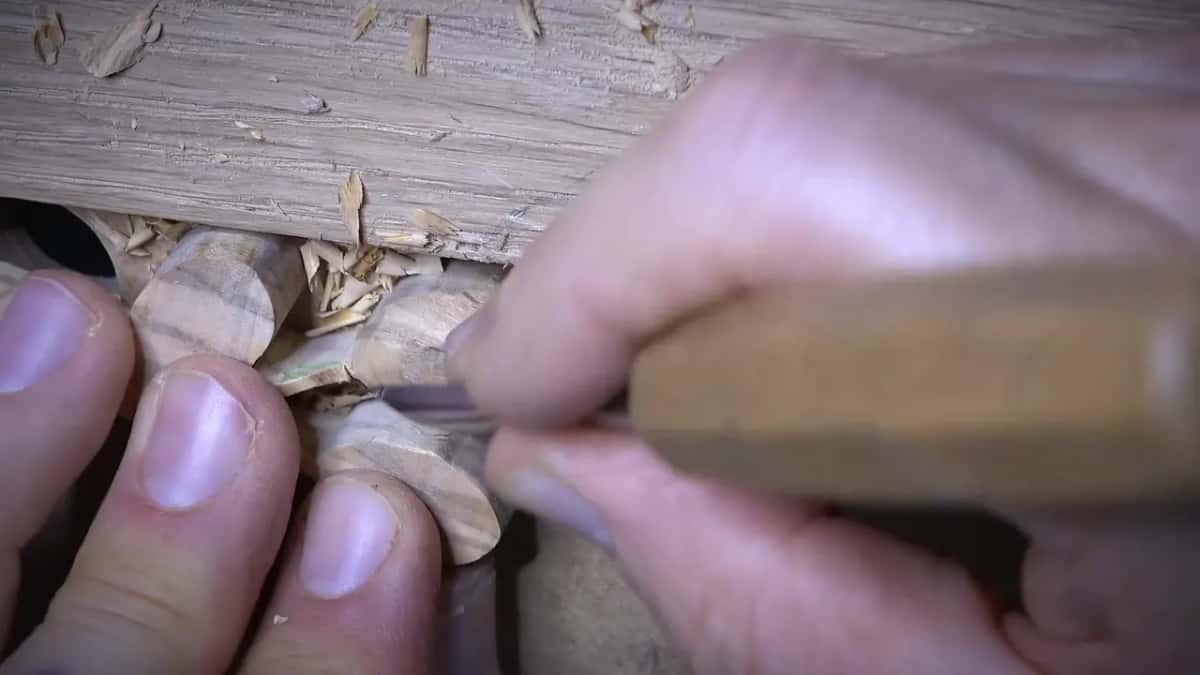
The curl comes off in one piece.
What I do at the bench is simpler. I write down which basis a figure came from, right beside the figure, and then I only ever compare like with like. The handbook chapter naming those four bases is free to read. Five minutes there saves you a year of comparing apples against bricks. And when a source will not name a method at all, the published standard for these measurements shows you what a real one looks like.
How much does one species move around its own average?
About ten percent either side of the published average, which is plenty to erase the gap between two species. A chart gives you a middle. Your board is not the middle.
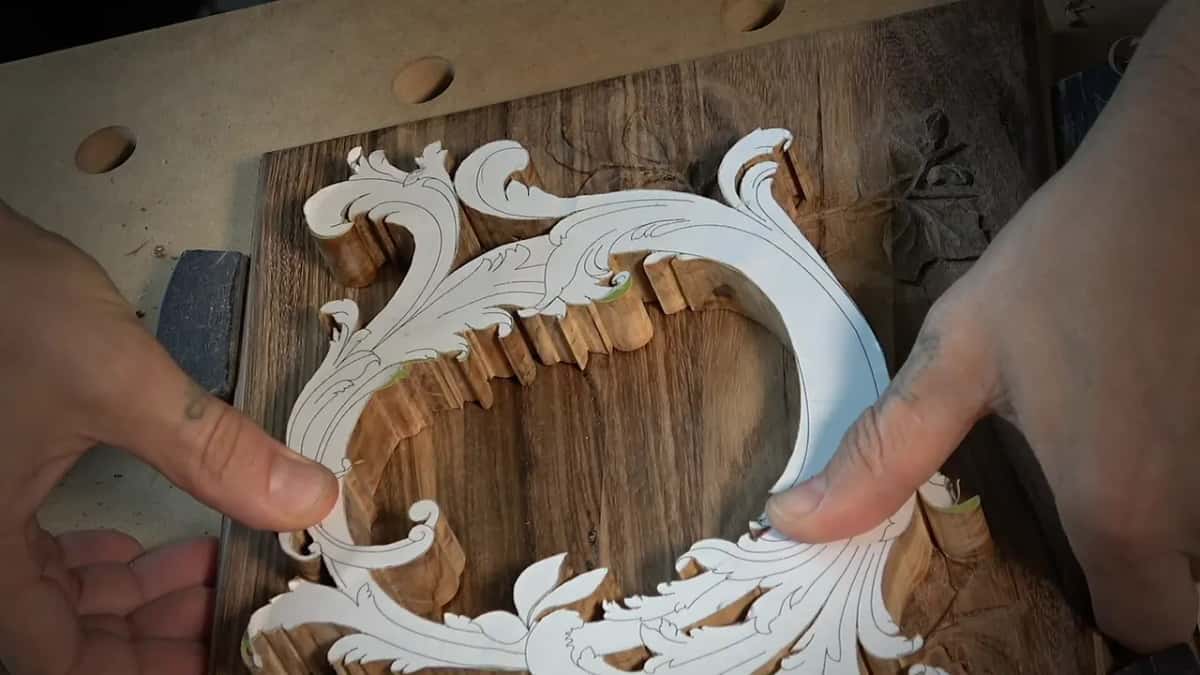
A printed pattern sits over this block, and the carving under it has already started.
The federal laboratory puts a coefficient of variation of about 10 percent on species density. Run that band across white oak, listed at 47 pounds, and the low end of the band lands near 42. Hard maple sits at 44. Those ranges overlap. A heavy maple plank can outweigh a light oak one, and no chart will tell you which of them is on the rack in front of you.
It goes deeper than that. A study of Central African trees, published in PLOS ONE, found that wood specific gravity varies inside a single tree from the pith outward. Across the 14 species they measured, gravity ran from 0.28 all the way up to 0.95, and the species name alone explained only 45 percent of the variation. The rest came from somewhere else.
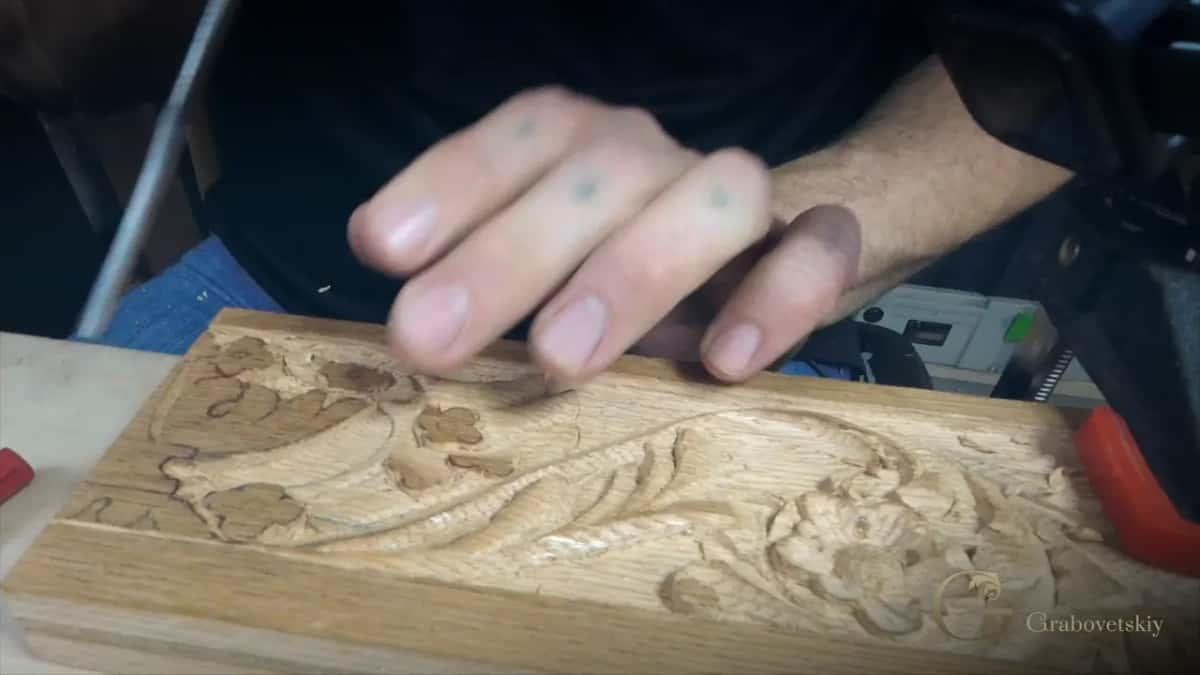
Orange clamp, relief panel, and a hand that will not hold still.
I meet that inside one board all the time. Carving a Venice Room panel I hit a patch where the tool suddenly wanted more shoulder. For some reason that area is dense. A smaller tool gave me a lot more control, and you can even hear the change in the way it carves. Same plank. Same week. Same species on the invoice.
Colour is the clue I reach for first, and here I have to be honest with you, because my own experience points two ways. Carving olive wood on the Lily Box I said the darker areas are harder and the lighter ones easier, and the density is different between them. Carving limewood in the Venice Room I said the opposite, that the darker colour right there was a little softer. Both are on camera. Both were true for the wood in my hands that day.
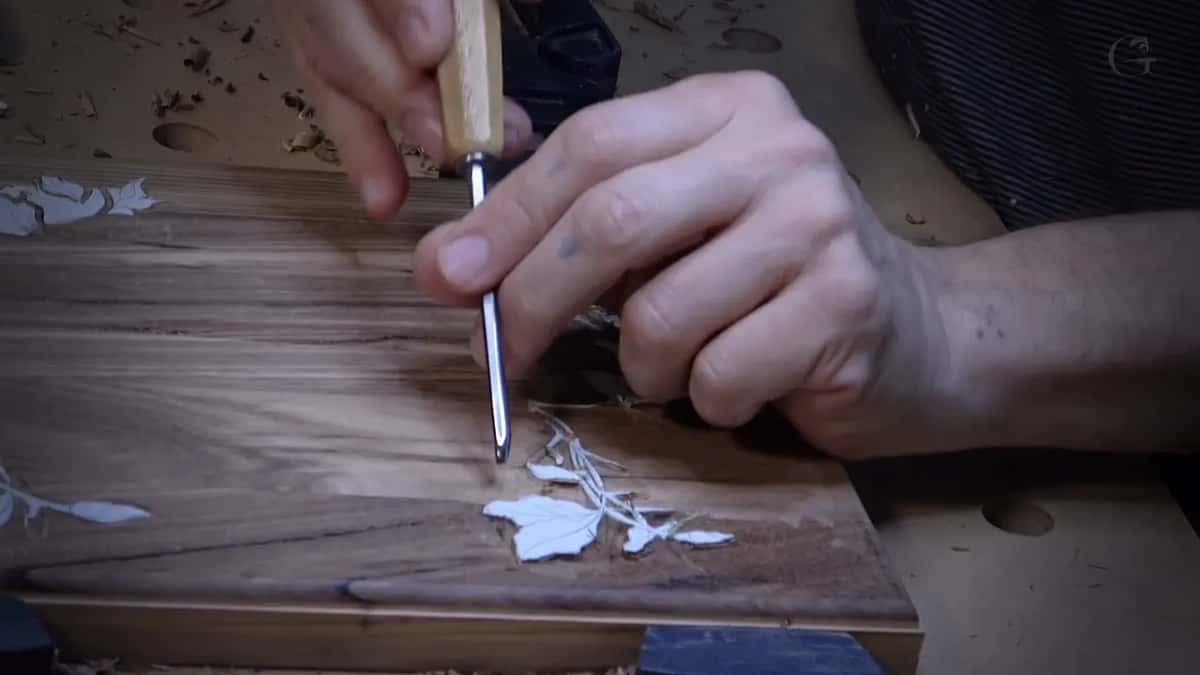
Notice the pale strip along the edge, a different colour in the same board.
I have never resolved that one. Colour tracks density inside a species, the direction it points depends on the species, and I read each board on its own. If somebody has a rule covering both cases, I would like to hear it.
For anyone who wants the raw material behind published averages, the Global Wood Density Database is public. Summary charts get built out of piles like that one, and the dataset record names its authors properly. Worth knowing it exists, even if you never open it.
Where does the water fit into all of this?
Water is most of what a green board weighs, and it leaves slowly. Every serious table names a moisture content for exactly that reason.
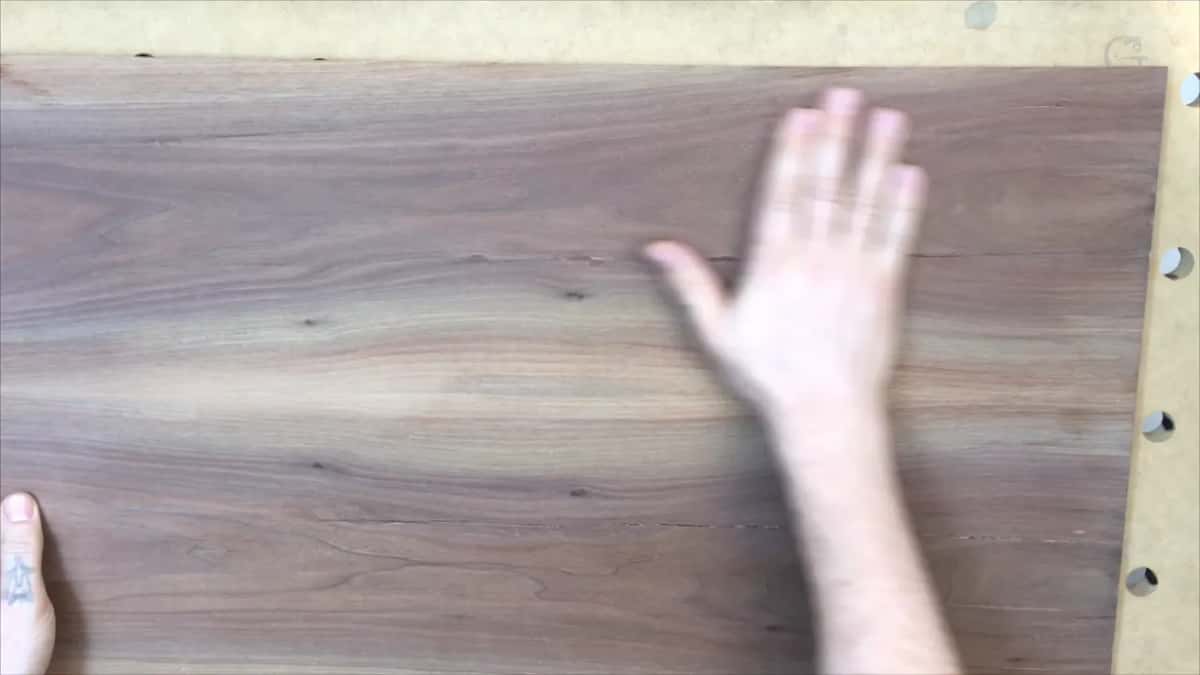
My hand flat on a wide dark board.
Green wood runs from about 30 percent moisture to over 200 percent, and those percentages get measured against the dry weight of the wood rather than the total. Basswood heartwood comes in at 81 percent and its sapwood at 133. A fresh basswood blank carries over half of its total weight as nothing but plain water. Nobody says that to a beginner buying his first log.
Other species in the same table sit lower. White oak reads 64 percent in the heartwood and 78 in the sapwood. Sugar maple, 65 and 72. Black walnut is odd, its heartwood at 90 above sapwood at 73. Black cherry heartwood comes in at 58.
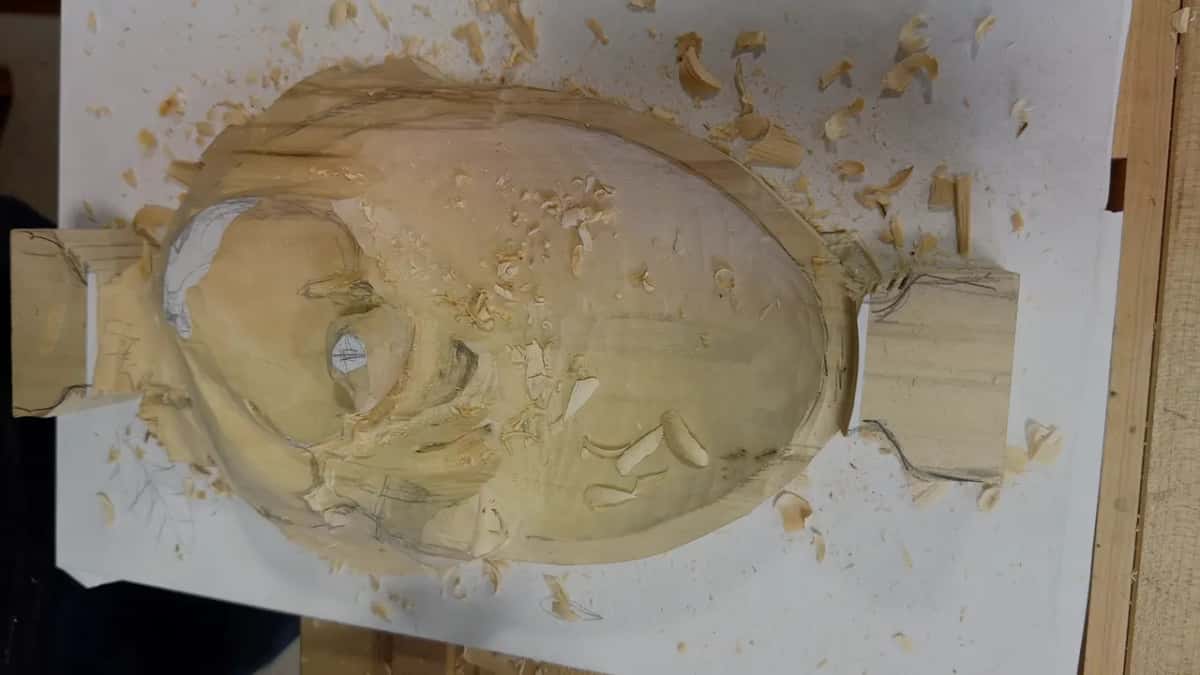
Rough oval blank, pencil guides still on it.
Under the gouge, water changes everything about how a plank behaves. Wood is alive. It sucks water in, it swells, then it shrinks back down again. More water in the fibers, or less, and the same plank carves denser one month and softer and mushier the next. Nothing about that is the wood being bad. Wood is simply being wood.
Which is also why the movement never stops after you put the tools away, and why a whole separate page covers how much wood shrinks and in which direction. Density and shrinkage are one story told at two different speeds.

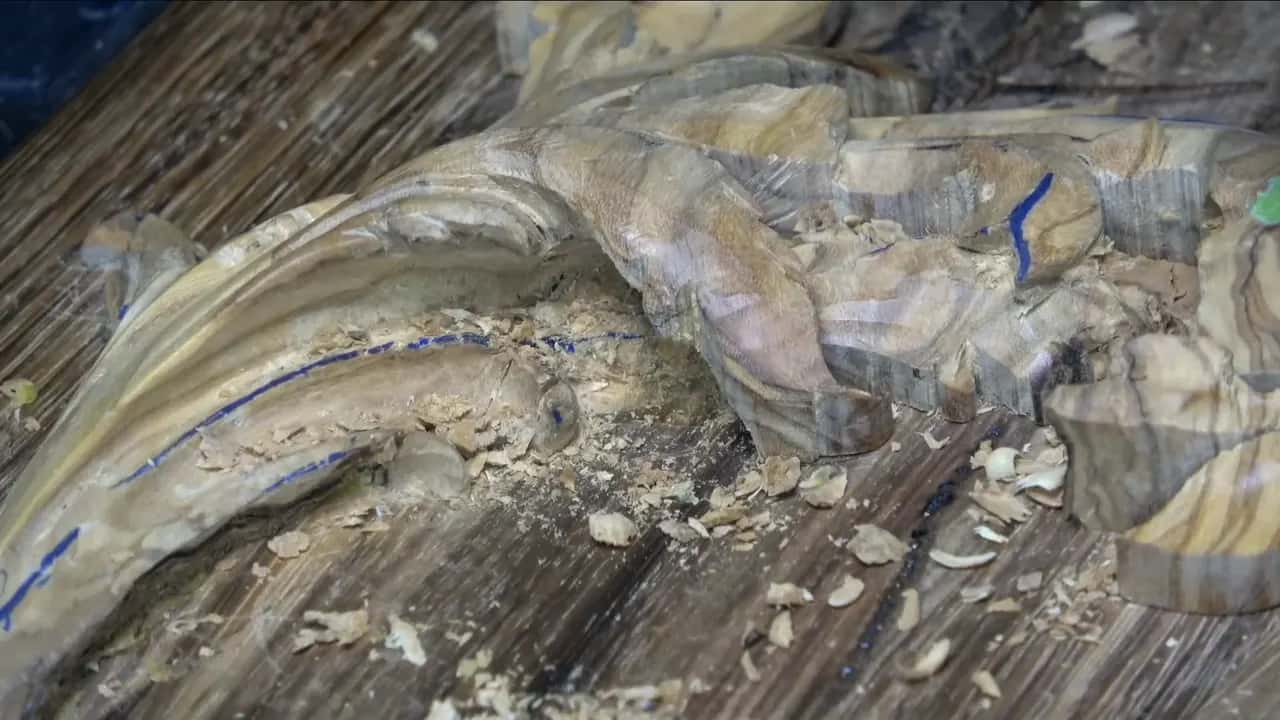
Thin cracks running along the grain of this weathered ribbon, and the blue dots are mine.
What can density tell you before you ever carve a chip?
More than any other single figure in the book, which is why this page is the parent of all the others. Density predicts the mechanical properties better than species names do.
Dent resistance tracks it closely, and the steel ball test behind dents has its own page about Janka hardness. Bending strength does the same, so a final snap sits under the modulus of rupture. Stiffness, meaning how far a thin part bends before it springs back again, belongs over on the elastic modulus page. And the load a post takes along its grain sits on the crushing strength page.
Rows of gouges on the shelves behind me.
Shrinkage follows density as well. Heavier woods move more while drying, since more cell wall material means more water given up and more pulling in. One figure hands you a rough forecast of hardness, of strength, and of how a finished panel will behave in a dry house next winter.
Rough is the word to hold onto. Is a heavier board stronger? Usually, and the answer has a page to itself because the exceptions matter. The handbook publishing those relationships also publishes the scatter around them, and the scatter is wide.

Half of this wreath is carved and half is still pencil.
Now the honest limits. Density says nothing about grain direction, and grain is what breaks tendrils. Silica hides from it too, and silica is what really eats an edge in some tropical species. Figure, colour, smell, none of that shows up in a density number, and neither does whether a board will hold a crisp undercut. For that you need the board, a sharp gouge, and ten minutes. If choosing is the real problem, we keep a page on which wood to use for carving, and another on telling good stock from bad.

Sitting at my own bench with the tool against the wood.
Is a hardwood always harder than a softwood?
Botany picked those two words, and hardness had nothing to do with the choice. Hardwoods are broadleaf trees. Softwoods are conifers.
Ohio State University Extension puts it plainly, that the term hardwood is not an indication of the hardness of the wood. Balsa is a hardwood. Which puts the lightest commercial timber on the market in the same botanical group as white oak.

Red line across four blocks pushed together, and botany is nowhere in this picture.
Look at the two woods a beginner is most likely to be handed. Eastern white pine is a softwood and reads 25 pounds. American basswood is a hardwood and reads 26. One single pound apart, and they sit on opposite sides of the botanical fence. A species guide covers whether balsa is any good for carving at that end of the shelf.
Let me tell you a story about softwood. A few years ago a job came in that had to be carved in hard pine. Interesting material. I broke quite a few gouges on it, and you cannot even drive a nail into the stuff, it was so dry. Harvested in the 19th century, then dried for a very long time before it ever reached me.
Blank in the vise, pattern already on top.
Every wood is carvable, more or less. Only the rare ones come close to impossible, and ebony is the one I name. Even ebony can be carved. Just dense, and gaboon ebony sits at 60 pounds against basswood at 26. For a list of the woods that fight back, we have a page on hard carving woods.
Me on camera, saying the same thing out loud.

Nothing carved yet, only a rosette drawn in pencil and a wedge beside it.
Can you read density with your hands instead of a chart?
My hands tell me more in one pass than any table ever has. Take a slicing pass across the grain and listen.
Olive wood taught me the top of my own scale. Really dense. Working it is almost not even carving, it feels like you are working with stone, and even with stone, limestone would be easier than this, because limestone has no grain you have to deal with. None of that is a figure of speech. My palm still knows exactly what that handle felt like an hour after I stopped carving.
Narrow blade, and the middle is still pencil.
My word for the failure is crunchy. When I say crunchy I mean the fibers are breaking instead of carving. They are breaking. And my tool is really sharp when it happens, which is the whole point of the word. Crunchy is a board telling you its density and its water content in one sound.
A good shaving is the opposite. It comes off long, it stays in one piece, and it curls ahead of the edge rather than crumbling under it. Ten seconds, no cost, and I trust it over any table.
Watch how thin that sliver comes away under the blade.
David Esterly, who carved the replacement for the lost Grinling Gibbons work at Hampton Court, wrote the best short description of a carving wood I know.
Crisp and firm, soft enough to be carved quickly but strong enough to be radically undercut, with a remarkable grain structure that can (with a little effort) be worked in any direction.
He is describing limewood, the European cousin of American basswood, and every word in his sentence is about density and structure working together. Not one of them is a number. He does not need one, since the board was in his hands, and yours is in yours. A species page covers basswood for carving and a longer article gives the best wood for carving if you want my own answer.
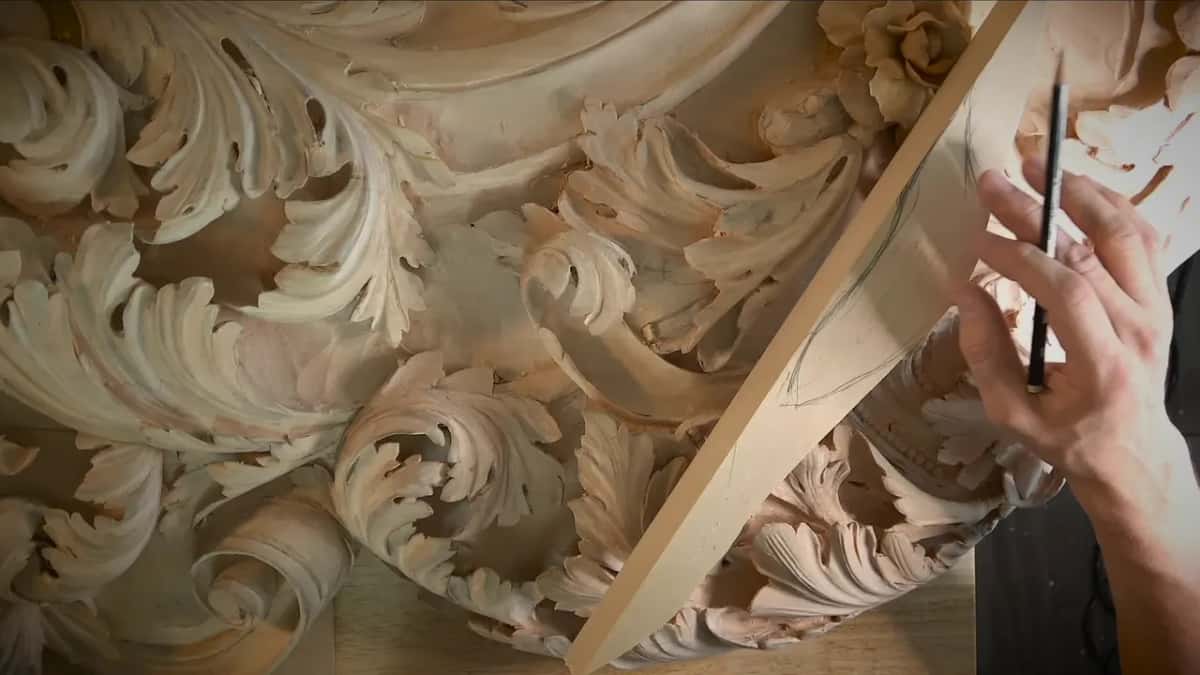
The next drawing goes down on a board laid across the finished panel.
Have you ever picked up two boards off one rack and felt just the one fight back? Do you carve leaf tips thin and lose them every so often? Would you like to know, before the first chip comes off, whether the board in your hands is going to behave? Then learn to read a board with a gouge, and let the chart be a second opinion.
Reading wood is a skill and it takes a while. We teach it inside the carving courses, starting with the beginner course, where the first thing you do is carve one shape in two different boards and feel the difference in your shoulder. Tuition supports orphans and widows, and it also pays the light bill. Who I am and what I have carved sits on my own page.
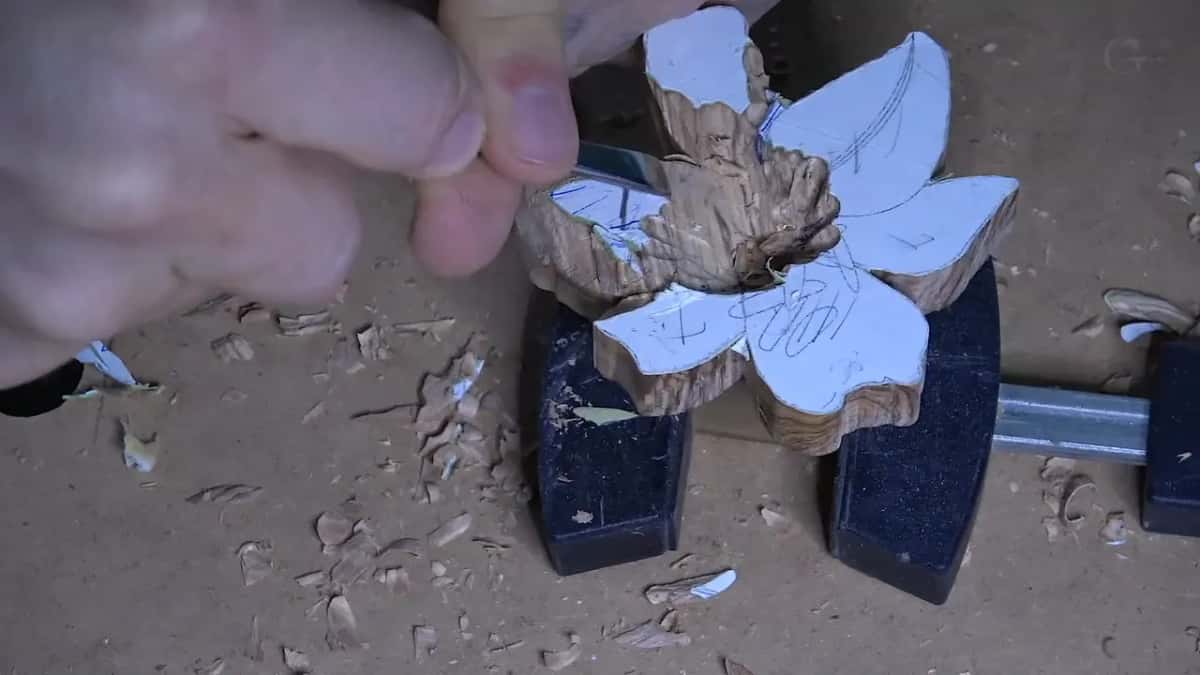
Small flower, clamped down, petals still under paper.
I still keep a scrap of that 19th century pine on the shelf above my sharpening stones.
Frequently asked questions
Does a heavier board always hold finer detail?
Usually a heavy board takes a crisper edge on small work, since more solid material holds each corner up. Grain matters as much though. A dense wood with wild grain chips out on an undercut while quiet basswood holds. Test a board before you commit a design to it.
What is the densest wood a carver is likely to meet?
Gaboon ebony, in most shops. Wood Database figures put it near 60 pounds for the cubic foot, against 26 for American basswood. Ebony can be carved, and I have done it, though the tools want touching up constantly and the work goes slowly. Buy a small piece first.
How do I turn a specific gravity figure into pounds?
Multiply by 62.4, since that is the weight of one cubic foot of water. A gravity of 0.42 gives about 26. Run the same arithmetic on any number you meet, and a mislabelled chart shows itself in roughly ten seconds.
Why does one plank feel different at its two ends?
Density shifts inside a tree, from the middle outward and from the base upward. A published study across 14 African species found gravity running between 0.28 and 0.95, with species identity accounting for under half the spread. Your plank inherits some of that scatter.
Should a beginner buy the lightest wood on the rack?
Light stock forgives a dull edge, so it makes a kind start for anyone new. Very light wood also crushes under the bevel and fuzzes on end grain. Basswood itself sits in a good spot at 26, soft enough to learn on and firm enough to hold a clean wall.
Is green wood easier to carve than dry wood?
Green stock carves easier and it also moves afterward, sometimes for years. Basswood heartwood runs about 81 percent moisture when fresh, so over half the weight in your hands is water. Rough out green if you like, then let the piece settle before any fine work.
Filed under
- best type of wood for carving blocks
- best wood for carving projects
- carving blocks density selection
- comparing wood density for carving
- does wood age change density
- effects of tree genetics on wood density
- environmental effects on wood density
- factors affecting wood density
- growth rate impact on wood density
- guides to wood carving density
- how moisture affects wood density
- how to choose wood for carving
- ideal wood density for carving
- moisture content and wood density
- properties of basswood for carving
- understanding wood for carving
- Understanding Wood for Carving
- what is the density of wood for carving
- wood density explained for carvers
- wood density in different tree types
- wood processing and density changes