

Alexander Grabovetskiy, woodcarver, School of Woodcarving · Published 2020
Which wood carving tools should a carver keep in the arsenal?
Quick answer: My words in video 11 of workshop 41: have both low and higher bevel gouges, if you can afford them. Other courses of mine use the word arsenal for a V tool, a router plane or a rasp, and for tiny tools too.
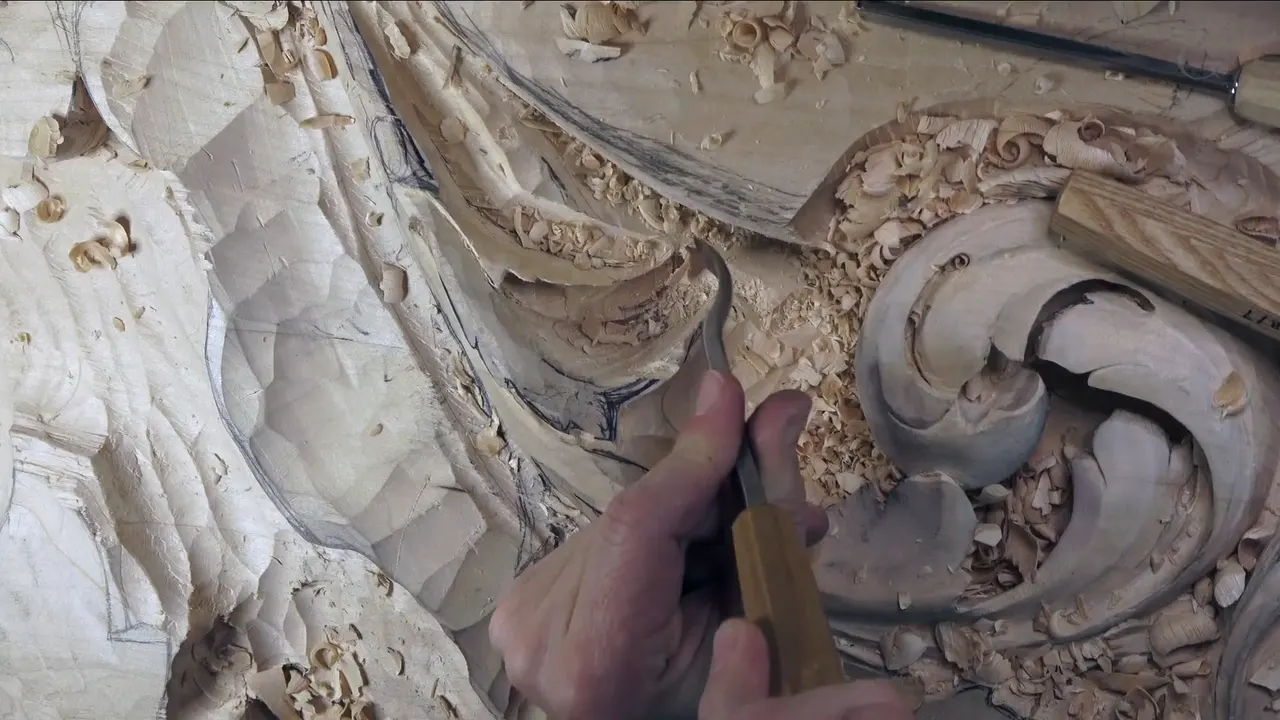

In video 11 of Venice Room workshop 41, I said, "it's a really good idea to have low bevel tools and higher bevel tools in your arsenal." Other courses of mine use that word for a V tool, a router plane or a rasp, and for tiny gouges such as a 1 millimeter (0.04 in) number 11.
Ever stood in front of a wall of gouges and wondered which ones deserve a place on your bench? Would it help to read which tools I put under that word, with the lesson where I said each one? Here they are, starting with the video where I said it out loud.
What was I carving when I said it?
I was working on one part of the Venice Room panel. The video opens on "Just outline it." Then: "I'm going to give separations a little later, once I get ready to work on inside, on this part." I wanted more ability "to get to it," since some of it will be gone downhill and easier for my tools to reach.
"For now, all I need is just the outline and see where it's supposed to go." Next came "let me round this part," and I guessed I needed to clean my area a little bit, because "there's too many chips."

For the opposite side my plan was to repeat about the same idea. One point I would bring all the way to another point, which meant outlining that first.
How did the tools run in that video?
A number 11, 10 millimeters (about 0.4 in), came first. It would give me, I said, "that feel like it's really round," because the part "has to also go underneath like that."
A bigger one was on my mind next, because right now the 10 was "a little too small," and the work would take me forever. Thirty millimeters (about 1.2 in) was the size I could use.

The wood in question was "a future shell, and that shell has to go underneath anyway," so I safely can move around with no problem. At one point I said, "I got to stop. I don't want to be too fanatical about it."

Next I planned "a smaller tool now, which is still big, 18 millimeters" (about 0.7 in), a number 11 again. That spot "needs to be excavated also," as a shell going downhill. Even that tool was "a little too big as of now," so I said I'd just use a number seven.

Why did I want low and higher bevels?
Of this particular tool: "I have to be careful how I'm doing it," because "that is really, really thin. It slices really easily through the fibers, but I got to be really mindful how deep I go with the cut."

Hence the line I opened with, which I finished with "if you able to afford it." The same holds, I said, for a hobby carver who wishes to work with different species of wood, beyond basswood and limewood.
"That is always good idea because on the harder woods, you really can't use too low bevel. You're going to break it." Next on my list: create the first separations, with number 11.

What did the videos on each side say about my tools?
Video 10 sits right before it. Maybe I should switch to number nine, I said, because it gives me more wiggling ability. About that tool: "Number nine is actually half a round." Another thought was whether "the quarter inch will be too big or it's going to be okay," and a quarter of an inch is about 6 mm.

Video 12 follows it. "Looks like my number three needs to be sharpened," I said, and "I need to use a smaller one." I also said "I'm going to use the same number three, but not upside down, but the normal way." In the Lily Box I used a number three upside down, as you read below.

Do I keep more than one tool for the same job?
My Hashemi Flowers course has me on the last two berries in workshop 25, video 2. It was the "same approach," V-tool first, and I told myself to make the separation cut and to make it tighter. A warning about pressure follows, with "I am barely creating any pressure."

The tool at hand was a number seven, five eighths of an inch (about 16 mm). It need not be that size, I said: "It could be different one, but looks like it works fine for me at least today."
Why say "today"? "Because sometimes there is more than one tool you can achieve the same results, and that's why I actually like to have multiple tools in my arsenal." Using one tool every day gets tiring, I said, and you want a different tool to approach something. It happens to me, I added, at least.
Where do the tiny tools sit?
The Grape Leaves Vase course gives a first answer. Lesson 2, video 10: "let me excavate the eye," and I named a 3 millimeter (0.12 in) number 11 veiner. Soon after, I needed a smaller number 11, and "if you noticed, I'm using a lot of number 11's on this project."
The arsenal word came next: "that's a good idea to have a good arsenal for number 11's veiners." One millimeter (0.04 in) was next, I said, "closer to the stem," to excavate "even little bit underneath."

Lily Box workshop 2, video 9, brings two veiners. The veiners were a number 11 at 1 millimeter first, then half a millimeter (0.02 in). Of those two, I said: "If you are a furniture maker, that's probably a must-have in your arsenal tools." It is "a really shallow carving," but "it looks like I applied that one because my undercutting is kind of deep." I was going in "approximately maybe even a 16th of an inch," which is about 1.6 mm.

In that workshop's video 13, my number three goes upside down, "a tiny number three." "Even on a micro carving like this, I'm still slicing it." I like it "for that type of work." And for a jewelry box or something like that: "those tiny tools, in my opinion, just must have in your arsenal."
Right after that I said "I almost don't see this line, and I need to exaggerate that," and my plan was the finer tool again.

My Grinling Gibbons class in Maine adds a warning. Class 13, video 1: "It's not micro tools," and I reminded the class that those tools are called detailing tools. My tool there was a number 3, an eighth of an inch (3.2 mm). For details, I said, "you really have to get some detailing tools or microtools."
The warning: "I wouldn't start, you know, from tiny tools." Even so, "I would buy them and keep them in my arsenal."

Does a V tool belong in every arsenal?
The Roman Acanthus course says it of a V tool. In workshop 2, video 2: "a V tool, again, it's one of the most important tools in your arsenal." I corrected myself right there. For relief carving, yes, and "of course, gouge."
On a big sculpture, I said, you are "using more gouges than V tool, so that would be probably more accurate."
My V-tool problem video in the sharpening course puts it another way. Not every wood carver has a V tool in the arsenal, I said: "It wasn't common actually until, let's say 19th century in Europe." Some wood carvers, I said, "they never use it even nowadays because of the problems." And "It's a excellent tool, don't get me wrong."
Further on I said "unfortunately I don't have bad tool in my arsenal. It's all taken care." So I said I would draw the notch, "and maybe understand much better."
What about a router plane?
The Acanthus over Moldings course brings in a router plane, my next tool in workshop 1, video 1. "Every furniture maker should have one. And I think every wood carver should have one because it's such a nice tool to have." A carver of small figurines, I said, really does not need it.
For furniture or architectural carving, I said, it is probably one of the tools you should keep in the arsenal. Of the two brands I like, I said one is much better here, because "you can change blades, and you can go from one millimeter all the way to one inch or three-quarters of an inch." One inch is 25.4 mm and three-quarters of an inch is about 19 mm.
"I barely use a really wide blade." And "sometimes you really have to get in the tiniest spots, like one millimeter or 16th of an inch, like millimeter and a half."

In workshop 32 of the Furniture Panel, video 2, I showed a small router plane, a microplane I said, I mean router plane, with a blade that "is kind of really small and tiny, and you're still able to get a really good support." There are limitations, but "in a small spots like this, that would be really good tool to get in."
The small plane, I said, is really a must have for wood carvers. My last words on it: "I'm not trying to sell you anything. I'm not making any money from it. Just, it's a good, good, good arsenal of tools."
Does a rasp count?
In Venice Room workshop 17, video 2, I said "let me get the rasp." "I can probably use a big one for now. Kind of give an overall shape." And "maybe a smaller one," to take care of the high spots.
Soon after I said, "Like I said, I didn't expect" to like it. The line that puts it in my arsenal: "I think it's a good tool to have."

How big should the big gouge be?
The Plate with Butterflies course, lesson 1, video 3: I said I would use a number seven. "That's always gonna help," I said about a bigger one. Seven eighths of an inch (22.2 mm) or even one inch (25.4 mm), I said, "it would be even better. If you do have that Arsenal."
Without it you can still carve. "It's still gonna be the same operation," I said.

My April 2020 livestream about plastic puts one more thing in the word. The subject, I said, "is about wood carving tools, and the plastic is a wood carving tool in arsenal." Then came a story from my school days: by the time of college we used plastic bags to carry all of our college stuff, and plastic wraps for the notebooks.
For me, I said, it was "like a heaven, like a paradise," because I was able to use a normal pen and draw. I would "just draw on my plastic bags and on my notebooks, just to develop some ideas." And "you could actually create beautiful stuff just on the plastic."
Where else did I say must-have?
The Grape Onlay course says it about back bends. A back bend, a number three, a quarter of an inch (about 6 mm), was a good idea for me to get, I said. "In my opinion, back bends. It's just must have tools if you are really serious about wood carving. Not in the beginning, of course."
In Furniture Panel workshop 15, video 9, I named the veiners for this type of carving: "three millimeter, two millimeter, one and a half millimeter, one millimeter, half a millimeter." That is 0.12, 0.08, 0.06, 0.04 and 0.02 in. Those, I said, are must haves.
Inside the Tray of Blessing, workshop 3, video 3, I named a number 11 for excavating. For the furniture makers, I said, it is a must have. Then: "You gotta have it."
In Greek Acanthus workshop 5, video 3, the background tools come in different sizes. This one, I said, is an eighth of an inch (3.2 mm), and there is a smaller one and a bigger one also. My opinion: it's "really must-have tool or must-have tools."
Is any tool not a must-have?
Yes, and I said so about a pointing machine, in the first video of the Chamomile and Bow Rosette course. "If you still did not invest in that tool, you're missing a lot. You don't really need it. It's not like a must-have tool," I said, though investing in it is a good idea. I added that I love it.
The word, the tool and the lesson
| Words | Tool named | Lesson |
|---|---|---|
| Furniture makers, with really shallow carving and deep undercutting | Number 11 veiners | Lily Box |
| Relief carving, where a V tool is among the most important | A V tool | Roman Acanthus |
| Furniture or architectural carving, but not for small figurines | A router plane | Moldings course |
| Hobby carvers who work in harder woods | Bevels that are not too low | Venice Room 41 |
| Anyone who wants to work on details | Detailing tools | Maine class |
How did video 11 end?
On a plan. "I need to create my first separations how it's going to be," I said, and "I need to use number 11."
To hear those lines in my own voice, the tuition opens every workshop in this room.
How it's done
- Outline first. For now, all I need is just the outline and see where it's supposed to go, I said in video 11.
- Reach for a bigger tool. The 10 millimeter number 11 would take me forever, I said, so 30 millimeters was an option.
- Step down in size. An 18 millimeter number 11 was my next plan, and a number seven after that.
- Mind a thin tool. The thin one, I said, needs care, and I had to be mindful how deep I go.
- Keep both bevels. Having both kinds is my advice, if you can afford it, and for hobby carvers too.
Frequently asked questions
Does an arsenal need to be big?
A number seven need not be that size, I said in the Hashemi course, because a different one can work. A bigger number seven helps, I said in the Butterflies course, but a smaller one gives the same operation. A V tool is not in every wood carver's arsenal, I said.
What did I call must-have for furniture work?
In Lily Box 2.9 I said it about number 11 at 1 millimeter and the finer one, for furniture makers. In the Moldings course I said every furniture maker should have a router plane. In Furniture Panel 32 I called the small plane a must have.
Why should a carver own both bevels?
The tool I was using in video 11 is really thin, I said. On harder woods you really can't use too low a bevel, and you're going to break it. A hobby carver who wants other species of wood than basswood or limewood should have both kinds, if affordable.
What to carve next