

Alexander Grabovetskiy, woodcarver, School of Woodcarving · Published 2020
What does "it's okay" mean when a wood carver says it after a cut goes wrong?
Quick answer: "It's okay" is my line once a cut goes against me. In workshop 41, part 8, the reason is that the movement I want still runs downhill. Elsewhere I name wood to spare, a fix to come, a bigger tool, or a time limit placed on the okay itself.
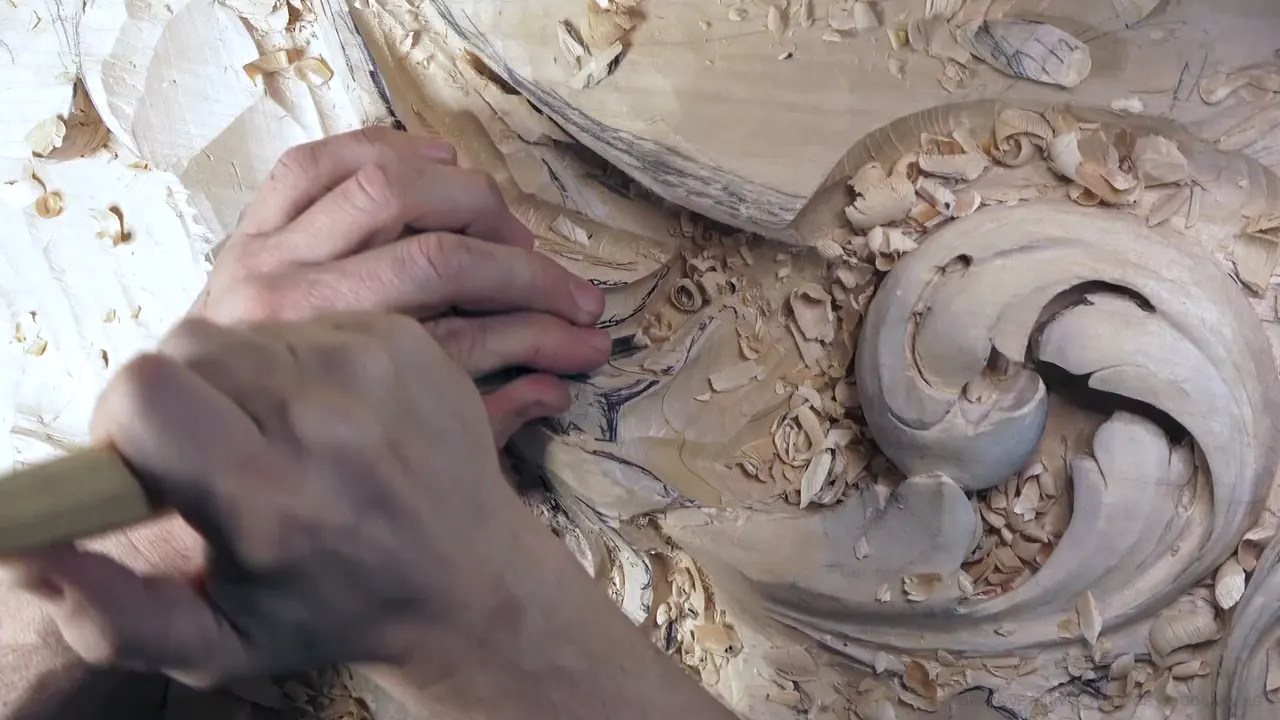

"It's okay" is what I say right after a cut I did not like, and the reason the cut can stay comes next. Workshop 41 of my Venice Room course has one such moment in part 8, on a carving of acanthus. The same two words turn up in my other courses, and what follows them changes from case to case.
Ever made one bad cut and wondered if the whole carving was gone? This part is short, 423 words. So this page sets it beside many of my other video parts: Furniture Panel, Lily Box, the floral panel, Byzantine Acanthus, Acanthus over Moldings, and other Venice Room workshops.
What does "it's okay" mean in Venice Room 41.8?
The line comes in one breath, at 01:30: "And I don't like what happened right here, but it's okay." The reason follows: "I'm still able to create beautiful movement downhill. So should not be a big problem." The video does not name the slip. The line points at a spot on the carving in front of me.
A few lines earlier, at 00:55, a number three is in my hand, "and that's not going to work." Number five takes its place: "Number five. Go down like that." Then, at 01:30, the line.

Next comes a plan, and it stays a plan. "Let me use number three again." Although it is not the final outline right there, "I'm going to cut straight down." A limit sits on it: "But not too deep because I really don't want to create marks, tool marks too deep, or it's going to be hard to clean."
Nowhere in those lines do I call the cut perfect. The movement is still there, and the next cut gets a depth limit so the cleaning does not turn hard.

Which tools come up in part 8?
A spoon gouge is on my mind from the first lines. For this operation it would be much better, I say at 00:13, and "I'm talking about excavating like this." Then comes "Don't want to change tools all the time."
The spoon returns at 05:54. The excavation on the inside I could get done with probably a spoon, and "It would be more logical to use just a spoon." Soon after: "I need to spoon it underneath also." By 06:50 the spoon is working on its side, sideways.

Then a plan with a size: "So let me use the 10 millimeters" (0.39 in). My main concave is closer to this flipping motion, I say, and it is flat pretty much on the inside. At 07:27 a bigger spoon comes into question, and I say it "is going to give me a much cleaner and quicker result." The last words are: "Maybe yes, maybe no. But looks like it does."

Small tools get calls too. The 1 millimeter (0.04 in) could go in later on, I say at 03:20, and then: "Actually, I could do it right away before I lose that idea." The point is "just to create some shadow." That 1 millimeter was on number 11. One doubt sits in the next line: "Clean that with number seven. I'm not sure if I'll be able to or not."
Next, the tool in my hand. Maybe it is a little too big for this operation, I say, and "I should use something different, but I also want to clean this a little bit nicer." The tool might be wrong, and the cut is not called spoiled.

What follows "it's okay" in my other courses?
Each passage below comes with the lines around it in the transcript. They sort into a few groups, and the first one matches part 8, where the spot is not what I wanted, and I name what I still have.
When the slip leaves wood to spare
Furniture Panel 18 has the same sentence, word for word. Right at 08:03, in part 5, I say "I don't like what happened right here, but it's okay. That is okay." Just before that I say I will have a chance to fix some of the movements later on. And right after it: "What can you do?"
A cut at 01:07 in part 5 of Lily Box 7 gets "that is no bueno," then "So I just made a mistake." I wonder aloud whether I should go deeper first, though "it's okay." I give the reason as "I still have plenty of meat, plenty of wood," and I can go a little deeper first, I say.

Lily Box 2 shows the same count of what is left, and part 11 has me look at how deep the undercut already goes. I start with "I almost lost--" and go on with "Well, I did the corner of it." It ends with "it's okay," and then "I still have plenty of the thorn." Number 11, one millimeter (0.04 in), goes in again.
Working a pipe in Acanthus over Moldings 5, part 3, I say "I broke that," and go on with "it's okay. I'm still safe. I'm all right." Back to the cut: "So let me attack that from that side." Lily Box 11 has a sound instead: in part 13 I hear the wood crack and say "Don't like when it cracks." Then: "that's okay, I'm still stable. Didn't break anything."

When a fix is already in mind
Sometimes the fix is the whole reason. Over in Furniture Panel 16, part 2, I say at 12:40, "I went all the way." Maybe I made a mistake, I add, and eight seconds on comes "it's okay. I'll take care of it." The pattern repeats in Furniture Panel 22, part 2. I say I do not want to mess up, and that I think I already did somewhere. The answer: "it's okay. I'll fix it."
Floral and Molding for the Panel 12, part 3, has a mistake at 12:18, and I still say "it's okay." Right after, I chip something, "so not too careful. Got to be more careful. Which is okay. In this case, it's going to work with no problem."

Glue counts as a fix. Something breaks again in part 2 of Lily Box 6, at 07:00, because I have a glue underneath. "I'll glue it back," I say. The glue on the bottom wasn't enough, I guess.
Cleanup counts too. Venice Room 69, part 9, shows an upper part that is rough and not the final shape. I know some of you probably don't like that and it bugs you, I say, and "that's okay. It's just a matter of cleanup."
Deep digging sits in Venice Room 62, part 10. My plan at 04:05 is number 11 again, 18 millimeters (0.71 in), to excavate much deeper in this area, "because I really need that movement." At 04:39 I say "Maybe I got too aggressive," and "it's okay." "Wonderful" comes next, and a few lines on I call it a really good starting point.

When a tool breaks or is the wrong size
Something breaks in Byzantine Acanthus 3, part 2: "See that? It broke." I call it okay and fine, then say "I'll just use a bigger one. Doesn't matter." And: "I'll fix that one."
A tool chips in part 9 of Lily Box 6, and I say "That is actually chipped away." Then comes "it's okay. That just means I can't use anymore the same tool." Something different has to come in, maybe just number three.
Size is the other kind of tool trouble, and it shows up in two more courses. In Floral and Molding for the Panel 2, part 1, some spots could probably take a little bigger tool, and "it's okay. This is going to be sufficient." A size doubt like the one in part 8 comes in Furniture Panel 27, part 2, at 13:07. Too deep an undercut is not what I want yet, only a slight one, and I say "Obviously it's a little too big for this area." It ends the same way: "it's okay."

One break changed my answer in the middle of a sentence. I just broke my number 11, half a millimeter (0.02 in), in part 6 of Lily Box 7 at 17:07. "I don't like when I break my tools," I say, and "it's okay. Well, it's not okay. I do have another one, and I'm going to resharpen the one I just broke."
You see, I was really careful, I say, and I didn't force too much, "but just because that is a hard wood. It doesn't help." So the two words are no blanket pass. I said them, took them back, and named what I had on hand.
When I break a rule
The grain is one rule. Over at 06:48 in part 9 of Furniture Panel 22, I say "little by little," then "Yes, I am breaking my rule. I'm not supposed to cut against the grain," and "it's okay. I should be fine." Venice Room 66, part 8, has the same rule, and "it's okay" comes before the hope that it's not going to damage it.

The part right before mine, 41.7, has the rough version, at 02:55: "Oops. That is no bueno. That's too much stress to the wood." Then "Stress against the grain is what I just did." Those lines hold no "it's okay." What I say is "But at least I'm able to see what is going on."
Position matters in Furniture Panel 20, part 3, at 05:52. I should change probably position and attack that from the opposite side, I say, and "it's okay." Then: "I have really sharp tool, and I can just break one of the rules."
When it is only okay for now
A straight down cut and a slip open Furniture Panel 15, part 4. "See, I just slipped," I say, "okay as of now. Later on, it would be a big mistake." Another way I could do it, I say next, is to take whatever gouge has the matching curvature and follow along that design.

In the Lily Box lesson 6, part 11, at 01:35, I say "I'm not too happy how it looks in this area," and then "it's okay for now, at least, okay?" And then: "So we'll see how I can deal with that."
A cut goes too deep in Furniture Panel 23, part 4: "See, that is a mistake, what I just done." It's not that bad and all, I say, and the extra movement it made is "absolutely okay" because extra movements are the next step with those flowers.

When the words do not come
My own workshop shows the other side in its part 9. It looks like I'm hitting the edge at 03:34, "which is okay. Not a big deal." Later, near 05:35, I wasn't too careful, and my tool is not too sharp either. "Just lost, and I don't like it." Then: "So now I have to move my eye farther."
I call it not a complete huge mistake, but something to avoid, "and I could, and I didn't." Nobody will know it except you, I say, or hundreds of you, because I have hundreds of members right now. "I have to be more careful, I should say." No "it's okay" sits in that stretch.

Then a thought about why I slip: "Maybe I'm spending too much time in one spot, and when I'm doing it, I have a tendency to make the mistake." I do not want to make mistakes, I say, "But I still do."
What do these passages share?
Here are nine of them side by side, with what went wrong and what came after the two words.
| Where | What went wrong | What came after the two words |
|---|---|---|
| 41.8, Venice Room | A spot on the carving | Beautiful movement is still there downhill, a small problem at most |
| 18.5 in Furniture Panel | Something I disliked | A chance to fix some of the movements later on, then what can you do |
| Lesson 15.4, Furniture Panel | One slip | Okay at the moment, a different answer later |
| Lily seven, part 5 | A mistake I called no bueno | Meat left, and I can go a little deeper first |
| Moldings 5.3 | Something I broke on a pipe | Still safe |
| Byzantine, lesson 3 part 2 | Something broke | A bigger one, and I'll fix that one |
| Lily 7.6 | My tool broke, the number 11 | Well, it's not okay. I have another one, and I plan to resharpen the broken one |
| 22.9 of the Furniture Panel | Breaking a rule | Little by little, and I should be fine |
| Workshop 62.10, Venice Room | Too aggressive, maybe | Wonderful, and then a really good starting point |
Read down the right column. Each row names something: movement that is still there, wood that is left, a fix I am going to make, a tool I have on hand, or a later time when the answer would change.

How do I use the words at the bench?
Read together, the passages above run in a plain order. First comes the spot that bothers me. Then what is still left, like "plenty of wood." Next comes the fix: "I'll take care of it," "I'll glue it back," "I'll just use a bigger one." If it is only for now, the words are "okay as of now."
One more, from part 8 of Lily Box 3 at 08:42: "Oops. That's not supposed to happen." Next: "it's okay." Then "I did not break it completely, but that's what happens when you're forcing too much." After the finish goes on, I say, it will be held together with no problem. And then: "But I shouldn't force it."

Back in Lily Box 11, part 13, right after that crack, I say maybe I should stop at this point and not do anything, just to cut it away and place it right in the flower. After that I say I used a scroll saw to cut that part, and that this is approximately how it will be located.

Now find one cut on your own workbench that you do not like, and say what you still have. My choices are on camera in part 8, and the lesson 41 page covers the whole workshop. For all my lessons in one place, start here.
The Venice Room course for workshops 38 to 49 holds the rest of this wood carving. Every figure in millimeters and inches on this page is mine, with the conversion beside it when I did not give one. The page also leans on my Furniture Panel, Lily Box and Byzantine Acanthus courses.
How it's done
- Name the trouble. I say it aloud, right where the line comes in. The video leaves the slip itself unnamed.
- Count what is left. Here the movement itself remains. Over in the Lily Box course, part 5 of lesson 7, I count meat and wood that remain, plus room to dig down first.
- Promise the fix. I promise to deal with it later in one panel lesson, to glue the piece on again in a Lily Box second layer, or to reach for a bigger tool in a Byzantine Acanthus lesson.
- Set a time limit. Another panel lesson puts a clock on it: fine at that moment, a mistake later on.
- Plan the next cut. Part 8 plans number three once more, straight down.
Frequently asked questions
What did I say after the line in part 8?
The movement downhill is still there, I said, so the slip should not be a large problem. Next came a plan: number three once more, a cut straight down, kept shallow so deep marks would not make the cleanup harder. I added that the outline at that spot is not final yet.
Did I call a broken tool okay?
Partly. In Lily Box lesson 7, part 6, my half millimeter number 11 (0.02 in) broke. I started with okay. Soon I corrected myself and said it was not okay. A spare was on hand, and I planned to resharpen the broken one.
How long can a slip stay okay?
My slip in Furniture Panel 15, part 4, was fine at that moment, and I said so on camera. Later on, I said, the same slip counts as a big mistake. The time limit sat right beside the cut, spoken in the same breath as the okay itself.
What to carve next