

Alexander Grabovetskiy, woodcarver, School of Woodcarving · Published 2020
What does "a tendency" mean when a wood carver says it about his own habits?
Quick answer: A tendency is my word for a habit I catch in myself at the bench. Part 9 of Venice Room 41 has me guess that too much time in one spot is when I tend to make the mistake. Other lessons name overdoing, rushing, leaning on the tool, cranking and going through to the back.
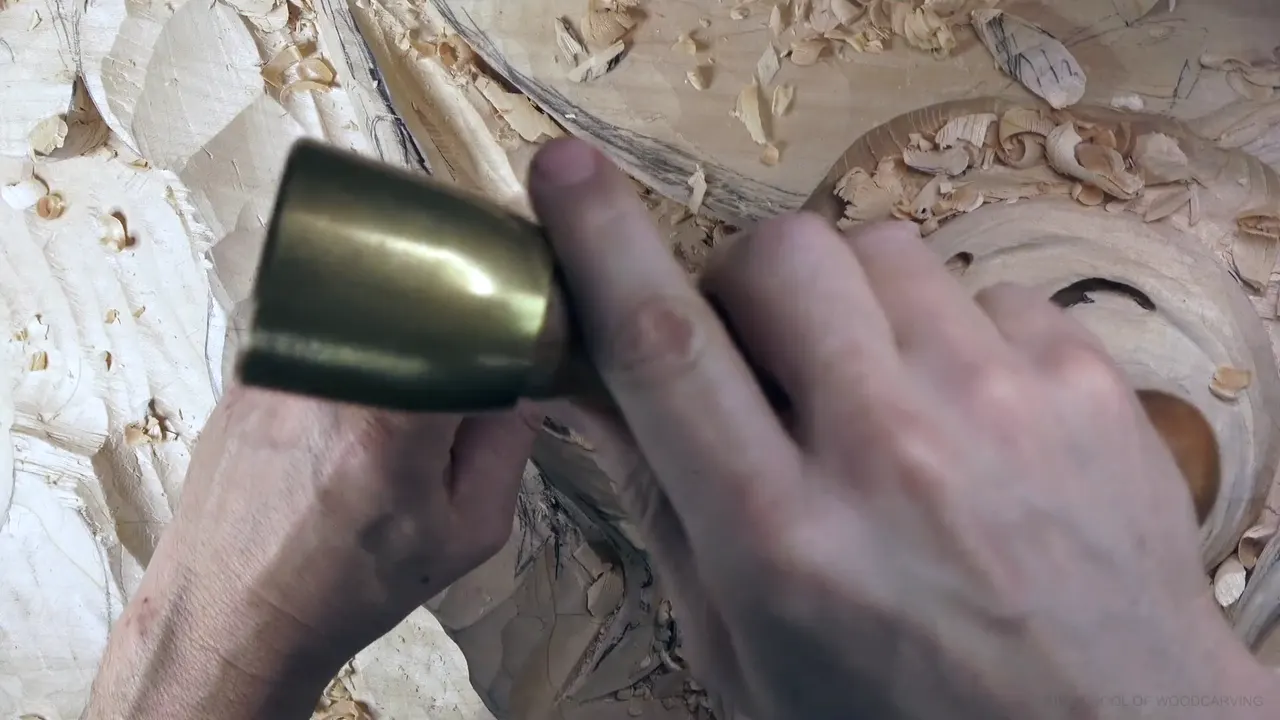

A tendency is my word for a habit I catch in myself at the bench. Part 9 of workshop 41 names it: a habit of making a mistake, with a guess that I stay too long in one spot. Other courses use it for overdoing, rushing, cranking and breaking.
Ever made a slip on a carving and then noticed it was the same slip you made last time? Did it come late, when you were tired of one corner? I say on camera that I do it too, and that I would rather not.
That part is short, 434 words. So this page lines it up beside other video parts where I use the word in wood carving: more Venice Room workshops, Hashemi Flowers, Lily Box, Roman acanthus, Greek Acanthus and Acanthus over Moldings.
What does "tendency" mean in the 41.9 video?
The part opens on a result I like. "Really nice and clean result," I say at 00:07, "so that way I don't have to worry about making it smooth." At 01:02 it is "nice and deep." I can probably give some roundness to one part with the number seven. That is probably as far as the seven goes, because a part that will be the ceiling sits right there.
A straight seven cannot go there. A back bent, I say, will give me more clearance. And again: "look at that. It's clean, and I don't need to do anything." Maybe I should go back to the normal way, without any sandpaper or rasps. I leave it at "so we'll see."

The edge comes next. At 03:34 it looks like I am hitting it, "which is okay. Not a big deal." Inside of those eyes I could use a smaller number 11. A need follows: "I really need to go underneath. Otherwise, I'm not going to get that effect of movement I'm after."
A straight tool is what I plan to try, to knock down one area and blend it. The small number three is what I name. By 05:16 I report back: I was able to, I say, but I still have to clean uphill, probably with the up cut.
Then the slip. "But I wasn't too careful. And my tool is not too sharp either." Soon after comes the verdict on my work, in these words: "and I don't like it. So now I have to move my eye farther."

Then I size it up. "It's not a complete huge mistake, but something to avoid, and I could, and I didn't." Nobody is going to know it except you, I tell the people watching. Next: "I have to be more careful, I should say." Then a short line, "Fix that somehow."
Last comes a guess at the cause. "Maybe I'm spending too much time in one spot, and when I'm doing it, I have a tendency to make the mistake. And I really don't want to make the mistakes. But I still do."
Where does the tendency come from?
In several lessons I name the same trigger: time spent in one place. Start with Venice Room 8, part 8. Work all day long and linger in one place, and you slip. Then I correct my own sentence. "Well, I shouldn't say you. I should say I have a tendency to make mistakes."
A moment later I call it "not really a deal-breaking mistake," and add "Still no problem." Cleaning a little with just a skew chisel is planned, and maybe an undercut.

In Venice Room 101, part 4, I count the cuts. I can overdo it, of course, and I don't really want to, and the problem is mine, I say, and also, I guess, everyone's. "When you concentrate too long on one area," I say, the tendency to overdo it shows up.
Carry that forward. A cut more in that section with a smaller number seven would overdo it, and I would have to fix it somehow. It is not unfixable, but the section is really nice and smooth, and I'd rather keep that feel. Number five is what I was using, and now it is number 11 again, to clean all that fuss.
The Moldings course has the same idea in lesson 6. I do not go right away to the final stage with every detail, because I like to look again after a few days. Work all day long on one piece, and I should say I tend to miss the mistakes. Come back the next day, I say, and the movement is not right. Then you grab your chisel and start fixing.
How does overdoing look?
It looks like one cut too many. In Venice Room 6, part 7, I say "let me get a little deeper right here," and then "That is enough," I say, because sometimes I overdo stuff, "which I shouldn't." I plan a number 11 at 3 millimeters (0.12 in), followed by the 1 millimeter (0.04 in).

A relief cut in Lily Box 5, part 12, brings it up again. "Just a relief cut, but carefully," I say. "Again, there is always a tendency of overdoing it." Half a millimeter (0.02 in) is my plan, with a mallet, taken from the opposite side.

The lesson on blending color, Lily Box 13, part 6, has it too. "Like everywhere else, the idea is not overdoing it." I correct myself: I mean I am able to overdo stuff, sometimes. "I'm still working on it."

Lily Box 12 adds a second kind, in part 6. "I always have to stop myself," I say, because I tend to make it paper thin. I cannot forget this is going to be an everyday use piece, so I cannot make it too fragile. Some parts I do have to make really fragile, like the middle part of a lily. As a wall decoration I could make it paper thin. Then: "just got too extreme."

One line in the seventh video of that same lesson turns the word around. If you tend to overdo it, "everything what you do, especially in wood carving, that actually tells something good about you, not bad thing." A true artist, I say, in any form of art, wants to do something else to the piece he works on.
What about rushing?
Rushing is a different habit, and I own it too. In Hashemi Flowers 3, part 3, I say it is important not to rush. I am "guilty myself," with a tendency to rush it "because I want to make sure I'm done quickly." Then: "it's better just to work your way in than rushing."

Roman Acanthus 13, part 4, goes further. On production work I need to be much quicker, I say, because I cannot waste time, but I am more on the side of being careful than rushing. "And I've done those mistakes when I rushed too much." I am using a number three, an eighth of an inch (3.2 mm), and plan to work my way in.
The cost comes next. When I rush, I say, I make a lot more mistakes, "and I break, and then I have to glue back, and that's not nice."
A day when it happens sits in the first video of Hashemi Flowers 30. Say you try to get as much as possible done in one day, I say, with setting in and final detail on the same day. A little more mistakes come, because with the big tools you are trying to rush everything and make quick movements. "And then you're taking tiny tools in your hands." By then, I say, your hands have already done the big stuff.

How do pushing, cranking and breaking show up?
In these three lessons the worry is the same: a break in the wood. In Roman Acanthus 16, part 5, I dig on the inside and create a channel. "But be careful," I say. I push sometimes too hard. Then the tool digs into those fibers, and I can break that section, which in my case right now is a weak spot.

So I keep an eye on it, and I say how. I place my fingers on the board. That way they work like a limiter of movement. The tool will not slip, because my finger is really solid on the board, and I control the tool with just the fingers.
The grain comes into it in Greek Acanthus Leaf 4, part 4. "Please control your tool," I say. I place my hand and my pinky finger there, because "when you do work with the grain," there is a tendency to push too hard, "and you can chip this section, and it's going to kind of fly out on you." That is not the safest, so my pinky and the other hand control the movement.

Cranking is the edge version, in Hashemi Flowers 47, part 1: be careful not to crank against the edge, because that breaks the edge. "And I found myself guilty also when I'm making cuts like that," with "a tendency to crank." The next tool I plan to take is smaller, half a millimeter (0.02 in), to make the cut even deeper.

Breaking shows up in Hashemi Flowers 12, part 1, where I work along the grain. I say I tend "to break too much," and that will not look good. So I must be really careful. "Just do by hand," and the trick is the rotation move.
What about going through to the back?
That one lives in Venice Room 17, part 10. I want the eye a little more pronounced, and I check the back side because I'd rather not overdo it and get all the way through. "And yes, I've done it too many times. Especially when I carved flowers." I own up to a tendency to go clean through.

A number 11 at 1 mm (about 1/25 in) comes next, and I say I am going to attack two sides, and maybe 2 millimeters (0.08 in) to clean up. I ask whether the deeper concave should go right there, and I decide: "I will just leave it like that."
Another habit comes up in part 10 of Venice Room 21. I actually can go in, no problem, but I've got to be careful how I do that. "Yes, I also have the tendency to try to take out before I even created the cut all the way." Better to remove the mess with another tool and hook it out. In my case I am using just a 1 mm (about 1/25 in) number 11 spoon gouge, and I can excavate as deep as I wish.

Can a tool show a tendency too?
Yes, in Venice Room 67, part 7. I reach for my favorite number nine, then decide on a bigger one. "There is a big space. I don't have to waste time." I take a half an inch (12.7 mm) number nine and say I am going to excavate. A big chunk, I say.

Its limit comes next. "I have a limitation with this tool. It actually has a tendency to go deeper, and I don't really need to go deeper."
A way of starting can have one as well, in Venice Room 89, part 8, where I plan a concave cut that runs nearly to the bottom, closer to the surface. "Otherwise, it's not going to look nice. I know there's a tendency to start somewhere right here and go along that line," I say, but it will not look good.
Do I keep a tendency on purpose?
One, yes. At the start of Hashemi Flowers 5, part 1, I name a tendency to jump around my design, and I say I do that on purpose. "When you just concentrate on one area, you are losing overall picture sometimes. Maybe not you, but I do."

It is easier for me to work one area and then jump to another, and that way I can see the overall picture of how it is developing. "And sometimes I see some changes I have to make, some design changes and so on."
What do these passages share?
Here are nine of them side by side. The middle column holds my tendency, and the right column holds what I said or planned right after it.
| Where | My tendency | What I said or planned next |
|---|---|---|
| Part 41.9 | Making the mistake | I must move my eye farther and take more care |
| Venice Room 8.8 | The same slip, one spot too long | Still no problem, with a skew chisel for a little cleaning |
| Workshop 101.4 | Overdoing one section | One more cut would overdo that section, then number 11 clears the fuss |
| Lesson 6.7 in Venice | Overdoing stuff | I stop, then plan number 11 for cleaning |
| Lily Box 12.6 | Making it paper thin | I stop myself, since it is for everyday use |
| Hashemi 3.3 | Rushing | Better to work your way in |
| Roman 13.4 | Rushing, then breaking | A tiny number three, working my way in |
| Roman 16.5 | Pushing too hard | Finger contact with the board works as a limiter |
| Hashemi 47.1 | Cranking against the edge | A smaller tool is the next one I plan to take |
Read down the right column. A few rows hold a tool, a few hold a way to hold the tool, and a few hold a thing I say to myself.
What do I do about a tendency?
I have no single cure, only what is on camera. In this part I say "I have to be more careful," and "Fix that somehow." In lesson 6 of that room I stop at one cut, and another lesson names the one cut that would overdo a section.
In Roman Acanthus 16 my fingers go on the board. In Hashemi 3 I say to ease in. The back side gets checked in Venice Room 17, and in Venice Room 21 another tool removes the mess. Days away from the piece let me spot what is not right in the movement.
So the tendency is still there when part 9 ends: I say I would rather not make the mistakes, and yet I still do.
Think of your own bench. Where in the piece do you linger longer than you meant to? Which cut tempts you once more? I name mine out loud at the end of part 9.
My own part is on the lesson 41 page, and the whole run of workshops 38 to 49 sits in the Venice Room course. Where I gave one unit, the other one beside it is a conversion I checked. The tuition gives you access to all of it, and you can start from the start page.
How it's done
- Catch it when it shows. Part 9 has me say it out loud, with a guess at the cause: too long in one spot.
- Stop at one cut. Lesson 6 has me stop at a cut with the words that is enough, then a number 11 for cleaning is planned.
- Say which cut is one too many. Lesson 101 has an extra cut with a smaller seven that would overdo that section.
- Let the fingers limit the tool. My fingers sit on the board in the Roman lesson, so the tool does not slip.
- Come back days later. The Moldings lesson has me look at the piece again after some days and fix what is not right.
Frequently asked questions
What did I name as my tendency in 41.9?
At 07:11 I wondered if a long stretch in one place was the cause. When I do that, I said, a mistake comes. I added that I really do not want those mistakes, and that they still happen. Earlier in the part, I had said I was not too careful and my tool was not too sharp.
Is overdoing a bad sign?
Over in the lily flower lesson, in its seventh video, I said that overdoing in everything you do, especially in wood carving, tells something good about you. In Lily Box 13 I also said I am still working on mine.
How did I keep the tool from slipping in the Roman lesson?
My fingers went on the board. I said they work like a limiter, my finger is solid there, and I control the tool with just the fingers. I had named a habit of pushing sometimes too hard, in part 5 of lesson 16.
What to carve next