

Alexander Grabovetskiy, woodcarver, School of Woodcarving · Published 2020
What does a wood carver mean by "something different"?
Quick answer: In Venice Room 41.1 I called a chunk of wood really beautiful and said I wanted something different for it. In other lessons the same words came with a second concave or four petals on a flower, and with a new gouge too.
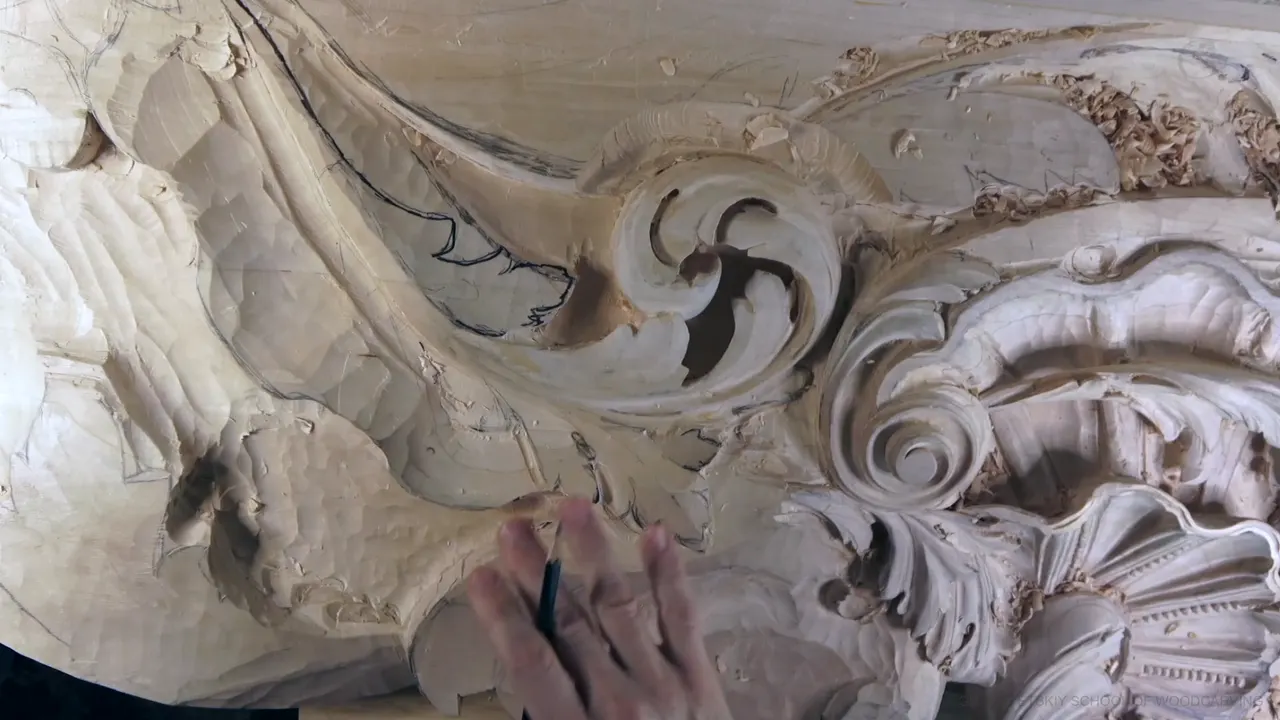

In Venice Room 41.1 I called a chunk of wood "really beautiful" and said, "I'm going to do something different." The same two words come up in other lessons across several courses. They go with a second concave and a flower with four petals, and with a flip I left out of one spot. Sometimes the next thing was a new gouge.
Have you ever carved one movement over and over until your hands could do it asleep? Does a spot of wood ever sit in front of you with plenty of material and no plan yet? Workshop 41 starts right there. Below is what I said and did, and then what those words meant in other lessons of mine.
What did I say about the chunk in part 1 of workshop 41?
Next I wanted to develop this area and "create something really, really interesting." Then: "But let me think how I can do that." I just liked the chunk of material I had, I said, and wanted to develop it really nicely. Especially that would be closer to the center, and that would also draw the attention.

"So let me think how I can develop it." After that came the line this page is about, and it came again in the next breath. My next words called the wood a "really, really good chunk," and a little later, "It's what I have."
How did I plan to work out the idea?
Thinking out loud, I said: "Could I, or I could not include this part? Maybe I could." I named my choices for drawing it: maybe a marker, or the pencil "with no problem," or work on paper first and then, maybe, put it "on a plastic and apply it right here."
I skipped the long version, and I told you why: "I didn't want to take time and just bore you with the development. But I think I found the solution I want to see right here." To understand what is going on, you would have to look from all the positions. "But you will once it's done."

"Nice, interesting movements," I said, and again, "Really interesting movements." I started with "And I wish," and went on, "Well, actually, no." That piece could extend all the way to the next one, and it would be low. Gorgeous, I called it.
What went with it, a number 11 and a twist?
That part would grow from underneath, so the first step was to outline it, and a number 11 could do that. "In this case, I could go deeper because I'm going to have a twist." It would be "the same twist almost like what I had right here, which is the small detail," I said. That detail twists and goes in and then out, and the new one, I said, would give me really beautiful movement.
More detail was possible, and I said, "I don't need to, but we'll see." To make that twist I needed "really good excavation." Later came a note about better light, and then: "I can go all the way down. That would be giving me really beautiful movement right here."
Part 2 of the same workshop opened on the twist. That side would be concave, which meant carving it "much deeper," and I said that would mean "a lot more material to work with."

One more thing about the outline: "visible only if you stay in another part of the room," I said about this particular part. From the bottom you would not see it, I said, "but still," it would be beautiful. Near the end I named a downside of carbon paper. It leaves a lot of dirt, black marks all over, and for this piece I did not really worry about it.

Does the whole shape change when I say something different?
Venice Room 53, part 1 gave me the other half. I talked about another chunk there. "I really don't want to develop exactly the same movement like everywhere else." And: "I just want to do something different in every area." Then the flow: "Still, the flow is going to be the same, but the development is going to be a little different."
Both halves already sat in workshop 41: the twist I called almost the same as what I had, and a chunk I wanted to treat differently.

Workshop 66 gave me a smaller case. For the upward movement I needed a different tool, I said, and I planned to raise this section a little and show that detail more. "It's not a big detail, but I think it's beautiful detail." I called it "Just something different," and added, "Not the same all the time." A 2 mm (about 5/64 in) number 11 took the cleaning after that.

A detail in workshop 61 pleased me "for some reason." It was "something different. Okay? Not like same old, same old." The tool in my hand was a number nine, 13 mm (about 0.5 in).
Visibility mattered in workshop 25. I took a different approach there, since that part would be visible from the bottom. "I want to make something different on this side. I don't want to repeat."
Why change a shape that already works?
Workshop 76 gave me a choice about a spot I designed at the beginning, and it could stay like the original. Yet "it's going to give me a little more movement," and the spot would not be as boring. And then came why: "Sometimes you get bored with the same elements. I'm not joking."
Carving all day long, "just the same movements, same movements all over," and "you really want to do something else." Soon after that line came "really deep excavation," and a little cleanup, since it would be visible.

Tools get the same treatment. In the Roman acanthus course I said that sometimes I reach for different tools for the same task. "You get bored with the same tools, and sometimes you want to challenge yourself." Over in workshop 163 I said I did a lot of number three before, but I get tired of the same tools sometimes. "And I want to make something different."
Leaving it alone is fine, too. Lesson 12 of Plate with Butterflies had a movement I turned the opposite direction, and I said the other choice was open: "if you're going to just do the same movement, that's absolutely okay." If mine did not please me, I said, that was okay.
Which flowers got a second idea?
A four-petal one turned up in Lily Box 12. Such a flower rarely can be found, I said. "Most of the time, you'll find five petal, even small like this." Five was not what I wanted, and my wish was something different. A micro marker, I said, might show what I mean, and next came "Here's my center." The golden ratio followed right after.

Blending came up a few parts later in that lesson. "Maybe second concave on this side also." Wanting something different was my only reason. I liked it, I said, and it was time to work on the middle part.
Sections taught me one more thing. A part in Lily Box 7 could have flipped right above another piece, which would give a little different look. Other sections already flipped like that, so I did not need it "everywhere the same." "So something different," I said, and a nice blend came next.

Hashemi had it too. Hashemi 47 had a concave right in the middle of it that I really liked, something different from rest. Then Hashemi 48 had one piece curling inward and another curling that way. Maybe I could make a movement like that, I said, some kind of concave at the top, "something different from those two." That needed some more real estate at the top, so my plan was to remove some of the material from the upper petal.
Working on a flower in the same course, I said it outright: "every petal is something different."

How did I handle a spot that looked wrong or dull?
Part 3 of lesson 31 in the furniture panel had a part I had not shaped yet. I planned something different there, and to get the stem right underneath. First, though: "Let me actually excavate first," and then a concave. The reason was short. "It looks just a little too boring for me."

Another spot was worse, and I said in lesson 20 of that panel, "I don't like what I see right here." Then: "Maybe, and I've done that before, maybe this flower is going to grow from underneath of here." That meant a big concave around it. Why I had done what I did there, I was not sure.

The furniture panel's lesson 24 had other tools that would give pretty much the same idea. In that section, though, I wanted something different. Next, I said, I would find the pencil, think about what I could do, and maybe clean it first.
In the same lesson I could finish pulling off some paper and create a smooth slope. I really didn't have to do it, I said, because "it would still look nice even with just a flat." I called the slope something different.
Not every change pleased me right away. Workshop 35, part 6, had a pass that "gave me something different, which I'm not sure if I like it or not." Overall it looked okay, but maybe I had too many separations in one spot.
Logic can ask for one, too. Workshop 29 had a spot that "doesn't make too much sense," I said, so I either had to create something different, like a double separation. One part would grow from below, and "that way it will probably, I would say, will make more sense."
Workshop 22 had a small curl back that I thought would make a really interesting movement, a little something different for that spot. Getting underneath it called for a smaller number 11. Workshop 87, part 1, had me weighing an airborne part with a hole right through it. It "would look really nice," I said, though I was not sure yet. "We'll see."
A class asked for variation. At the Maine class, lesson 17 some flowers would not match exactly, so I would introduce some variation. "We made the decision" to go with "a different form of flower." I call it a Venetian style flower.
When did something different mean a different gouge?
The words came when a tool failed and I named another number. Lily Box 6 has it: "That is actually chipped away, but it's okay. That just means I can't use anymore the same tool." Maybe just a number three, I said, and a little later, "a different number three spoon."

Workshop 35 had a tool in part 2 that was "not going to fly," so another one had to come. Maybe number three, and really blend that in. Attacking from the right position was "not too convenient, but it's still doable."
Floral and Molding 5 had a spot where, on the inside, it "just doesn't work." Number six was the next tool. About 12 mm (15/32 in), I guessed. "That should work. Let me check. And yes, it fits really, really nicely."
Workshop 53, part 8, had me guessing a flatter gouge, maybe number two or number five. Number five would work, I said. Workshop 99 had me reaching for a quarter inch, six millimeters or so, number five, for a spot where super clean could wait, since a shell was going to go that direction.
The furniture panel's lesson 26 had number three too big. I had to get something different, and number two was the tool I said I needed.
| Lesson | What I said about the tool | What came next |
|---|---|---|
| Lily Box 6.9 | Chipped away, I said, and that meant another tool | Number three spoon |
| Workshop 35, part 2 | A tool that would not fly, I said, so I had to use another | Number three, maybe |
| Lesson 41, part 8 | Maybe this tool is a little too big for this operation, I said | Another tool |
| Workshop 53, part 8 | I probably have to use a flatter gouge, maybe two or five | Number five will work |
| Floral and Molding 5.1 | On the inside, it just doesn't work, I said | Number six, about 12 mm (15/32 in) |
| Furniture Panel 15.10 | A little too big, I said, and I wanted smaller | A quarter inch (6.35 mm), number five |
| Furniture Panel 26.3 | The number three was too big for that spot | Number two |
| Acanthus over Moldings 3.2 | Bigger than I wanted, at 6 mm (about 1/4 in), was that tool | I would put it back |

Lesson 15 of that panel had a tool bigger than I wanted, so I looked for something smaller. The next one was a number five, a quarter inch (about 6 mm). Acanthus over Moldings 3 had the same trouble, I would put the tool back, and I do have other back bends.
Workshop 66 had both in one part: a different tool for the upward movement, then a section I planned to raise for the beautiful detail.
How can you try it on your own bench?
For the chunk, I weighed drawing the idea with a marker or a pencil, or on paper and then a plastic to apply on the piece. Workshop 53 had one flow, with a development a little different in each area.

When a tool failed in the lessons above, I named another number. That workshop sits inside Advanced Carving: Venice Room, Part 4, and each lesson above has its own page. To open them, you can start here.
How it's done
- Name the spot you want to develop. I talked about the chunk first, and said the spot would draw the attention.
- Work the idea out first. I planned to draw it, maybe with a pencil or a marker, or on paper and later on a plastic.
- Keep the flow, change the development. In workshop 53 the plan kept one flow and gave every area a development that was a little different.
- Ask if a repeat is needed. In Lily Box 7 other sections already flipped like that, so I did not need that flip everywhere and went for something else.
- Change the tool when it fails. Something chipped away in a lily box lesson, and a tool failed in workshop 35. The gouge I named there was number three.
Frequently asked questions
What did I name for drawing the idea in workshop 41?
A marker, or the pencil with no problem, or work on paper and then, maybe, a plastic to apply right on the piece. That was my plan, said while I thought it through.
Does a different idea change the flow too?
At workshop 53 I said I did not want the same movement everywhere, only a different take in every area. The flow would stay the same, I said, and the development would change a little.
Why did I carve a flower with four petals?
In Lily Box 12 I said four-petal flowers can rarely be found, and that most of the time you find five petals, even small. Five was not what I wanted.
What to carve next