

Alexander Grabovetskiy, woodcarver, School of Woodcarving · Published 2020
What does a wood carver mean by "I could actually"?
Quick answer: In Venice Room 41.6 I named an option for a line I planned to outline, and said I did not have to take it. In other lessons the same words came before a deeper undercut, a bigger gouge, a twist, or a step in the shop.
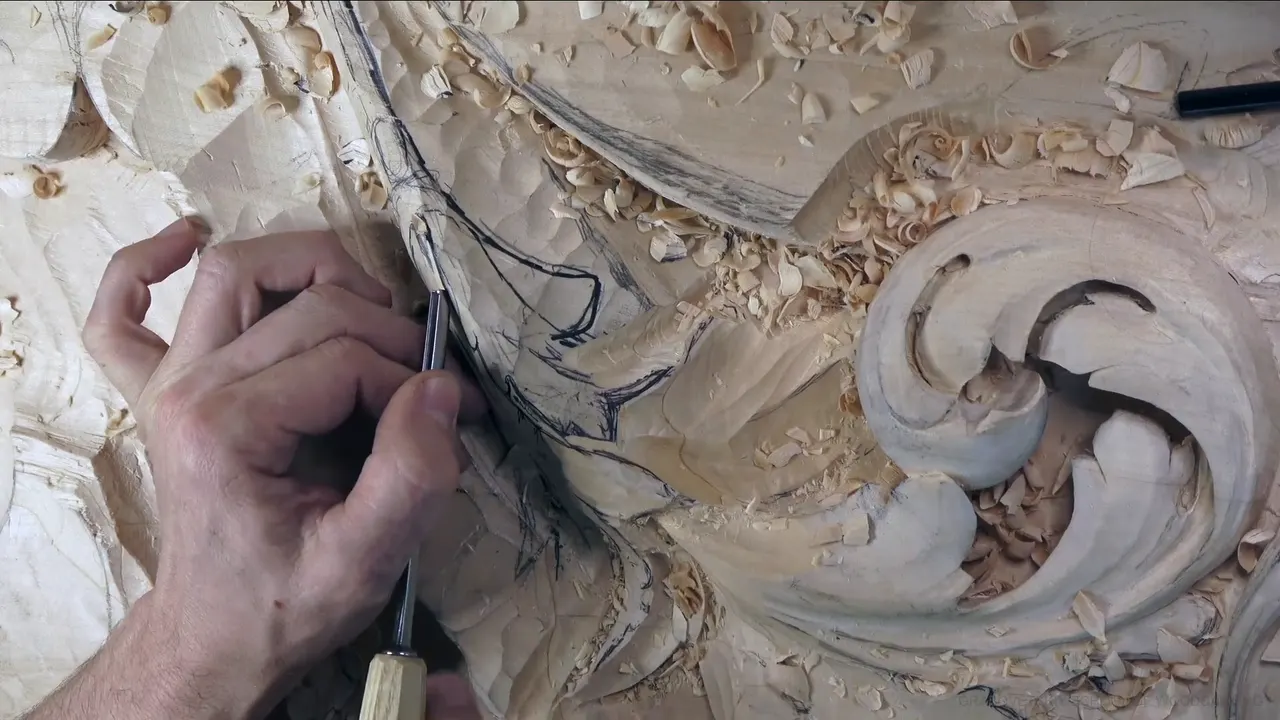

In Venice Room 41.6 I said, "I could actually create the effect that this goes a little bit above." The next line was "I don't have to, but I could." Other lessons carry the same words before a deeper undercut, a bigger gouge, a twist, or a shop step with no wood in it.
Have you ever stood at a carving with three ideas and one tool in your hand? Does a good shape ever go bad when you push it one pass too far? Part 6 of workshop 41 stops on an open choice. Below is the part, and then the other lessons where those words turned up.
What was I carving when I said it?
The line comes at the very end. The part opens with a warning to myself: "I don't want to create too much movement this way." That would "distract from overall movement."
One part had to go "underneath of this part." A much deeper excavation at one of the points might come, for extra shadow, and "I probably will," I said. First, though, "just to go underneath," and it would not be as deep. My tool was a gouge, a number 11 at four millimeters (5/32 in).

I love that element, I said, because in the future, below the corbels, there would be columns with about the same movement, a little smaller. By the law of design you have to repeat, because an idea carved in one place and nowhere else is "not related to overall design."
Professional people would look at the work, architects and designers on the project, and "not too many people left on the planet Earth" really understand what is going on. Most people would not catch it. Just sometimes, I said, you get really knowledgeable people looking, and I think that is a good thing.
Then the wood. "I did not cut really deep." Next: "let me get this one also separated," and for the blend I could use the bigger number three. The blending would start somewhere near there, and I still wanted to keep "this ridge," since it was "part of this movement." This part is supposed to feel like it grows inside and then out.

How did the grain get into it?
Off would come whatever ridges I did not need, to give some better roundness. Then: "sometimes, it happens just because the direction of the grain." If you carve upside down and the tool is "grabbing and destroying the design," I said, "just turn like this and shave it like that." "Because of the grain, okay, so that's why."
Hashemi 14 has a cousin of it. With a big number nine, 20 millimeters (about 0.79 in), "I could actually work against the grain right now," I said, and I added that I have to watch every move I make.
"I really love how this one looks," I said, but it should not be too thick. That would be another part. "Same thing." And a short verdict: "Okay, wonderful."

Where did "I could actually" come in?
Near the end. First, "Let me double check," and my plan was to outline the line right there. Then the option: "create the effect that this goes a little bit above." No need to do it, and yet I could. Last: "Let me think twice how I want to see it," and maybe a part of it would go "like this."
That is where the choice stays open.

What did the next parts do with the idea?
It starts in part 5. A "downhill cut" with the bigger number 11 started a really big concave, and the gouge was 18 millimeters, almost three-quarter of an inch (0.71 in). Light would come from the side and cast a nice shadow. As for the movement on the inside, "there is a couple of ways" to handle it, and the one I named was a little bigger concave in the middle. Afterward I wondered if I could place an eye a little farther out, and said it would be a little better if we place it "right here." Then I got careful: "I really don't want to mess up at this point."

I used the words in part 7: "Maybe I could actually get a little deeper underneath right here. Maybe yes, maybe no. Maybe I don't have to because I'm losing..." A round movement was what I wanted, and too much excavating would lose it. So I looked at another part: make a separation, "exactly the same idea," then the flipping motion, with a big number 11. Later in that part: "Well, actually, I could actually get another one." That part would go under the one beside it. Too wide was out, because "it's not going to look nice," and some of it would be undercut later.

Another one sits in part 2 of that workshop. A spot had to get much lower, and then came a question: "But what else I could do? I could actually lower this side of shell and expose a little more." Whether to do it, I had to think, since I did not want to lose the overall feel. Then came "Maybe I shouldn't."
What happens when I leave the option for later?
Workshop 46, part 8, has it plainly: "Maybe I could actually give an extra movement going that direction and go underneath of that one." And then, "I'll figure this out little later." A bit further on I asked myself, "See why I'm not undercutting right away, all the way until I develop everything?" And the answer was "because I'm always going back to the same area," and only when I'm happy with everything do I start the finalization of the movements.

Lesson 16 of the Roman acanthus course did the same thing. A little bit of undercut underneath was open "if I wish," but I would finish first and decide afterward. An undercut would cast even more shadow from underneath. The light would travel on its side, and it would give "one more three-dimensional look."

Doubt shows up in workshop 38. Really close, I said, and "I could actually even connect if I wanted to. I'm not sure if I should or not." The part did not look right, I said, and it needed to go down even more. Number six, a straight tool, was not giving me the ability to work all the way how I wanted, and so: "I need to use a spoon."
Hashemi had a spot like it. Of a curl I said, "I really like how it looks." Next: "I could actually take it even more to extreme on this side. I'm not sure if I should or not." The words after that were "Let me also undercut from above," the same idea with just a small gouge, in lesson 46.

When did I take the option?
Quickly, in Floral and Molding 11. The same tool could make a line much sharper and cleaner, and "I could actually even undercut underneath with the half a millimeter," I said, and "maybe I should." And "Let me do that." Where I had placed my half a mil, I forgot. "But let me undercut it," I said, and later, "Going to create a little deeper shadow."

A volute in Lily Box 6 gave me a choice of direction. A turn either direction was possible. The slope came next: "I could actually take this and slope it this way, and maybe it's going to look better that way." After that came "Okay, let me do that."

Workshop 45, part 4, goes the other direction from workshop 46, with "I could actually undercut pretty much right away." Why? Changing that detail was off the table: "I really love it." The cleaning came next, right at two millimeters (5/64 in), and then an undercut that way.
The eye in workshop 43, part 12, was another: "I could actually create huge eye. Big eye." And "before I forget the idea what I have in mind," I planned to excavate underneath to it.

Did I ever name two ways for one spot?
Yes, in workshop 40, part 5. I did not want too big a shadow in one place, "because I don't need it right there." Way one: "a really nice concave on this side" and a slightly raised ridge. "It's one of the ways." Way two: "I could actually give a concave" and drop the spot down. That one would give more roundness, and "that's what I'm going to do, probably."
A number 11 at 12 millimeters (15/32 in) was my plan for an excavation in part 9 of workshop 45, because a barrel was supposed to go inward. Out came "I could actually go" a bit this way, and then "But on another hand, I need to figure out..." A few lines later: "let me clean little deeper here," and the movement itself has "different ways of doing it." For a petal in Lily Box 12, I said, if it stops with the convex, a concave on this side "would look nice, I think." And right there I could do the convex in the opposite direction.
Was there a time I said no?
There was, and it was quiet. Back in the Lily Box scroll saw lesson, I had stopped at a point: "I could actually go further, but I don't need to." I would just go back to my same loop. Part 7 of workshop 41 has a no too, because the round movement would be lost.
Another no, with a catch, comes from workshop 47. I was probably about as deep as I wanted, I thought, and then: "Or I could actually lower that down a little bit, but not much because I really want to see that side also." A touch deeper, maybe, since a three-dimensional flow also mattered.
A no without the words sits in part 5 of workshop 41: "That is deep enough, I think, because I can't go too deep, otherwise I'm going to lose overall movement again."
Did the words go with a bigger tool or an exaggerated shadow?
Both. Up in workshop 49, part 4, I had to establish my main form with, again, 15 millimeters (about 0.59 in). Bigger was possible: "I could get actually bigger than that." Even 18 millimeters would do, which I called a little less than three-quarter of an inch.
Hashemi uses them for shape. Number five at half an inch (12.7 mm) would carefully establish my main movement in lesson 13, and then I could make it even more three-dimensional. In lesson 11 I could exaggerate a side, deeper and also going on inside, and for that I would probably use a smaller gouge, 3/32 of an inch (about 2.4 mm).
Furniture Panel 22 gave me an imperfection I could see. The fix I named was to exaggerate that shadow, "slightly move in," and I thought it would give me a much better result. A concave cut in Hashemi 40 could go even more to extreme, "but it's okay." Then: "Let's take the V tool again, and carefully undercut and clean it."

| Lesson | What I said I could do | What came next |
|---|---|---|
| Lesson 41.7 | Maybe a little deeper, maybe not, I wondered | Another flip |
| Roman Acanthus 16 | A small undercut, with the decision left for later | Finish first |
| Floral and Molding 11 | A half millimeter undercut, and maybe I should | My half a mil |
| Lily Box 6 | A slope across the surface of the curl | Slope it that way |
| Lesson 47, part 7 | Maybe lower this spot a little bit | Maybe just deeper |
| Lily Box scroll saw 1.2 | Further was possible, but no need for it | My same loop |
Does it work on a twist, a volute and a leaf?
Take a design lesson, Furniture Panel 12. "What I could do, I could actually make a really nice twist just like that and go underneath and go back to the flower." Then: "But I need to repeat that twist somewhere right here." Later came a verdict. "I don't like the movement of this. I like the end, but I don't like overall movement." My answer was to repeat the line, or be closer to it, and "do exactly the same twist."

The repeat from part 6 turns up there too. Hashemi 22 gave me a volute that "has to have a movement on inside." Going even deeper was open "if I wish," and the volute should end up higher than my highest point.
What about steps that are not carving at all?
The words also go to the bench. In Lily Box 5 I needed to recreate the original picture, and "I could actually draw." Or I could cut out a section of the paper. "It's just a piece of paper, and I can always reprint that."
A grape leaves vase lesson has a garage line. The piece could be carved right in place on the lathe, but "it's a little too hot in garage." Over in lesson 3 of that course I could apply the color a second way, and mixing it right inside of my cup was not needed. You just dip in a colorant.

How can you try this on your own bench?
Do you have two ideas for the same spot, a deeper undercut and a lighter one? Can you say out loud what you could do and what is not required, as I did in part 6? Then you have what I had. In workshop 41 the choice was mine, and the part stops with it open.
The workshop sits inside Advanced Carving: Venice Room, Part 4, and each lesson above has its own page. The Principles of Design course covers the laws in more words. To open the lessons yourself, you can start here.
How it's done
- Name the option out loud. At the end of part 6 I said what I could do there, then said it was not required.
- Weigh what the option would cost. In part 7 a deeper excavation underneath would lose the round movement I was after.
- Leave deep work for later. Workshop 46 held its undercut until I developed everything, and I said I would figure the extra movement out a little later.
- Take it when it suits the spot. A half millimeter undercut in the molding lesson became a plan.
- Look again before you commit. Part 6 ends on a second look and a thought to think twice about the line.
Frequently asked questions
What choice does part 6 leave open?
The end of part 6 holds a line I planned to outline. I named an effect I could create there and said I did not have to. My last words were that I would think twice about how I wanted to see it.
Does the option get taken?
No. The molding lesson in the panel course started as an undercut idea and became a plan to do it. The scroll saw lesson ended with a decision to skip the extra and return to the same loop.
Why did I hold back on the undercut in workshop 46?
My own question was why I am not undercutting right away, before I develop everything. I answered that I'm "always going back" there until I'm happy with everything.
What to carve next