

Alexander Grabovetskiy, woodcarver, School of Woodcarving · Published 2020
What does a wood carver mean by "make the decision"?
Quick answer: "Make the decision" is my phrase for the point where a cut, a depth or a division can go two ways and I have to pick one. In Venice Room 44, part 8, I weighed adding more division against leaving it, then said what I would do.
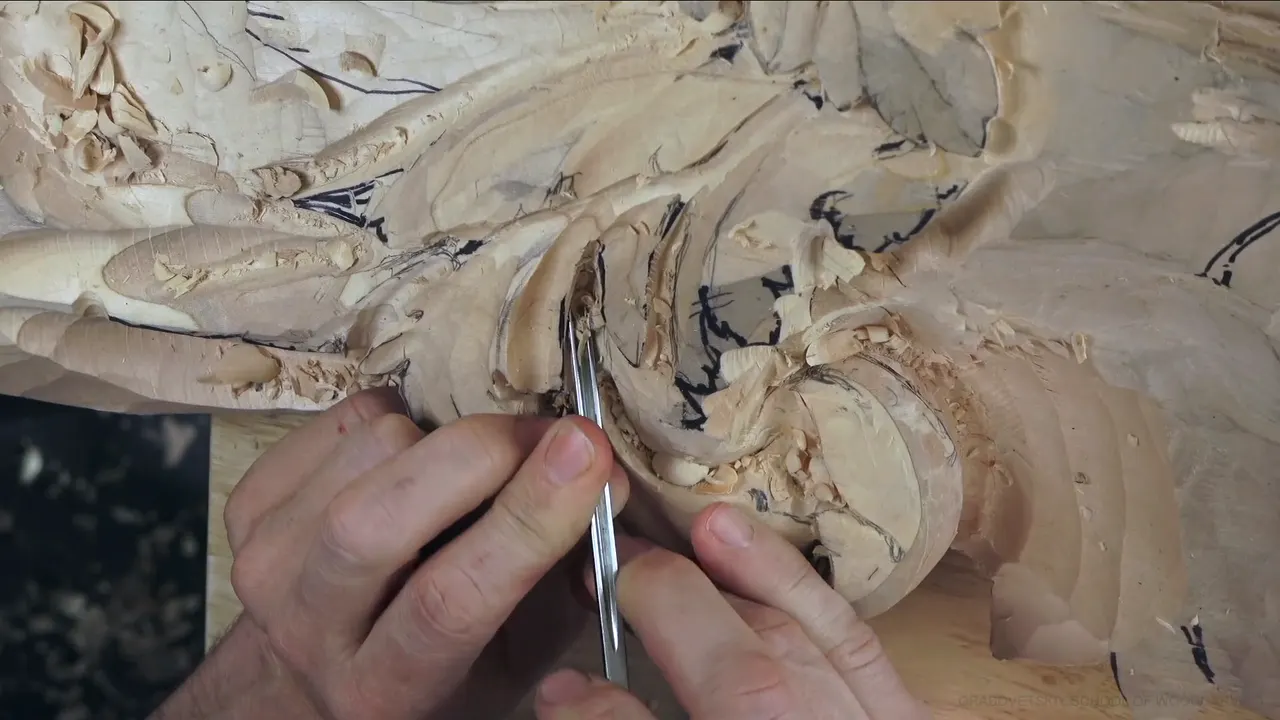

A decision, at my bench, is the point where a cut, a depth or a division can go two ways and I pick one. In Venice Room 44, part 8, that point came near the end. I was not too happy with how one spot looked. A little more division might be better, I said, or maybe I didn't have to, and could just get my division right here. "It's a moment for the decision," I said next.
Have you stood over the wood with a gouge in your hand and two good ways to go? Did both of them look right? One still has to win. Part 8 runs about seven minutes, so beside it I put the same word from my other wood carving lessons, and I name the lesson each time.
What did I choose in part 8 of workshop 44?

A pipe came first. One pass went all the way, right there, and I called it a really excellent pipe. I love it, I said. Then came the first small choice of the video, which was to blend it now, because I did not want to see any ridges. Pretty much just shaving, I said, and it was good.
A slip came next. I touched my beautiful concave with the edge of the tool. I can always clean it, I said, and it's better not to do that, but that is what it is.

Then another pipe. Logically this one was supposed to go one direction, and the movement had to continue that way, which means I need to excavate underneath and go below that movement. One question answered itself. The only tool I could fit was a number 11, used just on its side, and I undercut pretty much right away.

Size was the next question. A 4 mm number 11 (5/32 in) looked a little too big. I would need 3 mm (about 1/8 in) or even 2 mm (5/64 in), I said, and I planned to start with the 3, since maybe it would be enough. Less than half a minute later I said I think I need to switch to the 2 mm, to go even deeper and get an even more pronounced shadow.
How did one eye change the plan?

An eye sat right there, one I still had to bring out, and I said I could make it a little bigger. That bigger eye stayed an option in my words, and in this part I say nothing more about it.
Because there's an eye, I went on, I need a movement going a little downhill, because it has to feel like this part is growing from underneath. Right after it I hedged. It doesn't have to be, and it's not always the case. But in this case I thought it would give me a really nice movement, and that is a choice with its reason spoken in the same breath.

Between those lines about the eye, a mallet sat right by the tool in my hand.
Next I planned a number 11 of 7 mm (9/32 in), to see if I'd be able to get a little deeper in. There was a previous cut from the eye in that spot. That's okay, I said. Next I had to use something a little smaller, maybe about 5 mm (3/16 in), and get deeper, like that, I said.
One edge got a different kind of answer. Let me clean this edge a little, I said. Later I'll undercut it, but for now I need to make sure I'm looking at the right movement. Waiting was the choice there, with the reason said out loud.

Then even smaller again, the 2 mm, and that spot went even deeper. What I just did, I said, I created for myself an extra spot for the division. A division would go downhill from there, like that.
When does it become a moment for the decision?

Right after that extra spot. I was not too happy with how that spot looked, and I said so twice. Get a little more division, I said. I think it will be better, I added, or maybe I don't even have to, and could just get my division right here.
Then I named the moment. Okay, I said, that's what I'll do, and I said it once more with an "I think" in front. The last words I speak in part 8 are short: cut around this. Which road did I take? My words do not say which of the two it was, and I won't guess for you. Both roads had a name before I picked, though.

A pencil is in my hand in the frame from those seconds. Count the forks in that one video and you get six: whether to blend right away, which tool would fit, three millimeters or two, a downhill movement that did not have to be there, an undercut now or later, and more division or none. Each fork was a decision spoken out loud.
Do you decide before the cut, or while you carve?

Both, in my lessons. Digging underneath one part of the Lily Box, in lesson 4, I told you plainly to decide before a cut whether you really want to do that cut. A few seconds later I said it looks like I made the right decision, and I took a number 8 of one-eighth of an inch (3 mm) to dig underneath for a flipping effect.
Other choices only show up once the wood is in front of you. Lesson 11 of the same box is where I said it, while I worked out whether to bring one piece of the lily all the way down: I'm making decisions as I'm carving. On a piece of paper, sometimes it just doesn't make any logic, and when you carve it, you see you could give it a better shape.

My plan in lesson 10 was to move one line a little, and another one in from the edge, so I would have enough width there. That is sometimes the decision I have to make on the fly, I said. It's one thing when you draw it in a two-dimensional world, and another thing when you actually work in a three-dimensional world.
And some choices are yours before you start. In my Chamomile and Bow Rosette course I told you that you really don't have to repeat exactly what I do. You can be more creative if you wish. Just decide ahead of time what you would like to see.

Which choices come up again and again?
Above or under is the first pair. For the Venice Room 49 board I planned a really small number 11, 3 mm, one-eighth of an inch, pretty much. I could go bigger, and said I didn't need to. Then the choice itself. I could put this part above that one, or that one above this, but logically one was supposed to go underneath the other.

Concave or convex is another. This carving is pretty much all concaves and convexes, I said on the Furniture Panel, lesson 22, so the next pass has to be one or the other. Sometimes it can go both ways, and you have to decide which way will be better. My own lean, I added, is toward deeper, more exaggerated movements.

Which one sits higher comes up with grapes. With two of them on the grape onlay, lesson 3, I had to pick the higher one and the lower one. I don't want a fish scale effect, I said, so even a smaller grape needs full three dimensions.

How many parts is a choice too. For the border of my Plate with Butterflies, lesson 12, I could divide it in eight parts, or in seven, but I made a decision to divide it into six. I'm not going to overcomplicate stuff, I said, I'll just use the calipers. I think it's going to flow much better, I hope.
Size gets one too. The size of a volute in Venice Room 45 I called a really important decision, and I'd make it approximately 15 millimeters (about 0.6 in). How I got that number is how much material I have left to the bottom. I can't go too extreme, because I still have to keep some material.
Depth is the last of them here. Earlier in this same workshop, in part 2, I said I need to decide how deep I want to go, and I really don't want to go too deep.
Can the tool be part of the choice?
In part 8 the space picked it, since only a number 11 on its side would fit. The Venetian Flowers Rosette, lesson 3, left it up to you. I used number 11s for a clean undercut, and I said you could use V tools. Feel free to use whatever you feel is best, I said, and if you decide on a V tool, it is pretty much the same idea: you try to dig right underneath. I really don't have to use one. I'll use a number 11 of about half a millimeter (about 1/50 in), I said, and get exactly the same result.

My first tool choice in this country came long before that. When I came from Russia I had one gouge, which my teacher gave me, and one knife I made myself. Over here I had to decide what tools to buy, and honestly, it was a surprise to me, because here you can find anything. I tell that story in the tools selection lesson.
What if you can't decide yet?

Then I say that too. I said on the Lily Box in lesson 10 that I'm struggling with making a decision. Should I leave it, or should I keep digging? The area was really dense, really hard. Maybe I'll leave this section, I said, I don't know, and I planned to keep the connection for now, at least, and move on to the next one.
A first pass can buy time, too. On that same rosette I said I would decide first which petal goes under which. That choice I put off, with a preliminary first cut now and the choice a little later. One area of the grape onlay got the same treatment. I had to decide what to do with it, and probably I would just leave it for now.
How do you know you made the right call?
You look at the wood afterward. Back on the Lily Box, after that flip, I said I really liked how it looks, in my opinion really good, and then, again, that is just my opinion. And I said I was actually really happy, and that it was a really good decision I made.

Venice Room 40, part 6, opens on a verdict. Number 7, that's what I'm using, I said, and I think that was a really good decision, what I've done. It still needed cleaning and refining, which is okay. I'm working on a form first, I said.

A choice can also be one I talk myself out of. In lesson 9 of the Lily Box I said that normally, if the wood would allow me, I would go really deep. There it would have left a fragile area, so going too deep was not the wisest decision, and I kept working with a 1 mm number 11 (about 1/25 in).

And sometimes nobody can prove it. Someone asked me on the Furniture Panel, lesson 19, why I stopped one movement where I did. I'm not sure how to answer that, I said. It probably was just my decision, from how it looks overall, maybe not as logical, and I would have to look back at when I made it, and why. There was no certain rule behind it; I just thought it would look better.

Over on the grape onlay, lesson 8, I shifted a central line, and the bulge sat right in the middle. So I needed to drive an eye in one direction, I said, and then: what I just did, I made a decision, I made that twist. My bigger tool there was a number 11 again, 10 millimeters, three-eighths of an inch.
Where did these decisions happen?
Eight of the moments from this page, one per row, each with the words I gave it.
| Lesson | Choice | Words |
|---|---|---|
| Venice 44.8 | Add more division, or maybe not at all | Not quite happy with it |
| Venice 49.8 | Which part goes above and which part tucks underneath | The logic of it |
| Lily 4.7 | Whether I really wanted that cut under the flip | My own opinion |
| Lily 10.12 | Leave a dense, hard area alone, or keep digging there | Still struggling |
| Panel 22.1 | Whether the next pass makes a concave or a convex | Whichever way is better |
| Panel 19.1 | Where to stop one movement I was carving | It looked better |
| Grape onlay | Which one of two grapes sits higher than the other | No fish scale effect |
| Venetian rosette | Which petal should go under the other one | Left for a little later |
Some rows end in a verdict and some end in a wait, and both count.
Where should you start with your own?

Start with what I told you straight. Decide before a cut whether you really want that cut. When the next pass could go either way, pick the better way. The rest of this page is me at my own bench, talking while I work.
The workshop 44 page covers the whole lesson, and the Venice Room Part 4 course holds all twelve workshops of this acanthus relief. All my courses are one click away if you start here.
How it's done
- Follow the movement. In part 8 a second pipe logically had one direction, so its movement had to carry on below the part in its way.
- Let the space pick the tool. Only a number 11 laid on its side would fit there.
- Go smaller when a size looks big. The 4 mm looked a bit big for that spot, so I meant to begin with the 3, and soon said the 2 would take me deeper.
- Check the habit against the spot. A downhill movement beside the eye was optional, and here I expected it to give a really nice movement.
- Be sure of the movement first. One edge waited for its undercut, because I wanted to be sure of the right movement before it.
- Name the moment and pick. When one spot left me not quite happy, I weighed two ways to finish it, said it was the moment for it, and then said what I would do.
Frequently asked questions
What did one choice on the Lily Box cost in thickness?
All of it, as planned. The plan in lesson 11 was to bring one piece of the lily down to a point on the back and use 100% of the thickness of the wood, approximately three-quarter inch (19 mm) from one point to the other. I said it was fragile, and you could see it move, so I had to be really, really careful not to break it.
Is depth always the hard part of a choice?
Not on my Venice Room 49 board. In this case, I said, I don't worry about how deep I'm going; in some cases a deep pass is not what I want, but there it was okay. I planned a straightforward first pass around, and exactly the same on the opposite side.
Does a detail nobody will see still get a decision?
On my Venetian Flowers Rosette I said I could go even with a half millimeter number 11, and that it would give a really beautiful shadow, although nobody's going to see that. Maybe someone will, if they decide to look really closely. From above, I said, it looks awesome.
What to carve next