

Alexander Grabovetskiy, woodcarver, School of Woodcarving · Published 2020
How big should you carve the eye on an acanthus leaf?
Quick answer: The size of an acanthus eye is a choice I make on the board. In part 1 of Venice Room 44 one shape was a little confusing, so I said the eye should be bigger. The sizes I named for eyes on this page ran from 2 mm (about 5/64 in) to a quarter inch (about 6.4 mm).
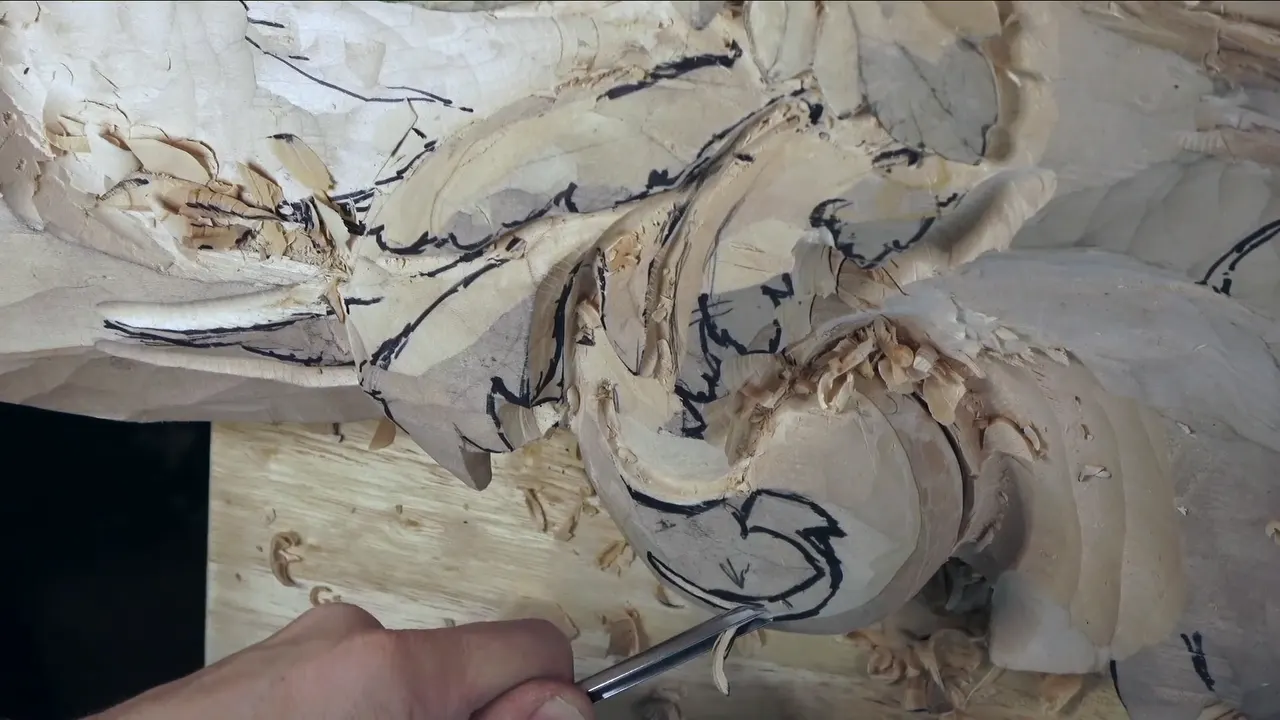

The size of an acanthus eye is something I settle on the board, with the shape in front of me. In part 1 of Venice Room 44 one spot was a little confusing to me, and my answer was a bigger eye. Across the acanthus leaf carving lessons on this page, the sizes I named for eyes went from 2 mm (about 5/64 in) up to a quarter inch (6.4 mm), and a 1 mm (about 1/25 in) tool went in for extra shadow.
Have you carved an eye on a leaf and then wondered if it should be bigger? Did the area around it look a little chunky, or did the curve look wrong? Those questions came up for me too, out loud, on my boards, and more than once my answer was a bigger eye. The part 1 video runs a bit over seven minutes. So beside it I put my other words on big eyes, from the relief boards of the Venice Room, my grape vase, a furniture panel and the Hashemi flowers, with each lesson named.
Big eyes in six lines
- One shape in part 1 left me confused between an eye and a movement, so I picked a bigger eye.
- Venetian acanthus gets big, deep eyes from me, like the originals I studied.
- On a too chunky area in workshop 65, the tool I named for bigger eyes was a narrow number 11.
- Some spots get a small eye, like one that goes underneath, or the second eye of a pair.
- Material stayed in reserve on my workshop 55 board.
- After the big eyes in workshops 53 and 55, the next step I named was the blend.
What made me want a bigger eye in part 1?
One shape got a little confusing. The video opens with an order to myself, go much deeper underneath of this one part, and I reminded myself that it will be visible from the bottom, so it has to be clean and look good underneath too.

Then came a maybe, to outline all around also, maybe with the bigger number 11. Under a minute later I told you, now it gave me an idea where I'm at.

A question about one shape followed. Okay, let me think, came first. That shape would be an eye, or a part of this movement. I could do it, but that could be a part of this movement, so it was kind of a little confusing right now, what I've got.
Then the call came. But I think I should create a bigger eye, I told you, and right after it I repeated it.

How did the eye come along after that?
With a blend first. Let me blend it, I said, and I'm going to see much clearer. Going this way also was the next thing I needed.

Depth came next. I do not want to go too deep, I said, talking about how deep I cut. I don't know, maybe I do.
One line made sense a moment later. Oh, I know what that line was, I told you, and it was this part. Whether we'd do it, we'll see. But probably yes, because it has visually to be logical.

My next line was, let me recreate the eye, and right after it, that is looking good. A plan followed, I'm going to pop that eye right away. One part was headed underneath, and another one underneath of this way, so then it would make sense. Otherwise, it's not.

Maybe I should remove a little more in one area, I said. A number 7 could go there, but let me do the preliminary with a number 3, just a chop down in this direction. That spot would still show, I said, but it would be a more logical movement.

Near the six-minute mark I said, let me establish this eye. One point after that was an important detail, I said. A plan to lower down one side a little bit came after that, and right away I fixed my own words. Actually, not a little bit.

Why do I like big eyes on Venetian acanthus?
The old carvers made them big. Back in Venice Room workshop 13 I kind of liked the big eyes, I said, since it's what they did back then. Two eyes were coming in that spot, and my plan was to excavate a little deeper right away, as those eyes are really important. They give a really good shadow, one that will go around that detail.
The same feeling came in workshop 19. After I said, let me now create this eye, my words were, and yes, I really like big eyes. This project, at least that's what they did. Huge eyes.

The plainest reason came much later, in workshop 53. Let's do a 3/16 of an inch (4.76 mm) eye, I said there, and I called it 5 millimeters as well. Then I told you why I'm not afraid of those big eyes on this particular acanthus movement, the Venetian one. I studied the originals, and they made those big, really deep eyes, really big eyes, and by they I meant the people from Venice.
Which gouge makes a big eye?
A narrow one, on the grape vase. Lesson 3 of that course had a 3 mm (about 1/8 in) number 11 placed straight down for the first cut on the eyes. It could be 4 millimeters (5/32 in), 5 millimeters (0.2 in), I told you, if you really want to do a bigger eye, though 3 millimeters should be sufficient.

If you like, a 1 millimeter (0.04 in) number 11 can then exaggerate that cut inward, though we don't have to. I asked you to see how beautiful a shadow it creates.
My Hashemi flowers, lesson 16, got a number 8 of 3/16 of an inch (about 4.8 mm) for one eye. Let's make it big, I said. For those eyes I usually use 1/8 of an inch (3.2 mm), but here was a big claw, and I thought it would look good. So that would be a big eye, and then came, let me take a V tool again and connect this part.

Another video of workshop 53 brought up one more. I think I could do a much bigger eye in this section right here, I said, probably the same eye I did before, 5 millimeters (about 0.2 in) and a number 11. Five millimeters (about three sixteenths of an inch) and a number 11 came up in workshop 69 as well.
On the workshop 26 board I named the size in inches. Should I do big eyes? That was my question, and then, bigger eyes in this case would look really nice. Okay, quarter inch (6.35 mm).
When does a bigger eye fix a shape?
When an area looks too chunky, or a curve does not look good yet. One area of my workshop 65 board was just too chunky, just not what I would like to see, so I still wanted to get bigger eyes there. What I'm using is 2 millimeters (0.08 in), I said, and that is, of course, a number 11. You could use a number 9, by the way, and it would give exactly the same result.

A curvature problem was the trouble on the workshop 73 board. I really don't know if I should, I said, and then, I probably should do a much bigger eye, because this curvature, it does not look good yet. Yep, a bigger eye it would be. Let me use 3 millimeters (0.12 in), number 11, of course, came next, and then I could blend in with the same back bend.

Movement can be the reason too. On a part in workshop 35 where a long pipe would go, I could create a bigger eye to give more movement of this part, I said. Getting by without it, to make it more simple, was possible. But I think it's going to look really nice, and the tool was 3 millimeters (roughly an eighth of an inch), a number 11.
Is a small eye ever the right call?
On some spots it is. In workshop 21 I wanted an eye right there, one that should go underneath, and in this case, I said, I cannot put a big eye. It's going to be a smaller one, and that's the main development right here.

Short words did it in workshop 51. Two millimeters (5/64 of an inch), and then, don't need big eye. At two millimeters, number 11. A 1 millimeter tool (about 1/25 in) was my maybe for an even nicer shadow.
My furniture panel, lesson 21, had one that was not big. Right there is my eye of that movement, I said, not a big eye, but still an eye. An eye of acanthus.

Pairs can go big and small. For workshop 73 I told you an eye on the opposite side has to be a symmetry, and if you wish, there is such a thing as a dynamic symmetry. It's symmetrical but a little different. This is a big eye, and there's going to be a lot smaller eye.
The workshop 47 board had a pair too. I said maybe I can get actually a bigger eye there, and this one a little smaller. A straight number 11 was not going to fly there, because I had stuff in my way, so a spoon it would be, two millimeters (roughly 0.08 inch) in this case. Earlier in that workshop, although I could use a bigger eye, it's okay, I said, and went on with the 2 mm.
Can you change your mind about the size?
You can, as long as wood is left. My words in workshop 55 were, let me think how big eye I want to do. My guess was a big eye, almost a huge one. Let's see if it looks good or not, I said. If it's not, I still have material.

Out loud, in workshop 69, I changed it. Maybe it was a good idea to also add a little bigger eye for this section, and then logically an even bigger eye. Not bigger, I said right away, but about the same eye right there. Again, just the preliminary idea for those eyes.
Part 3 of workshop 44 had a size change of another kind. Something that was really tiny and small on the 2D drawing was bigger now, I said, and I could exaggerate this eye if I wanted to. A little bigger eye stayed an option in part 8, I could create one, and the part moved on.

An early video goes another way. In workshop 9 I chose a bigger eye again, right there, and then I told you that sometimes you could just drill a bit, if you wish. Just kind of on an angle on the inside, and it gives you a really good eye also.
What comes after a big eye?
A blend, in the workshops below. All right, so now the next step would be blend, I said in workshop 53, right after the big eyes. To blend it, just a skew would do.
The huge eye in workshop 55 was followed by the same thing. Just blend that in, and for the blend I meant to use just a scoop. The back bend was the one I named in workshop 73. And workshop 51 had the blend planned ahead of the smaller tool. Before I do that, I need to blend, I said, otherwise it won't look good.

Where did I make the eye bigger or smaller?
Six of the lessons on this page, one row each, with the size I named.
| Lesson | What the eye was for, in my words | Size I named |
|---|---|---|
| Venice 44.1 | A shape I could not read yet, so I called for a bigger eye | No eye size named in that part |
| Hashemi 16 | Big claw | 3/16 in (4.8 mm) on a number 8, over my usual 1/8 in (3.2 mm) for eyes |
| Venice 53 | Big, really deep eyes, the way the old carvers of Venice made them | 3/16 in, which I also called 5 mm |
| Grape vase 3 | First cut straight down | 3 mm, or 4 to 5 mm for a bigger eye (0.12 in, or 0.16 to 0.20 in) |
| Workshop 65 | Bigger eyes, since that area was too chunky | 2 mm on a number 11 (0.08 in) |
| Venice Room 51 | No big eye needed | A 2 mm number 11, and 1 mm as a maybe for more shadow (0.08 and 0.04 in) |
The sizes are the ones I said in those videos, with my figure first and the conversion after it.
Where can you start with your own big eye?

With the straight-down cut I showed on the grape vase. Place a 3 mm (roughly 1/8 inch) number 11 straight down to start an eye, and take 4 or 5 mm (about 0.16 or 0.2 inch) if you really want it bigger. If you don't know what the eye of acanthus is yet, I asked in workshop 19, please watch the course on acanthus.
The workshop 44 page covers the whole lesson, and the Venice Room Part 4 course holds all twelve workshops of this wood carving. Every course of mine is one click away if you start here.
How it's done
- Read the shape first. Part 1 had a shape that could be an eye or a part of the movement, and that is when I called for a bigger eye.
- Pick a narrow gouge. A 3 mm number 11 (0.12 inch) made the first cut on my grape vase eyes, straight down.
- Blend, then look again. My plan in part 1 was a blend, so I could see much clearer.
- Weigh the depth. Too deep was what I didn't want there, and then I said maybe I do.
- Keep a second eye smaller if the leaf asks. In my workshop 73 pair, one eye was big and the other was planned a lot smaller.
- Leave wood for a change. If it doesn't look good, there is still material, as I told you in workshop 55.
Frequently asked questions
Did the old carvers of Venice make big eyes?
Yes. I studied their originals, and their eyes were big and really deep, so on Venetian acanthus big eyes don't scare me. Back in workshop 13 I gave a shorter reason, that it's how they did it back then, and that I kind of like them.
Does a big eye need a big gouge?
Not on my workshop 65 board. I wanted bigger eyes there because one area looked too chunky to me, and I picked a number 11 of 2 mm, a little under a tenth of an inch. A number 9 would give exactly the same result, I said.
Could you drill the eye of an acanthus leaf?
You could. My workshop 9 board got that note from me, to just drill a bit, kind of on an angle on the inside, and it would give you a really good eye too. That came right after I picked a bigger eye for that spot.
What to carve next