

Alexander Grabovetskiy, woodcarver, School of Woodcarving · Published 2020
What does "not bad at all" mean when a wood carver says it?
Quick answer: Saying not bad is how I judge a stage of a carving that looks right for now and is not finished yet. In part 2 of Venice Room 44 I said it with one separation only somewhat done, and my next words were a plan. This time one piece would go below the other, the opposite of the leaf before.
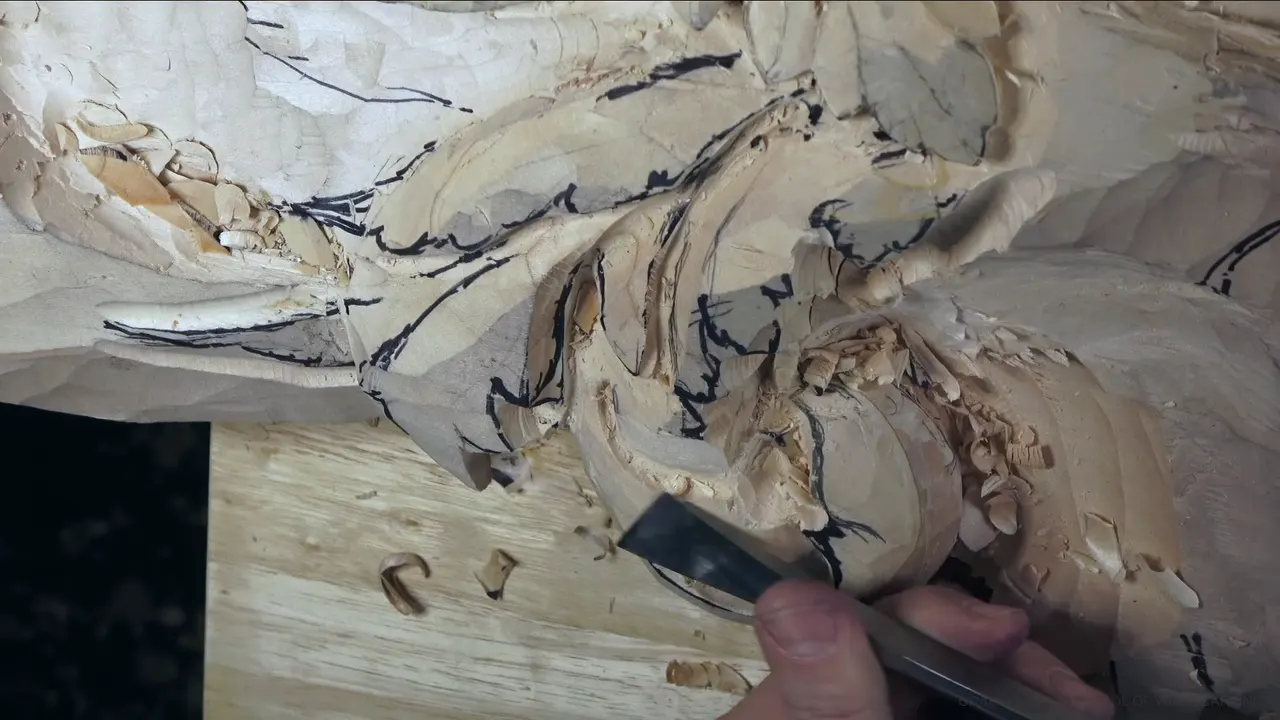

"Not bad at all," on my boards, means one stage of the carving looks right to me for now, with work still ahead of it. I said it in part 2 of Venice Room 44, over an acanthus leaf, once one separation was somewhat done. My very next word was "Now," and a new job.
Have you ever stepped back from a carving, liked it, and still known it was not done? Did a small word come out of you, something less than good? Mine is not bad. You can hear it in video after video of mine. So this page puts part 2 beside the other times I said it, in my other courses, with what I did or planned right after each one.
Six lines on not bad
- It came in part 2, after one separation got somewhat done.
- Right after it I planned to do it the other way round from the leaf before, one piece going below another, and named a number 11 for it, 3 mm (roughly 1/8 in).
- An except names the next job.
- The butterfly plate had it said of one step, and the next step was a different operation, a border.
- A sharpening pass earned the same words, though not as consistent as I would like to see.
- One unsure area was to wait.
What did I call not bad in part 2?
One acanthus leaf on my Venetian relief panel, and the work that led up to it. While I worked, I had to settle where the point would be. Like I said before, I could take it to about an inch and a quarter down, maybe about 30, 35 mm.

Which means this side had to move. It needed to be removed, and then something would show, but only the inner part. That's the letter S, I said, and that's what I had done right there.
Next I needed a bigger tool, a number 11 of 15 mm, 5/8 of an inch, and I said I'll go this way. Now it should make sense, I said, twice.

One piece I wanted to keep. Maybe a little deeper there, I said, for a little more shadow, and that is probably what I'd do, because I still had to make the movements on that one. This part would go below that part, below this line, and it would look the right way.

I wasn't too careful, and my tool hit the edge. Which is okay, because it was not the final cut yet anyway.
How deep to go was the next question. I really didn't want to go too deep. This ridge needed to come down, then go in, I said.

By then you should probably be able to see the movement already, I told you. The birth of the movement. One spot would be an eye, and one part would go underneath. I said I was happy with the overall development, and I wanted that separation done right away.
Somewhat done, I said, not completely done. Blend a little bit, I told myself, and make it clean. Then came the words this page is about.

What came right after it?
A small change from the leaf before, and I named the difference for this case. On the previous one, that small detail goes on top. The other piece goes underneath. In this case I'd do the opposite, with this one going below that one. So a little different.
The tool I named for it was a 3 mm (about 1/8 in) number 11, to cut that in as a preliminary. Just like that. I was going a little deeper, because I really wanted to develop it nicely.

Maybe a little farther, actually, I added, to make it really nice. Take this ridge out, I told myself. I could use a number 5 there, I said, or even a number 7. But that's okay. The part ends right there. So the not bad was a stop on the way, not the end of the leaf.

Does not bad mean the carving is finished?
Far from it, in my videos. On my butterfly plate the perimeter was in, and I said that's how it's supposed to look. Not bad for that step, I told you. That step was done, and the next one would be a different operation, the border I designed, which I said would be slightly more challenging.
On Carving Plate with Butterflies 5, the border would need a little deeper carving underneath my butterflies. Going right through was not my plan.

A Venice Room board in workshop 82 heard a longer version. I spoke of prolonged cuts in a few areas, gave my verdict, and said it's going to look really good once it's done, I know for a fact. Then I said I needed to take care of a transition, because I didn't like how it feels, the overall movement downhill, in 3D.
Same story on the board in workshop 37. After I told myself to knock down one side, the verdict came three times in a row. Yes, of course, later on I will have to clean it and make it to the perfection, I said, but as of now, it's really good. Now I can probably start on my shell.
A forecast came in workshop 36, said twice, about how a spot will look. At least that's going to give me ability to work on a shell right now, I said, and on all the rest of the movements.
My first cuts course for beginners puts it in plain words. The result drew the same verdict, and I said it was just a quick design. We could spend more time and do a lot more details, but even just like that, it looks nice.

What follows the word except?
The next job, named in the same sentence. On Venice Room 13 one spot got the verdict, then except right here, I can probably clean a little bit more. Let me clean this one, I said, it bugs me how it looks, and I need to use a bigger tool, and I could use actually number seven.
In workshop 23 the except was about the size of my tool. I didn't want to go too close with the big tool, so maybe the smaller one right now, I said, and get rid of this ridge. A little later, to excavate inside an eye, I said I'd use a number 8 of a 16th of an inch, one and a half millimeters, with a couple of rotations, but carefully going in.

Some excepts are about a separation. Workshop 11 had one that needed some fixing, kind of, otherwise it doesn't make sense, I said. A little later came now I like it a lot more.
In Venice Room workshop 95 I said I had exactly the same problem, and I took the word problem back almost at once. Not the problem, but it doesn't look as acanthus yet. Which means I need to bring this separation all the way to this point, I said, with small tools like a two millimeter (about 5/64 in) number 11, and then one millimeter (about 1/25 in) to remove some of the excess materials.

A furniture panel got an except too. In Carving Furniture Panel 34 I said that is not bad, except I'm going to lower down this leaf, with number 3 again, because right now it was too high. It was just the rough stage, and I wanted the flow to be really nice. I don't want to see any straight lines, I said.
On workshop 28 the words were not bad, but this side needs to be also kind of knocked down a little bit. In Venice Room 130 I hoped you could catch the concave look overall. The verdict came twice, and the words after it were which means. Now what I have to do is take care of this line, I said, and I planned a number 11, 5 millimeters (about 3/16 in).

Where I said not bad, and the job after it
Here are five of those moments side by side, each in a different lesson. The middle column is what I judged, and the last is the job I named next.
| Lesson | What I called not bad there | The job I named next |
|---|---|---|
| Workshop 13 | One spot that still wanted cleaning | A bigger tool, maybe a number 7 |
| Furniture panel 34 | A leaf still too high for that moment | Number 3 again, to bring it down a little more |
| Venice Room 95 | A spot that did not look like acanthus yet | Small tools, a number 11 of 2 mm (about 5/64 in), then 1 mm (0.04 in) |
| Room 130 | A concave look you could catch overall | That line, with a 5 mm number 11 (about 3/16 in) |
| Butterfly plate 5 | My perimeter step | A different operation, the border I designed |
My figure comes first in every row, with the conversion after it.

Is not bad a step below good?
It can sit right next to really good. In workshop 77 I called a spot wonderful, but I need a gradual movement, I said, and a ridge there I did not like. My verdict came with although in front of it. It looks really good, I said, but we can do better than that. After that, I said I need to take it with the number 7 all the way to the edge.
Venice Room 17 went the same way, with a not bad, huh, then one more. Let me use just the gouge and create that separation, I said, and maybe just clean a little bit with the gouge, which I really don't have to, because it looks already really good. You can watch it on Venice Room 17.

Light can make the call. I cast a shadow on Venice Room 43, and you could see it's actually a really nice movement, with the verdict right after. But right here, I could also give a little concave and go also toward the center, I said.
Sometimes I made it plainly my own view. That is not bad, I said on Venice Room 67, and I said it twice, the second time in my opinion. At workshop 45 all it was going to take was just clean up, and I said I love the overall development, how it develops, and gave it my verdict, in my opinion.
English has a name for saying a thing by denying its opposite. It is litotes, a kind of understatement, and the Wikipedia article notes that not bad can be said so it means either mediocre or excellent. The sentence after it, on my boards, tells you which.

Can a bevel be not bad?
In sharpening as well as in carving, it can. In my lesson on a fingernail gouge, the bevel got the verdict with a really in front of it, although it's not as consistent as I would like to see. So let's change the grit, I said, and move to the next one, a higher grit. That lesson is Sharpening Fingernail Gouge.
A tool can be judged inside the verdict, too. Over in workshop 38 I said let me clean that separation, then I think it's okay, and the verdict followed with an although. This is a little too big of a tool for those separations.

Can not bad mean leave it for now?
When the rest of the area still leaves me unsure. On workshop 83 it does look not bad, I said, then except this area is still not too happy, it just doesn't make too much sense. Maybe I just have to get rid of the whole section and keep this part, but I'm not sure yet. That's why I'm going to leave it for now.
On my Tray of Blessing I said not bad, and I still have plenty of the material right there. I could put a tendril there if I wanted to, coming from underneath and right on top of the leaf. But without micro tools it would be kind of hard for you, so that one was a maybe, and the other one was for sure. That lesson is The Tray of Blessing 7.

Doubt comes into it too. On Venice Room 102 I said maybe it's not bad. Maybe I just didn't finish it, that's why I kind of have doubts. I think it's going to be okay, I said, except this section needs to be somewhat nicer flowing.

Where should you start?
With practice. That type of carving can run for miles and miles of molding, I said in my first cuts course for beginners, and my knife piece there got the same verdict. My plan then was to go on the middle line, refine it, and get my leaves toward it. Please just practice that, I asked you, in Beginner in Woodcarving Workshop 2.
What still bugs you on your own piece? Which tool comes next? The workshop 44 page covers the whole lesson, and Venice Room Part 4 holds all twelve workshops of this wood carving. Every course of mine is one click away if you start here.
How it's done
- Settle the point first. I worked out in part 2 that I could take the point about an inch and a quarter down, maybe 30 or 35 mm.
- Take a bigger tool. 15 mm, 5/8 of an inch, on a number 11, was the bigger one I needed.
- Check the depth. Again I had to settle how deep to go, and I really didn't want it too deep.
- Get the separation somewhat done. Not completely, just somewhat, with a little blend and a clean as my next orders to myself.
- Judge it, then name the difference. Right after my not bad came the plan for this leaf, this time one piece under the other, opposite to the previous one.
- Start the next part as a preliminary. My choice was a 3 mm number 11, roughly 1/8 inch, and I went a little deeper so it would develop nicely.
Frequently asked questions
Did you say it anywhere else in workshop 44?
Yes, in part 7 and part 9. Part 7 had the verdict with a really in front, then a plan for a number 11, maybe half an inch (about 13 mm), to bring out the pipe a little more. In part 9 a shorter verdict came before a more pronounced eye, with a number 8 and a plug cut planned.
How do I find the one spot that is still off?
Rub your finger over the surface. On a furniture panel I said that sometimes you can't even catch it by the eye, but you can feel the high spots and low by finger. This side is really good, I said there, and this side is not bad, but I've got only one spot I'm not too happy with.
Can a small flower get the same verdict?
Mine did, on the lily box. I really don't like big facets on small flowers, I said, and a moment later came good, see, and the verdict. I still had more wall to remove, and I needed to follow the shape of this edge.
What to carve next