

Alexander Grabovetskiy, woodcarver, School of Woodcarving · Published 2020
What does a professional wood carver notice that most people miss?
Quick answer: What a professional carver sees is the small stuff most people miss, like a carved movement that looks good but isn't 100% true. In Venice Room 46.11 I fixed one with a matching gouge, and I said I didn't have to. It would still look good. Professional people would know, I said, the ones who really do understand movements and ornaments.
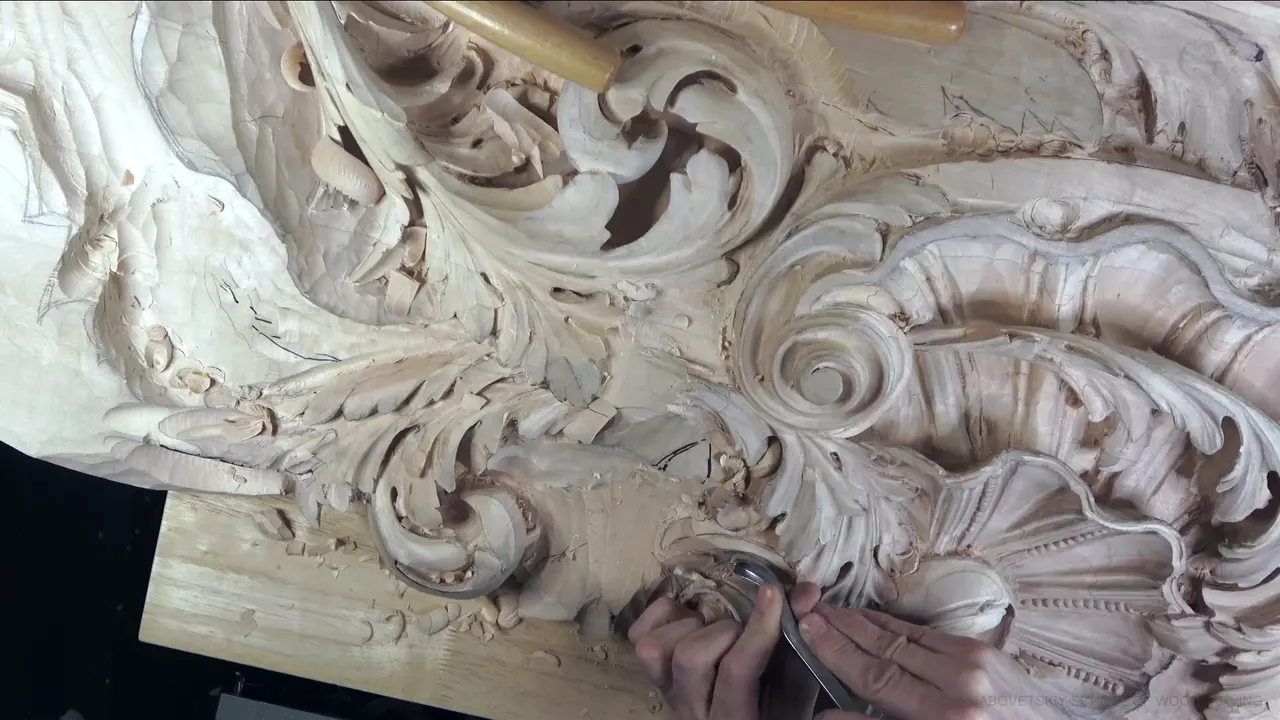

What a professional wood carver notices is the small stuff that slips past most people, like a carved movement that looks fine to everyone and still isn't 100% true. I had one of those in Venice Room 46.11. I fixed it anyway, for the people who really understand movements and ornaments, and I said so in the video.
Have you looked at an old carving and felt one curve was a little off, and you couldn't say why? Or felt the opposite, that every part of it just sat right? Those feelings have reasons, and this page puts my reasons side by side.
Part 11 is a short video, so lines from my other lessons sit next to it, and each one links to its own page.

What the people who understand ornament see
- A curve that pleases everyone and is still off a little.
- A smooth transition.
- Whether an idea carved in one place comes back somewhere else, the way the law of design says it has to.
- Which type of acanthus is on the board.
- Tiny eyes on a leaf, if they know its anatomy.
- How your tools lie on the bench.
What did I fix in part 11 that nobody would know about?
One movement. I was still not too happy about it, I said. Not 100%. Happy, yes, but not 100%, and I wanted to make sure it looked good. "Let me try to find a matching gouge," I said, and then that I could probably do something like that. Right after it, I said now I know it's a really true and nice movement like this.

And then this. By the way, I didn't have to do that. It would still look good, and nobody would even know. "But professional people will know it."
Who did I mean? There's a lot of people who call themselves professional, I said. The ones I meant really do understand the movements, and the ornaments.
Next I said now it is good, I think. It is good. A mess was still inside, and I told you not to worry about it, because I'd clean it. All I worried about was the development of that one movement, and only that.

Who are the professional people I mean?
The ones who know ornament well enough to see what others don't. In workshop 41 of this same course one movement would be about the same as another, a little smaller, with about the same idea, because by the law of design you have to repeat. If you've got an idea in one part, you repeat it somewhere else, or it's not related to the overall design.
Most people won't catch it, I said. But in my case, some professional people would be looking at it, and I wasn't talking only about the members of the school. I meant architects and designers involved in the project. Sometimes really knowledgeable people look at a piece. Not always, just sometimes, and I think it's a good thing. There aren't too many people left on the planet Earth who really understand what is going on.

Back in the first course of the room, workshop 12, I said a lot of people don't even know what an acanthus leaf is. Even professional furniture makers, a lot of them, have no idea there are so many different types of acanthus. You can probably combine a lot of different types and be okay, because most people don't get it anyway. But sometimes you come across smart people who understand the difference. Then you can get in trouble.
The bench gives it away too. In a livestream I said that from a picture of a carving bench I can tell if a carver is a professional or just calling himself professional, only by the position of the tools. If they lie in a mess, number one, he's probably tired and it's time for a break, and that happens with professional people also. Take one every 20 minutes, I said, because your brain gets tired and you start placing your tools really messy. If you are professional, you walk away and reorganize.
In the tools course I said it plainly. Not everyone who calls themselves professional does this, but the most professional people put the tools toward ourselves, with space between them for the hand. You read the sweep quickly, you save time, and when you grab one, the blade points away from you.

What else in part 11 would a trained eye catch?
A line I wanted to keep almost invisible, gradual and nice, and raised up. "It is subtle," I said. "It's not really a heavy effect."
Before it, I said I need to create the concave first. I need to establish the boundary of this concave on one side, because it's really important not to mess up there. Then I said carefully, I'm going to start my concave. And I guess it does not have to be that extreme. Really doesn't have to be.

That tool, I told you, was a number 11, a spoon, about half an inch (about 13 mm).
So it has to be a gradual movement, like I said from the beginning, and I have to use multiple tools to create that.

Like I said before, any gouge or any veiner, one side is always cleaner. In this case one side would come out much cleaner. Then I'd have to rotate the other way and go the opposite direction to the edge. For the moment, though, I said I'd go like that.
The grain changed, so I need to go the opposite direction, I said, and attack closer to one side. Right in one spot, though, I said I still have to do it that way.

Eyes and pipes were still to come on that leaf. My work right then was the main idea, its main development and main form.
That is probably what I want to see, I said. I'd got really close to this edge, and that's raised up. Even if you don't see it, it is. Then I apologized in case you just saw my head, and said sometimes I have to stick my head in.

With the number 11 I have to continue this concave all the way, I said, and it was also a number 11 before, but now I have to use a smaller one. The part ends on one spot: a little bigger right here, that's a little too small.

Which small things look more professional to me?
Smooth transitions, for a start. I don't want to see any sharp transitions, I said on the second layer of my lily box. I want a smooth transition everywhere I can give one. Even where it won't be visible. You can't see it with the naked eye, and people probably won't know it. But I'll know this actually looks more professional.
Later in that part, after a really deep excavation, I said I could just leave it like that, and people wouldn't even know. But I think it's a lot more professional to do it that way and remove all that junk.

That same layer has one tiny eye I called my micro eye. It's almost impossible to detect, I said. But people who know the anatomy of an acanthus leaf will know it's a professional approach, to create even those small, tiny eyes.
One warning came on the first layer. Place a tool true, 90 degrees down, and you make a cut right in the background. Then you undercut underneath, but that cut is still going to remain right there, and it's not going to look too nice, I said. Well, I should say, not too professional. So give the tool some angle when you do that, inward of the design.

Which habits are not the mark of a professional?
Rushing, for one. Venice Room 56 is where I said I need to be a little more careful, not so aggressive. When I feel I'm rushing something and getting more aggressive with my cuts, I can break a tool, and I broke some before. So it is not the mark of a professional man.
The Corinthian acanthus brought it up too. It's easy to break your tools when you undercut, I said. I know some of the most professional carvers who would never break a tool in any other place, only when undercutting. So it's important not to rush it.
Hitting the tool with a bare hand is another one. Even professional carvers hit with the hand a lot, I said in Venice Room 34, and no, you shouldn't do that. In Europe they call what it does the carver's disease. You hit the nerves inside your palm, you damage them, and the hand can't open. There's a pad sold for it, but never just a bare hand, I said. Use a mallet.

What gets called unprofessional that I do anyway?
Take wiggling a gouge. Some wood carvers would say it's not professional, I told you while carving the lily flower, but that's not necessarily true. First, I use wiggling all the time. Second, it's a technique of the jewelry makers, who work with dense materials, with metals, where sometimes it's the only way to get the material out, and you can't say they are not professional. Wood carving is my 100% profession, my bread and butter, so nobody can tell me that, when I use it in my own profession.
Background punches got the same treatment. The flower rosette lesson has the story: in some European cultures, a punch on the background meant you were considered not a professional carver. That was the case. But I don't see why you wouldn't use something like that, because it gives you really good results.

Then the edge. At the sharpening class I said some tools show a little waviness on the outside of the bevel, and some professional woodworkers would say it doesn't look good, you're not professional. I'm in business of carving wood, I said. If my edge is a little wavy sometimes, I'm okay, as long as it's super sharp.
Even my pulling cut. Back in Venice Room 5 I'd make a cut, pull back, then cut again, so the grain wouldn't split the wrong way. I call it the pulling cut. It's the same as with a pencil when you draw something, which professional artists say you're not supposed to do. You're supposed to do one long line. Yes, it's true, I said, but not always possible.
Last, working one area until it's done, which some carvers do, even professional ones. I've done it too, and on some projects it's fine. But in most cases, I said while carving the grape onlay, it's better to block in, see how it looks, and make changes while it's still just a preliminary look.

How are professional tools different?
They're not always marked with the size. The tools I use are professional, I said in workshop 57, and professional tools are not always marked exactly the size. The maker of that number five, about 10 mm (about 3/8 in), marks pretty much only the sweep. I like that, because I'm not always looking for a specific size. I grab visually, since I can see which tool will fit better.
In another livestream I talked about a number six with only a little mark on its side. For professional people, I said, you really don't need to know how wide that tool is. I just look at it. I know it's about one inch, pretty much about 25 millimeters. That's all I need.
You'll want more of them, though. Why spend a lot of money if you don't do it professionally, I asked in the micro tools lesson. There was a time I carved with only one knife and one gouge, and for a hobby you really don't need a lot of tools. But for professional level work you can't get that with one tool, especially when you go underneath and excavate inside. With one tool you won't get all the way into those cavities.
Even the words have a professional side. Outlining a relief is called setting in, in the professional wood carving world. That was on the lily box, and on the acanthus over moldings I called it the woodcarver's term. On the Roman acanthus, sweep was the professional term, for how curved a gouge is. Pretty much only a number one is a chisel, I said.

What I said each time, lesson by lesson
Each one is in this table, with the lesson and what I was doing.
| Where | My words | What was on the bench |
|---|---|---|
| Venice 46.11 | But professional people will know it | One movement that looked good to everyone, and a matching gouge for it |
| Workshop 41 of this course | Some professional people looking at it | A repeat most people won't catch, on a project with designers involved |
| Lily box, second layer | A lot more professional | Junk cleared from a really deep spot that people wouldn't even know about |
| Its first layer | Not going to look too professional | A tool set true, at 90 degrees, leaving its mark in the background |
| Room 56 | Not mark of professional man | Rushing and aggression, when a tool can break |
| The lily flower | Some would say it's not professional | Wiggling, which I use all the time |
| Tools course | The most professional people | Tools on the bench pointing toward us, with space left between them for the hand |
Where can you watch part 11?
You'll find it in the Venice Room Part 4 course, inside workshop 46, as one of its twelve parts. Part 10 comes before it and part 12 after.
Is there one curve on your own board you're happy with, but not quite? On mine, a matching gouge was the answer. If you want to watch every pass, the tuition opens every workshop of the Venice Room.
How it's done
- Look again at a good movement. My words were happy, but not 100%, and I said them out loud.
- Try a gouge that matches it. Let me try to find a matching gouge, I said. Right after it, I called it a really true and nice movement.
- Leave the mess for later. I'd clean the inside later. All my worry went to how that one movement developed.
- Mark where the concave stops. First I needed the boundary of this concave on one side, so I wouldn't mess up there.
- Keep the line raised. Almost invisible, gradual and nice, and raised up. I got really close to the edge, and that part is raised.
- Turn when the grain turns. Once the grain changed, my need was the other direction, attacking closer to one side.
Frequently asked questions
Can anyone tell if a carved curve is slightly off?
Most people can't. A few can. On my Venice board I fixed one movement that already looked good, and I said the professionals would know. Workshop 41 is where I named who they were on that job, architects and designers, and said really knowledgeable people look at a piece sometimes, not always.
Is wiggling a gouge unprofessional?
Some carvers would say so, and I'd say that isn't necessarily true. Jewelry makers use the same technique in dense metals, and you can't call them unprofessional. Carving wood is my bread and butter, and wiggling is a technique I use in it.
Why do even good carvers break tools?
Rushing, in my case. When I feel myself getting more aggressive with my cuts, I can break one, and I have before. Some of the most professional carvers I know would never break one except while undercutting, so I said not to rush it there.
What to carve next