

Alexander Grabovetskiy, woodcarver, School of Woodcarving · Published 2020
What does "more important for me" mean when a wood carver says it?
Quick answer: In Venice Room 46.5 I said how gradual a slope goes counted for more than recreating my line, after I said I did not like how a side looked. A rasp on that edge was my next idea. Other lessons use the words for a clean side, a fragile ridge or an overall look.
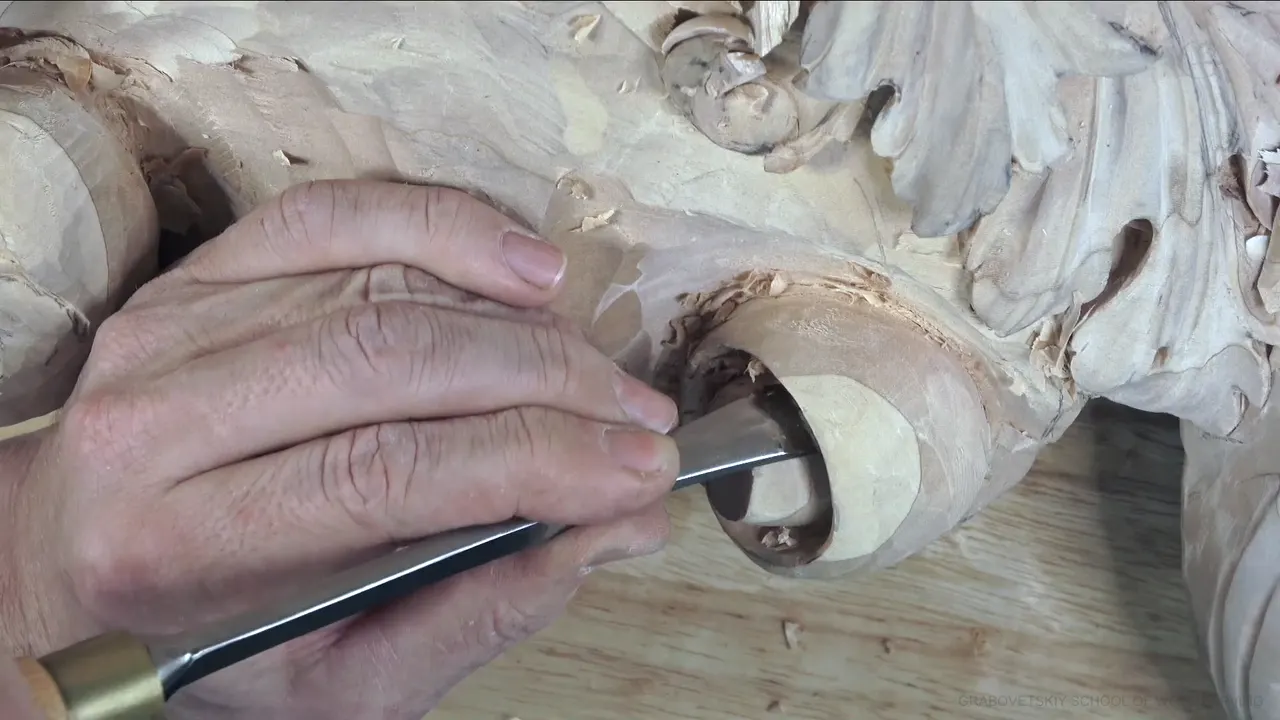

In Venice Room workshop 46, video five, I said, "But for me, it's a lot more important how gradual that goes." Other lessons of mine have the same words, and what follows the words is something different there.
Have you ever worked a wood carving piece and found a spot that looked fine from the front and wrong from the side? Did you fix everything at once? Or did you pick the one thing that had to be right? Watch what I picked in video five, then in the lessons where I said it again.
What did I say in video five?
The part opens with "Get a little more in," and a little later I said, "I need to get two millimeters" (5/64 in). "I could go as deep as I wish," I said, even with "a one millimeter" (0.04 in) tool, and "make it completely go all the way right there." That "would look also really nice, actually." But a tiny movement left alone, I said, would be "too weak."
"Okay, I think that's good. That is good. And I'm going to leave it like that. No more than this." Inside, it "looks really nice and clean," I said, and I could "work my details on the outside."

My plan for the outside was a small ridge, "about maybe about one-eighth of an inch." It would run "from 5 millimeters, 3/16 of an inch right there," and "go to one-eighth of an inch around," which I called about 3 millimeters (0.12 in). I told you, "I'm just eyeballing it." That ridge, I said, is one I am not going to touch.
A side bothered me. "I don't like how it looks," I said. Another spot turned up, "one more thing I don't like," and it "is not too gradual."

"And yes, I will need to recreate my line. But for me, it's a lot more important how gradual that goes." The slope came before the line. One idea was "maybe it's not bad idea at all," a rasp "just on that edge."
"And I create really nice and gradual movement." Next, "that does look like it's gradual." I told you I was "looking from the side," and maybe "right away, pretty much knock down" to "the one-eighth," about 3 mm.

"Now let me recreate the line," I said. Maybe a "really small gouge upside down" would "clean those marks I just created." That spot was "kind of hard right here," and I could fix it a little later, "so I don't want to overdo it again."
The hollow came after that, and I planned "approximately half an inch, about maybe 12 millimeters" (0.47 in), a "deep concave." "I am just eyeballing it," I said, and it would go on "this side same way."
Which side matters more when a gouge cuts clean on one side?
Workshop 58, video 1, had me leaning toward the right-hand side. A gouge, I said, "is always cutting on one side clean and another side is tearing out the grain." That day "it's the right-hand side that's clean," so I would "concentrate right now on the right-hand side a lot more than on the left." I also said I had to change position and "attack a little bit from this side."

My stroke there was not straight. "I'm actually creating almost 45-degree right now. That way, it slices much better and creates beautiful and clean cut without too much force." In video 6 of that workshop the side people see came first. "This side is more important because it's going to be visible more than that side."
"All I need is just to create that roundy feel," I said. "So that's why I am trying to get as clean as possible on this side, and I don't really worry about the other too much." "Got to be careful right here." One spot closer to a detail, I said, could wait. "Right now, I don't have to worry about too much."
Over in workshop 60, video 4, I said it "looks like I'm doing wrong. I'm doing from wrong side." Well, I added, it all depends what you mean by wrong. One side was clean then, and the other was not. My tool was a sweep number eight. Six millimeters, "one-quarter of an inch." The left side came ahead, "so I should do it a little cleaner."

Acanthus over Moldings, lesson 2, video 2, has the same fork. The left hand side "cuts really clean. And another side is kind of rough." I wanted that left hand side "lot cleaner than right hand side." Attacking from both directions was an option for me. One side cuts "with the grain."
A ridge got hit in workshop 69. "Yes, I hit little bit that side, but it's okay. For me, it's more important to get a cleaner convex side." Inside I would use "number 11, seven millimeters" (0.28 in), "just barely hitting the tops like this." Next, I said, "Maybe I should just get little more detail done."
What do I protect first, a fragile ridge or a dome?
Workshop 51, video 5, protected the ridge. My tool was a number nine, "quarter inch," and I wanted to "go deep. That way, you'll see a lot more shadow." Getting "really close to this wall" did not scare me, "because it has to wrap anyway on inside." The ridge was different. "It's more important to keep away from this ridge because it's fragile." "I can actually start from much farther." Then, "Let me see if it's enough with this number nine." A smaller number nine was possible, I said, "but this needs to be undercut anyway."

In lesson 32 of the Furniture Panel, video 3, I did not want to "lose a leaf itself completely," but it is "not supposed to scream." I said I needed to "lower down this lift a little more and get rid of whatever the high spots I still have on this flower." The dome "is more important than anything else," I said. My next plan was "a small ring around those domes."
My Hashemi flowers course, lesson 11, video 6, had a gouge "just a 16th of an inch" (1.6 mm) in my hand. "I have to be really careful not to pry too much." My aim was "that feel of the eye," and "that direction is actually more important." A drill bit "would be much quicker," I said.

Roman acanthus lesson 16, video 5, was about buffing. A blue paste, I said, is "still diamond, but it's more finer." My main idea was to "buff a little more on inside." The inside counted for more in my case. I said to clean it, since I did not want the mess on my wood.
Lily Box workshop 13, video 2, shows two faces. "That is the backside, by the way, that I'm working on right now. Here is the front." The front mattered more, of course. After that I said I would take a number seven, 14 millimeters (0.55 in), and told you "make sure you are slicing." Your tool "absolutely must be sharp."
Why does the overall look come before one detail?
Venice Room workshop 3 says it. "Now this spot I'm going to use for attaching my flower." Details could wait, I said. "It would be also a mistake because we are working in three dimensions." Small parts "are going to move around," so they sit somewhere else. Establishing overall movement came first. "Maybe just indication."

The Grape Onlay course, lesson 4, has it too. I would leave the grapes alone for now, and I said I had done grapes in one of the in-person classes "a few years ago." "As I told you multiple times," I said, I really don't worry "at this point," and "I'm looking for overall shape." Then came the tendrils. "See how complex those tendrils are."
Some lines in workshop 53, video 1, sat in a position I kind of did not like, and I was probably going to clean the whole section. "I'm not afraid of losing original lines and all." The overall look, "overall development," came first. Especially, I said, it would be "seen from the bottom."

Pencil marks were in view in workshop 72, video 8. "Don't pay attention to those pencil marks. I'll get rid of them, okay? It's not a big deal for me at all." What counted for a lot more was the whole piece, and I think it looks good. "It looks a lot nicer" in real life.
Workshop 32 has a line I might redo. "I still probably have to recreate my concave, which is absolutely okay." Then, "to create beautiful movement," came first, "as of now."
In workshop 20, video 8, I said that on the edge "you're going to have some multiple separations," and "it's going to give a really nice interesting feel to it." Then, "I'm not afraid of losing anything because I have a lot of material right here." Giving that "definition" mattered more, and I said to use a number five. "I don't want to dig inside of the background." "Too messy to my taste." What I needed was a "clean canvas."

In lesson 17 of that panel, video 1, I would outline with a smaller knife, I said ("let me see what's going on right here"), and "I'm not doing a really deep cut." Being fluid weighed more than depth, "to create a beautiful line, curvature, if you wish." Then, "I slipped away from the line again."
Lesson 22, video 2, follows a complaint about "a little hump." So no good, I said. No bueno. I would fix it "on inside," and that's "not a big deal at all." In another spot, "right here," it mattered more to me.
Does "more important" ever mean quality over speed?
Workshop 39 has "quick and dirty," the way I called "really quickest." "But it's not always the safest way." Some people "don't really care about if they break anything." Then, "all they care about how much work they've done in one day." The quick way, I said, was "not the best."

It doesn't mean I don't care how much work I've done, I added, "but between the quality and speed, I would still probably choose quality." Quality, I said, still came first.
Skill gets the same ranking in workshop 52, video 1. I was using "a lots of number 11 veiners," and you can do your work "without really, really expensive tools." I was relieving "those triangles." Skills, I said, matter more than tools: "what kind of skills you have."
Sharpening gets the word too, in my Maine class on tool sharpening. "When you buy sharp tools, they don't last." It's when they will go dull. "So sharpening, really important, and nowadays, even more important than design."
Nature gets it in the Lily Box, workshop 10, video 6. I had curled a piece around and said I needed to "chop a little bit off my original design." Being "more accurate to nature" came first.
How do I decide when two lines both want to win?
Video 3 of workshop 53 has "Let me think what I can do," because a chunk "does not make too much sense." I put it as a choice. "I need to make the decision what is going to be more important for me. To create that line going all the way to this point, or should I just switch and create the main middle line right here?"

"Let me preliminarily put it." I thought it would "look much better that way." "So I have to change a little bit the design," I said. The chunk on the left would be "part of one main acanthus movement," and "yes, I am changing my design."
The words and what came next
| Words | Next | Lesson |
|---|---|---|
| Keep away from this ridge because it's fragile | A number nine, quarter inch | Video 5 of workshop 51 |
| I am trying to get as clean as possible on this side | The other, not too much | Video 6 of workshop 58 |
| As I told you multiple times, I'm looking for overall shape | Grapes left alone for now, tendrils next | Grape Onlay, lesson 4 |
| Sharpening, really important, and nowadays, even more than design | When tools go dull | Maine sharpening class, 1-1 |
| So I need to make the decision | A switch to the main middle line | Workshop 53, third video |
| Maybe it's not bad idea at all, just use a rasp | Nice and gradual movement | Venice Room 46, video 5 |

Where does video five leave the ridge and the slope?
That ridge was about 3 millimeters (0.12 in). The slope came first. I also named a rasp for the edge, a small gouge for the marks and a deep concave.
The tuition opens every workshop in this room, slope included.
How it's done
- Find the spot you don't like. "I found one more thing I don't like," I said, and I named it.
- Say what comes first. How gradual it goes went ahead of my line.
- Check the slope. "That does look like it's gradual," I said after looking.
- Pick a tool for that edge. My idea was a rasp just on that edge. A really small gouge upside down was my thought for the marks.
- Leave the ridge. The small ridge, I said, is not for touching.
Frequently asked questions
Does the phrase mean the other thing stops mattering?
In 58.6 I said I don't really worry about the other side too much. In 72.8 I told you not to pay attention to the pencil marks. In 46.5 I said I would need to recreate my line, and right behind that came the slope.
What came first in video five, the line or the slope?
One spot was "not too gradual." My idea was a rasp. Attention went to the slope, and the ridge was not for touching.
Which side do I put first when one side cuts clean?
It changes with the spot. Workshop 58, video 1, had the right-hand side, because that side was clean. Workshop 60, video 4, had the left side, and so did Acanthus over Moldings 2-2.
What to carve next