

Alexander Grabovetskiy, woodcarver, School of Woodcarving · Published 2020
What does "I like it so far" mean when a wood carver says it?
Quick answer: "I like it so far" is what I said partway through a carving in 46.10, and "but I just thought maybe I should give a little more movement that direction" came right behind it. In other lessons a concave, a new tool or a check on the fit came next.
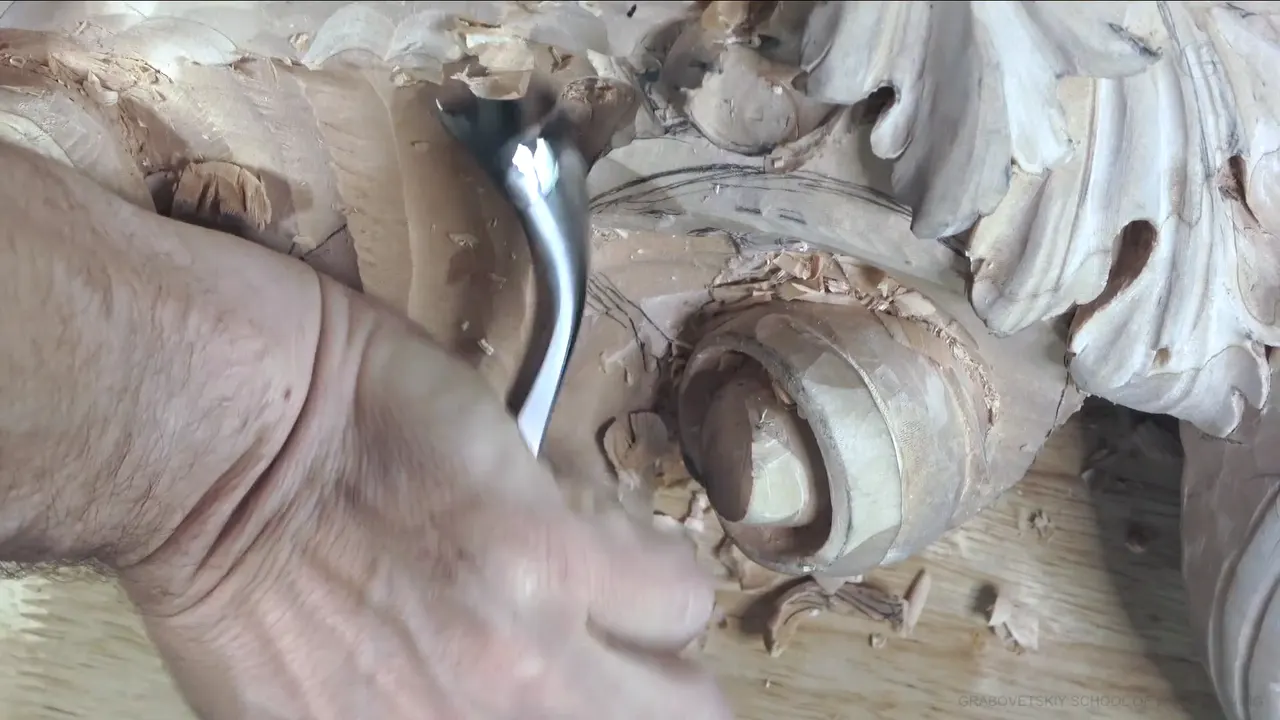

In Venice Room workshop 46, video ten, I said I liked it so far and added, "but I just thought maybe I should give a little more movement that direction." In my other courses those words come before a concave, another tool or a check on the fit. Other times "so far" leads into a complaint.
Have you ever stopped halfway through a wood carving project and liked what you saw, with one thing still missing? Did you keep going, or did you look again first? Watch what I do with that missing thing in video ten, then in the Lily Box, the Venice Room and my classes.
What did I say next in this video?
"Let's see," I said. Then, "Since I moved that line right there, so it has to go this way." It has to go "all the way like that." One more way followed, "And maybe this way," and I told you it was the middle point I meant.
Then, "But before I make my decision, double check." And then, "And it's going to be good because really, I really like the idea that it goes underneath of this detail." I think it looks good.
What did I do with the wood after that look?
Two ways were on the table. "But what I could do, I could develop actually much deeper cut right here and make a really nice movement." I said "Let me actually do it like that," and then, "Or the old way."

Further in came "See how nice that I did not take too much material out?" Another line followed, "So now I'm able to create whatever I want." I have so much material I can work with, I said, and right now I can take probably this out with no problem. "And with help of a mallet. That's what I need."
"Beautiful development," I said, and a line later, "Really beautiful development." You really don't have to agree with me, I told you. "I like it, personally."
How did the concave and the ridge come into it?
Cleaning came first. Now I can develop this side a little better, I said, and "the way I see it, I need to roll it this way a little bit" to that middle ridge. My reason was plain, "Otherwise, it just doesn't look as good." A line later, "Okay, now it looks better."

A word got corrected on the way. A division goes upward there, I said, and then, "Not division, but a section going upward." Right after, "It is division, actually." This one, I said, could be taken out "a little closer to the center line."
I said I want to see the convex and the concaves. My plan was to raise slightly one of the sides, the ridge, and to leave only about five millimeters (about 3/16 in). The concave would run the whole way and die somewhere on the inside.
Five was no rule. "Although it doesn't have to be five millimeters everywhere." Right here it will be only eighth of an inch (about 3 mm), I said, and that part would disappear underneath.

Before any of that, I said, I really need to make my preliminary cut and "clean up cut, I call it." Then the edge. "I do not want to lose that edge because it's a really nice and beautiful edge." With the concave, it is possible to lose it, and "do I want to lose it? Of course not."
Cleaning on that side could wait, "but I really need that ridge." Later on I'm going to undercut underneath, "But as of now, I just need that ridge." The part ends there.
What came after the words in my Lily Box lessons?
Video 11 of workshop 5 has a "But" behind the line. "But I also want to give a concave cut to this separation right here." Multiple separations were coming, I said, and a "really nice overlap" with them.

A tool came next, a 1.0 millimeter (0.04 in) number 11 that is "not the gouge. It's a veiner." The name "tells you the story" of that tool, and a number 11 is the most used on flowers and acanthus leaves on leafage.
The same line comes in workshop 6, video 6, after I said I would check from the sides. Then came a one millimeter number 11. The cut underneath had to be careful, "just because of those cracks." The half a millimeter (about 0.02 in) would follow, and "of course, it's a number 11, like always."

A mallet got a warning there. "And if I need the help of a mallet, I'll do it. But really, if you're going to use a mallet, be really careful how you're going to do it."
In workshop 12, video 8, I was fitting a piece to "see how it looks in overall." The same line followed. "I need to check how it's supposed to be positioned." The piece goes "kind of underneath of that one," and I would double-check a flip.

Something was in my way, a little spot, so I said I could take a knife or a gouge and "cut a little more in that spot and fit that better." Further on, "it fits pretty much perfectly." Two connection points came up too, one "down right here" and one below it.
In workshop 5, video 9, I put my liking next to a point about three-dimensional lines and curves. From above it's one thing. "But I also have to just look from the sides, from both sides," to see if my curve also flows really nicely.
What came after them in the Venice Room?
At the start of video 2 in workshop 111 comes the line, and "Let me get rid of some of the mess I created with the 20 millimeters number 11" (about 0.8 in) follows. Soon after, "Now it's easier for me to undercut." That shadow, I said, would be much easier to get much deeper.

"Let me blend it little better with the number three," I said, and I'd ride right on top of that movement "so you can see it's kind of rough." The number three could take care of that roughness. "That's enough." A part stayed untouched. "I kept that part which I don't want to touch."
Over in workshop 110, video 2, I worded it another way, "I like so far the development." Then, "So let me clean inside right here a little bit, and undercut underneath right here." The plan was a number 11 of 4 millimeters (about 5/32 in), a spoon veiner, laid right on the side.

The 2 millimeters (about 5/64 in) came up next, for "a little deeper excavation." And then a turn. "Well, actually, you know what I can do?" Then "1 millimeter pretty much right away," and a last line, "I think 1 millimeter will do."
Workshop 53 has it. In video 10 I said I liked it so far, and then "Let me outline first my preliminary outline." I would stay away "approximately maybe one-eighth of an inch, three millimeters away." In video 3 I said I kind of like it, and then "I need to deal now with that chunk." A little further on, "that is a good development." But "three divisions is not enough."

Sloping came next in workshop 63, video 1, after "I like the development so far." I'd probably use just a skew, a big one. It would be one inch (25 mm). Even if it doesn't look too good yet, I said, "it will be good." On to workshop 44, video 9, with "I love the movement so far," said after "That is all junk, so don't pay attention to it." After it came "I want to get this part below that part."
Praise and trouble sit together in workshop 62, video 2, where I said "So far, I'm happy" with the whole look. The convex had gone, I said, and "Not authentic. I got to have some convex." A backbend was my plan, even if the spine must go and come back. Later in that video came "I like the development so far," then "Let me use number six" to clear tool marks, "Preliminary, of course."
Does "so far" ever come with a complaint?
In Lily Box 9.2 I said "And so far, I don't like it." Ask me why, I said, and "I just don't know." It "feels something wrong with that." Next, "Let me think a little harder." If you look from above, I said, it would look much better with a separate movement, and I'd use a smaller number seven, or six millimeters (0.24 in), for the concave.

Video 10 of workshop 82 has "I'm not really happy how it looks so far. I'm not too happy yet." The movement could go downhill underneath, I said, and I was not sure I wanted that. Another way was to take one piece and roll it a little more. "Let me try it, and if I like it, I'll leave it like that."
Over in workshop 16, video 12 I wanted to "see that movement the right way," and "so far" came with "I'm not too happy." Next, "I can probably excavate underneath right now," and "maybe that is going to help me to see the way I wanted to see it." My plan was a 3 millimeter (0.12 in) number 11. The overall feel of this side was another thing I did not like, I said.

Both feelings sit in one stretch of talk in workshop 10, video 7. "But so far, I am happy, I would say. Well, happy, but I'm always finding something else." Further on, "once I look from the side, I see some unevenness," and I wanted just a knife. I also said I need one more pass on the inside corner, maybe with the 2 millimeters (0.08 in).
Does "so far" tell you about the wood too?
On the wood itself, in Lily Box 7.13, I said "I don't want to go too deep because so far, like I said, the material is really fragile." And overdoing it, I said, is "always possibility."

Next came "Let me use number seven," for an even better definition of the flip, and "And I am really happy so far." There were a couple of ways to develop that detail. One was to leave it and let the whole detail flip. The other was a twisting effect, with some of the material removed on the side.
The second way, I said, gives "a more three-dimensional flip," and "I think originally, actually, it's what I planned to do." I'd use number eight, carefully.
Another one is workshop 25, video 12, where I said "I think that is enough so far." Going too deep would be a problem for me, I said. Opening video 9 of workshop 35 are the words "It looks like so far it's okay," about seven millimeters (about 0.28 in), a little bigger than quarter inch.

"I really want to see big shadow," I said in that video. It's a big tool, and "I'm still going to be able to finish it with no problem." But "there is some stopping point when I can't go deeper than that."
Do I put it to other people as a question?
In my Grinling Gibbons class in Maine, class 1, video 3, I put it to the class as a question. "Makes sense so far or no?" It was easy enough, I said, so "nobody's lost just all around." The lower part would be untouchable yet. Two steps at a time, I said, and "really try to understand the logic."
My Byzantine acanthus course, lesson 7, video 2 has "Later on, we're going to take that middle line, and going to bring that all the way like this. Everything is going to blend again back, okay? So makes sense so far?" Then came "So I left it rough," and then "We're going to finish it nicely."

The line and what followed
| Words | Next | Lesson |
|---|---|---|
| And I can create a really nice overlap | A little undercut | Lily Box 5, video 11 |
| I need to check how it's supposed to be positioned | A flip | Lily Box 12, video 8 |
| Now it's easier for me to undercut | A deeper shadow | Venice Room 111, video 2 |
| So let me clean inside right here a little bit | Spoon veiner | Venice Room 110, video 2 |
| I'm going to stay away a little bit from this line | Three millimeters | Workshop 53, video 10 |
Where did video ten end up, in the end?
It ends on "that ridge." It began with a look and a "but."
If you want to watch every pass of that ridge and concave go in, the tuition opens every workshop in this room.
How it's done
- Say where you are. I tell you what I think of the carving at that moment, as I did in video ten.
- Name what is missing. After that I say what I would still change, more movement.
- Check the sides. I look from above and from both sides, to see if my curve also flows really nicely, as I said in Lily Box workshop 5.
- Say what comes next. Video ten gave a deeper cut and a mallet. A concave cut with a 1 mm number 11 was the next thing I named in the Lily Box.
- Keep the part you need. The ridge is what I need, and I called the edge really nice and beautiful.
Frequently asked questions
Does liking it so far mean I am done?
In 53.3 my next words were about a chunk I needed to deal with. In 46.10 I added a "but" about movement. The 5.11 video in the Lily Box put a "But" right behind it, about a concave cut to a separation.
What do I do when "so far" goes the other way?
I say that out loud too. The Lily Box video 9.2 has me saying I don't like it. Asked why, I said I just don't know, and then I said I'd think a little harder and use a different line.
Which tools came next?
A 1 mm number 11 in Lily Box 5.11, and in Venice Room 111-2 a number three. In 63.1 it was a skew of one inch, and in 62.2 a number six. In 46.10 the tool I named was a mallet.
What to carve next