

Alexander Grabovetskiy, woodcarver, School of Woodcarving · Published 2020
What tool did old wood carvers use?
Quick answer: In Venice Room 53, part 7, I named a number 11 at 30 millimeters (about 1.2 in) and said a lot of carvers back then used one big tool like that, a veiner. Other lessons of mine say what carvers had, did and used, from a V tool not all had to basswood.
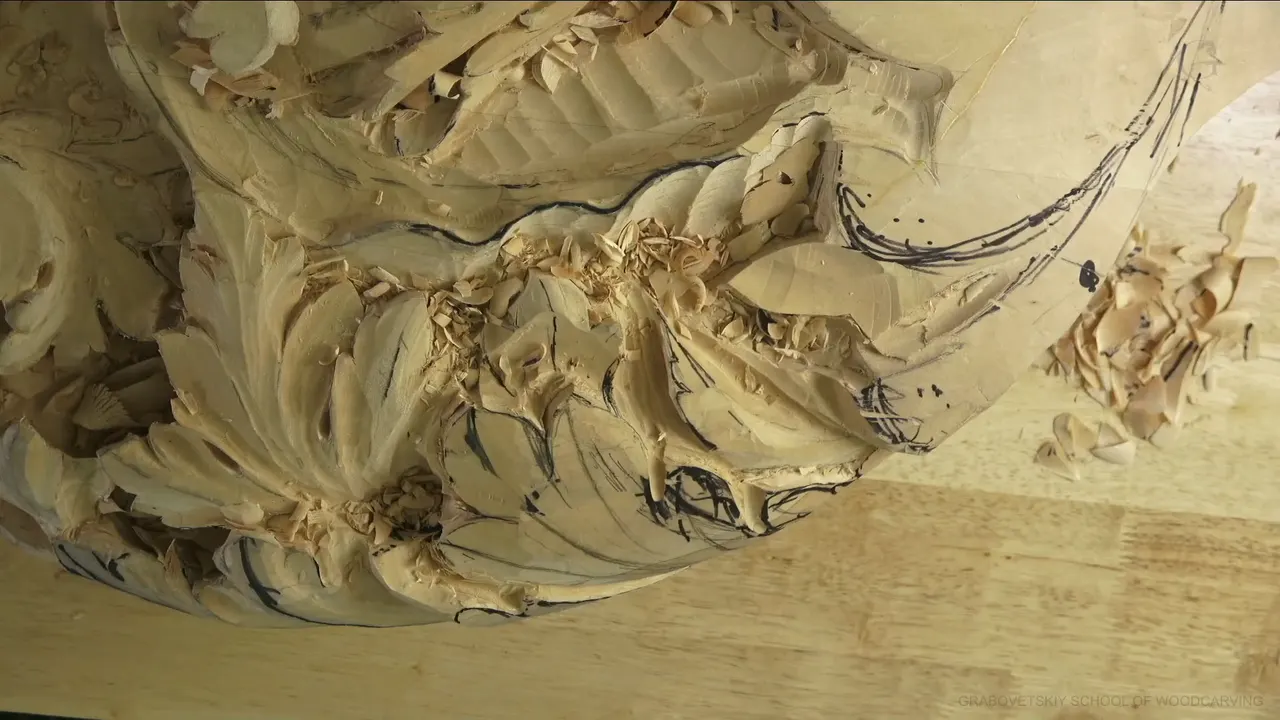

In part 7 of Venice Room 53 I said that a lot of carvers back then used one big tool, a veiner. In other lessons I say what carvers had, used and did, and below you can follow each line in wood carving.
Ever stood at a board with one big gouge and wondered how far a single tool can go? Did you think you had to own a whole rack first? Here is what I said in part 7, and the lessons where I talk about old carvers.
What does "in history" cover, at a glance?
- Part 7 names a veiner and a number 11.
- Some carvers had no V tool, I say in the furniture panel lessons.
- Basswood gets a note of its own.
- A router plane, lots of lines and a background punch each get their own words.
- Eyes in a Roman leaf, a Venetian leaf and the classical carvers of the 19, 18 and 17th century get theirs too.
What did I say right around those words in part 7?
This part opens with "Before I establish my pipes and eyes, I have to create." One area would be concave and run "right to the center line," I said. Right here, the same: a concave "this way."
Concave and concave, I said, "logically in the places of raised," the future raised pipes. But first I have to lower down the whole thing, "otherwise it's not going to look authentic." Almost from nothing, and both sides "right away, pretty much."
Next came the tool. "I'm using number 11. I don't have to use number 11 in this case. I could use number nine, but I have number 11 and 30 millimeters, huge, big ones." That is about 1 3/16 in. "And I can control and blend pretty much right away."

Right after it, the line about old carvers. "And a lot of wood carvers in history, that's what they used, just one single big tool like that, okay? A veiner."
"But you already should get the feel how it feels, and it feels really good already." I added, "I can actually get even deeper if I want to with this movement." Then "Like that." A plan for this side: "a little more extreme, I should say." I can "right away kind of blend that together."

How did I handle the middle?
That part is a convex, I said: "Middle part I'm talking about. That's supposed to be convex." The same tool could attack it, "just use as a number nine, pretty much. Number three, I'm sorry. A flatter tool. I'm just using one side of it."

After "Blend and blend," I said, "That way, I do have a clean surface to work." Then: "I've got the main idea. So it's a concave, convex, concave, but I also have to down roll this way." Later on, I said, some of it would be raised.
Then the middle line: "Let me recreate the middle line." Then, "Although it shifted." On the other hand, "I could actually shift," since the line would still hit that point. "That's okay, too." Then: "I could do that, I think. Although, no, it's not going to be good. Let me do that." And "Let me recreate my movements on inside."

Where did the eyes come in?
"And now I have to create my eyes, eyes of acanthus, and create some more divisions." "At least on this part." "A couple ways I could attack." This part could go underneath of that part, or "on another hand, this part could go underneath of this side." My plan: bring "the right-hand side leaf or division underneath of middle division."
Then: "Actually, you know what? Just because of that, I could create a little different movement like this." On the right, one part can "develop underneath, and that's still going to keep the form."

Next, the tool: "4 millimeters, in this case, number 11," about 0.16 in. I planned to lean "a little bit to the right" and "create my preliminary cut like this." And yes, I could give "a much deeper cut in this area. It's going to give me lightness." Then, "That's cut number one." The other side would get the same tool.
"And yes, I can go much deeper." The eye would be "almost 3/16 of an inch eye. Almost 5 millimeters." (3/16 in is about 4.8 mm, and 5 mm is about 0.2 in.)

Then: "But I could actually do 5 millimeters. I could do, and I probably should. Let's do it." And a plan: "let me excavate deeper."
Why am I not afraid of those big eyes? On this Venetian acanthus, "because I studied original what they did, and they created those big, really deep eyes, really big eyes." The people I meant: "Venice craftsmen, people from Venice."

It ends on the next step: "So now the next step would be blend." For the blend I could use a skew, I said, and "Same thing. Would give me the same idea." I also said I probably need a little deeper cut right here.

Did every old carver have a V tool?
Part 3 of Furniture Panel 19 has me saying I love the V tool, "one of my favorite tools." But, I said, "if we really want to be authentic to the original wood carvers" of the 18th century, not in all countries where they made furniture did they have V tools. "They did not have parting tools until later."
Even nowadays, I said, not every carver in the world knows a V tool exists. Among European carvers, "some of the wood carvers never use V tool." And "back in history, they had lots of veiners and gouges, but not all of them had a V tool."

Could a carver work to final depth without a router plane?
Part 10 of Furniture Panel 15 has me saying, "Let me use something different. Number five and a quarter inch," which is about 6.4 mm. The next words were "And get close to the final depth."
Then: "And yeah, without a router plane, it's still possible to do that," and many carvers have done it. It is the same operation, I said, that I'm doing right now with the flatter gouge. The router plane "just makes more sense," and "they had router planes in the 18th century." It was "one of the furniture maker's tools."
You can get "really, really close and get it really clean and nice," I said, and "you can make it really flat and beautiful with no problem." I added, "You just have to be a little more careful, I would say, when you're doing it with the gouges, because you can dig sometimes a little too deep."

Which wood did old carvers use?
Flower Rosette 1, part 3: I did not mention that I'm using just basswood for this project, I said. I found it's "one of the best woods for wood carving for a long time," I said, and it is "exactly the same wood, lime wood or basswood," that other carvers used in history.

What did carvers do with all those lines?
Lily Box 5, part 10, opens on a dislike, and the first words are "I'm not the biggest fan of putting lots of lines, lots of veins." There is a technique, I said, "and some carvers used that in history. They did a lot of lines like that everywhere, in the middle, in between."
"But I guess that's just opinion of taste, how it looks. And with those lines, you can also overdo. And they did it, actually. They overdone it in the history." I looked sometimes online on older carvings, and "it looks really nice. But still, if you look closer, you can see all the mistakes they've done also." Then: "Well, maybe I shouldn't say it's a mistake, just the approach they took." And "I kind of like it."

In Furniture Panel 4, part 2, I said that in this type of design, "we're still going to use lots of acanthus details, which was really, really common, like I said, in the whole history of wood carving."
Who carved what, back in history?
In Roman Acanthus 13, part 5, I said, "I know for a fact in history, there are different types of wood carvers." It used to be boat carvers, who "would carve for the big boats in the 18th, 17th, 19th century." Other carvers worked outside, "carving for the vehicles," and "there were inside carvers for the houses."
The inside carvers "would be divided also in two." Some were architectural wood carvers, who "would just concentrate more on architectural details." Others were ornamental. Ornamental wood carving, I said, "is actually the most difficult."
Part 3 of Roman Acanthus 1 turns to a volute with sticking out centers. "Although probably in history, there is thousands and thousands and thousands of wood carvers and stone carvers done it. Similar design." And: "the Romans and the Greeks and the Corinthians, they are the first ones who utilized that type of acanthus."

Then: "Probably more simplified forms of acanthus archaeologists found in Egypt also are semi-symmetrical, I would say. About the same idea what we're doing right now."
Which eyes did artists make?
Roman Acanthus 12, part 1, goes to eyes and pipes. I had made a promise: "I'm going to show you something different, what they've done throughout history." By "they" I meant "the artists and sculptors in history, and right now we're working on a Roman style."
"And they added some return on those eyes. So it's going to look like it's coming from inside out like this." The size I gave: "approximately maybe half an inch, about 12, maybe 13 millimeters," and "I'm eyeballing." Then "about maybe 10 millimeters right here." "Here's my eye," I said, and "I'll just do about three-eighths of an inch, 10 millimeters." The plan was to "do that almost on every pipe and almost on every eye."

Beside it, a line from Venice Room 94, part 5. "Again, what I'm doing, it does not apply to all of acanthus in history there is lots of different acanthus. This is just more like Italian Venetian style."

How far did classical carvers go?
I said in part 7 of Lily Box 12, "if you're doing it for money," or for a living, "sometimes you have to underdo." "Stopping point somewhere." And "that really applies to the classical carvers in the 19 and 18, 17th century."
"You can see some of them really didn't do completely fine, full work. They didn't undercut deeply, and they would stop without finishing." Then: "it's not because it was classical idea. It was just because they would get paid exactly the same amount if they would just go to extreme, or if they're going to stop somewhere. They knew they needed bread."
Part 4 of Flower Rosette 5 has me using just one knife to remove the background, "whatever I can reach." I'm not afraid if it's "kind of bumpy and wavy," because later we're going to use the background punch, "which used to be really, really common in the history of wood carving."

In Antique Style Rosette workshop 5, some of you had asked for the best books to read on its history. There are quite a few books about wood carving, I said, "but not a lot about the history." The best ones I found, "it's actually university books like from Yale, Oxford."
Where did I say it, side by side?
Here are the lessons, with the words I said beside each one.
| What old carvers did, as I put it | Where | In my words |
|---|---|---|
| One single big tool, a veiner, like that | Venice 53.7 | A lot of them used it, I said |
| Not every carver had a V tool | Panel 19.3 | Lots of veiners and gouges |
| Get close to final depth with a flatter gouge | Panel 15.10 | Possible with just the gouges |
| Basswood, which is also lime wood | Rosette 1.3 | Among the best, for a long time |
| A lot of lines everywhere, in the middle, in between | Lily 5.10 | They overdone it in the history |
| Some return added on those eyes | Roman 12.1 | Coming from inside out, I said |
| Boat carvers, outside carvers and inside carvers | Roman 13.5 | Different types of wood carvers |
| Thousands of wood and stone carvers, similar design | Roman 1.3 | Probably in history, I said |
| Some did not undercut deeply, would stop without finishing | Lily 12.7 | They knew they needed bread |
| The background punch, planned for later | Rosette 5.4 | One knife now, to remove the background |
| Lots of different acanthus in history | Venice 94.5 | This is just more like Italian Venetian style |
Where can you watch all of these lessons yourself, in full?
Each lesson sits inside a course of mine. Workshops 50 to 61, where part 7 is, sit in Venice Room Part 5, and the other courses above hold the rest. Every course is one click away if you start here.
How it's done
- Lower the whole thing first. Before the raised pipes, I said, I have to lower down the whole thing, otherwise it would not look authentic.
- Name the big tool. I named number 11, huge, and said I can control it.
- Attack the middle with one side. For the convex middle I said I can attack it with the same tool, using one side of it like a flatter tool, and blend that.
- Start the eye. I planned a preliminary cut, and then said I could make the eye deeper, and I probably should.
- Blend next. The next step would be blend, I said, and I could use a skew, which would give me the same idea.
Frequently asked questions
Which tool did I name in part 7?
A 30 millimeter number 11, about 1.2 in, which I called huge. I don't have to use number 11 in this case, I said, and could use number nine, but I can control the big one and blend it pretty much right away.
Did every carver in history have a V tool?
In the nineteenth panel workshop I said V tools were not in all countries where they made furniture, and not all of the old carvers had one.
Which wood did other carvers use?
In Flower Rosette 1, I said basswood has been among the best woods for wood carving for a long time. Lime wood or basswood, I said, is what other carvers used in history.
What to carve next