

Alexander Grabovetskiy, woodcarver, School of Woodcarving · Published 2020
What does a wood carver mean by "the reason why I'm doing it"?
Quick answer: The reason in Venice Room 53, part 12, is extra shadow: "Just to create extra shadow." For the number 11 it was a smooth transition. In other lessons I named a ridge to raise, a view from below, light from the side, a spot to develop and a tool that reaches better.
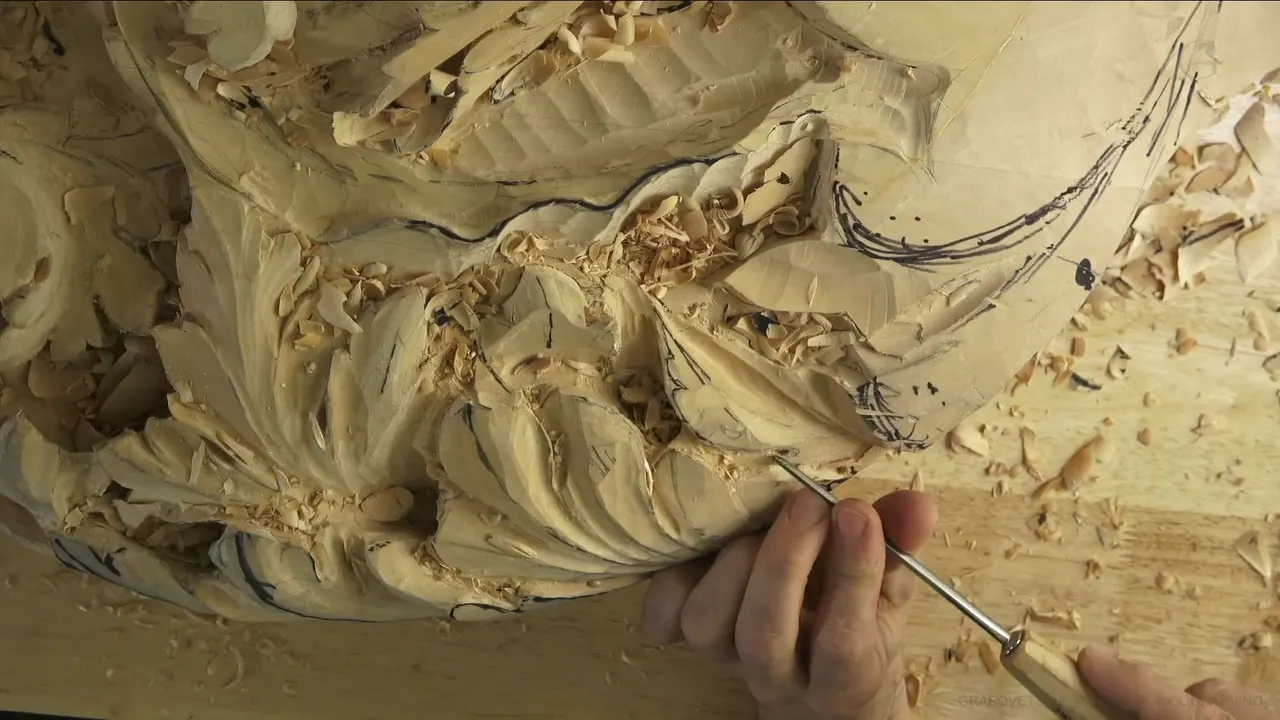

Extra shadow is the reason I gave in part 12 of Venice Room 53. I asked myself why I was doing it, and the answer came straight after the question. The tool I picked brought another reason. More of them sit in my other lessons, and I link each one below.
Ever stopped mid-stroke and asked what that cut is for? Do you know the answer before the gouge goes in? Read this part first, then follow the same question through my other carving courses, one lesson at a time.
Where the reasons sit at a glance
- Shadow is the point of the work in this part.
- A number 11 comes with a line of its own about transition, and a sharp tool comes with a line about the grain.
- Parts 10 and 11 add a deep hole for shadow.
- Other Venice Room workshops, Hashemi Flowers and several more courses name reasons of their own.
- A table near the end puts the reasons side by side, one row for each lesson.
What was the reason I gave in part 12 of this workshop?
Shadow. "Again, why am I doing it? Just to create extra shadow." Right after that I added "Because in reality, it's all about the shadow." Then came "All about light and the shadow."

The wood came next. I said I said, "I want to make sure it's thick enough, this region," and "I don't want to create too fragile piece." My figure for the thickness was "about 5 millimeters, 3/16 of an inch." Then this: "I still have to create some concaves on this side, and I have to be careful how thin or how thick this area is."
Why did I pick a number 11 for that spot?
A smooth transition. "And the reason why I'm using number 11 right now, I really like smooth transition." Praise followed, "Okay, beautiful" and "I think it is just beautiful."

Cleaning was next for the spot, and I said "I will just clean it, just like that, to the cut." A line about the surface came after it: "See? I've got really nice movement on this side." The tool could "even create sharper edges," and an even nicer look was where that was heading.

How did I free the waste from a deep spot?
With a hook. A challenge sat in front of me, "to get that stuff out," and I planned a number 11 again, to "hook and pull that stuff out, just like that."

Another option, I said: go the opposite direction and undercut toward the inside of that cut. After that came "now all the junk is free, not connected."
Chips came next. "I can take probably my blower, hair dryer, and get rid of some of the chips," I said, and after it "Let me do that."

How does the overall picture flow?
"Beautiful development, I love it," I said. I asked you to look at the overall picture, "how it just flows nicely." This board is going on a ceiling, and once this side is all done, the board would look "gorgeous," I said.
I even told you what I would accept: "But if you not agree with me, I'm okay."

Why was I okay with the grain here?
A sharp tool, and a part still waiting for its concaves. "And yes, I am carving against the grain, but if I have a really sharp tool, I'm okay."
The words after it carry the because. "And it's not the final cut, not the cleanest cut, because I still have to establish some concaves even on this part." I added "So I really don't worry about that."

Before that line I had named a number 11 and a 4 millimeter veiner (0.16 in), with the plan "I'm going to outline little deeper." Starting my roundness was in the plan too, and I said "And now I can just start movement inward."

Which reason went with the undercut and the light?
A spot with a problem: "Now I need to undercut underneath right here. But for me, I do have a challenging area because not every tool going to fit right there."
On the junk I said "Get rid of some of that junk I'm not going to need." At that area, "I need to get a really good shadow spot." Developing something below was a maybe.

The number 11 was up again for undercutting: "We're going to start undercutting. I need to create the shadow." light entered it, "because I've got a light source on the right-hand side pointing from this direction, so it's not going to create really deep shadow."
Turning that light off was the other half, and it would give "really deep and nice shadow." A small line on rolling: "I don't have to roll too much. I could, but I don't have to."

Then the divisions. "Let me create the divisions," I said, and my plan was "relief cuts first." One division would come, with the same tool, "Number 11 veiner, 4 millimeters" (0.16 in).
What do parts 10 and 11 say about shadow?
A bigger tool shows in part 10: 10 millimeters (0.39 in), a number 9, and a mallet. "I'm going to create a really deep excavation at this point because I really want to see that shadow," I said.

Nobody would see inside that hole, and I said so. "Nobody's going to look inside right there, but it's going to cast so deep shadow." In that part I also said "the point is creating this hole just to give that motion, that shadow."
Part 11 has a step that I called not necessary. What it gave me was "extra light and shadow play," and the dark spot was "which is I'm after." Under a small detail in that part the undercut would "cast even more shadow to this small detail."

Which reason did I give for a movement or a ridge?
Triangles are the work in Venice Room 75, part 9, with a warning to myself about going all the way through. I wanted to move it one way, for the "overall movement."
In workshop 57, part 2, I said "just little by little, without pressing too much." The plan there was a concave, and my line for it was "I really want to raise one of the ridges up."

Over in Venice Room 19, part 8, I said a movement could go inside and underneath. A little deeper underneath on each side was possible, and so was an exaggerated section. "This little thing going to be visible from down below," I said.
Over in Venice Room 155, in part 2, the first concave gets a number 11 of 7 millimeters (0.28 in). That concave would come "kind of low," I said, "because I want to raise up my convex."
Seen from below, which reason did I give?
Venice Room 22, part 1, had a couple of ways to do a movement, and I said I could use a number 5. My line was "visible from the bottom," and I added "it's really important for me, the right movement."

Light is the cause in Venice Room 26, part 9. Light would hit from one side, I said, and on that side I was "creating on that side a little deeper concave."
In Venice Room 88, part 9, the view is from underneath: "the rough side when I'm looking from the bottom." So I said "it has to go downhill like this."

Lily Box 3, part 8, has me picking a side for a deeper concave, one that sits on the outside of the box. A second layer was to sit on top, and "my shadow is going to be casting this way."
In Hashemi, what came with a number 5 and a clean-up?
Hashemi Flowers 10, part 5, shows a number 5 of "about, I would say, seven-sixteenths" of an inch (about 11 mm). Light would catch a ridge there and "create beautiful shadow movement."
Another number 5 shows in Hashemi Flowers 36, part 3, with the words "Make it a little cleaner." The cleaning was not a must, I said, and still I named a reason: "I'm cleaning just because I want to see what type of movements I can do."

Why a bigger tool and a deeper dig?
In Venice Room 52, part 11, the 10 millimeter tool (0.39 in) was done, and I said "now I have to switch to a smaller one," a number nine at "a quarter inch, about six millimeters." The words for it were "excavate until you can't even catch."
The same part says why a piece was left unfinished the time before. I knew I wanted to excavate a lot more, and "final details" were to wait until I create "my final destination of depth."
In Furniture Panel 18, part 8, the tool is bigger, 3 millimeters (0.12 in). For going deeper right there I said "develop this area, lots of movement." The panel itself was "only 10 millimeters, three-eighths of an inch, so not really a deep panel, no."
Workshop 140, part 1, names a number 11 of "maybe even just the 30 millimeters" (1.2 in). With it came "see how quickly I can get to the final depth." A bigger tool brings "a lot more resistance you're going to experience," I said, and "you have to be strong to push it." Then: "Or just use a mallet."

In Carving Hazelnuts, workshop 6, part 3, I planned a number 11, at "3/16 of an inch" and "about five millimeters." I said "the reason why is, like I said, I want to create a shadow."
Lily Box 5, part 3, brings a bigger concave, with a number six as the tool I could use. The line was "if you look to this line, logically, it has to be going all the way like this."
In the Dining Table Apron course, workshop 11, I was using a V-tool, and the reason was "the wood is really dry and the fibers are crunchy." A gouge turning around my center would "most likely" snap it, I said, and "I need to keep my high points."
Why a back bend and a colored mark?
Roman Acanthus 7, part 3, gives a short answer, "just easier to reach." Sometimes I have "a limitation with the straight gouge," I said, and about the back bend I said "It's not what you really have to have. You can get by without it."
Byzantine Acanthus 1, part 3, has me marking colors on the board, and I said "So blue, concave, orange, convex." About that I said "just to show you the idea," and "a lot easier to see on the screen also as well."
In Hashemi Flowers 42, part 2, I said a marker is "just for filming," and that I "probably" should not use it: "I don't want to remove too much."
How do the reasons line up?
Here they sit in one place. Each row names the lesson, the step, and the reason in my words, shortened.
| Lesson | Step | Reason |
|---|---|---|
| Workshop 57, part 2 | Concave planned | One of the ridges that I really wanted to raise up |
| Venice 22, part 1 | A movement | A view from underneath, and the right movement for it |
| Lesson 26, part 9 | A deeper concave | Light hitting that side and the extra shadow it gives |
| Hashemi 10, part 5 | A number 5 | Light catching a ridge for a beautiful shadow movement |
| Hashemi 36, part 3 | Cleaning | A wish to see what type of movements I can do |
| Panel 18, part 8 | A deeper dig | A wish to develop one area with lots of movement in it |
| Room 155, part 2 | A low concave | Keeping the concave low, to raise up the convex |
| Lily 3, part 8 | A side picked | A second layer on top, and a shadow cast this way |
| Roman 7, part 3 | A back bend | A limit of the straight gouge, and an easier reach |
| Byzantine 1, part 3 | Colors marked | Showing the idea, with a view that reads easily on the screen |
Which steps were not necessary?
Rolling in part 12 was one: I could roll, and I did not have to. The cleaning in Hashemi 36 was another, and a step in part 11 of workshop 53 was a third. Two of them came with a reason anyway.
Would you like to hear the reason before a cut, not after? Does the shadow, the light or the view from below decide it on your board? Open the whole Venice Room Part 5 course and listen for the reason beside each cut. Or look at tuition and access.
How it's done
- Say what the cut is for. In part 12 I asked it out loud, and the answer was extra shadow.
- Check the wood that is left. My words were "this region thick enough," with the thickness named.
- Name the tool by what it leaves. For a number 11 I named a smooth transition.
- Free the loose waste. I planned to hook and pull, and said "now all the junk is free, not connected." A hair dryer was in the plan for the chips.
- Say what a sharp tool allows. About the grain I said "I'm okay," and named the concaves still to establish.
- Undercut for the shadow. The light source was on the right-hand side, and with that light off I said the shadow would be "really deep and nice."
Frequently asked questions
Why extra shadow in part 12?
My answer to my own question in this part of workshop 53 was extra shadow. I added "it's all about the shadow." At the undercut I said "I need to create the shadow," even if you will not see it right away, because the light source is on the right-hand side.
What did a sharp tool allow in part 12?
With a really sharp tool I was okay with the grain, I said. It was not the final cut, because I still had some concaves to establish on that part, so I really did not worry about it.
How thick did I want the thin spot to be?
My figure in part 12 was approximately 5 millimeters (0.2 in). I wanted to be sure it was thick enough, and a too fragile piece was the worry. Concaves were still to come on that side, and I said to watch "how thin or how thick this area is."
What to carve next