

Alexander Grabovetskiy, woodcarver, School of Woodcarving · Published 2020
What does a wood carver mean by "don't forget to comment"?
Quick answer: Venice Room 53, part 9: after I explained how the number 11 works, I said to ask me and told you to comment. Other lessons of mine carry the same request, with my words on emails, on reading the replies, and on the school site.
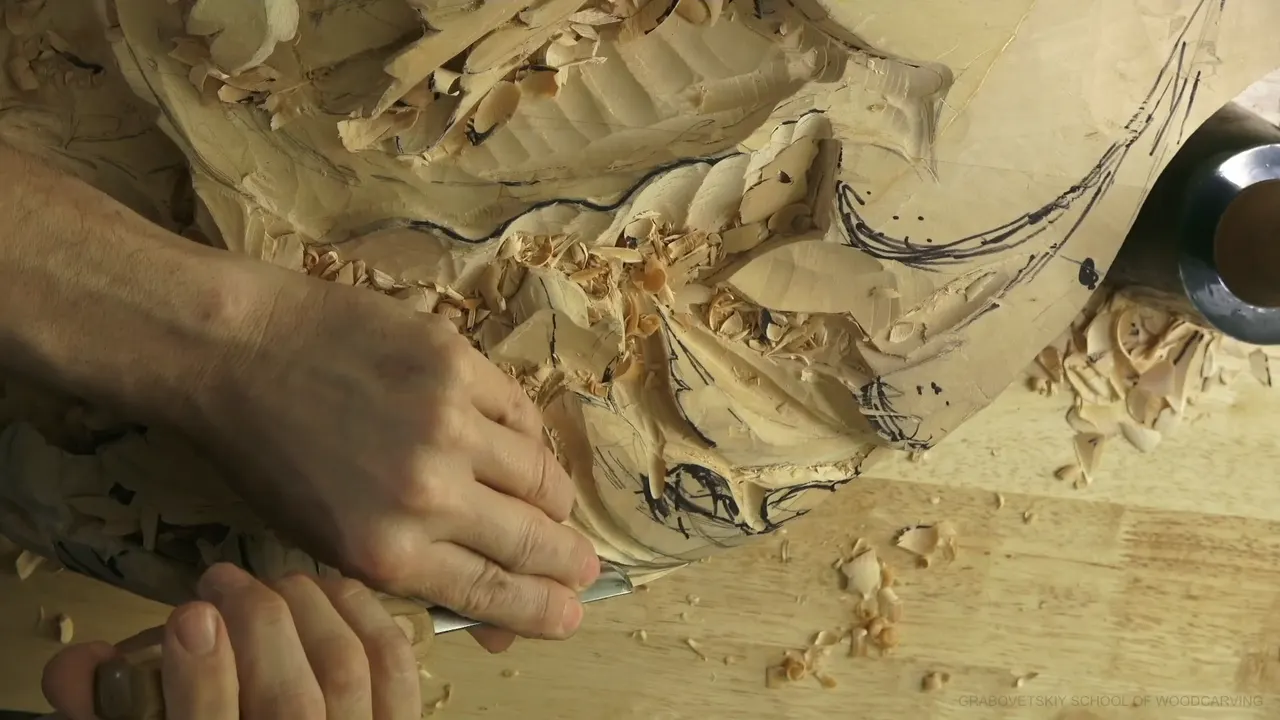

In part 9 of Venice Room 53 I told you to comment and to ask questions. I did the same in lessons from other courses, each time with other words around it. Below you can follow every one in wood carving.
Ever finished a carving video with a question still sitting in your head? Did you know where to put it? Here is what I said in part 9, and what I said in lessons of mine from other courses.
The comment request, at a glance
- In part 9 the request came right after I explained the number 11.
- Other lessons ask for questions, for your view of a project and for ideas on what to carve next.
- Floral and Molding 14 has me saying a comment is better than an email.
- Roman Acanthus 16 and Venice Room 61 have me reading comments.
- The school website is named in Lily Box 10 and Venice Room 58, and both name Google.
- Every lesson I quote is linked on this page.
What was I carving when I asked you to comment?
Two pipes. "But I've got my pipe, I've got another pipe, so two pipes. That is good." The pipe, I said, "is supposed to go between those two lines," with a middle line "right here of the separation" and one "right there."
My plan was to put it "right between." Then a small move came: "Maybe just a shift a little bit to be closer to Fibonacci sequence."

For readers who want the math, the Fibonacci sequence is a row of numbers where each one is the sum of the two before it, and the ratio of neighbors in that row leads toward the golden ratio. My own measure: "from this point to that point, and I moved that little bit to that direction, six parts out of 10."
Next, the tool. "And in this case, I'm going to lean on the left-hand side a little bit my tool and start my concave." Then: "See? It creates a movement like that. Okay? Like a U shape, but it goes on in."
Which words about the number 11 came right before?
"So there is going to be two tools you should use if you would just use normal gouges, like number nine and then number three. But in this tool, with number 11, you can create just pretty much in one cut what usually requires multiple tools."

"And I'm not sure if I'm clear or not." The normal way, I said, is to "create a first cut with just a gouge, with the normal gouge, and then get rid of this side with the flatter gouge, like number three sweep."
"With the number 11, on the other hand, you're getting that effect pretty much right away because number 11 fits like this." And: "Okay, so it's a U-shaped tool, and you're already taking care of this ridge, not ridge, but the slope, and you're taking care of this side with number three. So it's a single cut."
Right after that: "And if it doesn't make sense, please ask me." Then: "Don't forget to comment and ask me questions."
What did I carve after I asked?
"Okay, like that." I said "I can blend even more," and "I'm ready to go on another side." Then: "Same idea. But I'm going to lean toward the right-hand side, toward this direction."

"I don't want to go beyond the middle ridge, which I know it's messy and you don't see it, but it's there. It is there."
"Okay, so I've got another pipe. It's good. Now I need to blend a little better because it doesn't look too good." Then: "clean also because it's a little too messy as of now." Next, a division. "Another division which is going right there. Preliminary, just to create that movement right here like that."

"I think I could do a much bigger eye in this section right here." My plan was "probably the same eye that I did before, five millimeters. Number 11." Five millimeters (about 0.2 in), then.
"Oh, and you know what? To make it look lighter, I'm talking about more almost like air, light. So I need to bring that eye much closer right there." Then: "My apologies that you can't see, but I think that way it's going to be much more logical."
"I can actually go even deeper with this separation just because of I do have plenty of the material." Also: "I can go right away and make my undercut."
Why do I say comment instead of email?
In Floral and Molding for the Panel 14, part 3, I spoke to "students who's watching all of those segments for multiple years" and said: "Please don't be afraid. Comment, okay?" Next: "I'll answer. It's better to comment below the video than to send me emails."

Over in Lily Box 5, part 9: "feel free to ask me. You don't even have to email, just comment below". Then: "sometimes you sending me emails, but for some reason, if you find that I did not answer, I did not ignore it, okay." And: "it just sends emails straight to spam, which I don't usually check daily."
In Venice Room 56, part 11, I said: "It is better if you can just ask me in the comments." Next: "The reason why I'm getting hundreds of emails daily and sometimes it just slips through my hands." Then: "By no means I'm not trying to ignore nobody, but if I'm not answering you, it could be a couple reasons. First of all, I do have a really heavy anti-spam filter."
"Reason because marketers are trying to send me emails all the time how they would love to improve my website. And I never mark anybody as a spam."
The same lesson names the live streams: "a good opportunity to ask me any of the questions." Then: "So much better than even emails."
Workshop 56, part 12: "So if you do have a question, it is much better if you would go directly to the comments section." About the live chat: "I can probably address right away."

Which questions do I want in the comments?
Roman Acanthus 16, part 3: "if you have any questions, please leave comments. I'll try to answer you." From Roman Acanthus 8, part 2: "You can write emails. You can ask in the comments. So the whole reason is actually to show the way I do, and I hope you like what you see."
Then Lily Box 12, part 4: "I would really love to communicate with you more on this subject."
Inside Hashemi Flowers 12, part 1: "please feel free to ask me in the comments any questions you do have about this project or any other project." Then: "That is actually privilege for me to communicate with people like you." The people, in my words: "lots of people from all over the world, talented people".

Hashemi Flowers 19, part 2: "ask me anything. Well, not anything, but that also helps me to understand what exactly you people need to hear more, and what you would like to hear from me."
Furniture Panel 19, part 2: "If it doesn't make sense, just ask me again in the comments." Then, "ask me any questions, not any, but I'm talking about just concerning that design."
Also in Hashemi Flowers 21, part 2: "For me, it's really important to hear from you, just to give me some feedback. Just say something, email me, or leave a comment."
Do I read the comments?
Next, Lily Box 10, part 2: "I am actually checking those comments." From the Roman course, part 3 of lesson 16: "I actually read my comments, and I answer those comments."

Then Venice Room 61, part 9. "I really appreciate those questions and comments. Okay? It's really important." After that: "I do read all the comments, and I'm trying to answer all of them."
Venice Room 50, part 6. "I had a really good question about people who carved about 1,000 years ago." Then: "I already tried to answer that in comments, but for those of you who missed that answer". The first part of that lesson has "I really appreciate for the comments, and I'm also happy to see you in chat."
What do I ask you to tell me about a project?
Vase with Grape Leaves 1, part 11: "please comment, if you like this project or not. Okay? The idea of it." And from Venice Room 72, part 12: "And let me know, please, in the comments if you like the design overall and the Venetian style."

From Venice Room 59, part 3: "Do you like that project, by the way? Comment a little more. I'm not trying to beg for comments, but it's going to give me encouragement to film it. Am I doing that stuff and that is interesting for you, or that stuff is not interesting for you? So for me it's important to know, okay?"
Grape Onlay 12, part 3: "I am planning to do some other projects for the school, for the courses." Then: "let me know, please some comments." And: "What would you like me to concentrate, you know, more?"

From Stropping and Compound 3: "what pastes are you using and what honing and stropping and buffing approaches you have, or how you do that. I would really love to hear from you. Just leave some comments below". Then: "the world is big and it would be really interesting."
Inside Venice Room 104, part 2, the line before it was: "I hope you like that idea of using iPad." Then: "If you'd like to know a little more, just comment below the video. I'll just show to you the whole process."
What do comments do for the school website?
"I fixed my comments field. For some reason, it disappeared for a while, and I didn't pay attention to it. But now it's all available." That is Lily Box, lesson 10, part 8. Right after: "comments, I would really do appreciate. And it also going to help our website ranking in Google and so on." Then: "But we don't have too many comments, so I really do appreciate if we can catch up."

In Venice Room 58, part 3: "And people, I really appreciate if you can comment on site also." Then: "on site, it's also important. Important for a couple reasons. I read them and I try to answer every comment. Secondly, nowadays we are in a Google war. We call it a Google war because Google looking for the sites with the most comments."
Hashemi Flowers 19 has "leave a comment, and also share it." Then: "If you don't like it, I understand, but if you do like it, why not just spread that?" And: "There is such a thing as SEO."
Furniture Panel 16, part 5. "and your comments, that's what I'm trying to communicate. When you comment, like I said, that's really good for SEO, for search engine optimization." The term is search engine optimization, a way of getting a page found in a search.

Why are my segments seven to ten minutes long?
Over in Venice Room 57, part 1: "I am doing my segments about seven, eight, nine, 10 minutes long for a reason, okay? Some of you like longer, some of you like shorter."
Earlier in that part: "I do appreciate all of you people who left the comments or leaving comments." And later: "And also, it's a lot easier to find the segment you did not watch yet. So that's why." Then: "But still, even on shorter segments, please try to comment. Okay? Try to comment."

Where did I say each one, side by side?
Here are the lessons from this page, with the words I said in each one.
| Lesson | What I asked for | My words |
|---|---|---|
| Part 9 of workshop 53 | Questions about the number 11 tool and its single cut | Ask me questions |
| Floral 14 | A comment instead of sending me an email | I'll answer |
| Roman 16 | Leave comments if you have any questions | I answer those comments |
| Lily 5 | Ask me with a comment, with no need for mail | You don't even have to email |
| Hashemi 12 | Questions in the comments about any project | Privilege to communicate |
| Venice 59 | Whether the project interests you | Give me encouragement to film it |
| Lesson 72 | Whether you like the design and the style | In the comments |
| Onlay 12 | What to carve and what to concentrate on | Some other projects |
| Stropping 3 | Tell me which pastes and approaches you use | The world is big |
| Lily 10 | More comments on the school site | Catch up |
| Lesson 58 | Comments on the site as well as on the live streams | A Google war |

Where can you watch all of these lessons yourself, in full?
Every lesson above sits inside a course of mine. Workshops 50 to 61, where workshop 53 sits, are in Venice Room Part 5, and the other courses hold the rest. When you want to ask me something, start here and leave your question below a lesson.

How it's done
- Ask in a comment. A comment, I said in the Floral course, is better than an email.
- Say when it is unclear. I said to ask me if my number 11 explanation did not make sense.
- Keep it on the design. In Furniture Panel 19 I asked for questions concerning that design.
- Give your view. Workshop 72 asks what you think of the design and the Venetian style.
- Name the next project. Grape Onlay 12 asks what you would like me to concentrate on more.
Frequently asked questions
Which words did I use right after the number 11 talk?
The number 11 was a single cut, I said. If the explanation did not make sense, my words were to ask me, and then to comment and ask questions.
Which lessons say a comment beats an email?
The Floral course says it's better to comment than to write an email. Workshop 56 says the comments are the place to ask.
Do I read the comments?
From lesson 16 of the Roman course: I read my comments and answer them. From workshop 61: I read all the comments and answer them all.
What did I want to know from you about the Venetian panel in my lessons?
What to carve next