

Alexander Grabovetskiy, woodcarver, School of Woodcarving · Published 2020
What is a lobster cut in wood carving?
Quick answer: Venice Room 53, part 8: I was actually starting at the end and moving backward, like a lobster movement, and named it lobster cut. After I created multiple small cuts like that backward, I said, I can go back and create normal cut.
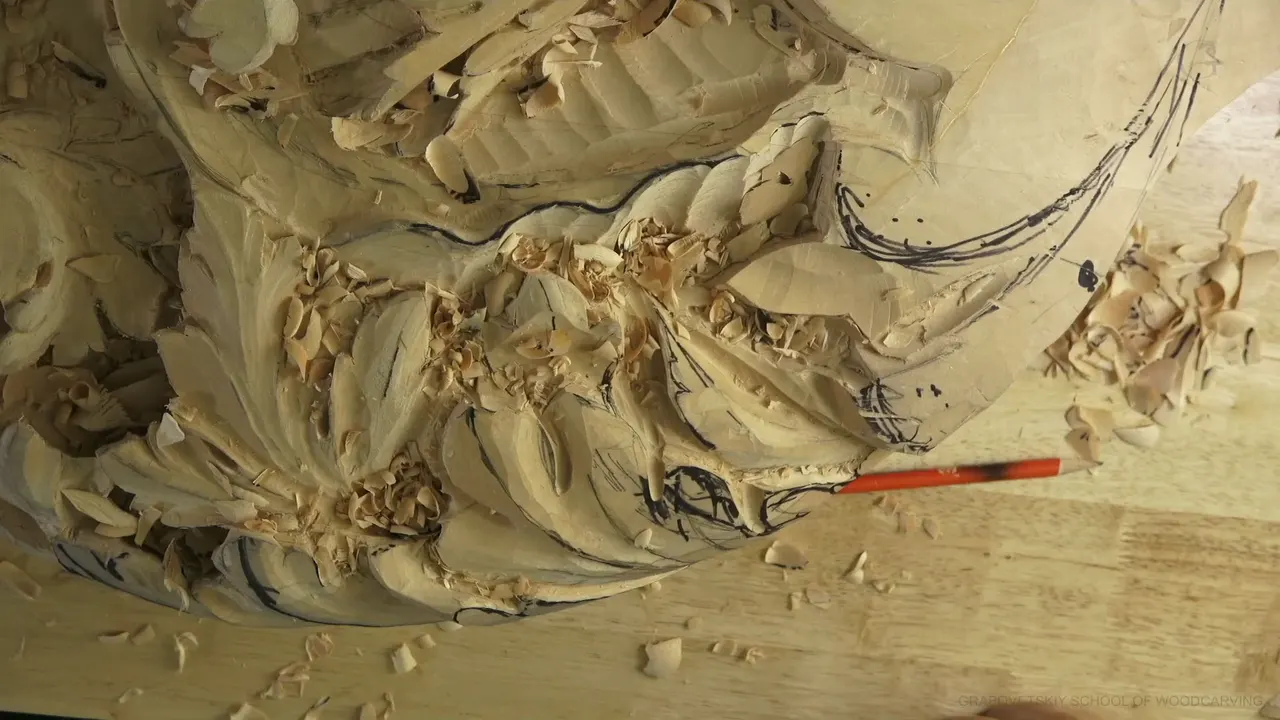

In part 8 of Venice Room 53 I named a way of carving: "lobster cut." In other lessons I name a cut as well. Below you can follow each name in wood carving.
Ever started a pass at the usual end and wondered what to call it when you went the other way? Did you think a cut had to have a proper name before you could use it? Here is what I said in part 8, and the lessons where I name other cuts.
The lobster cut, at a glance
- How I carved the second concave: going backward, one small cut after another.
- Small backward cuts first, then back for the normal one.
- Pulling, stepping, wiggle, escaping, wall, clean, slicing, blending, relieving and boxer: each is a cut I named in another lesson.
- Each of them is linked to its own lesson further down this page.
Which words came right before the name?
"One concave, and I'm ready for the second concave." Next came this: "But in this case, I have to be just more careful, I think, and start little by little and go opposite direction."

"You start usually right there and go all the way, but I'm actually starting at the end and moving backward." Then: "Like a lobster movement, backward. So we can call it lobster cut."
"And after I created multiple small cuts like that backward, I can go back and create normal cut." Then: "Although I should probably use a smaller tool to do that."

How did I carve the first pipe before that?
A flatter gouge, I said, is what I probably have to use: "maybe number two or number five. Number five will work."
About the pipes I said: "So now I have to create the concave, concave, concave, and a concave. So four concaves to create two pipes." The tool I named was "number 11, that's the tool," and then "Carefully just start."

I like the idea of number 11, I said, "because I can use it as a gouge if I'm just holding this straight, but if I'm going to move to the right or to the left, I'm creating absolutely different cut." Moving right was the plan: "I'm going to move to the right to make it blending, to get rid of this ridge I created previously."

How did I carve the left side of that pipe?
"Let me do on the opposite side of the pipe, on the left side of the pipe." And: "Carefully. I need to change the position."
About the way I was carving, I said: "I'm not suggesting that you do that because it's actually breaking the rule." You're usually not supposed to carve toward yourself, I said, "because you can cut yourself." And: "if you lock your hands, really placing your hand right on a piece of wood and holding that strongly, I believe it's safe enough. But I'm not advising anybody to do that."

"In this case, I can't rotate this piece, and that's probably the only way I can attack." Then: "It still create my cut with the grain, I should say. Sorry for mumbling."
"See? Can you see this pipe? It's already visible," I said, and then "I just created the pipe, one pipe," with "Now I need to jump and create the second pipe" right behind it.

Which tool made the second pipe?
"Again, let me start on this side, carefully, and I'm using, by the way, 12 millimeters," I said, "okay, number 11, 12 millimeters, little less than half an inch." Converted, 12 mm is 0.47 in.
"And yes, I am cutting uphill," I said, and that is against the grain, "actually even worse." Still, "see what it does? It just creates a really beautiful shadow."

Blending came next: "yes, I can blend it, just go from opposite direction or even from this direction. Not a problem. And use just the side as a number three sweep."

And what about number 11 in part 9?
In part 9: "With number 11, you can create just pretty much in one cut what usually requires multiple tools." The normal way, I said, is "a first cut with just a gouge, with the normal gouge, and then get rid of this side with the flatter gouge, like number three sweep."
With number 11, "you're getting that effect pretty much right away because number 11 fits like this. Okay, so it's a U-shaped tool." Then, for the other side: "Same idea." And: "I don't want to go beyond the middle ridge, which I know it's messy and you don't see it, but it's there."

Why pull the tool backward at times?
The pulling cut comes from Venice Room 5, part 12. "I am carving against the grain in this case. And logically, I'm supposed to go from this side, but absolutely no way." Then came "So I really have to break the rule."
"I have to keep an eye on the grain of the wood, for it's not splitting the wrong direction. And that's why I'm pulling sometimes backward. So I make my cut, then I pull, then cut again, then I pull, then cut again; so I call it the pulling cut, just like that." Then: "I'm doing it quickly, but you'll know once you're going to try it, what I mean by that."

"It's the same like with the pencil when you draw something, which professional artists are saying you're not supposed to do. You're supposed to do just in one long line like that. Yes, it's true, but not always possible. I can do one long cut also once I get closer to that result I want to see." And: "So it gives a really nice almost half a sphere look. Not the sphere, I'm sorry, just the true half a pipe, I should say."
Where do I step the tool along?
Greek Acanthus Leaf 8, part 1, has me saying I would use "probably just number seven since we do have that on the workbench," and "Just be careful because the grain changes." I was "across the grain."
"That is called actually a stepping cut. So I'm stepping. I start with one edge, and then rotate, and then move, then rotate, then move. Then just again, move my tool, rotate, and again, step, step, step, step."

Some people name it differently, I said: "I know some people don't call it that way, but for me, it makes sense because you can see what I'm doing, making my steps."
How does a wiggle cut go without force?
Floral and Molding for the Panel 13, part 2, has me going to "remove that space between," and I said, "Be really careful how you approach that."
"I don't push it, okay, I don't really create any force. But little by little, I'm just wiggling with my tool." "That's how I call it, wiggle cut." Of the name I said: "I'm not sure if there's even name for it, like a wiggly cut, but that's what I'm doing, okay?"

"Just wiggling without pushing too hard. I actually using just the sharpness of my tool." Then, "I'm not taking a lots of material at once," and sometimes "it just takes a little longer than what you expect, but I'm okay with that."
When do I escape out of a cut?
In Modern Acanthus 3, part 2, I said: "If you do have a problem with escaping with the straight tool." Then: "when you dig in, escape out, that cut is called escaping cut."
"Don't stress yourself, use a spoon," I said, "it's the name after what we've done, we are doing a spooning pretty much, so it's a lot easier to escape now."

"If it fights you, don't dig deeper, you're gonna have a problem, change, rotate the piece, attack from other side, it's gonna be much better."
How straight does the wall stand?
In Greek Acanthus Leaf 2, part 4, I said: "we're going to establish the straight down cut. It's called a cut with the wall. The wall is going to be exactly 90 degrees toward the background."
"I've got number seven in my hands," I said, "number seven, 20 millimeters" (0.79 in), and "I make my cut just straight down, 90 degrees." "Just be careful," I said, and "Don't force it." Then: "I'll just go around."

Then: "Like I said, that's called a wall cut," and "you can see there is a 90 degrees wall left." "So later on, we're going to undercut it and establish more details of it, but for now, that is going to be my main outlining cut."
Where does a clean cut end?
Over in Flower Rosette 2, part 1: "I can actually miss, and I don't know what's the grain going to do. I start somewhere away from the edge, and I'm not taking too much material at once, and I have to really check that I'm not below my line."
Next, "Now I going to rotate and do the same thing from this side. I call it clean cut." Then: "Take it all the way to the line." The sides, I said, are "exactly the same thing" with "even more careful."

Why slice instead of push?
Byzantine Acanthus 2, part 1, is where I said "let me explain you one of the cuts, one of the most important cuts. In woodcarving world, we call it slicing cut."
"A lot of people, they just push, and that's no good." My way is this: "When you're placing your tool on a board, you rotate... either to the left or to the right, and you start your cut."

"While I'm pushing, I create rotation movement." Then: "it's a lot less resistance in the wood, just by the logic how it works." Direction, I said: "It could be from the left to the right, or it could go opposite direction this way." And: "see how quickly I can take the material out."
Does a blending cut come before an undercut?
Hashemi Flowers 31, part 1, is where I said I could "extend this small section underneath of this one and make a concave cut first." Then: "I'll take a number nine, a small concave cut, like a blending, you could call it blending cut." After that: "I'll make an undercut right here with the V tool."

Why call it a relieving cut, funny or not?
Venice Room 50, part 7: "That is really important, actually, to do those relief cuts." Then: "I know some of you probably just doubt that." The name is relieving cut, "even if it sounds funny for some of you." Next: "I don't really care if it sounds funny, it's just the right thing to do."

How is the boxer cut named?
The boxer cut is from Venice Room 57, part 3, which opens on a name: "And yes, it's like a boxer cut." I explained it with boxing: "people who's doing boxing, they doing one jump forward, two jumps backward, jump forward, two jumps backward."
"And that's how I call that cut. Just like that, okay?" Then: "Before I just do continuous long cut, I'm just doing cut forward, then go back, cut forward, go back." I added: "got to be careful because of the grain."

I also said: "it would make a lot more sense, just long continuous cut." Then: "Now, I was doing a boxer cut. And don't try to Google it, all right, there is no term." I added "It's not a scientific name for it."
Where did I say each one, side by side?
Here are the cuts I named, with the words I said beside each one.
| Name I gave it | Lesson | What I said about it |
|---|---|---|
| Lobster cut | Workshop 53, part 8 | Backward, in small cuts, then a normal one |
| Pulling cut | Part 12 of Venice Room 5 | Cut, pull back, cut again |
| Stepping cut | Greek Acanthus 8, part 1 | Rotate and step along the cut |
| Wiggle cut | Floral 13.2 | Wiggling with my tool, no force |
| Escaping cut | Modern Acanthus 3.2 | When you dig in, escape out |
| Wall cut | Greek 2.4 | A 90 degrees wall left |
| Clean cut | Flower Rosette 2.1 | To the line, with real care |
| Slicing cut | Byzantine 2.1 | Rotate to a side, left or right |
| Blending cut | Hashemi Flowers 31.1 | A small concave cut, like a blending |
| Relieving cut | Venice 50.7 | Funny, but the right thing |
| Boxer cut | Part 3 of workshop 57 | Cut forward, then go back |
Where can you watch all of these lessons yourself, in full?
Each name comes from a lesson inside a course of mine. Workshops 50 to 61, where part 8 is, sit in Venice Room Part 5, and the other courses above hold the rest. Every course is one click away if you start here.
How it's done
- Make one concave. One concave was done and I was ready for the second, I said, with more care and a slow start.
- Move backward from the end. You start usually right there, I said, but this time the start was the end.
- Make small cuts backward. My backward moves got the name lobster.
- Come back for the normal cut. Once those were done, a normal cut is next: I can come back and make it.
- Plan a smaller tool. My words were that I should probably use a smaller tool.
Frequently asked questions
What did I call my backward carving in part 8?
I called it lobster cut, moving backward from the end. After the small cuts backward, a normal cut is something I can come back and make.
What size was my number 11 in part 8?
12 millimeters (0.47 in). It was a little less than half an inch, and I was cutting uphill, which I called actually even worse.
Which other cuts did I name in my lessons?
A pulling cut, a stepping cut, a wiggle cut, an escaping cut, a wall cut, a clean cut, a slicing cut, a blending cut, a relieving cut and a boxer cut.
Does the boxer cut have a proper term?
What to carve next