

Alexander Grabovetskiy, woodcarver, School of Woodcarving · Published 2020
What does a wood carver mean by "repeat myself"?
Quick answer: In workshop 53, part 6, I repeat myself over two lines and my point. In other lessons I say it near a warning, a tool size or a reason, and over work I would not do twice, as in a panel and a layered ceiling board.
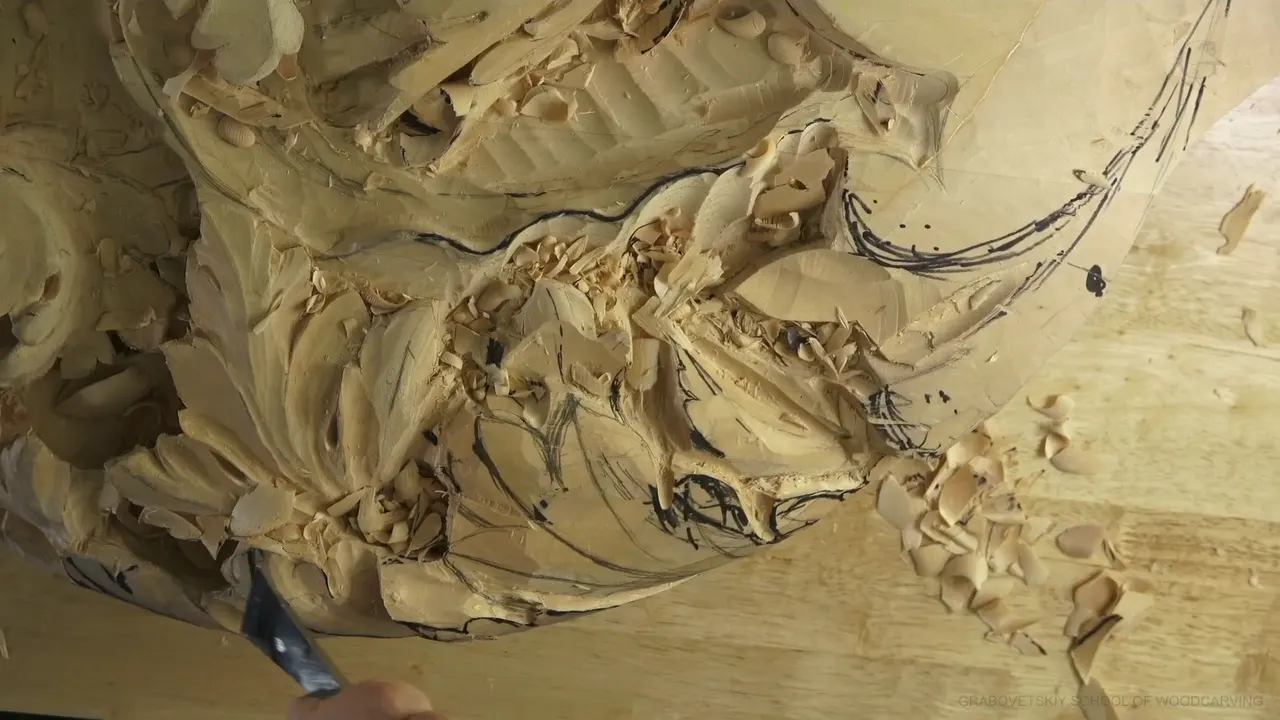

In part 6 of Venice Room 53 I said, "Let me repeat myself," and then I named the line right here and the line on this side, with a point between them. I use that phrase in other lessons too, over a warning, a tool size or a reason, and below you can follow each one in wood carving.
Ever told someone the same thing twice because it mattered? Did the second time save a finger or a cut? Here is what followed those words in this part, and the other lessons where they come out of my mouth.
Where I say "repeat myself," at a glance
- This part says it over a line, a point and a section cut.
- A tube filled by half and paste kept off the fingers show up in Lily Box and Butterflies.
- Legs to keep and relief cuts to watch show up in two courses.
- A 3/32 in blade, a mallet and bigger tools share the same words.
- Crunchy wood, two sides of a cut and a bridge each come with a reason, in three courses.
- Three lessons say I chose not to repeat the same work.
What did I say right after those words in part 6?
The part opens with "Let me clean it, and you will see what I mean by that." Soon after, I said I could probably chop right away. "Now it's more logic," and it would go "to the same direction, to the same movement."

Then came the words, "Let me repeat myself." After that came a line right here and one on this side, and "that line has to fall somewhere between." That would be my point, and the point would be "equal almost to this line."
Farther on I said I'm not sure I could go a little bit this way, but I don't have to, because "this point is going to be farther." I added, "So I think that is okay."
Part 5 of this workshop had a line to move. Two lines met in a T, and I said I have to create approximately a parallel line, at least between those two lines, which meant a shift of my middle line.

Call it a subdivision if you wish, I said, and that's also legit. "For me, it's a division, and subdivision is going to be smaller sections of divisions."
Which tools came out in the same part?
I said I'd hit the outline with the number five, I believe, and then: "Let me see if number five or number six. Number six is not good. Let me see number five." The curvature of the sweep was what I wanted, close to the outline I made, so that I can make a perfect edge even if I subdivide it later.

I tried to see if it would fit and said, "It is." Then again: "And yes." I don't worry about that mess, I said, which will be removed later. All I need is "a really good outline."
"Not going to go deep yet," I said, "because I still have to create concaves and convexes."

The undercut got the same reason. I had to be careful not to undercut too much, because the convexes and concaves still had to come, and too much in that area "can give me a big problem." I want no problems there.

With the same tool I'd roll it, and the result was "actually giving me a beautiful shape." "I don't want to roll too much," and I have to be really careful how much I roll.

Smaller was what I needed next, 5 millimeters (3/16 of an inch), a number 11, "in this case, it's a Swiss Made." Other brands would do, I said, and it's still the same thing. The Swiss made shape, for me, is "not true U," not like a letter U.

A little deeper excavation right on the side was my plan, and I could see both sides opening up, which I called one of the big movements, "just one huge movement."

The part ends on the lines that give this page its name. Main concaves and convexes in that section come next, I said. "Like I said many times already in this project," it is really important to me to be authentic to the original Venetian style.
Then came the three words, "concave, convex, concave if you're just doing a section cut." And I said, "I know I said that multiple times, but I really want to drive the point home."

Part 7 says the same three, with a note that I also have to roll down this way.
Is a warning worth saying twice?
"Flock it!" is part 10 of Lily Box 13. On the box: just a normal cardboard box, placed on purpose. If you'd rather not breathe that stuff, go outside, or use a mask to protect your breathing.
Then I said it again, "because I know some of you will do mistakes." Just fill half of the tube, and don't fill too much. Later came "Just make sure go all the way, all the sides," and my plan to give it about 72 hours, maybe more.
Paste has its own warning in Carving Plate with Butterflies 5, part 1. After a little more paste I said, "Don't use your fingers." Some glue is fine on the skin, "not all the glue," but not that stuff. It's "gonna just destroy your skin."
Chunks first, then the scroll saw: in Modern Acanthus 1, part 1, I said we can chop the bigger chunks on a band saw and take the piece to the scroll saw, "but remember keep those legs." I repeat myself multiple times, I added, "but I know what I'm saying," and "people make mistake."

Furniture Panel 16, part 7, has me saying I can probably chop with the same tool and make a couple of relief cuts. Then: "I'm going to repeat myself, be careful with those relief cuts, because again, you really can overdo it."
Some wood stays a little higher, I said, because I really want to reach the final depth with my router plane. That way I'll know it's really consistent. The height is only about maybe 1/32nd of an inch, maybe even less, which is about 0.8 mm.
Which blade and tool sizes come with the words?
In Furniture Panel 18, part 9, I wasn't sure it was too aggressive, but I had a lot of material to remove anyway. I said I'd repeat myself: "It's a 3/32 of an inch blade," which is about 2.4 mm. Some areas I really need to do just by hand, because of the twists.
In Furniture Panel 24, part 5, I guessed a millimeter and a half would be better in this case, the same number 11, and I planned to make the cut with the help of a mallet. "There's a lot more control." That is 0.06 in. A smaller tool was next in my plan, maybe one millimeter, which is 0.04 in.

Big tools get the words in Hashemi Flowers 12, part 1. Really heavy cuts are out, because the piece becomes more fragile and I can easily break it. The bigger the tools, I said, the cleaner the cut, and "so much less to clean later."

Which reasons did I give beside them?
The first step in Lily Box 5, part 9, was a small relief cut, with a number nine, or "number eight, I'm sorry," in the place of division or subdivision. Why I do that, I said, is that "wood is really crunchy," and without the relief cut I can lose that detail.

Small details make a huge difference, I said, and that is just my opinion. Scale came into it too. We were talking about a small box for the Bible, and the scale is small. On a bigger carving I wouldn't do so many subdivisions, but on this one I think it's a good idea.
Roman Acanthus 15, part 2, puts the reason on the grain. One side is really clean and shiny, and the separation line on the other is "not shiny and not clean." That's why, I said, "again, I know I repeat myself," I have to attack from two sides to make this cut clean.

A bridge is the subject in Byzantine Acanthus 9, part 3. After saying I'd do exactly the same right there, I asked, "Do you understand what I just said? Keep the bridge." Further on I said I'd go back over why I did what I did. We needed that support for future projects, I said, and even in a light and airy piece you really need support if you want to bang with the mallet.

The words come just before a line about light in Lily Box 8, part 7. "But for me, wood carving is more about light and the shadows and how it's going to dance together." Then: "It's like a dancing," I said, and "Light and the shadow dancing." A small number three was next in my plan, to create that notch.
What do I say about repetition itself?
A knife is my plan in Lily Box 12, part 5, coming from the opposite side, blending my cuts to the edge. Then: "Yet again, tools. I know I repeat myself many times and just sometimes sound like a broken sound or broken record, but it's really important, okay? Really, really important."

The saying followed. "Just like repetition is a mother of knowledge. Knowledge is the mother of understanding, and understanding is the mother of wisdom." After it I said I'm going to repeat myself many, many times, "maybe more than you like, but that's okay."
Where it came from is in Modern Acanthus 8, part 1. Of one spot I said it's probably one of the really important spots because it is an eye. I repeat myself a lot of times, I said, and it is really important, because my father said repetition is a mother of knowledge, knowledge is a mother of wisdom. It was a smart saying, I said, and I asked, "Did you write that down?"
Which work did I choose not to repeat?
At times I say the same words about work I chose not to do over. In Venice Room 1, part 9, what I did off camera needed explaining, I said. I did not want to repeat myself. It was the same operation as on the first layer, and I added a second layer and a third, so all together it was about six inches thick (about 152 mm) at that point.
It would go all the way to nine inches (about 229 mm), I said, maybe a little bigger. We'll see. Another round of just the jigsawing, the same operation, wasn't what I wanted. "And today is the day."
A promise of a panel "in this style, like Chippendale style" opens Furniture Panel 1, part 1. The words follow: "I don't want to repeat myself," nor to do exactly the same panel.
What I had was leftover of some unique walnut. I had a project where the whole house was walnut, and it wasn't just black walnut or European walnut. The walnut was special, "more like a purple." The doors were about two inches and seven-eighths, almost three inches thick. Two and seven-eighths inches is 73 mm.
A separation is the subject in Venice Room 8, part 9. I wanted a little bit underneath to make a nice separation, and not the same one everywhere. My plan was a concave cut on the side of the future pipe, using the same number nine, 16 millimeters, which is 0.63 in.
What waits until later?
In Venice Room 99, part 5, I said I'd get my skew and clean up my wall. Next I said I would repeat myself: I'm not going to undercut anything yet, not in this section. Once I get my shelves in place, I said, I'll finalize my undercutting.

Layers wait in Hashemi Flowers 6, part 1. I wanted to say it again: I'm still going to keep my flat spot right here, because I still have to glue my layers on the top. It's really important to keep the flat spots.
Where did I say it, side by side?
Here are the lessons, with the words I said beside each one.
| What I said again | Where | Words beside it |
|---|---|---|
| That line has to fall somewhere between | Venice Room 53.6 | That's my point |
| Half a tube and no more | Lily Box 13.10 | Some of you will do mistakes, I know |
| Keep fingers off that paste | Butterflies 5.1 | It will just destroy your skin |
| Remember the legs when I take it to the scroll saw | Modern Acanthus 1.1 | People make mistake, and I know what I'm saying |
| Careful with those relief cuts | Furniture Panel 16.7 | You really can overdo it, I said |
| The bigger tools you use, the cleaner the cut will be | Hashemi Flowers 12.1 | So much less to clean later |
| Why I make that relief cut in the division | Lily Box 5.9 | Wood is really crunchy |
| Attack from two sides for a clean cut | Roman Acanthus 15.2 | Not shiny and not clean on one side |
| Keep the bridge | Byzantine Acanthus 9.3 | We needed that support for future projects |
| No undercut yet in this section | Venice Room 99.5 | Once I get my shelves in place |
| I'm still going to keep my flat spot right here | Hashemi Flowers 6.1 | Glue my layers on the top |
Where can you watch every one of these lessons yourself?
Each lesson sits inside a course of mine. Workshops 50 to 61, where this part is, sit in Venice Room Part 5, and the other courses above hold the rest. Every course is one click away if you start here.
How it's done
- Say the line again. In part 6, I came back to two lines and the point between them.
- Warn once more. The flock lesson has me saying it again: the tube gets filled by half, with nothing beyond that.
- Name the size again. The blade size, again: 3/32 in, about 2.4 mm, in Furniture Panel 18.
- Give the reason. The grain is the reason I attack the cut from both sides, in the Roman Acanthus lesson.
- Keep what has to stay. In Hashemi 6, the flat spot stays, with layers still to glue on the top.
Frequently asked questions
What came right after the words, in this part?
I named two lines, one right here, one on this side, and said my point is equal almost to this line.
Which lessons carry a warning I said again?
The Lily Box lesson says to fill half of the tube. The Butterflies lesson tells you not to use your fingers on that stuff. A Furniture Panel lesson asks for care with relief cuts, and a Modern Acanthus lesson says to keep those legs.
Why do I say I repeat myself?
My Lily Box 12 lesson ties repetition to knowledge, understanding and wisdom, and says the repeats would come many, many times, maybe more than you like. Another lesson credits my father with a similar saying.
What to carve next