

Alexander Grabovetskiy, woodcarver, School of Woodcarving · Published 2020
What does a wood carver mean by "translate"?
Quick answer: In workshop 53, part 5, I put a chunk in one movement at approximately inch and a quarter (32 mm) and said I needed to translate it on another side. Other lessons of mine carry a shape, a depth or an edge across, using calipers and a pointing machine.
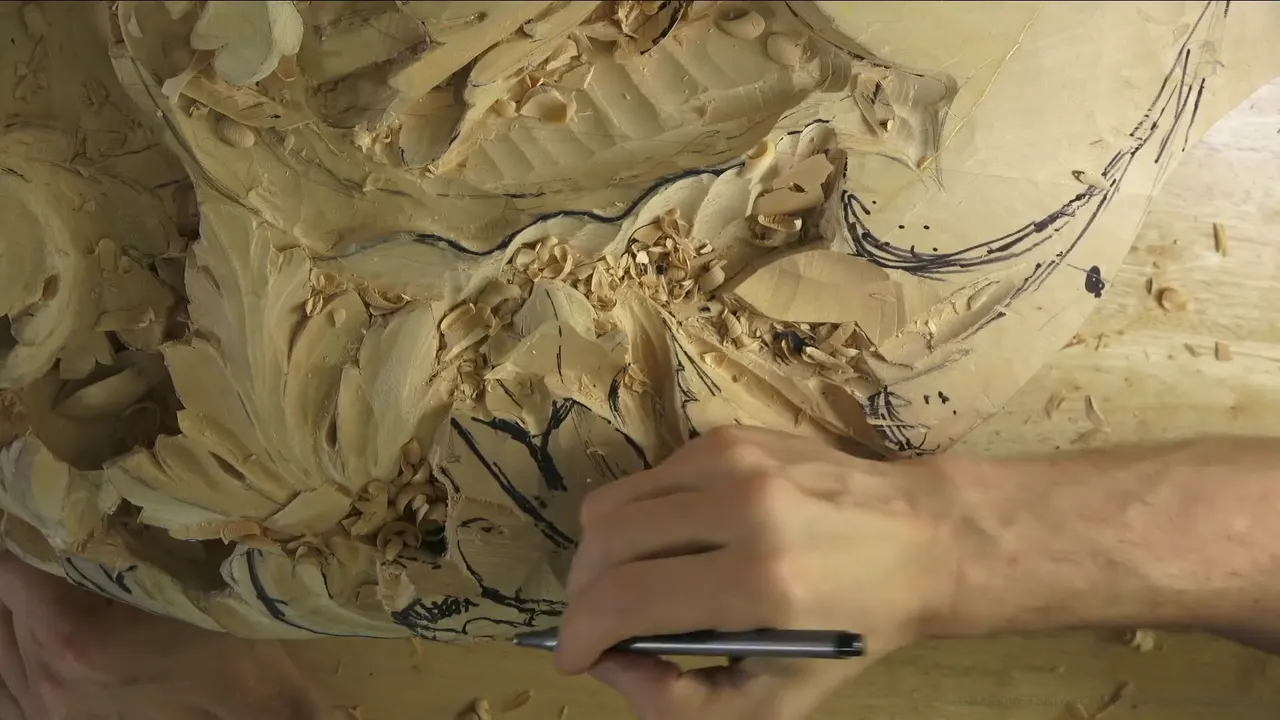

"So I need to translate that on another side," I said in part 5 of Venice Room 53. I had just asked you to look at a chunk in one movement. I use the word in other lessons too, over calipers, a pointing machine and plain paper, and below you can follow each use in wood carving.
Ever drawn one side of a design and needed the same thing on the other? Did you measure by eye and hope? Below is what I did in this part, and where else I say the word.
Where I carry a spot across a carving, at a glance
- Venice 53.5: a chunk near 32 mm of one movement.
- A T-stop moved a line.
- Workshops 79, 81, 86, 101 and 106 of Venice Room: shapes and spots, depths and edges.
- Venice 159: a height taken with paper.
- A livestream and Furniture Panel: a pointing machine, an original and a workpiece.
- Lily Box and Roman Acanthus: an inside, and a style.
What was I translating in part 5 of Venice Room 53?
The part opens with a plan: outline a movement you don't see, running in the opposite direction from the one on this side. A preliminary cut was a job I named too.
My tool was a number 11, "same number 11 what I used before," at seven millimeters, "quarter inch, little bigger than a quarter inch," and "about one millimeter bigger than a quarter inch." That puts 7 mm (0.28 in) next to a quarter inch (6.4 mm).

"Yes, I am carving against the grain, so I have to be kinda careful how I am attacking it." Against the grain "is not the best idea, but sometimes I just can't change the position because this piece, particular project, I cannot rotate and I can't walk around my bench," I said. The other way costs me too much time.
The skew chisel came next in my words: "Let me get the skew chisel, and I'm going to blend little better this way." Everything should be tangent, I said, "tangent to the same movement."

Of one spot I said, "That's little too deep of a cut I created. Looks like it's no bueno, not good." Of that I said it will be "clean canvas for me," and "let me recreate my middle line."
How do I find the middle between two points?
You don't see, I said, but "I still try to be in a golden ratio. If I take this point and that point, future points are still shifted a little bit, making six parts out of 10." My easiest way to calculate is a center point of this movement and a center point of that one.
Since I have that piece right there, "I really need to create the center point to the right position," which is going to hit "approximately the same point right there." The middle line is "just the middle line, by the way," and a movement on the inside has to be developed also.

How big was the chunk I needed on the other side?
Here is what came with it: "See this chunk on the right-hand side of the movement? I have approximately inch and a quarter, I would say, in this area." In metric that is about 32 mm. It needs a match on the other side.
"It doesn't have to be exactly like that, but something like that," I said, and "which means this needs to be also a little bigger, at least same." "Or I could make this little smaller also, which I don't need to." "So that would be more logical."

Why did two lines make me shift a line?
One line curls a little one way and another goes the other way, which you probably don't see, I said. One of them "intersects with this one, and that's called a T-stop. It's like a letter T right there." My word for it was "no bueno," and "I need to move it."
The fix I named was a parallel line: "approximately a parallel line, at least between those two lines." That means shifting my middle line, with my point "somewhere right there." "Now it just curves more fluent, okay?"

A shift shows up in part 4 of workshop 53 too: "I need to recreate the line, maybe just shift a little bit," which gives "a little more chance to shift that slightly this way." Part 6 says a line "has to fall somewhere between," and "that's going to be my point."

Does a measuring tool help me translate a spot?
Measuring is in part 1 of Venice Room 79. "That is little too big for the bandsaw," I said, and "all I need to do is just measure. Measure, find the points I have to measure." How I mark it I would not show, "but that is the step number one."
The shape right there must be translated onto this side, and "if I can just place it, and I can trace it." The job is "not really complicated except I need to find the right position because I do have a specific line I have to reference from."

"It's supposed to be like a 90 degrees movement." "So it really has to be referencing to the line." For big chunks of wood my plan was "probably just the big gouges, like number seven and three inches." Three inches is 76 mm.

A second line, in part 2 of the same workshop, is "almost impossible for me to show": "that line is actually a volute." "I translated that on a piece of wood, on a block of wood, and I know I aligned that perfectly." "Found the position, and that is only one method."
My plan for the rest was a speed square, a "really, really easy-to-do process." "If you look at this side, I've got a bunch of lines. So which means I can always align my speed square to those lines, and I'll know exactly I'm going to translate that point all the way to the board with no problem."

The lowest spot comes in part 11. "The next I have to just measure the next position and create another hole, and that way I'll know exactly where am I supposed to be." Marking it is a plan for the calipers: "let me mark it, and I'll just mark it with the calipers." And: "let me translate that on the side."
I was "just going off the one-to-one scale paper," and I named the pointing machine as my tool.

In workshop 81, part 2, the move comes back. The plan: measure again the spots I marked, translate one spot right there, and translate a low spot in another place and lower that down. "I'm actually missing some stuff," I said.

How did I translate a depth from a printed paper?
Three-dimensional form is the subject of workshop 86, part 3. I really need to create it, and it is "a little challenging" because "I don't know the plane or curvature yet in 3D." The way I placed a line was "the same way I've done everything before."
"I printed out the paper and marked every one, every inch," that is 25.4 mm, and "I just used the calipers, just the normal calipers, whatever calipers you have, measured that on the paper." The measure went out of the edge and onto the dots, and I connected them. I also got that depth correctly, I said.
A second pair was "little different calipers," the type "most of the time used by woodturners." About a couple of spots I said they are translated onto the wood right there: "I just referenced from the backside, and I got my depth."

The next one goes on the opposite side, the right-hand side of the main design, and I have to do another one, exactly the same thing on the other side.
Can an edge be translated to the other side?
A ruler comes out in part 10 of Venice Room 101. "That's a good idea for me to measure now just to get the straight edge and just to check if I'm there or not." "Just a normal, any ruler, any straight edge will work, and check my surface." "Looks like I'm really close where I want to be."
Now I have to find the point on the left side: "I need to get that edge translated right here." Once that edge is exposed, I said, it will be "looking really good."

Depth gets a check of its own: "Also, good idea to check if I've got the right depth," with calipers on this side. The difference I found was "just about one millimeter I would say in this spot, but it's okay." One millimeter is 0.04 in.
The backside of my carving shows in part 12 of the same workshop, where I have "some drawings" I "translated that on another side." Now the work is to "develop this side and continue that to the corbel actually pretty much." On the way in: "Let me think how I going to approach it. Maybe I need to lower that down slightly and see."
Can a pointing machine translate a depth?
The pointing machine gets praise in part 3 of Venice Room 106. "I really, really like my pointing machine, and in this case, it's actually going to help me." Marking gets easier: place it on the surface, measure the depth, "and I can actually translate a little closer to this part."

On this side too, I said I'll take my needle, measure it, and "translate that right on the side." "I can always blend that," and "I can see this line on this side."
The machine is in Furniture Panel 18, part 9. The needle can be readjusted "if I need to." Using it is "the complicated way, I guess," and I said I probably will not use it, maybe in some small areas, but not everywhere.
Still, "it's actually a handy tool to have." "You can duplicate anything pretty much." "So you measure the original, and you can translate that to the workpiece." With it there is "a lot less chance to make the mistake."

If you're in a sculpture, I said in the same part, you create it first from clay. "If you would like to carve that out of the stone, like limestone or other types of stones," "you can always measure on an original," then take it to marble or stone, "whatever you work on."
A livestream in April 2020 about clay modeling says it again. "You take that pointing machine to a model, get to the point, and translate that, transfer that to a block of wood." With a clay model, "you're saving so much time because it's much quicker." My steps: "take a drill bit, drill it to the point, and then you chop it." "You know you're not going to make any mistakes because there is already a point established."
Do I need calipers to translate a height?
A section of molding appears in part 1 of Venice Room 159: "I want to see for the future acanthus development." About the height: "For me, I could use just a ruler or even just calipers. I can measure whatever the distance is."

"You don't really have to use a calipers. You can use a piece of paper if you wanted to. Piece of paper is one of the best measuring devices, and you can translate right on the side the height of it." "So that is my height. And let me mark it for just my future reference."
What about the inside of a piece?
The inside is the subject in part 6 of Lily Box 11. I worked on one side but never did anything on the other, I said, about this piece. The inside needs a form: "I need to see where my middle part going to be. Need to translate that to that side."

I said "let me get two millimeters again" (2 mm is 0.08 in). This stage, I said, is "almost like a jewelry making," and "we are working on a micro level."
Is translate only a word for measuring?
Not in Roman Acanthus 6, part 6. I told about a student of mine from South America who carved the same piece, the same grape, with "more Latino culture." They "still use a lot of Romanesque style, which is translated, in my case, in the concave cuts on inside of those leaves." "Even the same design," I said, "and it look beautiful, actually," with "nothing wrong with establishing your own style."
Curly Kitchen Cutting Board 3.1 uses the word for a name: "in different nations, different names, but to be translated, a curly type of wood carving."
Where did I say translate, and what was I doing?
Side by side, here are the lessons.
| What I was translating | Where | Tool |
|---|---|---|
| Chunk near 32 mm in a movement | 53.5 (Venice Room) | No tool named |
| Shape on a piece too big for the bandsaw | 79.1 (Venice Room) | Trace it, big gouges |
| End of a volute, aligned on a block | 79.2 (Venice Room) | Speed square |
| My lowest spot, to be marked by calipers and moved over to the side | 79.11 (Venice Room) | Calipers, then pointing machine |
| Spots I marked, measured again, and a low one to lower | 81.2 (Venice Room) | With a pointing machine |
| Marks on a printed paper, and a depth taken with calipers | 86.3 (Venice Room) | Normal calipers |
| Edge to find on the left side | 101-10 (Venice Room) | Ruler, calipers |
| Drawings on the backside of the piece | 101-12 (Venice Room) | Not named |
| Depth, and a line seen on both sides of the piece | 106-3 (Venice Room) | Needle, pointing machine |
| Height of a molding, taken right at the side | 159-1 (Venice Room) | Paper, ruler, calipers |
| Measure on an original, moved to the workpiece | Furniture Panel 18.9 | Original, pointing machine |
| Middle part of a piece, to give the inside a shape | Lily Box 11.6 | Not named |
| Style carried into the concave cuts | Roman Acanthus 6.6 | No tool for it |
| Clay model, then the wood to carve | Livestream April 2020 | Clay, pointing machine, drill bit |
Where can you watch every one of these lessons yourself?
Each lesson sits inside a course of mine. Venice Room Part 5 holds workshops 50 to 61, where this part is, and Part 7 and Part 9 hold more of those I named. Every course is one click away if you start here.
How it's done
- Measure first. Venice 79, part 1, says to measure, and to find the points I have to measure.
- Mark the spot. In Venice 79, part 11, my plan was to mark my lowest spot with the calipers.
- Name the chunk. Venice 53.5 has a chunk of one movement that I needed to translate on another side.
- Check the depth. Venice 101, part 10, calls it a good idea to check the depth, with calipers on this side.
- Look at the lines. A T-stop in part 5 meant a line had to move, to make a parallel between two lines.
Frequently asked questions
What chunk did I want matched in part 5?
A chunk of a movement. I said that "this needs to be also a little bigger, at least same," and that it needs translating on another side.
Which tools do I name for translating a spot?
Calipers turn up in Venice 79, 86 and 101, a speed square in Venice 79, and a pointing machine in Venice 79, 81 and 106 and in the Furniture Panel course. Venice 159 adds a ruler, and paper.
Is a depth translated, not just a line?
Venice 86 marks a printed paper every inch (25.4 mm), measures it with calipers, and gets that depth correctly. In Venice 106 I name placing the pointing machine on the surface to measure the depth.
What to carve next